Catalogue Note
Undoubtedly one of the most controversial street artists in the contemporary art scene, Bristolian street artist Banksy has achieved global attention whilst still maintaining his anonymity. Known for his iconic anti-war imagery such as Kids on Guns (2003), Banksy’s works provide poignant and potent social commentaries on contemporary issues such as terrorism, political authority and capitalism. Utilizing simple visual cues and a strong contrast in color, his works deliver powerful messages that are universally understood, marked by dark humor, satire, and strong political undertones.
“All graffiti is low-level dissent, but stencils have an extra history. They’ve been used to start revolutions and to stop wars.”

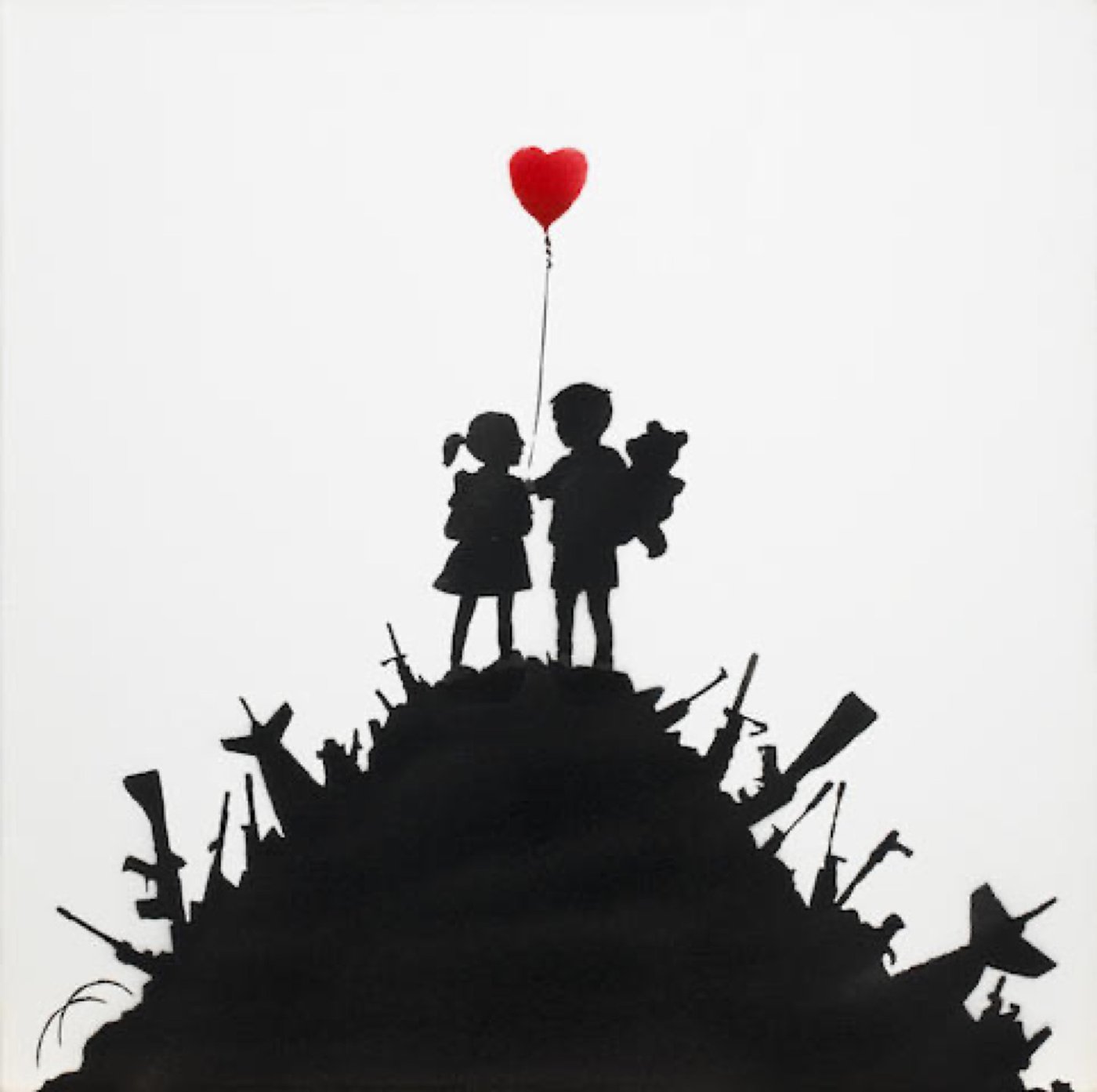
With its striking simplicity and raw immediacy, Kids on Guns is a prime example demonstrating the artist’s famed stencil and spray paint approach that originated from his time as a graffiti artist on the streets of Bristol. This technique allowed him to work quickly and make hasty escapes, maintaining a consistent level of quality in his work whilst protecting his anonymity as his popularity grew. In Kids on Guns, the artist places the image of an innocent little girl and boy – accentuated with a heart shaped balloon and teddy bear – against the silhouettes of a mountain of weapons below their feet in a satirical juxtaposition. Surrounded by violence and threats, the two young children look to each other for consolation, as the boy rests his hand on the girl’s shoulder as a sign of reassurance.

Standing atop the mountain of brutality with a shining red balloon – an iconic motif that is almost synonymous to Banksy himself – the children are advocating for hope amongst fear in somber solidarity, offering an alternative view against the chaotic state of affairs that is war, oppression, hatred and violence.
The contrasting, punchy visuals barely conceal a more somber, hard-hitting reality, giving way to reveal the visual paradox of the two young children – the epitome of innocence – amidst the overflowing, violent weaponry. The young boy, clutching his teddy bear to his chest, appears to console the young girl, who carries the infamous red heart balloon that has since become a hallmark of Banksy’s trade. Their emotive depiction, juxtaposed against the sharp, jutting edges of the various guns and artillery at their feet, serves as a blatant critique of a global society riddled with conflict and aggression. The compositional arrangement, with the figures standing at the apex of a towering pile of symbolic violence, draws pronounced visual parallels with Eugène Delacroix’s Liberty Leading the People, the July 28th, 1830, inspired by the bloody July revolution in Paris that saw the overthrow of Charles X.
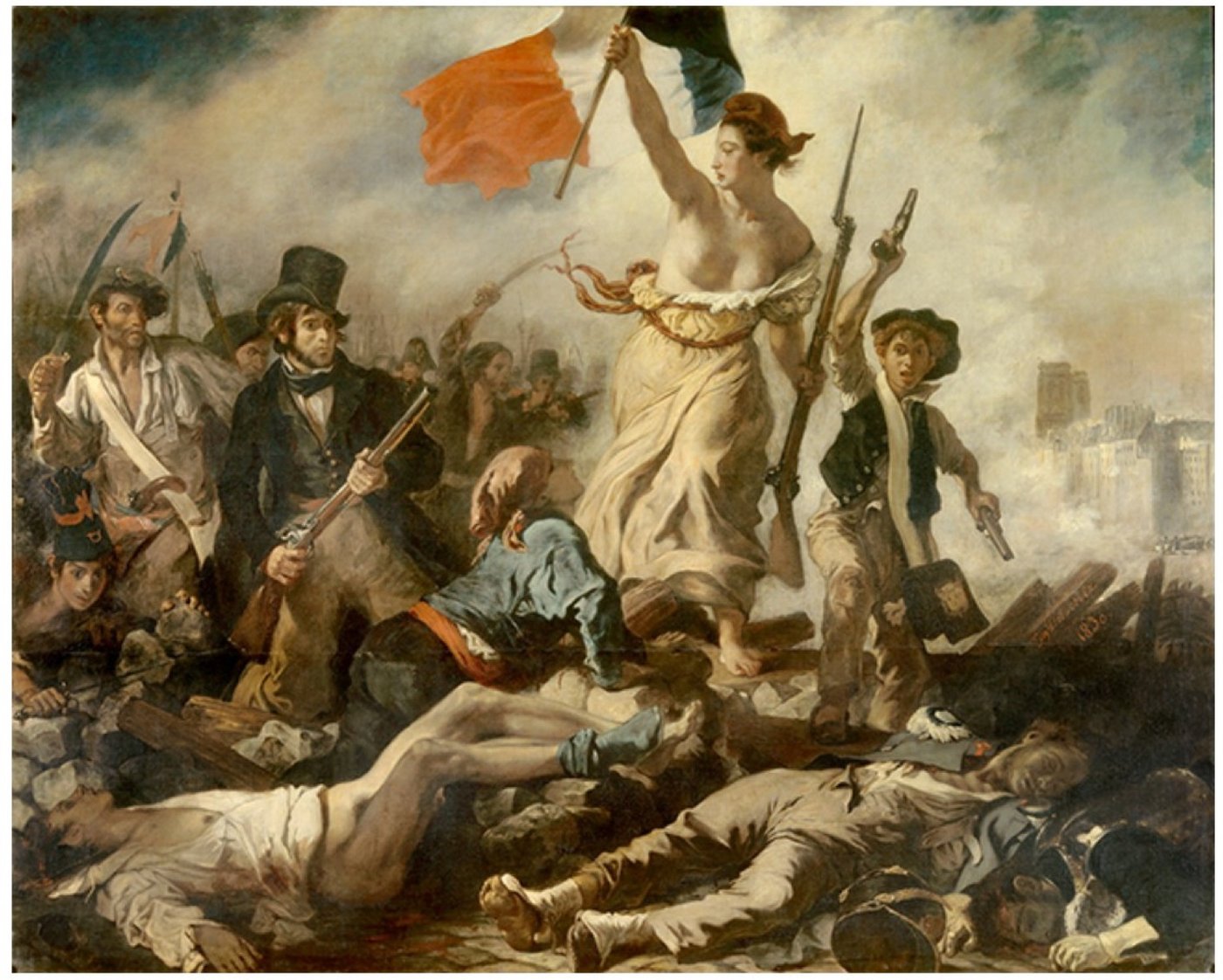
A renowned depiction of heroic rebellion, it became one of the artist’s most well-known and recognizable paintings, held in the permanent collection at the Louvre and, to this day, remains a work synonymous with themes of liberation, democracy and victory over oppression. The leading figure, a classical personification of liberty, brandishes a Tricolor, the crimson red of the flag recalling that of the balloon in the present work, and the tumultuous scene rises in a similar pyramidal arrangement of death and violence, delineated by the sharp protrusion rifles and bayonets. Kids on Guns bears a marked comparison with the 19th Century masterpiece, both visually and conceptually, a contemporary reinterpretation that reiterates the same socio-political concerns that, tragically, endure nearly two centuries later with modern warfare. Laced with inherent undertones of violence, the iconography of the innocent children perhaps also provides an element of hope that humanity and compassion have the power to overcome conflict in the same way that liberty presided over Paris in Delacroix’s time.
“Art should comfort the disturbed and disturb the comfortable.”
Acting as institutional critique, these works questioned and subverted the very environment in which art lives in – the museum, making a statement that art does not have to be produced and consumed by a certain coterie of artists and critics, breaking art free from its preconceived definitions and constraints. These underlying satirical and political tones of Banksy’s creations evoke the same dissident principles that inspired conceptual art, marking him as one of the pioneering artists of his time. Embodying both sides of a multi-layered paradox, Banksy’s works comment on potentially marginalizing political issues with contrasting punchy, light humor; he is immensely popular, yet remains an anonymous persona; his works originated from the streets yet has found their ways into international prestigious institutions. Continuously pushing the boundaries of art and taste, it is this unique duality that captivates the audience with such powerful resonance.
STAY INFORMED
Receive the latest news, exhibitions, artworks and market updates on Banksy.