BANKSY (1974-)
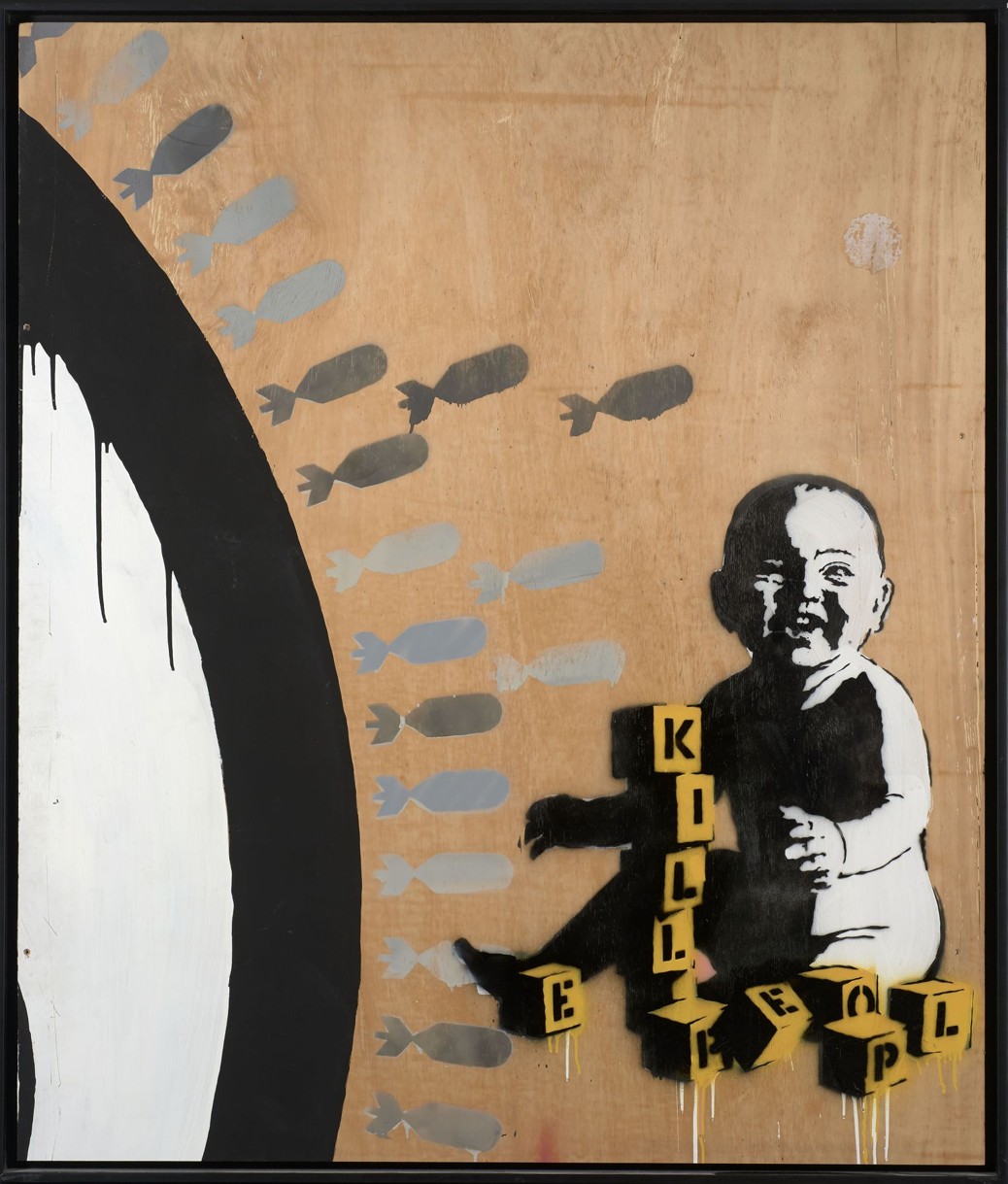
Kill People, 2003
Stencil and spray paint on wood
140.5 x 120 cm (55-3/8 x 47-1/4 inches)
Sydney, Semi-Permanent Graffiti & Street Art Exhibition, April 2003
Auction History
| Artcurial Paris 27 October 2015 Est.: EUR 120,000 – 150,000 |
Price Realized |
Catalogue Note
Created in 2003 for the Semi-Permanent Graffiti & Street Art Exhibition in Sydney, Kill People is one of Banksy’s earliest surviving works on wood and forms part of a larger temporary installation painted directly onto a construction hoarding. Like many of his most significant early interventions, the work was never originally conceived as an autonomous artwork. Instead, it belonged to a broader environmental composition, later dismantled into individual panels after the exhibition, each preserving a fragment of Banksy’s visual narrative.
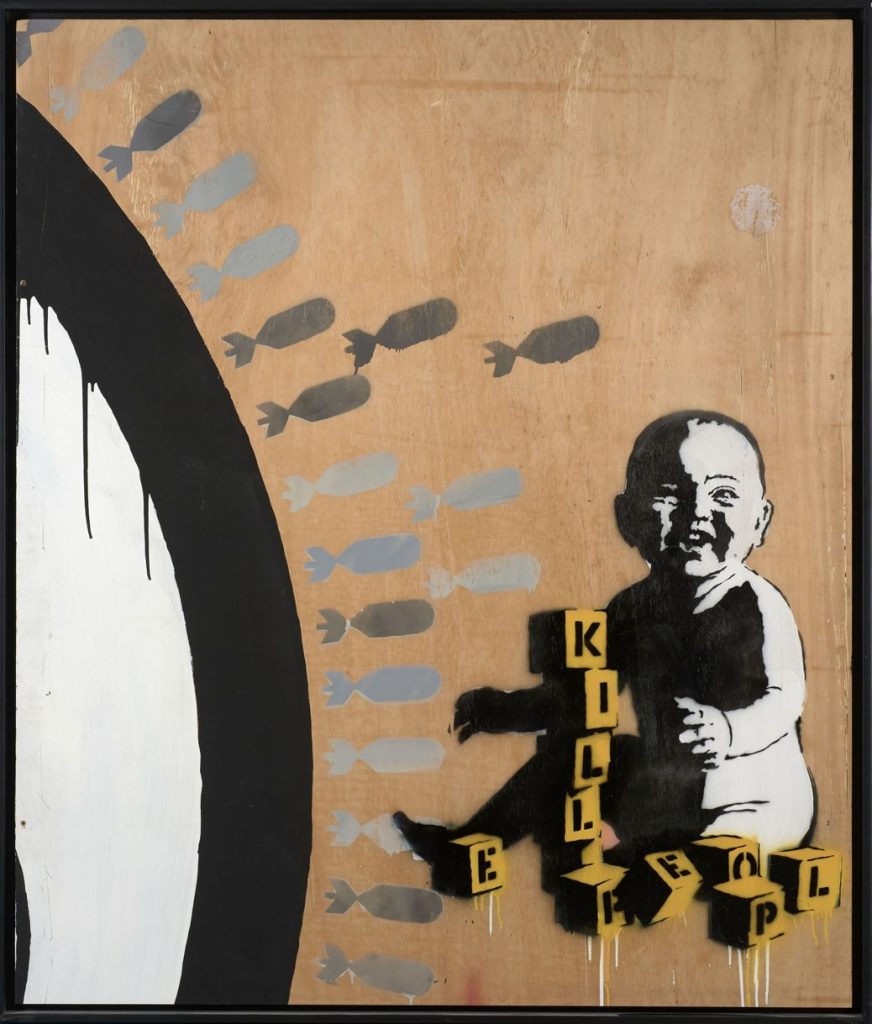
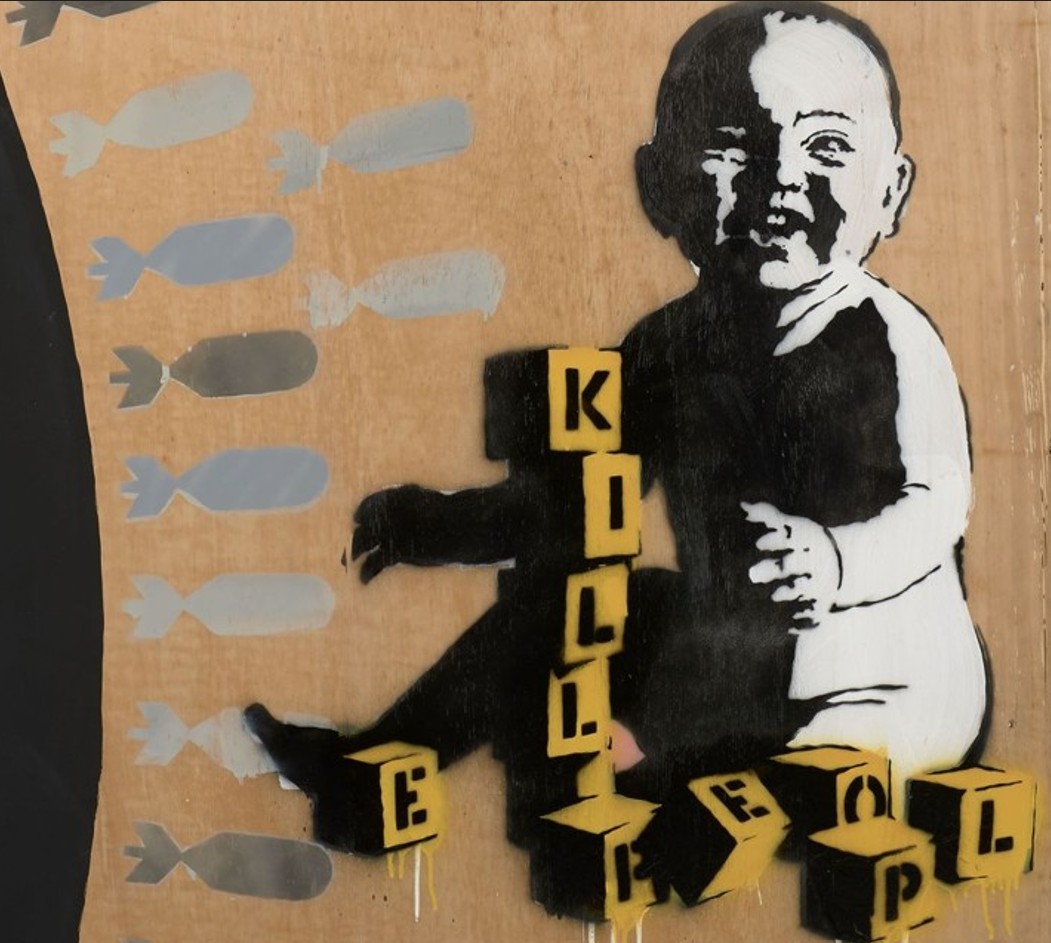
The composition is deceptively simple. Against the raw plywood support sits a young child, rendered in Banksy’s characteristic black-and-white stencil style. Before him lies a scattered collection of brightly colored alphabet blocks. Rather than spelling an innocent childhood word, however, the cubes assemble into the disturbing imperative “KILL PEOPLE.” Above the child, a procession of falling aerial bombs descends across the panel, their rhythmic repetition suggesting both movement and inevitability. To the left, a sweeping black-and-white graphic form frames the composition, recalling the larger mural from which the panel originally came.
Banksy’s strength has always been his ability to confront viewers through the collision of innocence and violence, and Kill People is among the earliest and clearest examples of this recurring strategy. The child appears entirely absorbed in play, unaware of the deadly message emerging from his toy blocks or the bombs silently falling overhead. The scene evokes the universal language of childhood while exposing the uncomfortable reality that hatred, violence and warfare are not innate instincts but behaviors that societies gradually construct and transmit from one generation to the next.
The alphabet blocks occupy a particularly important role within the composition. Traditionally symbols of education, learning and development, they become instruments of indoctrination. Rather than spelling words associated with childhood, discovery or imagination, they form an explicit command. Banksy suggests that language itself can become a vehicle through which violence is normalized. The sculpture-like arrangement of the blocks recalls the first lessons every child learns, raising the unsettling question of what values are truly being passed from one generation to the next.
The descending bombs reinforce this reading. Unlike the dramatic explosions often associated with images of war, these bombs appear almost decorative in their orderly progression across the plywood. Their repetition strips them of individuality, transforming them into a visual pattern that mirrors the repetitive conditioning implied by the alphabet blocks. Violence becomes routine, almost banal—a familiar feature of the landscape rather than an exceptional event.
The work belongs to a particularly important moment in Banksy’s career. Executed the same year as Turf War, it predates many of the iconic images that would establish his international reputation while already demonstrating the visual vocabulary that would come to define his oeuvre. Children confronting the machinery of war, innocence corrupted by political ideology, and the use of simple graphic language to communicate complex ethical questions would all become recurring themes throughout Banksy’s practice. Works such as Bomb Love (Bomb Hugger), Napalm, No Future, Happy Choppers and Ballerina with Action Man Parts all revisit, in different forms, the same fundamental tension between childhood and organised violence.
The use of raw plywood is equally significant. Rather than concealing the grain and imperfections of the support, Banksy embraces its utilitarian character. The exposed wood recalls the temporary hoardings and construction barriers upon which much of his early work was executed, preserving the mural’s original street context even after its removal. The panel therefore retains the immediacy of graffiti while simultaneously functioning as an autonomous work of art.
Although the command “Kill People” is deliberately provocative, Banksy offers no explicit explanation. The phrase can be understood as a critique of militarism, propaganda, nationalism or the broader cultural mechanisms through which violence becomes accepted and reproduced. Its power lies precisely in its ambiguity. By placing these words in the hands of a child, Banksy forces the viewer to confront the uncomfortable possibility that prejudice and aggression are learned rather than inherited.
Originally conceived as a temporary public artwork, Kill People has acquired particular historical importance as one of the surviving fragments of Banksy’s Semi-Permanent installation in Sydney. It documents a pivotal period during which the artist was moving beyond traditional graffiti while remaining deeply committed to the language of the street. Today, the work stands as one of the clearest early expressions of a theme that would define Banksy’s entire career: the tragic corruption of innocence by the systems of violence created by the adult world.