BANKSY
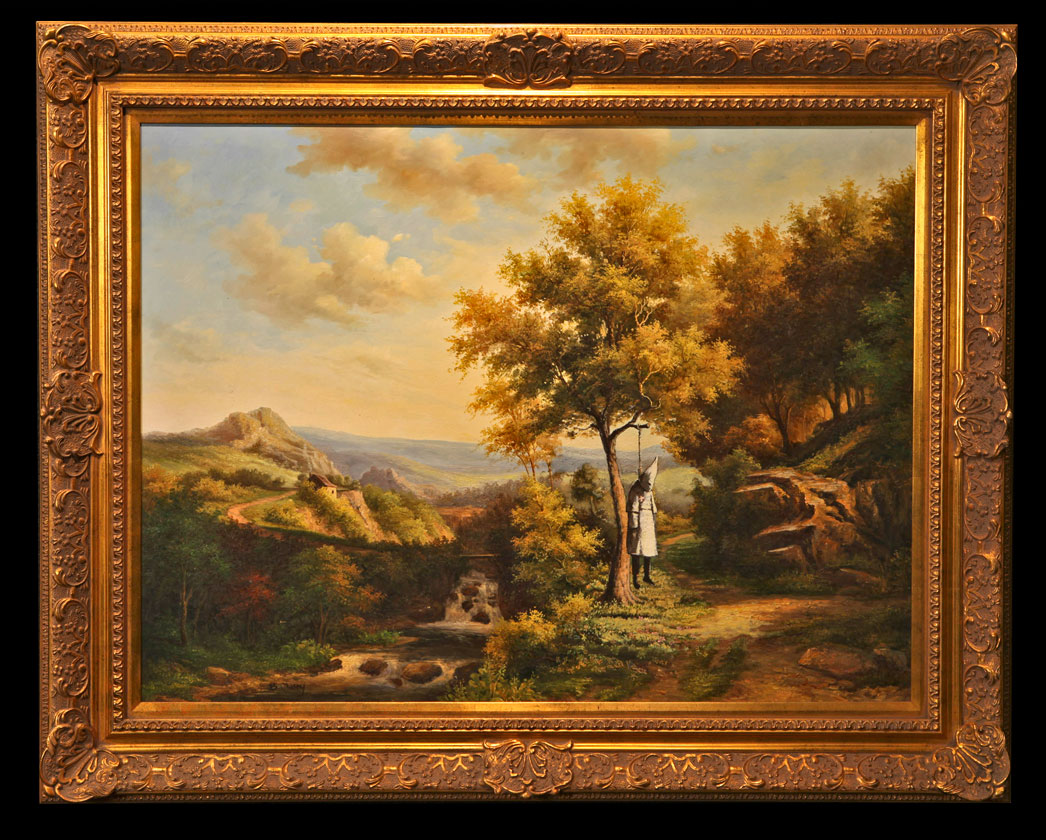
Hanging Klansman, 2009
Banksy vs. Bristol Museum, Bristol Museum, Bristol, 2009
Catalogue Note
Few images capture Banksy’s talent for disrupting artistic conventions as effectively as Hanging Klansman. At first glance, the composition appears to be a perfectly ordinary nineteenth-century Romantic landscape. A peaceful valley unfolds beneath a luminous sky, a winding stream meanders through the countryside, and towering trees frame an idyllic rural scene painted with remarkable technical sensitivity. Only after a moment does the eye discover the small, almost inconspicuous figure suspended from one of the trees: a member of the Ku Klux Klan hanging lifeless at the very center of this tranquil landscape.
The power of the work lies precisely in this delayed revelation. Rather than confronting the viewer with explicit violence, Banksy allows the painting’s serene beauty to lower our defenses before introducing an image of profound historical horror. The contrast between the idyllic landscape and the lynched Klansman creates an unsettling tension in which beauty and brutality coexist within the same frame.
Like many works from the Crude Oils series, Hanging Klansman demonstrates Banksy’s fascination with appropriating traditional painting only to undermine its original message through a single, carefully placed intervention. Here, the anonymous landscape painter celebrated nature as a place of harmony and contemplation. Banksy transforms that same landscape into a meditation on memory, justice and the darker chapters of human history. The intervention is remarkably restrained; nothing else in the composition has been altered, making the solitary figure all the more disturbing.

The identity of the victim introduces an additional layer of ambiguity. Banksy deliberately depicts a member of one of history’s most notorious white supremacist organizations, forcing viewers to confront conflicting emotional responses. The image evokes the horror of lynching while simultaneously presenting the execution of someone associated with racial terror. Rather than offering a straightforward moral lesson, the work raises uncomfortable questions about vengeance, justice, and whether violence can ever erase the legacy of hatred. Banksy refuses to resolve this tension, leaving the viewer suspended between satisfaction and unease.
Created in 2009 for the landmark exhibition Banksy vs. Bristol Museum, Hanging Klansman belongs to the artist’s mature exploration of altered oil paintings. Unlike works that rely primarily on humor, this painting demonstrates Banksy’s growing confidence in using silence and understatement as artistic strategies. The intervention occupies only a tiny fraction of the canvas, yet it completely transforms the emotional reading of the landscape, proving once again that the smallest gesture can profoundly alter the meaning of an image.
Within Banksy’s oeuvre, Hanging Klansman sits comfortably alongside works such as Vandalized Oil (Choppers), Subject to Availability, Home Sweet Home, and Devolved Parliament, where inherited visual traditions are appropriated not to mock the past, but to expose the uneasy relationship between history, ideology, and collective memory. It exemplifies one of Banksy’s greatest strengths as an artist: his ability to make us look twice, and in doing so, to discover that what initially appeared peaceful was never truly innocent.