BANKSY
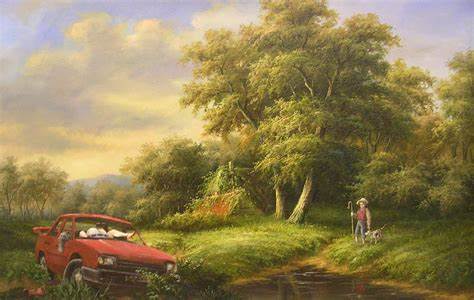
Landscape with Abandoned Car, 2006
Exhibited
Barely Legal, Los Angeles, 2006
Catalogue Note
At first glance, the landscape appears reassuringly familiar. Majestic trees frame a peaceful clearing, sunlight filters gently across the grass, and a lone shepherd quietly tends his flock in the distance. The scene evokes the Romantic tradition of landscape painting, celebrating harmony between humanity and nature. Yet this illusion is quietly broken by the abandoned vehicle occupying the foreground. Its presence feels strangely intrusive—not because it dominates the composition, but because it simply does not belong.
Unlike Landscape with Car Wreck or Landscape with Crashed Car, where the damaged vehicles suggest sudden catastrophe, Landscape with Abandoned Car speaks instead of neglect. The violence has already occurred. Whatever story brought the automobile into this peaceful setting has long since disappeared, leaving only its silent remains. Banksy replaces the spectacle of disaster with its aftermath, inviting viewers to contemplate the traces that modern civilization leaves behind.
The abandoned car functions almost as an archaeological object. It is simultaneously evidence of human mobility and of human failure. Designed to symbolize freedom, technological progress and personal independence, the automobile has instead become a discarded relic slowly being reclaimed by nature. The work subtly reverses the traditional hierarchy between civilization and landscape. Rather than humanity mastering the environment, the environment patiently absorbs humanity’s inventions.
Throughout the Crude Oils series, Banksy repeatedly challenged the idealized vision of nature found in classical landscape painting. The nineteenth-century countryside was often presented as untouched, harmonious and eternal. Banksy reminds us that no landscape remains immune from contemporary society. Roads, pollution, consumer goods and abandoned technology have become inseparable from the natural world. The countryside itself has become another casualty of modernity.
This recurring motif of damaged or abandoned vehicles occupies an important place within Banksy’s oeuvre. Cars traditionally represent mobility, prosperity and progress—some of the defining myths of twentieth-century consumer culture. By repeatedly depicting them wrecked, abandoned or absurdly misplaced, Banksy quietly questions whether technological progress has fulfilled the promises it once made. The automobile becomes less a symbol of freedom than one of impermanence.
Its inclusion in Barely Legal reinforces the exhibition’s broader dialogue between classical art history and contemporary life. Throughout the exhibition, Banksy repeatedly inserted elements of the modern world into inherited visual traditions, exposing the growing distance between idyllic cultural myths and present-day reality. Here, the intervention is remarkably restrained. Unlike the dramatic vandalism of his modified portraits or overt political imagery, the abandoned car whispers rather than shouts. Its quiet presence proves more unsettling precisely because it feels plausible.
The painting also reflects one of Banksy’s recurring artistic strategies: allowing absence to speak louder than action. There are no figures associated with the vehicle, no visible accident, no explanation. The narrative has already ended before the viewer arrives. We are left only with the evidence, forced to imagine the story ourselves. In that sense, Landscape with Abandoned Car becomes less about a specific event than about the lingering consequences of modern civilization.
Ultimately, the work suggests that humanity rarely destroys paradise in dramatic moments. More often, it leaves things behind. A forgotten object, a neglected machine, a discarded technology—small interventions that gradually accumulate until even the most idyllic landscape bears the unmistakable fingerprints of contemporary life.