BANKSY
Landscape with Crashed Car, 2006
Exhibited
Barely Legal, Los Angeles, 2006
Catalogue Note
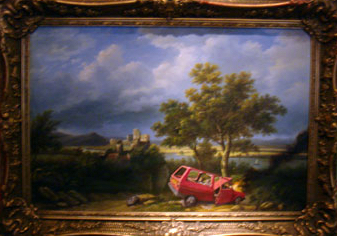
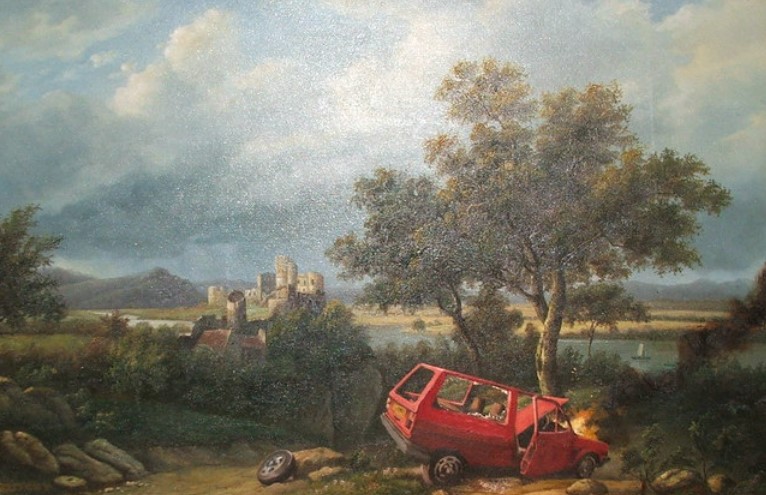
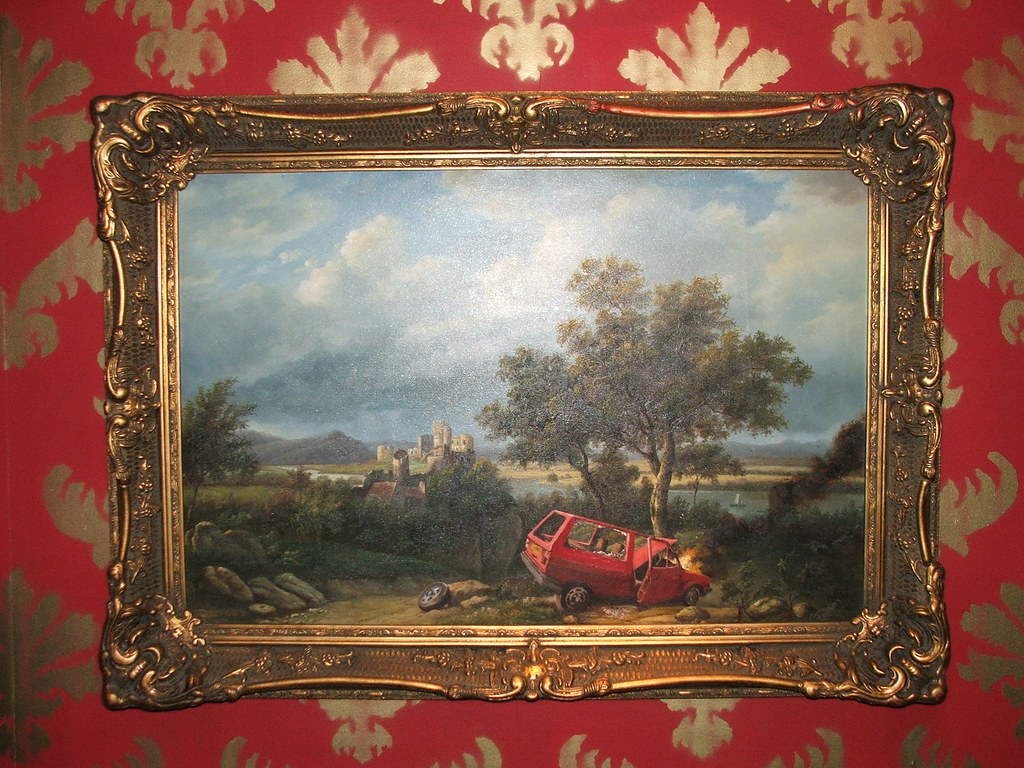
With Landscape with Crashed Car, Banksy once again appropriates the visual language of the nineteenth-century pastoral landscape only to disrupt its quiet harmony with an unmistakably contemporary intrusion. Nestled among rolling hills, ancient ruins and peaceful trees sits a small red van that has veered off the road, its door hanging open and smoke gently rising from the engine. The accident is strangely understated. There are no victims, no drama, no visible panic—only the quiet evidence that something has gone wrong.
This subtle intervention exemplifies one of Banksy’s most sophisticated artistic strategies. Rather than overwhelming the original painting with overt political symbolism, he inserts a single contemporary object into an otherwise timeless landscape. The collision between centuries is immediate. The pastoral idyll, traditionally conceived as a refuge from modern life, is quietly contaminated by one of its most familiar products. The van appears almost absurd in its surroundings, yet it also feels strangely inevitable.
The abandoned vehicle becomes a metaphor for modern civilization itself. Cars have long symbolized progress, freedom and technological achievement, but here that promise has literally broken down. Isolated in a landscape that has survived for centuries, the wreck suggests the fragility of the contemporary world when measured against the permanence of nature and history. The medieval ruins in the distance have already witnessed countless generations rise and fall; the van, by contrast, already looks obsolete.
Like several works from the Crude Oils and Barely Legal exhibitions, the painting explores the uneasy relationship between romantic idealism and contemporary reality. Traditional landscape painting often presented nature as ordered, harmonious and eternal. Banksy introduces a quiet reminder that the modern world cannot simply be excluded from that vision. Pollution, consumer culture, abandoned machinery and human error inevitably find their way into even the most idyllic settings.
The choice of a modest red van rather than a spectacular luxury automobile is equally significant. Banksy consistently avoids glamour. The vehicle belongs to everyday life rather than fantasy, reinforcing his fascination with ordinary objects that quietly reveal broader social truths. The accident could have happened yesterday, or decades ago. Its very banality makes it believable.
Created for Barely Legal in Los Angeles in 2006, Landscape with Crashed Car belongs to Banksy’s celebrated series of vandalized landscapes, alongside works such as Landscape with Car Wreck, Modified Oil Painting #12 (CCTV Countryside), Frontier, The Waterfall, and Guantanamo Bay. Together these paintings demonstrate that Banksy’s interventions are rarely acts of destruction. Instead, they function as temporal collisions, allowing contemporary anxieties to enter compositions originally conceived as visions of permanence and tranquillity.
The work also reflects one of Banksy’s recurring philosophical concerns: the illusion of progress. Modern society often imagines itself moving inexorably forward, yet the crashed van suggests another possibility—that progress can stall, lose direction or simply end up in a ditch. The surrounding landscape remains serene and indifferent, continuing its slow rhythm while human technology sits abandoned in silence. Nature neither celebrates nor mourns our achievements; it simply outlasts them.
Ultimately, Landscape with Crashed Car reminds us that paradise is rarely destroyed by grand catastrophes. More often, it is interrupted by the quiet accumulation of ordinary human mistakes. A single vehicle is enough to fracture the timeless illusion of the pastoral landscape, just as a single contemporary object can transform the meaning of an entire painting. In Banksy’s hands, that modest red van becomes less an accident than a gentle meditation on the precarious place of modern civilization within the much longer history of the natural world.