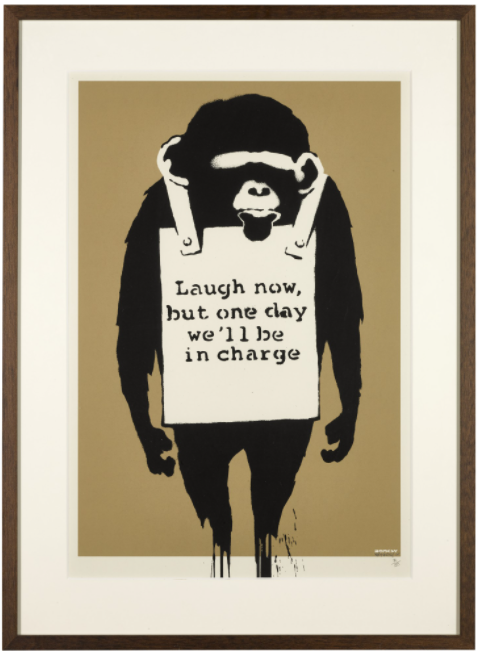
Laugh Now
Editions
Signed Edition: 150
Unsigned Edition: 600
Artist’s Proofs: 69 signed AP
A Study in Obedience, Irony, and the Performance of Power

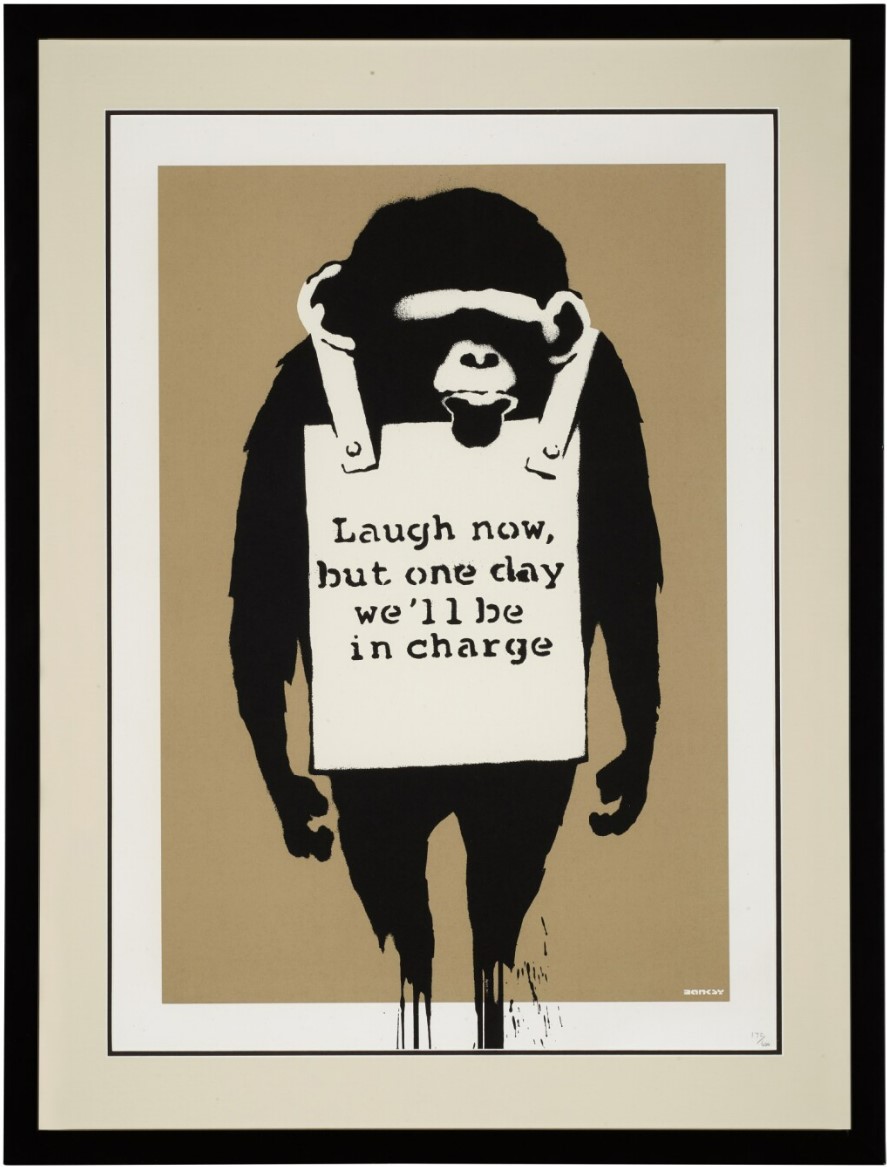
The composition is stark. The monkey occupies the space with little surrounding context, allowing the message to dominate. The monochrome palette reinforces the austerity of the image, while the hand-painted text introduces a raw, almost improvised quality. There is no movement, no narrative action: only a figure presented for observation, caught between display and resignation.
The Inversion of Power
At its core, Laugh Now is an image about hierarchy. The monkey, historically associated with mimicry and entertainment, stands here as a surrogate for the marginalized, the underestimated, or those reduced to spectacle. The sandwich board suggests forced communication: an imposed message, rather than a chosen one.
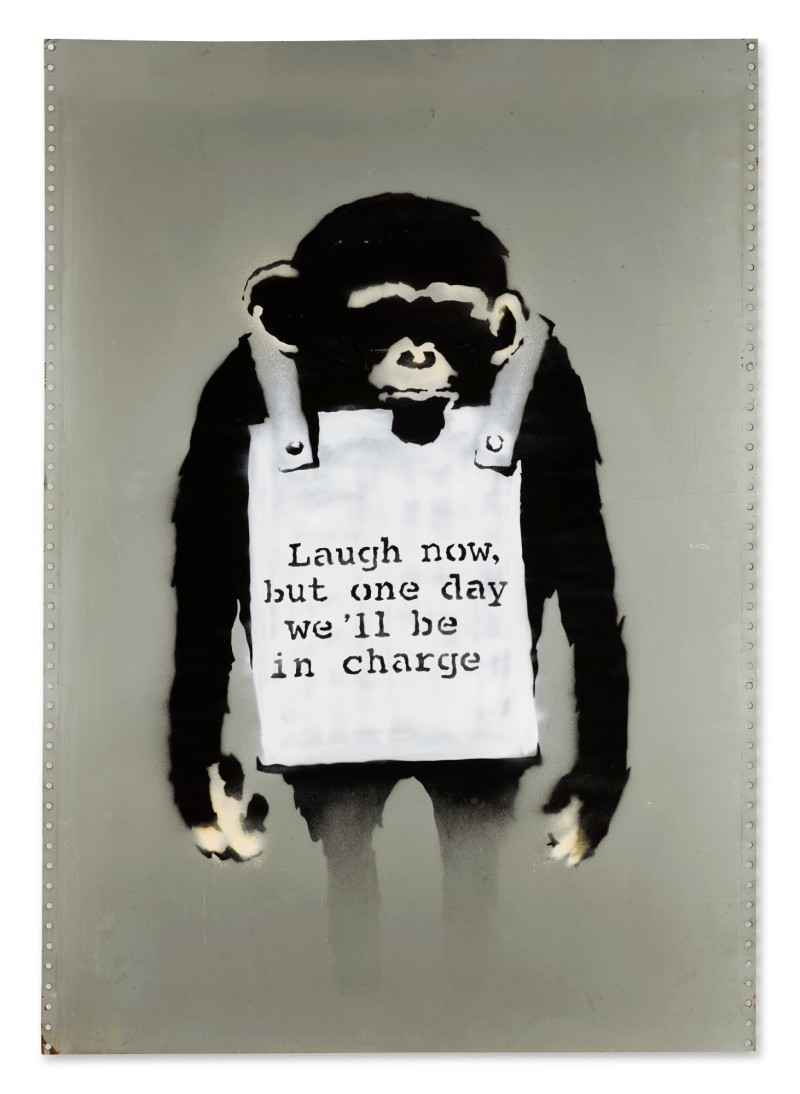
And yet, the text introduces a reversal. What begins as an invitation to mock (“Laugh now”) quickly shifts into a quiet warning. The second half of the sentence destabilizes the first. It suggests that the current order is temporary, that roles may invert, and that those perceived as powerless may one day assume control. This duality is central: the figure appears submissive; the message is defiant at best. Banksy does not resolve this contradiction. Instead, he allows both readings to coexist, creating a tension between appearance and intention.
Laugh Now has become one of Banksy’s most widely recognized and reproduced images, precisely because of its clarity and adaptability. The phrase itself has entered broader cultural circulation, functioning almost independently of the image. It resonates across contexts (political, social, even personal) each time reactivating its core tension between present perception and future possibility. Within Banksy’s oeuvre, the work stands as a cornerstone, a perfect synthesis of visual simplicity and conceptual depth.
Laugh Now operates with quiet confidence. It does not shout, provoke, or overwhelm. Instead, it presents a figure and a sentence, and allows the implications to unfold. The monkey stands, waiting. The message remains. And somewhere between the two lies the uncomfortable suggestion that the roles we accept today may not remain fixed tomorrow…
Release Context
Laugh Now originated in the early 2000s as part of a commission for a nightclub in Brighton, where Banksy created a series of monkey stencils installed across the venue’s interior. In this setting, the image functioned as both decoration and commentary: an ironic mirror held up to a space dedicated to entertainment and spectacle.

107.5 x 604.5 cm (42 3/8 x 237 7/8 inches)
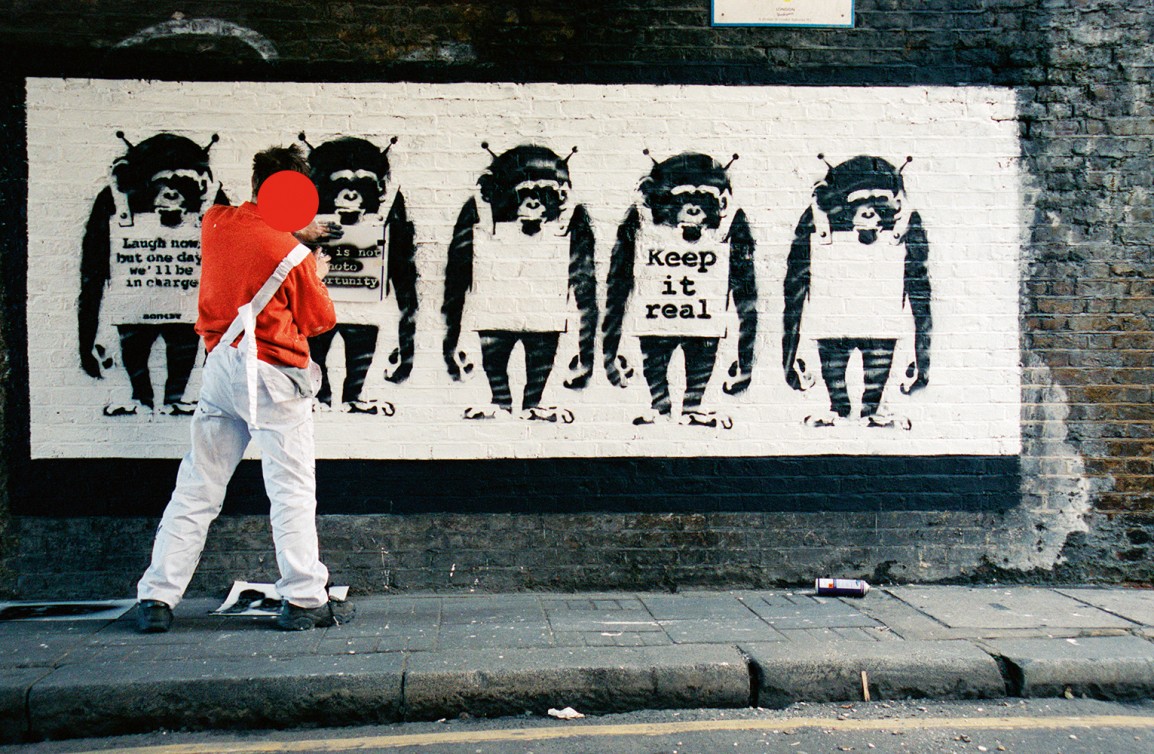
Rivington Street, London, 2002
Banksy’s history as a street artist and his efforts to conceal his identity make his artistic figures his only interactive surrogates. Bearing this in mind, the monkeys upon the panel not only assume an anarchistic quality—promising full revenge upon their rise to power—but also make for a fascinating study into the future of street art. And, as his exhibition spaces shift from urban alleyways to galleries, Banksy paints a fascinating commentary on the current state of contemporary art.

Shortly thereafter, the work evolved into one of Banksy’s most recognizable images, appearing in various formats including prints released through Pictures on Walls (POW). This moment is significant. It reflects Banksy’s growing ability to: (i) Translate street imagery into reproducible works; (ii) Maintain conceptual integrity across contexts; and (iii) Expand his audience without diluting his message.
The Monkey Motif in Banksy’s Work
The monkey is a recurring figure in Banksy’s visual vocabulary. Across multiple works, primates appear in roles that mirror human systems (politicians, workers, observers) often highlighting the absurdity of social structures. In Laugh Now, the monkey becomes a vessel for exploring obedience and future reversal.
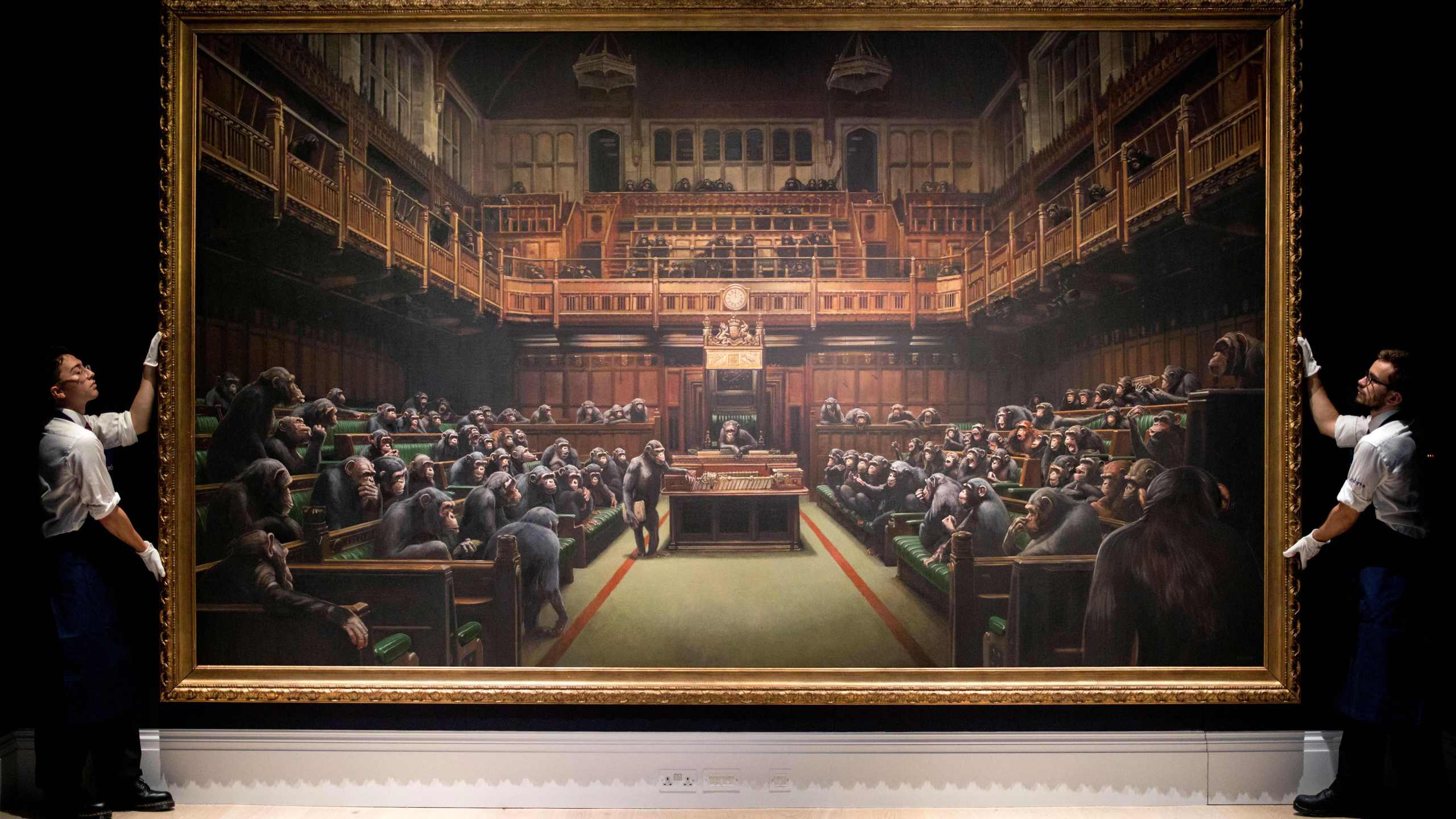
The choice is deliberate: (i) Monkeys mimic suggesting learned behavior; (ii) Monkeys entertain suggesting spectacle; and (iii) Monkeys resemble humans suggesting uncomfortable proximity Through this motif, Banksy collapses the distance between subject and viewer. The image is not merely about “them”—it implicates “us.”
Even though no mural remains with this iconic stencil, Banksy realized many originals on various media using the Laugh Now stencil. Those command high prices at auction.
Auction Results
PLEASE CLICK BELOW FOR AUCTION RESULTS