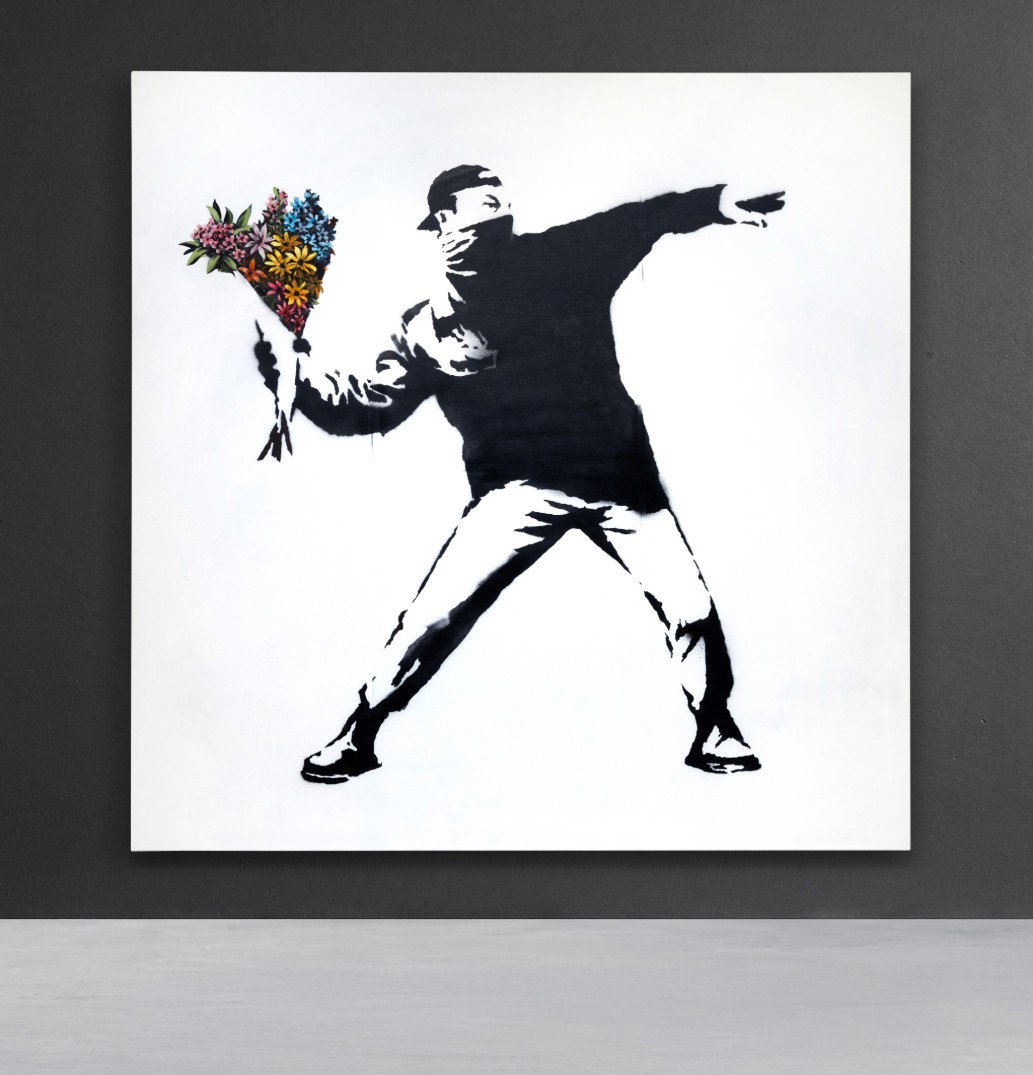
BANKSY (b. 1973)
Love Is In The Air (life size), 2011
Spray paint and oil on canvas
210×210 cm (82-5/8 x 82-5/8 inches)
Signed and dated 11 (on the overlap)
Provenance
Pest Control, London
Private Collection, San Francisco
Comden Contemporary, Los Angeles
Acquired from the above by the present owner
Auction History
| Sotheby’s London 25 June 2026 Est.: GBP 3,500,000 – 5,500,000 |
Price Realized GBP 6,434,000 / USD 8,619,290 Banksy | Love Is In The Air (life size) |
Catalogue Note
Source: Sotheby’s
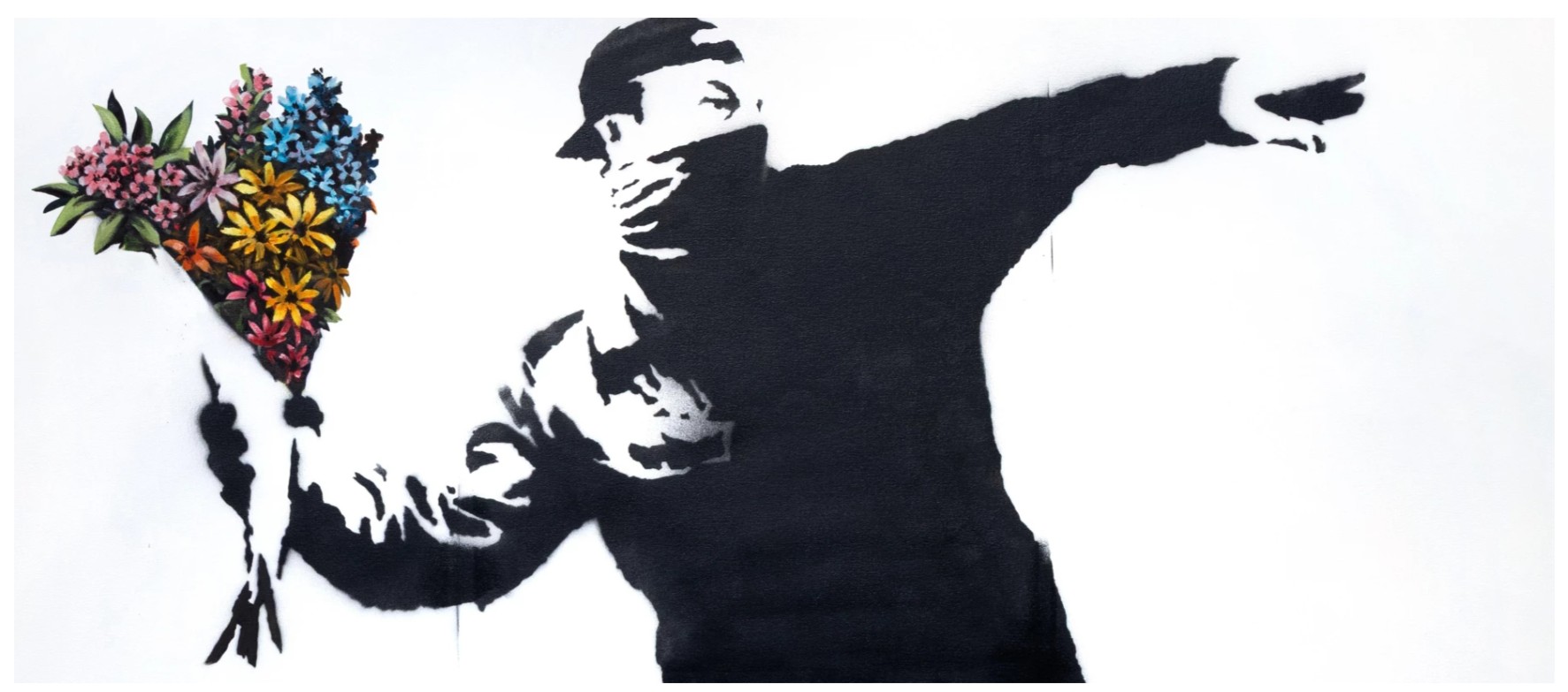
Among all known painted versions of Love Is In The Air, the present work stands apart both for its scale and its ambition. Measuring more than two meters square, it represents one of the largest and most imposing realizations of Banksy’s most celebrated image, transforming a composition originally conceived as a fleeting act of street intervention into a work of undeniable monumental presence. At this scale, the image undergoes a profound transformation. No longer encountered as a familiar icon reproduced endlessly through books, posters, social media, and popular culture, the Flower Thrower confronts the viewer directly, almost face-to-face. The distance that usually separates spectator from symbol collapses, replaced by an immediate physical encounter.
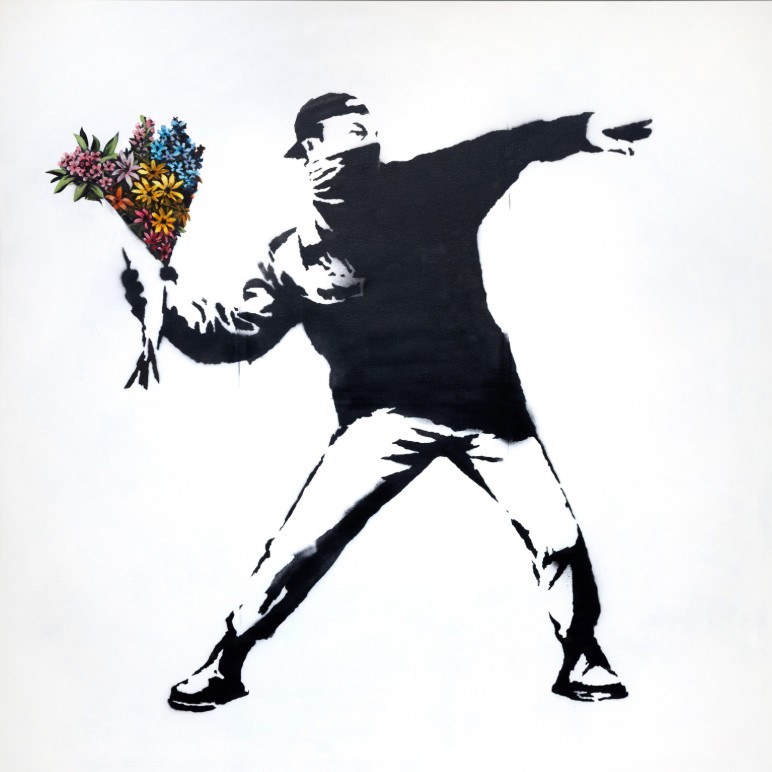
The figure’s dramatic gesture remains as compelling today as when it first appeared. His body twists in anticipation, arm drawn back, poised at the very instant before release. The tension is theatrical, almost cinematic, recalling the grand rhetoric of revolutionary painting while preserving the raw urgency of Banksy’s graffiti origins. The scale amplifies every aspect of the composition, elevating an image that began on a wall into something approaching a contemporary history painting. This is not simply a larger version of a familiar motif; it is the transformation of one of the defining images of our time into a work of museum-scale authority.
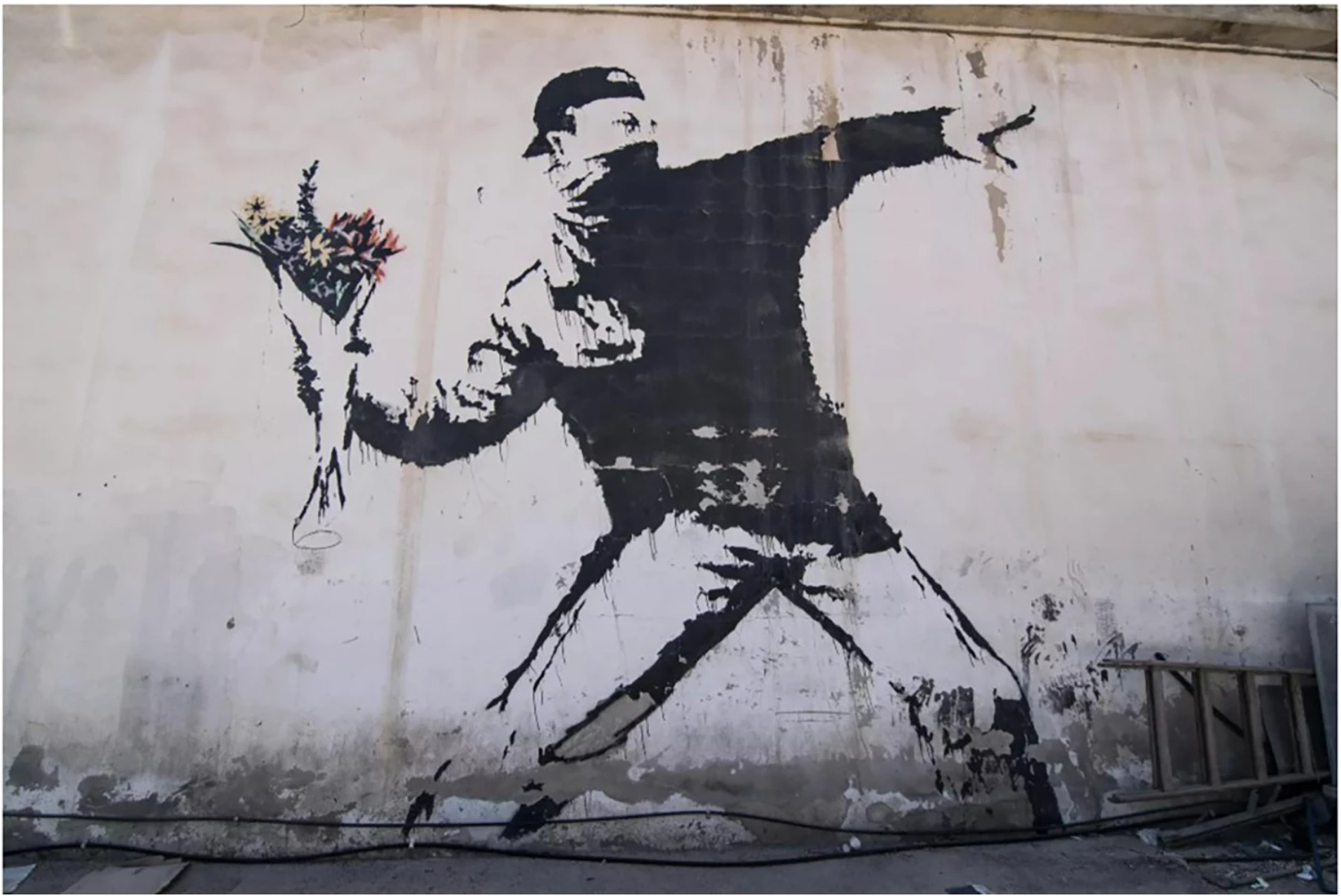
Banksy’s famous mural Rage, The Flower Thrower (Love Is in the Air) painted on a wall in Bethlehem, Palestine, Photo © Matthias Kestle / Alamy Stock Photo ARTWORK: © BANKSY 2026
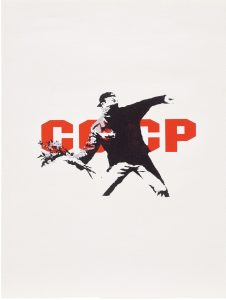
Few contemporary artists have created an image as universally recognizable as Love Is In The Air. First executed in 2003 on a wall in Beit Sahour near the Israeli West Bank Barrier, the composition depicts a masked protester preparing to throw an object towards an unseen adversary. Yet Banksy famously overturns expectations. Rather than a grenade, a brick, or a Molotov cocktail, the figure holds a bouquet of flowers. With this deceptively simple substitution, Banksy disarms the visual language of conflict itself. Violence is replaced by beauty, aggression by hope, confrontation by the possibility of dialogue. The image embodies one of the central themes that runs throughout Banksy’s oeuvre: the belief that acts of humanity may still challenge systems built upon division and force.
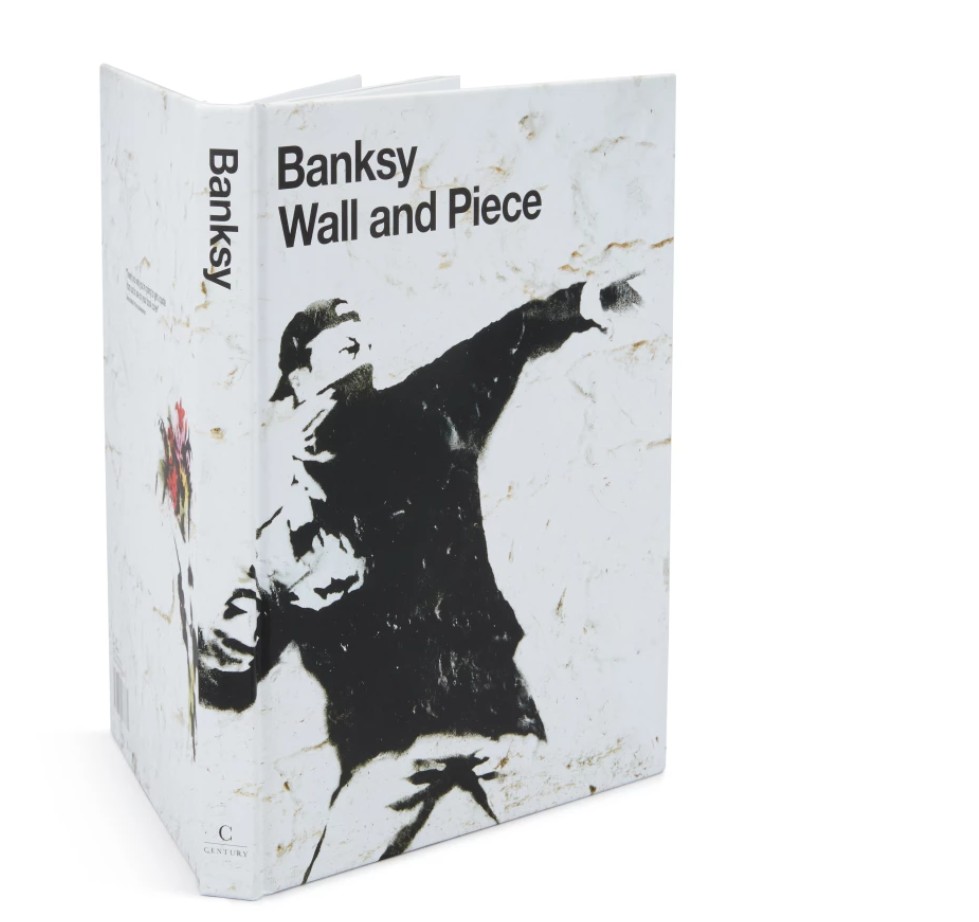
Love is in the Air illustrated on the cover of Banksy: Wall and Piece
ARTWORK: © BANKSY 2026
The importance of Love Is In The Air within Banksy’s artistic legacy can scarcely be overstated. The image was selected for the cover of Wall and Piece, the artist’s landmark 2005 publication, effectively establishing it as the visual manifesto of his practice. Over the years it has transcended the circumstances of its creation and entered the realm of collective cultural memory. Much as Leonardo da Vinci’s Mona Lisa, Andy Warhol’s Marilyn, or Alfred Leete’s iconic Lord Kitchener Wants You poster became symbols extending far beyond their original contexts, Banksy’s Flower Thrower has evolved into a universally understood emblem. Its countless reproductions in protest movements, political campaigns, publications, and popular culture demonstrate not merely its recognizability but the extraordinary efficiency with which Banksy condenses complex political ideas into a single unforgettable image. While Love Is In The Air is among the most reproduced images in contemporary culture, original painted examples remain surprisingly scarce.
Unlike Girl with Balloon, which exists in numerous editions, formats and variations, major unique canvases featuring the Flower Thrower appear only occasionally on the market. This relative rarity has contributed significantly to the work’s mythology and desirability among collectors. The paradox is striking: one of the most familiar images in the world remains one of the least frequently encountered in its original painted form.
The present painting is distinguished further by the compelling dialogue between mechanical execution and painterly refinement. The monochrome figure, rendered through Banksy’s signature stencil technique, possesses the stark immediacy of photojournalism, political propaganda, and tabloid imagery. Against this restrained visual language erupts the bouquet itself, richly colored and delicately executed in oil paint. The flowers introduce a degree of sensuality and painterly sophistication rarely encountered in Banksy’s predominantly graphic vocabulary.
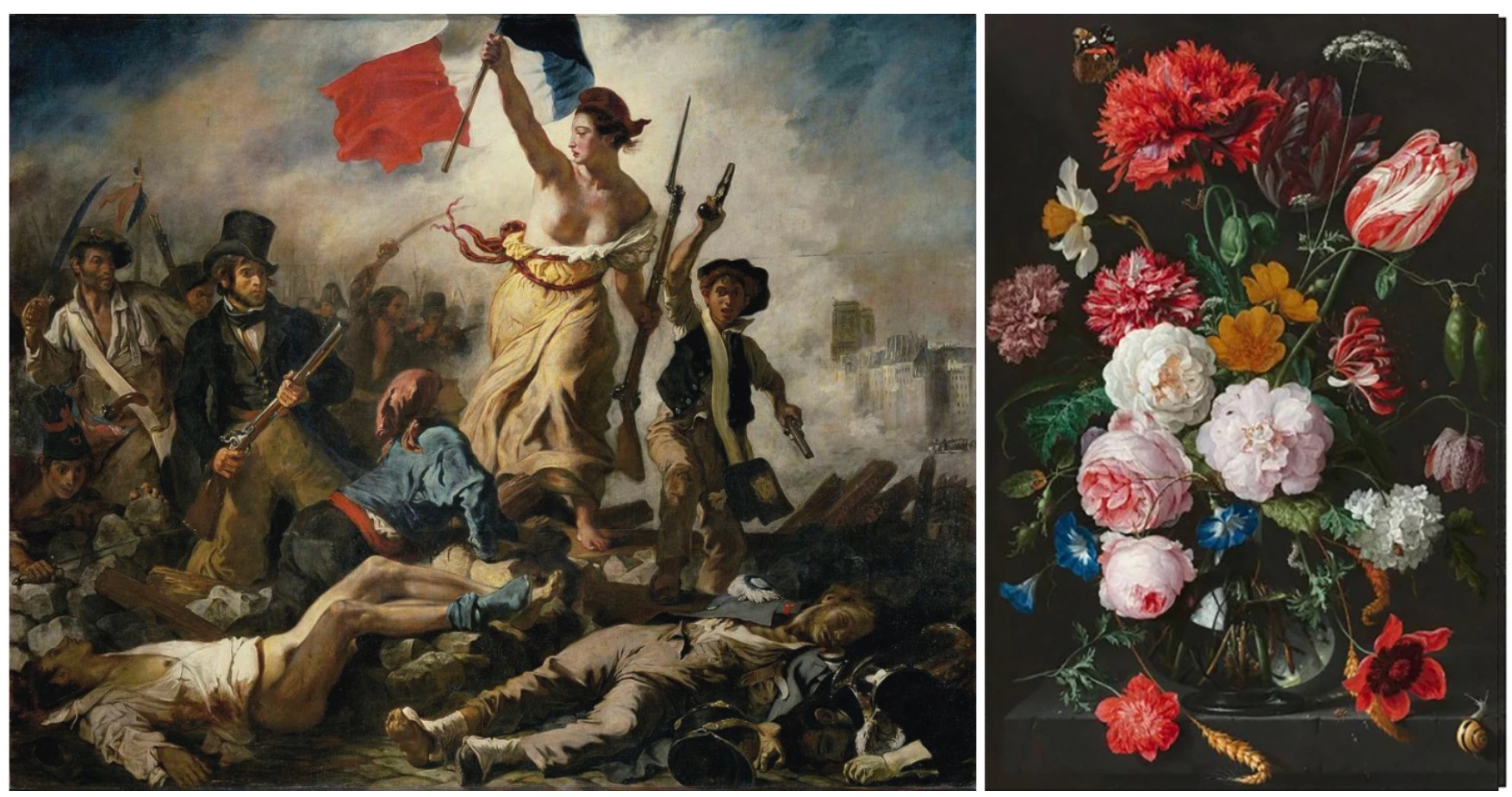
Left: Eugène Delacroix, Liberty Leading the People, 1830. IMAGE © Louvre Museum, Paris
Right: JAN DAVIDSZ. DE HEEM, STILL LIFE WITH FLOWERS IN A GLASS VASE, 1665. IMAGE © MUSEO NACIONAL THYSSEN-BORNEMISZA, MADRID
Their vibrant chromatic presence evokes centuries of art historical tradition. One is reminded of the sumptuous floral arrangements of seventeenth-century Dutch still-life painting, where bouquets functioned simultaneously as displays of beauty and meditations on mortality. Echoes of Renaissance symbolism also emerge, recalling the ways flowers were employed to communicate virtue, sacrifice, renewal, and hope. Yet Banksy deliberately destabilizes such associations. These are not flowers arranged for contemplation in a vase, nor symbols of life’s transience. They appear hastily gathered, almost improvised, transformed from objects of admiration into instruments of confrontation.
This tension between stencil and oil paint lies at the heart of the work’s conceptual sophistication. Banksy’s adoption of stenciling during the late 1990s emerged from practical necessity, allowing him to execute complex imagery quickly while avoiding police intervention. Yet the medium carries deeper historical and political resonances. Stenciling has long been associated with grassroots activism, punk culture, political agitation, and forms of visual communication that operate outside institutional structures. Through its reproducibility and anonymity, it becomes a democratic tool of dissent.
The hand-painted bouquet disrupts this quasi-mechanical aesthetic. It reintroduces the presence of the artist’s hand and, with it, a sense of vulnerability, intimacy, and individuality. The work therefore oscillates between opposing forces: reproduction and uniqueness, confrontation and compassion, anonymity and personal expression. It is within this unresolved tension that the enduring power of the image resides.
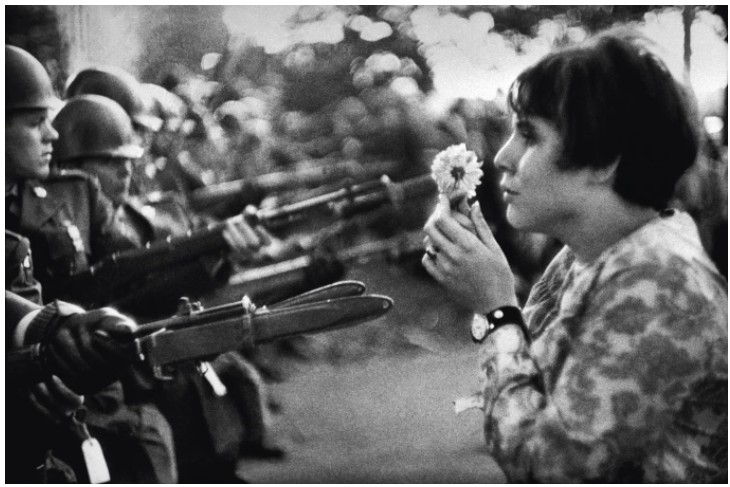
An American young girl, Jan Rose KASMIR, confronts the American National Guard outside the Pentagon during the 1967 anti-Vietnam march. USA. Washington DC. 1967. © Marc Riboud – Fonds Marc Riboud au musée Guimet
The composition also belongs to a broader lineage of anti-war imagery. Inevitably, the Flower Thrower recalls the visual culture of the 1960s peace movement, particularly the celebrated photographs of demonstrators placing flowers into the barrels of soldiers’ rifles during protests against the Vietnam War. Banksy channels the optimism of the flower-power generation while simultaneously acknowledging the complexities of a world shaped by surveillance, militarization, and persistent geopolitical conflict.
Importantly, the work avoids sentimentality. The protester remains masked, anonymous, and visibly tense. Peace is not presented as passive idealism but as something that must be actively asserted and defended. The flowers do not erase conflict; they challenge it. At life size, this tension becomes even more pronounced. The viewer no longer observes the protester from a safe distance but encounters him as an equal physical presence. The image acquires a new corporeality, intensifying both its emotional charge and its political resonance.
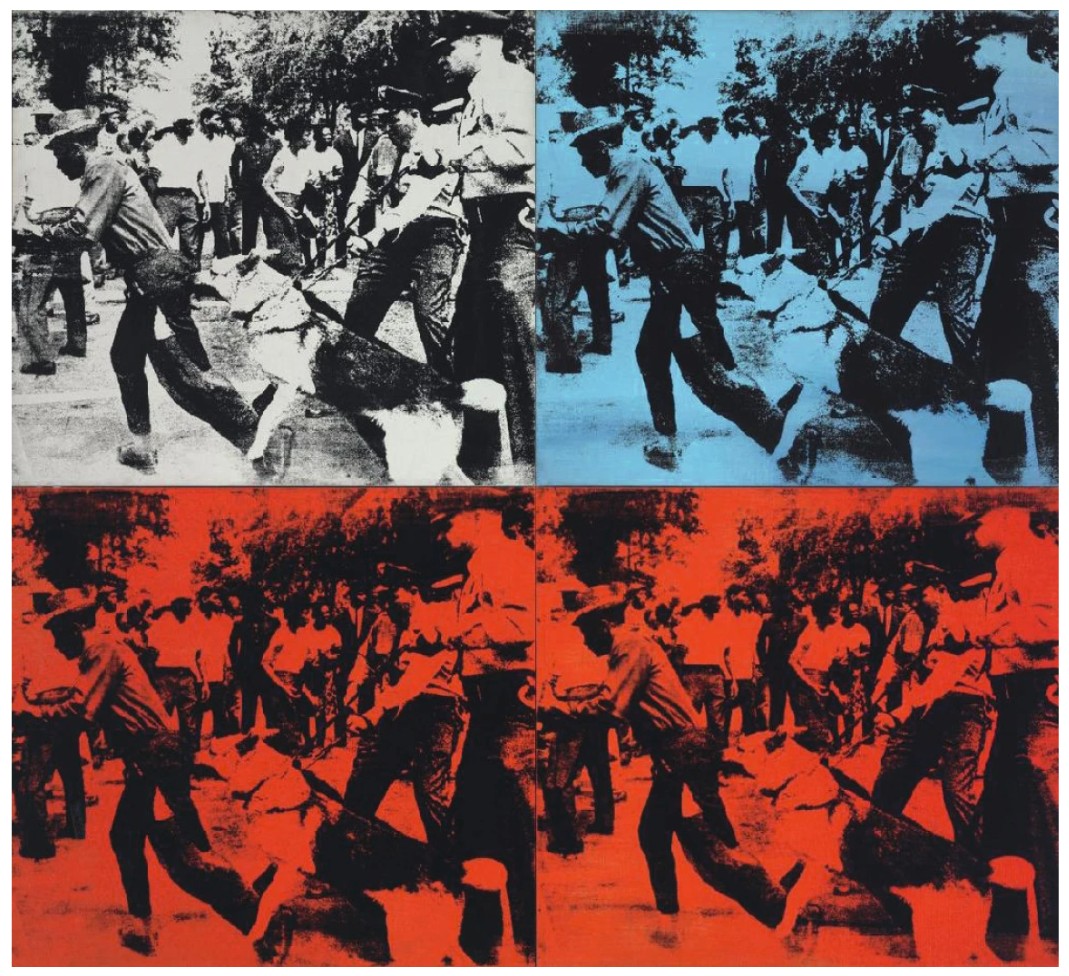
Andy Warhol, Race Riot, 1964, Private Collection
Art © 2026 The Andy Warhol Foundation for the Visual Arts, Inc. / Licensed by DACS, London.
More than two decades after its creation, Love Is In The Air remains one of the defining images of contemporary art because it addresses a question that continues to haunt the modern world: how does one respond to violence without becoming part of it? Banksy offers no easy answers. The work does not suggest that flowers can overcome tanks, nor does it indulge in naïve optimism. Instead, it proposes something far more powerful: the possibility that humanity, empathy, and imagination may still interrupt cycles of conflict, even if only momentarily.
Part of the enduring strength of Love Is In The Air lies in its extraordinary ability to operate simultaneously as a work of art, a political statement, and a universal symbol. Like Picasso’s Guernica, Warhol’s Marilyn, or the famous photograph of the Tank Man in Tiananmen Square, the image has transcended its original context to become part of a broader visual language understood across cultures and generations. Few works created in the twenty-first century have achieved such a status.
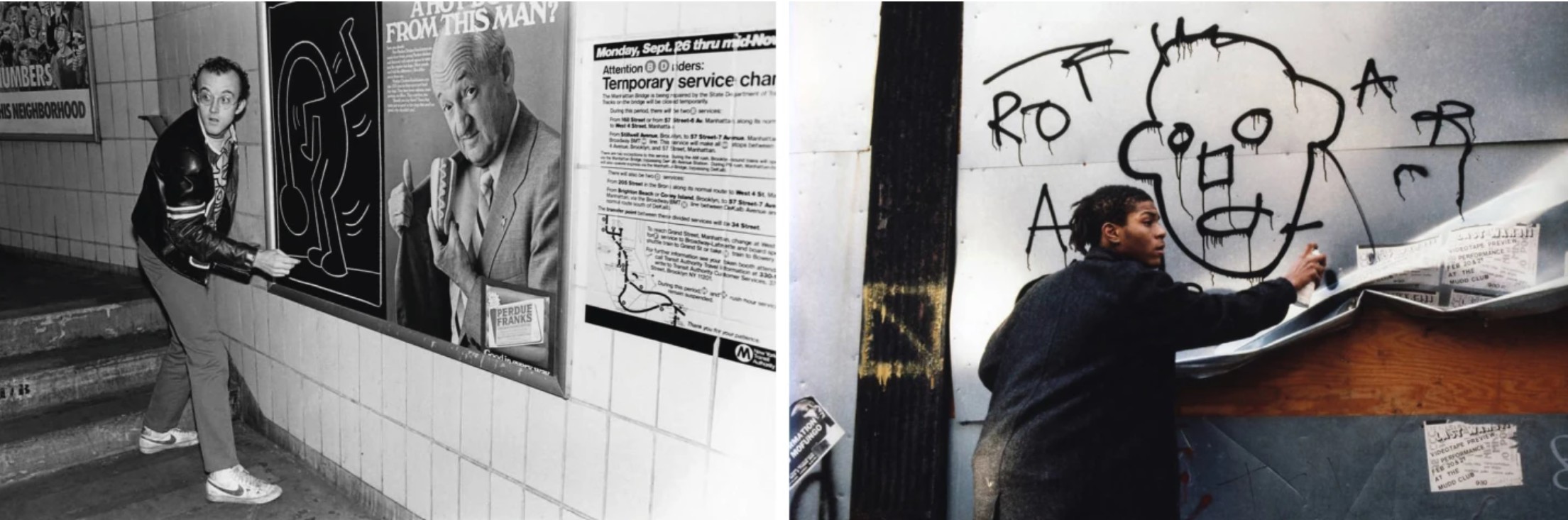
Left: Keith Haring drawing on a subway platform in New York City, circa 1982. Photo by Laura Levine/Corbis via Getty Images. Art © 2026 Keith Haring Foundation
Right: Jean-Michel Basquiat in a film still from Downtown 81, 1981. Photo Edo Bertoglio © New York Beat Films, LLC © Estate of Jean-Michel Basquiat. Licensed by Artestar, New York.
Indeed, one could argue that Love Is In The Air occupies a unique position within Banksy’s oeuvre. While works such as Girl with Balloon, Laugh Now, or Barcode Leopard have become instantly recognizable, it is the Flower Thrower that most completely encapsulates the artist’s philosophy. Here, Banksy’s visual language reaches its purest and most distilled form: a simple image, immediately accessible, yet capable of sustaining endless interpretation. It is the work through which Banksy transformed himself from a highly talented street artist into a global cultural phenomenon, creating an image that now belongs as much to collective consciousness as it does to the artist himself.
The present painting represents the ultimate realization of that achievement. By translating an image born on the street into a monumental life-size composition, Banksy grants the Flower Thrower a physical and symbolic authority rarely encountered in contemporary art. Monumental yet intimate, confrontational yet hopeful, the work retains all the immediacy of graffiti while achieving the gravitas traditionally associated with history painting. It stands not only as one of the most important versions of Love Is In The Air ever created, but as one of the most compelling and ambitious works in Banksy’s entire body of work.