BANKSY
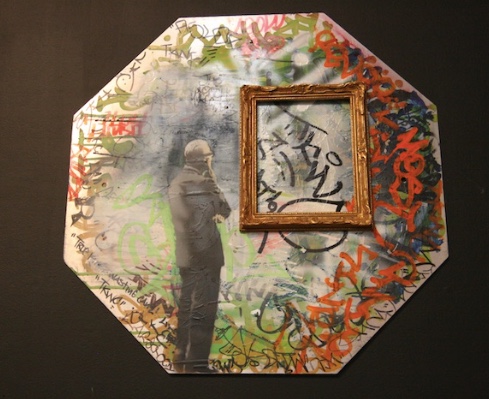
Man with Empty Frame, 2011
Art in the Streets, Museum of Contemporary Art Los Angeles, 17 April – 8 August 2011
Catalogue Note
The empty frame immediately alters the viewer’s perception. Although it encloses nothing tangible, it compels us to look at the graffiti behind it differently. Random tags and layers of spray paint, normally dismissed as urban clutter, suddenly acquire the status of an exhibition. Banksy demonstrates that framing is never merely physical; it is an intellectual act that changes the way we assign meaning and value.
The anonymous spectator becomes an essential part of the composition. Rather than presenting a finished artwork, Banksy depicts the very act of looking. The viewer within the work mirrors the viewer standing before it, creating a subtle mise en abyme in which observation itself becomes the true subject. Art exists not only because an artist creates it, but because someone agrees to contemplate it.
The work also continues Banksy’s long-standing dialogue between the street and the museum. Graffiti, traditionally regarded as vandalism, is literally elevated through the conventions of display. By placing an ornate classical frame onto an urban wall, Banksy questions the arbitrary distinction between sanctioned culture and unsanctioned creativity. The frame does not alter the graffiti; it alters our willingness to appreciate it.
Created for Art in the Streets, the first major museum exhibition devoted to graffiti and street art in the United States, the work carries an additional layer of irony. Once an outsider to the institutional art world, Banksy now stages the very process through which museums transform acts of rebellion into objects worthy of contemplation. The work therefore occupies the uneasy territory between critique and participation that increasingly defines Banksy’s mature practice.
Man with Empty Frame belongs to a broader body of self-reflexive works including Boring, Big Gold Frame, The Key to Making Great Art Is All in the Composition and Exit Through the Gift Shop. Together, these works reveal Banksy’s growing fascination with the invisible forces—context, presentation, authorship and institutional approval—that determine artistic value as much as artistic quality.