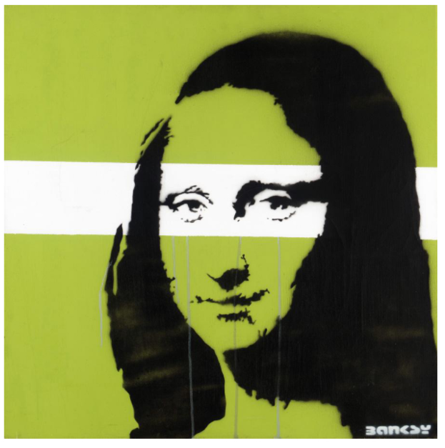

Mona Lisa, 2003
The artist ultimately only made a maximum of three works in this format.
Laz. Inc., London
Auction History
| Sotheby’s London 18 October 2006 Est.: GBP 15,000 – 20,000 | Price Realized |
Catalogue Note
Few artists have challenged the history of art as persistently as Banksy, and few subjects have been revisited as often as Leonardo da Vinci’s Mona Lisa. In this rare early canvas, however, the artist approaches the world’s most celebrated portrait with remarkable restraint. Rather than replacing the sitter with a smiley face or equipping her with a weapon, Banksy performs a single, almost surgical intervention: a broad white band passes horizontally across her eyes, partially erasing the very feature that has fascinated viewers for more than five centuries.

The gesture is deceptively simple. The mysterious gaze that has made the Mona Lisa an enduring icon of Western art is literally censored, denying the viewer the psychological connection that has defined the painting since the Renaissance. Identity remains intact, yet vision is removed. The portrait survives, but its power to look back has been deliberately interrupted.
Banksy’s intervention extends beyond Leonardo’s masterpiece to question the mechanisms through which images acquire authority. Museums, textbooks and popular culture have transformed the Mona Lisa into perhaps the most reproduced work of art in history. By obscuring only her eyes, Banksy reminds us that even the most familiar images are mediated, edited and reinterpreted by every generation. We rarely encounter masterpieces directly; we inherit carefully constructed narratives about them.
The vivid acid-green background reinforces this act of reinvention. Far removed from Leonardo’s subtle sfumato, the saturated field projects the image into the visual language of advertising, street culture and contemporary graphic design. Banksy does not seek to imitate the Old Masters but to rescue them from untouchable reverence, placing one of art history’s greatest icons back into contemporary visual culture.
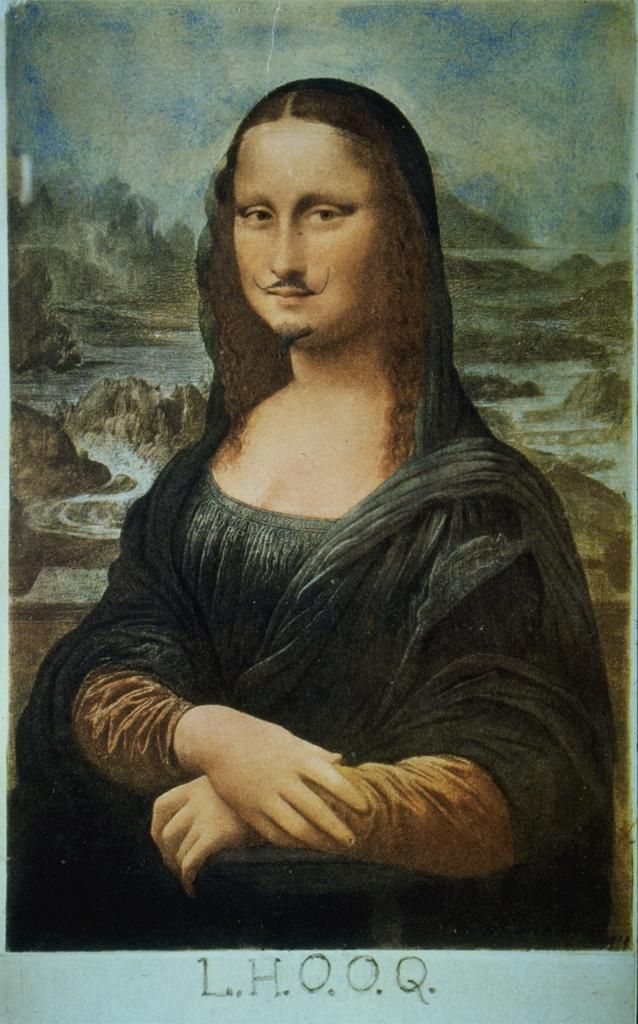
The work also enters into a distinguished lineage of artistic appropriation. Marcel Duchamp famously defaced a postcard reproduction of the Mona Lisa with a moustache, challenging notions of originality and artistic sanctity, while Andy Warhol transformed her into a reproducible commodity through serial repetition. Banksy belongs naturally within this tradition, yet his strategy differs from both. Rather than mocking or multiplying the image, he withholds it. The painting becomes not an object of parody but of interruption.
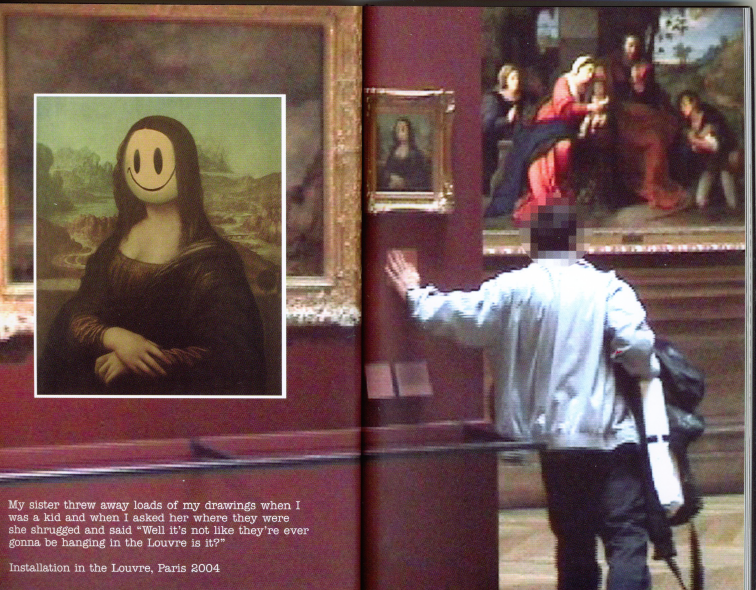
Executed in 2003, this canvas predates Banksy’s celebrated 2004 intervention at the Louvre, where he secretly installed his own altered Mona Lisa featuring a yellow smiley face. Seen in retrospect, this work represents an important stage in that evolving dialogue with one of the most famous paintings ever created. Here, the critique is quieter, more conceptual and perhaps more unsettling.
Ultimately, Mona Lisa is not an attack on Leonardo da Vinci but on the unquestioning reverence surrounding cultural icons. Banksy asks a deceptively simple question: what happens when we can no longer meet the gaze of history? His answer is elegant and profoundly contemporary. Sometimes removing the smallest detail is enough to make us see an image anew.