ONE NATION UNDER CCTV
One Nation Under Surveillance
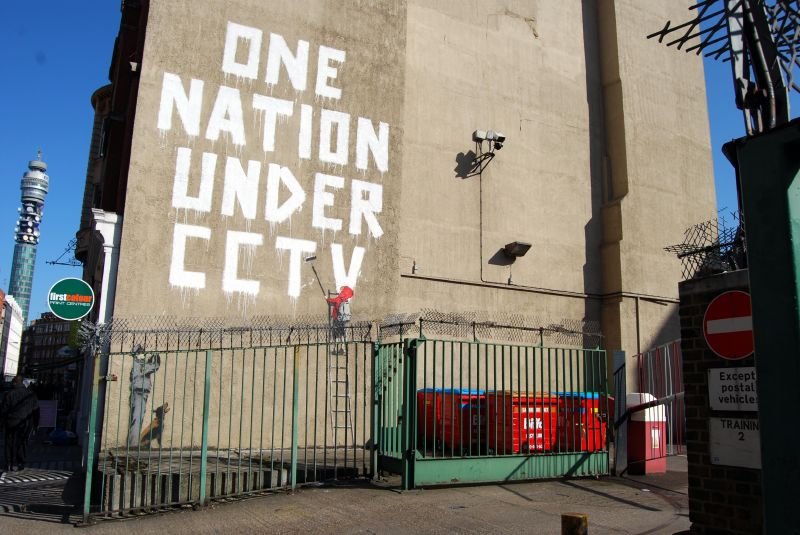
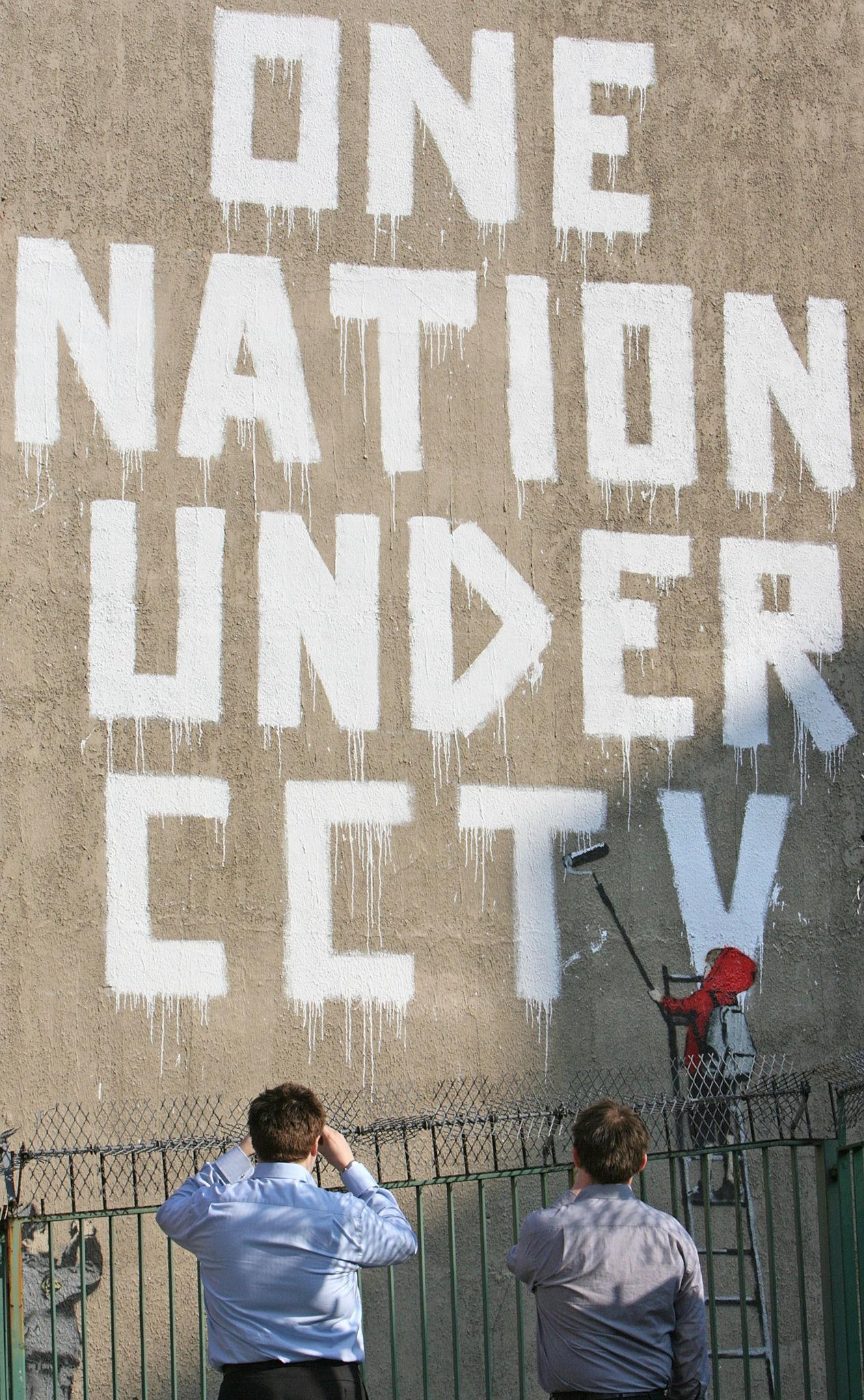
In April 2008, one of Banksy's largest and most audacious London murals appeared high on a blank wall overlooking a Royal Mail yard on Newman Street, a few steps north of Oxford Street. In enormous white letters, arranged vertically across the building, Banksy declared: ONE NATION UNDER CCTV
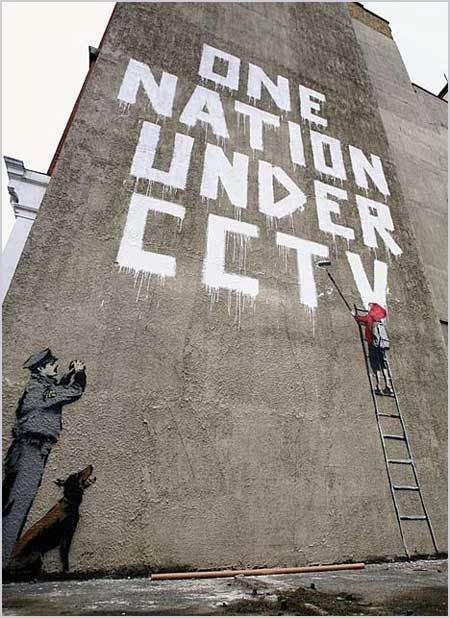
At the bottom of the composition, a child in a bright red hooded sweatshirt balances precariously near the top of a ladder, apparently finishing the final letters with a paint roller. Several metres below, a uniformed security officer photographs him while a dog looks upward. Above them all, mounted on the building itself, was something Banksy did not have to paint: a real CCTV camera.
That camera transforms the work. One Nation Under CCTV is not simply an image about surveillance; it was constructed inside an actual system of surveillance. The architecture, security fence, camera and Royal Mail yard become part of the composition, collapsing the distinction between the artwork and the environment it criticizes.
How Did Banksy Paint It?
The circumstances surrounding the mural are remarkable. Contemporary accounts reported that Banksy or his team managed to erect three storeys of scaffolding behind a security fence. The scaffolding was screened with polythene, allowing the enormous work to be produced largely out of view before the structure was dismantled. All of this apparently happened within sight of the CCTV system the mural was mocking.
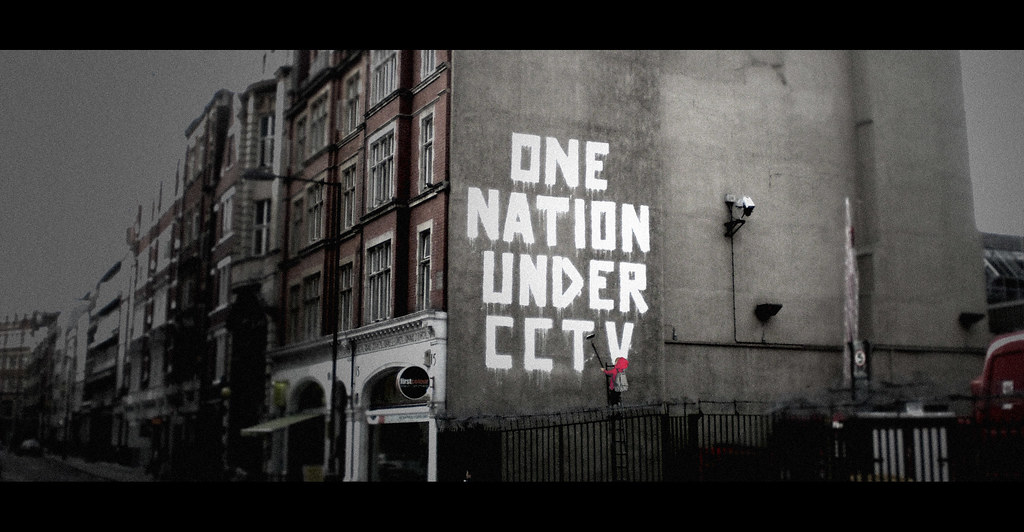
A contemporary observer passing the site on Sunday remembered seeing the scaffolding still standing and shrouded; when it came down, the mural was revealed. Another local account from 14 April describes crowds already gathering to look at the newly appeared work.
Whether the camera was operating, whether anyone was actually monitoring it, or precisely what permissions had been obtained for the scaffolding is less certain. But that uncertainty arguably improves the joke. Banksy had apparently produced an enormous unauthorized-looking criticism of surveillance while standing directly beneath the machinery supposedly designed to prevent exactly that kind of activity.
The Composition
Visually, the mural is exceptionally economical. Most of the enormous wall remains untouched. Against its dirty brown-grey surface, the white lettering resembles an official proclamation, monumental enough to be read from far down the street. Paint drips deliberately from the letters, preventing the typography from becoming too polished and reminding us that this apparently authoritative declaration is still graffiti.
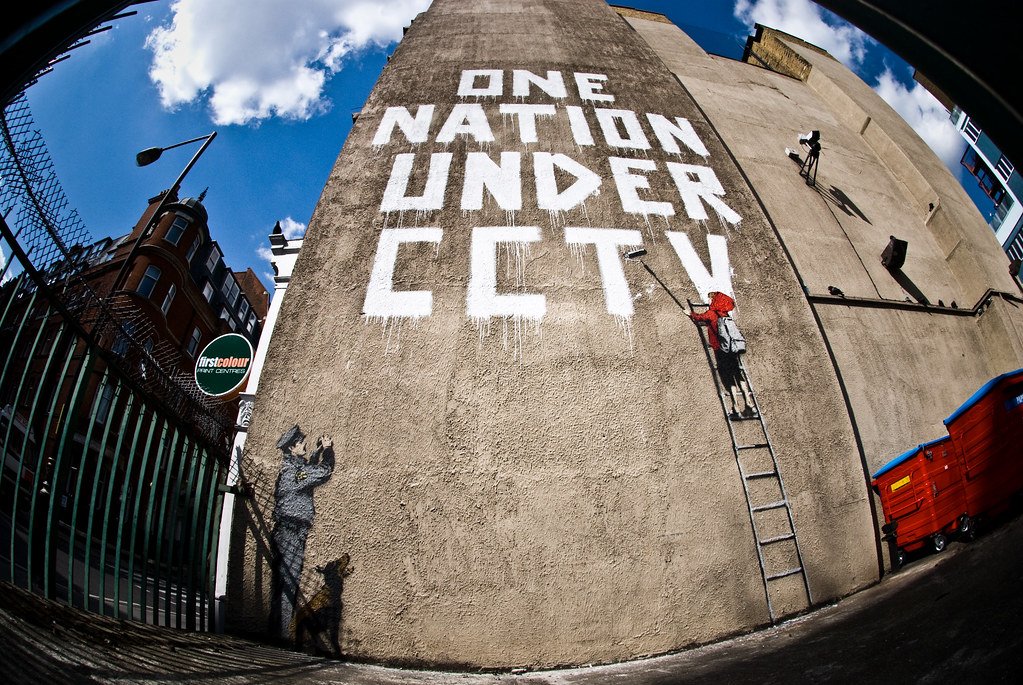
The small figures underneath establish the extraordinary scale. The child seems almost absurdly vulnerable at the top of the ladder, while the security officer does not intervene: he records. This is an important distinction. Banksy's authority figure has exchanged physical action for observation. The camera in his hands mirrors the CCTV camera above, producing surveillance within surveillance.
Then there is the red hoodie. Almost everything else is subdued—white letters, grey uniform, brown dog, weathered wall—so the small flash of red immediately draws the eye toward the supposed offender. In a composition about being watched, Banksy makes sure that we, too, watch the child.
One Nation Under CCTV
The title turns surveillance into a national condition. The wording plays on the familiar phrase “one nation under God”, but replaces divine omniscience with technological observation. The substitution is both funny and deeply uncomfortable: the all-seeing eye is no longer metaphysical. It has become a camera bolted to a wall.
The work appeared at a particularly relevant moment. Britain had developed one of the world's most extensive networks of public CCTV cameras, accompanied by continuing debate over the balance between security and privacy. Banksy does not attempt to settle that debate. Instead, he reduces it to a visual absurdity: a child paints a warning about surveillance while a guard photographs him and a camera watches them both.
There is also a characteristic Banksy ambiguity concerning graffiti itself. Surveillance is theoretically there to deter antisocial or illegal activity, yet the act it fails to prevent produces something that thousands of people immediately regard as art. The question therefore becomes not only who is watching us, but who gets to determine which activities taking place under that watchful eye are legitimate.
Westminster Council Enters the Picture
The story acquired another layer in October 2008 when Westminster City Council ordered the mural removed.
The council's position was uncompromising. Planning committee chairman Robert Davis argued that Banksy's fame should make no difference: unauthorized graffiti remained graffiti, regardless of who produced it. The council simultaneously acknowledged that the work might have value somewhere else—such as an art gallery—but maintained that this did not justify its presence on the Newman Street wall.
Banksy's response was predictably mischievous. His spokesperson challenged the council's initial characterization of the mural as an unauthorized commercial advertisement. Banksy argued that advertising makes people feel inadequate in order to encourage consumption, whereas graffiti generally does not make people rush out to buy anything—“except maybe high strength cleaning products.”
The exchange inadvertently sharpened the conceptual problem at the heart of Banksy's street practice. Had the same image been removed from the wall, authenticated, framed and placed inside a gallery, it might have been protected and traded as a valuable artwork. Remaining where Banksy intended it, however, it was officially treated as something requiring removal.
The mural was ultimately painted over in 2009.
One Nation Under CCTV is one of Banksy's most successful examples of site-specific street art because removing the work from Newman Street also removes part of its meaning. The CCTV camera, Royal Mail yard, security fence, enormous inaccessible wall and apparent impossibility of producing the mural unnoticed were not incidental surroundings. They were materials Banksy incorporated into the idea.
There is also something wonderfully circular about its history. A surveillance system apparently failed to prevent Banksy from erecting scaffolding and painting a seven-metre-high criticism of surveillance. The authorities then spent months publicly debating what should happen to it before eventually erasing it.
Banksy did not merely paint a mural about being watched. He made the act of watching part of the mural.
STAY INFORMED
Receive the latest news, exhibitions, artworks and market updates on Banksy.