BANKSY
Paintpot Angel, 2009
Exhibited
Banksy vs. Bristol Museum, Bristol Museum, Bristol, 2009
Catalogue Note
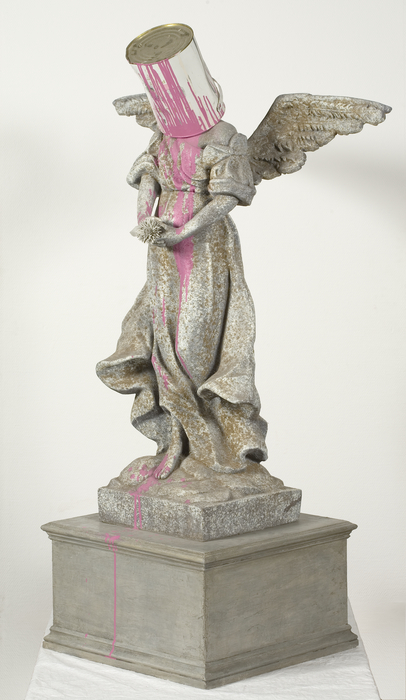
With Paintpot Angel, Banksy transforms a classical garden sculpture into a witty reflection on artistic creation. A weathered stone angel, symbolic of purity, beauty and permanence, stands with a paint pot placed upside down over its head. Bright pink paint spills down the figure, flowing across its body and pedestal in vivid contrast to the muted grey stone. The intervention is both playful and surprisingly elegant, allowing the sculpture to exist simultaneously as a historic object and a contemporary artwork.
The image initially recalls an act of vandalism. A classical sculpture appears to have been defaced by careless paint. Yet the longer one looks, the more that interpretation begins to dissolve. The paint does not conceal the angel’s beauty; it transforms it. Rather than destroying the sculpture, Banksy gives it a new identity, suggesting that creation and destruction are often separated only by perspective.

This ambiguity lies at the heart of the work. Throughout his career, Banksy has repeatedly challenged the assumption that graffiti is simply an act of damage. Here, he reverses that argument completely. The paint—the very material most commonly associated with vandalism—becomes the instrument through which a forgotten decorative object is reimagined as contemporary art.
The choice of a classical angel is equally significant. Angels traditionally symbolize transcendence, purity and spiritual perfection, ideals frequently associated with the cultural authority of museums and monuments. By placing an ordinary household paint pot over its head, Banksy gently punctures this reverence without mocking it. The gesture is humorous, yet affectionate, reminding us that even the most revered artistic traditions were once the result of experimentation, risk and creative intervention.
Created for Banksy vs. Bristol Museum in 2009, Paintpot Angel belongs to a broader body of works in which Banksy reconsiders historical art through subtle acts of transformation. Like The Gleaners, Arrow Head, Dorothy and Girl and Balloon on cardboard, the sculpture questions where an artwork truly begins and ends. Is art defined by the original object, or by the idea that reshapes it? Rather than presenting graffiti as the enemy of tradition, Paintpot Angel suggests a far more generous relationship between the two. Banksy reminds us that every artistic generation leaves its mark upon the past, and that what initially appears to be an act of defacement may ultimately become another chapter in the history of art.