PIE FACE, 2006
Provenance
- Lazarides Gallery, London
- Acquired directly from the above by the present owner
Auction History
Prices are inclusive of buyer’s premium unless stated otherwise, as reported by the auction houses.
Catalogue Note
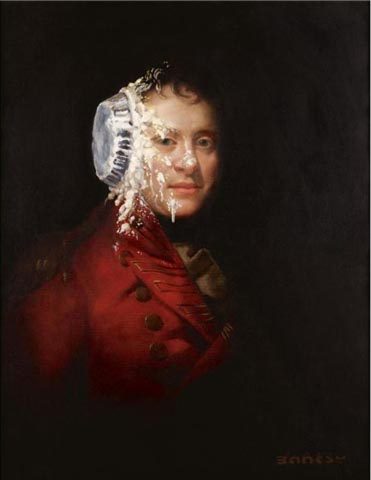
Pie Face is Banksy’s gleeful slap in the face, literally, to the stiff formality of art history. Here, a noble 19th-century gentleman, resplendent in his red military coat, is immortalized in oil… mid-pie attack. The whipped cream and tin are painted with startling realism, interrupting the sitter’s composed dignity with a slapstick insult worthy of a circus skit. Part of Banksy’s “Crude Oil” series, the painting is both a visual prank and a philosophical jab. The pie becomes a symbol of rebellion, mockery, and the great equalizer of pride. The target? Aristocracy, military power, colonial heritage: take your pick. With this single gesture, Banksy reminds us that even the grandest portraits can be humbled by a well-aimed custard missile. By defacing the past with humor, Pie Face invites us to question what we preserve, what we revere, and what happens when sacred cows get a pie in the kisser.
Crude Oils” are modified oil paintings in which Banksy applies his street graffiti to fine art paintings by other artists. The ‘Crude Oils’ tackle with similar subversive intent and visual humor the themes of political and social commentary found in Banksy’s street art, and like his carefully placed, stenciled graffiti, the idea of context is all important.
“If you want to survive as a graffiti writer when you go indoors. I figured your only option is to carry on painting over things that don’t belong to you there either.”
Over the last few years, a disguised Banksy has succeeded in placing his corrupted oil paintings onto the walls of the world’s most respected museums and art galleries including The Louvre, The Tate, The British Museum and New York’s Museum of Modern Art. These light-hearted gestures of ‘art terrorism’, many of which hung for several days before being noticed and removed, poke fun at the closed and elitist nature of the art world as it is perceived by many. In this, as well as in their use of another artist’s work as a readymade, Banksy’s crude oils draw clear parallels with works like Marcel Duchamp’s L.H.O.O.Q., Robert Rauschenberg’s Erased De Kooning Drawing, and more recently Jake and Dinos Chapman’s Disasters of War in which they reworked an entire series of Goya’s original prints.
STAY INFORMED
Receive the latest news, exhibitions, artworks and market updates on Banksy.