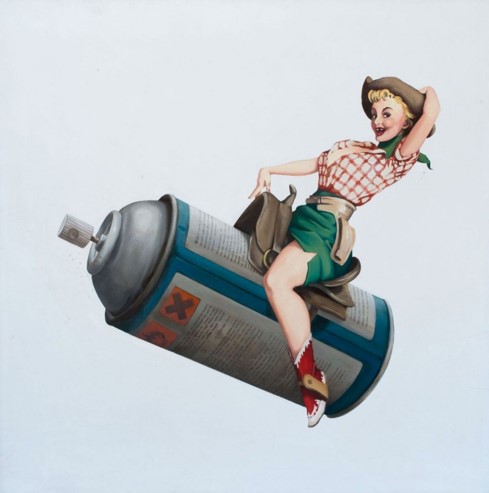
Rodeo Girl, 2009
Acquired directly from the artist by the current owner
Exhibited
Banksy vs. Bristol Museum, Bristol Museum, Bristol, 2009
Auction History
| Artcurial Paris 28 February 2017 Est.: EUR 200,000 – 300,000 |
Price Realized EUR 379,500 / USD 415,795 Urban Anthology from a Private Collector |
Catalogue Note
With Rodeo Girl, Banksy brings together two visual languages that rarely meet. A cheerful 1950s pin-up cowgirl, borrowed from the optimistic imagery of post-war American advertising, rides a giant spray paint can as though it were a bucking rodeo bull. Executed with remarkable technical precision, the work combines the polished glamour of commercial illustration with the raw symbolism of graffiti, creating an image that is both playful and quietly subversive.
The spray can has long occupied a central place within Banksy’s practice. It is the essential tool of the street artist, a symbol of rebellion, anonymity and creative freedom. Here, however, it behaves less like an artistic instrument than a wild animal. The rider is not using the spray can; she is struggling to master it. In doing so, Banksy transforms graffiti itself into an unpredictable force that refuses to be entirely controlled, even by the artist.
The choice of a 1950s pin-up reinforces this tension. These idealized figures were originally created to sell products and promote an optimistic vision of post-war consumer culture. Banksy removes the cowgirl from that commercial world and places her atop the very object most closely associated with unauthorized artistic expression. Advertising and graffiti, often presented as opposites, become unexpectedly intertwined. One sells conformity; the other celebrates disruption.
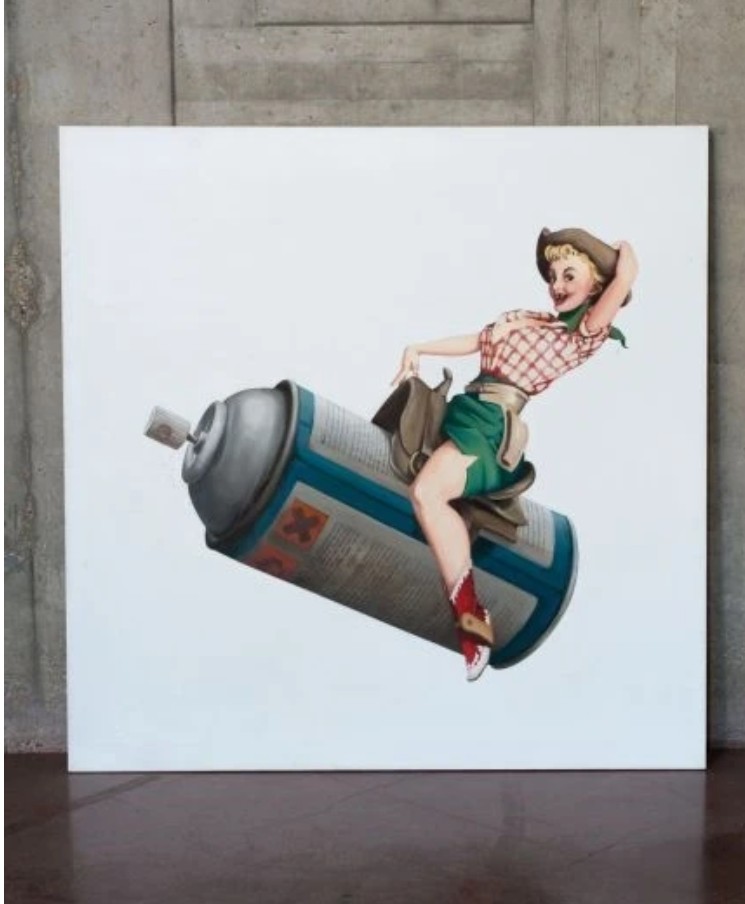
The composition also reveals Banksy’s affection for American popular culture. Rather than mocking the visual language of vintage advertising, he appropriates it with wit and admiration, allowing nostalgia and irreverence to coexist. The image possesses the energy of a comic book or pulp magazine cover while quietly questioning who ultimately controls the symbols of modern culture.
Created for Banksy vs. Bristol Museum in 2009, Rodeo Girl belongs to a series of works in which Banksy explores the meeting point between street art, popular imagery and art history. Like Paintpot Angel and Dorothy, it reflects his growing interest in moving beyond the wall while preserving the visual immediacy that made his street works instantly recognizable.
Ultimately, Rodeo Girl suggests that creativity is never a passive process. Like riding a bucking bronco, making art requires balance, instinct and a willingness to embrace uncertainty. Banksy reminds us that the spray can is not merely a tool—it is an unpredictable force capable of taking the artist in directions he never entirely intended.