BANKSY AND SIMON MUNNERY: THE COMMANDMENTS, 2005

The Commandments
Created in 2005, Banksy’s collaboration with the English comedian and writer Simon Munnery occupies a distinctive position within the artist’s oeuvre. The group consists of unique text-based works painted in spray paint and emulsion on pieces of reclaimed wood, plywood and other roughly finished supports. Each carries a short aphorism written by Munnery and visually interpreted by Banksy through stenciled lettering, ornamental initials and compositions recalling traditional book design. Even though Banksy has never titled this group of works as a series, we would use The Commandments as the principal title because it captures the mock-authoritative tone of the works: each panel resembles a moral instruction, proverb or fragment of inherited wisdom, yet every statement collapses into irony. Each is unique, and several were exhibited at Santa’s Ghetto in London in December 2005. Rather than forming a conventional edition, they constitute a family of individual works united by language, materials, humour and presentation.
The series represents a rare meeting between two closely compatible artistic sensibilities. Munnery’s writing depends upon linguistic compression, misdirection and the sudden reversal of expectation. Banksy’s visual practice similarly relies upon economy: an image or statement appears immediately legible before revealing an internal contradiction. In these works, the mechanics of the joke and the mechanics of the stencil become almost indistinguishable.
The panels present themselves as repositories of wisdom. Their decorated initials and old-fashioned typography evoke fables, sermons, commandments, Victorian moral instruction and the opening pages of antique books. Yet the lessons they contain are profoundly unreliable. They address sex, punishment, alcohol, advertising, ambition and disappointment, but offer no path toward moral improvement. Instead, they expose the absurdity of human behavior and the inadequacy of the formulas through which people attempt to explain it.
They are commandments for a world that no longer believes in commandments.
The Origins of the Collaboration
Munnery described an encounter with a graffiti artist who approached him after a performance and admitted to spraying fragments of his material on walls. According to Munnery’s account, a similar encounter occurred approximately a year later, when the man identified himself as Banksy. Munnery subsequently contributed writing and ideas to Banksy-related projects, although he characteristically resisted providing a definitive or neatly packaged history of their relationship.
The collaboration is especially natural because both artists work through the controlled disruption of expectation. A comedian constructs a sentence so that its final words force the audience to reinterpret its beginning. Banksy frequently constructs images in precisely the same way: what initially appears sentimental becomes political, what seems violent becomes tender, and what looks familiar suddenly turns absurd.
In the Munnery panels, language performs the visual reversal normally supplied by Banksy’s imagery. The viewer does not merely read the joke; the viewer is caught inside it. The opening phrase establishes a familiar moral, proverbial or conversational structure, while the conclusion overturns the apparent meaning.
Banksy’s contribution is nevertheless far more than decorative. By transferring Munnery’s lines from the stage onto salvaged wood, he changes their cultural status. A sentence that might have existed for a few seconds during a comedy performance becomes a unique, physical object. The joke acquires a surface, a scale, an exhibition history and an afterlife.
Santa's Ghetto, 2005
Several works from the series were shown at the 2005 edition of Santa’s Ghetto, Banksy’s alternative seasonal exhibition and retail project in London. Santa’s Ghetto brought together original works, prints and objects by Banksy and artists associated with the Pictures on Walls circle, presenting art within an environment that simultaneously resembled and mocked a commercial Christmas shop.
The series was particularly suited to this context. Santa’s Ghetto borrowed the appearance of retail while questioning consumption; the Munnery panels borrowed the appearance of moral instruction while questioning wisdom. Both employed recognizable cultural forms only to undermine them from within.
The year 2005 was also one of extraordinary experimentation for Banksy. His work moved fluidly between street interventions, altered paintings, museum infiltrations, politically charged murals and unique studio objects. The Munnery collaboration belongs to this wider investigation of authority: the authority of museums, historical painting, political borders and, in the present series, language itself.
Rather than altering an existing masterpiece, Banksy here interferes with the structure of the proverb. The cultural object being vandalized is not a painting but a sentence.
The Appearance of Authority
The visual language of the panels is central to their meaning. Their compositions frequently feature large ornamental initials, traditional serif lettering and decorative flourishes suggestive of illuminated manuscripts, early printed books or collections of moral tales.
Historically, such visual devices conferred importance upon written language. Ornament suggested that a text deserved attention, labor and preservation. Banksy borrows these conventions but reproduces them with spray paint and stencils—the materials of speed, repetition and unauthorized urban communication.
The result is a collision between two seemingly incompatible traditions. The elegance of the antique page encounters the roughness of the street. Formal typography is placed upon plywood, crate timber or damaged boards. Decorative letters resembling the work of a patient scribe are produced through a process associated with rapid execution.
This visual contradiction exposes the way authority is constructed. A banal sentence may appear profound when rendered in formal typography. A joke can begin to resemble a proverb when isolated on a panel. The appearance of wisdom may depend as much upon presentation as upon meaning.
Banksy simultaneously exploits and ridicules this mechanism. He gives the statements the dignity of historical inscription while ensuring that their content remains stubbornly undignified.
Repurposed Wood and the Material Language of the Street
The wooden supports are not neutral surfaces. They bear stains, scratches, nail holes, uneven paint, visible grain and evidence of earlier use. Some resemble parts of packing cases; others suggest temporary hoarding, discarded signs or fragments removed from construction sites.
This material roughness prevents the works from becoming polished exercises in graphic design. Their surfaces preserve a connection with the urban environment and with the improvised nature of street art. Rather than placing stencil painting upon pristine canvas, Banksy allows the pre-existing history of each board to remain visible.
The materials also intensify the central contradiction of the series. The statements mimic eternal truths, yet they are recorded on objects associated with temporary use and eventual disposal. They resemble commandments, but their tablets are pieces of plywood.
This tension between permanence and impermanence would become increasingly significant within Banksy’s career. An inexpensive piece of reclaimed timber, once painted and authenticated, is transformed into a unique and valuable work of art. Yet it continues to resemble something that might have been discarded. The object therefore retains two identities simultaneously: cultural artefact and construction debris.
Auction Results
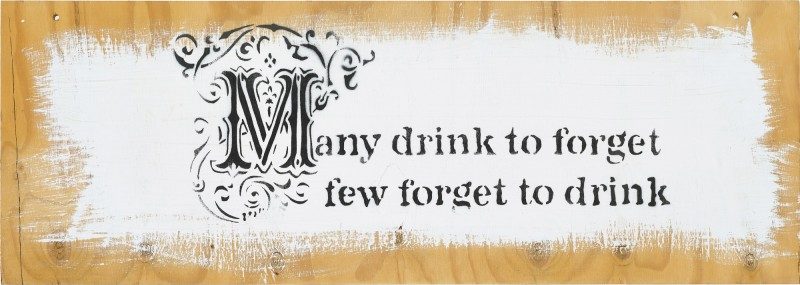
Description
- BANKSY (b. 1975)
- Many drink to forget…, 2005
- Spray paint on wood
- 43.5 x 121.8 cm (17-1/8 x 48 inches)
Provenance
- Santa’s Ghetto, London
- Private Collection
- Christie’s, London, 30 June 2016, Lot 122
- Acquired from the above sale by the present owner
Auction History
Prices are inclusive of buyer’s premium unless stated otherwise, as reported by the auction houses.
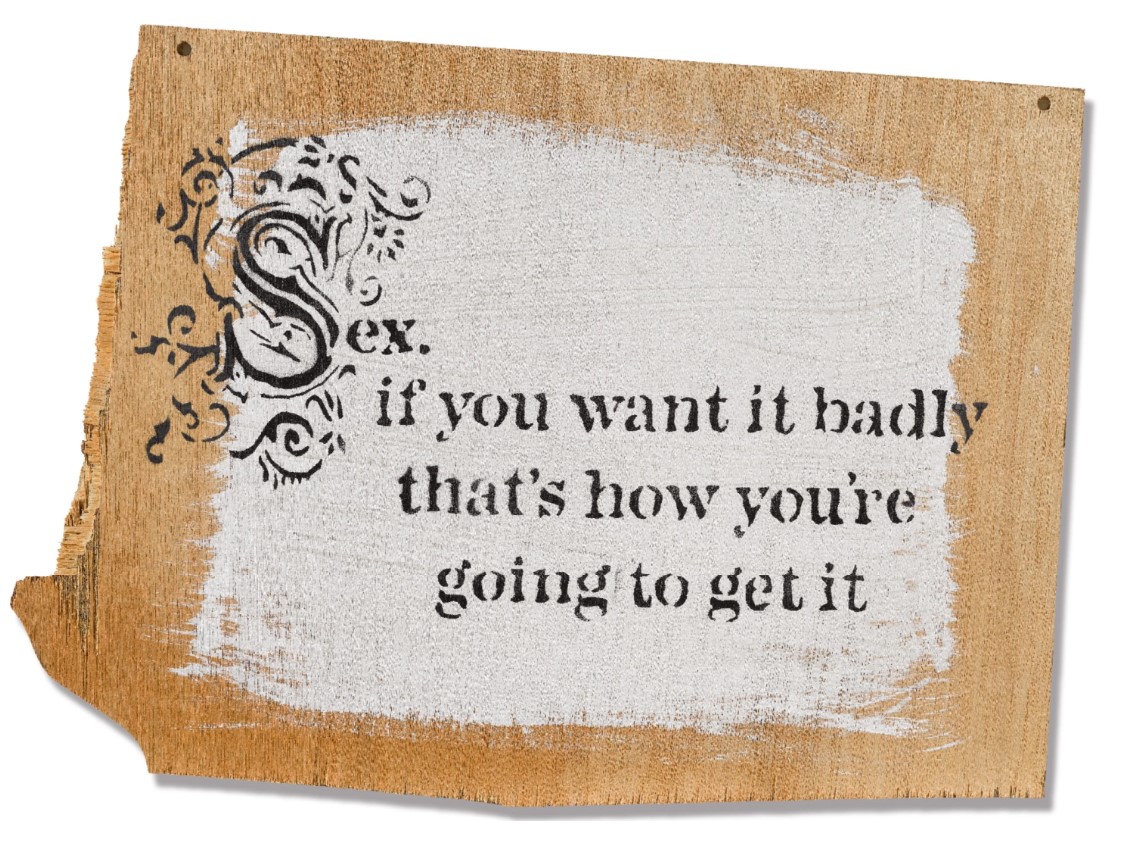
Description
- BANKSY
- Sex If You Want it Badly, 2005
- Stencil spray-paint and emulsion on ply-board
- 49.7 x 68.7 cm (19 5/8 x 27 inches)
Provenance
- Santa’s Ghetto, London
- Phillips London, 3 July 2014, Lot 177
- Acquired from the above sale by the present owner
Auction History
Prices are inclusive of buyer’s premium unless stated otherwise, as reported by the auction houses.
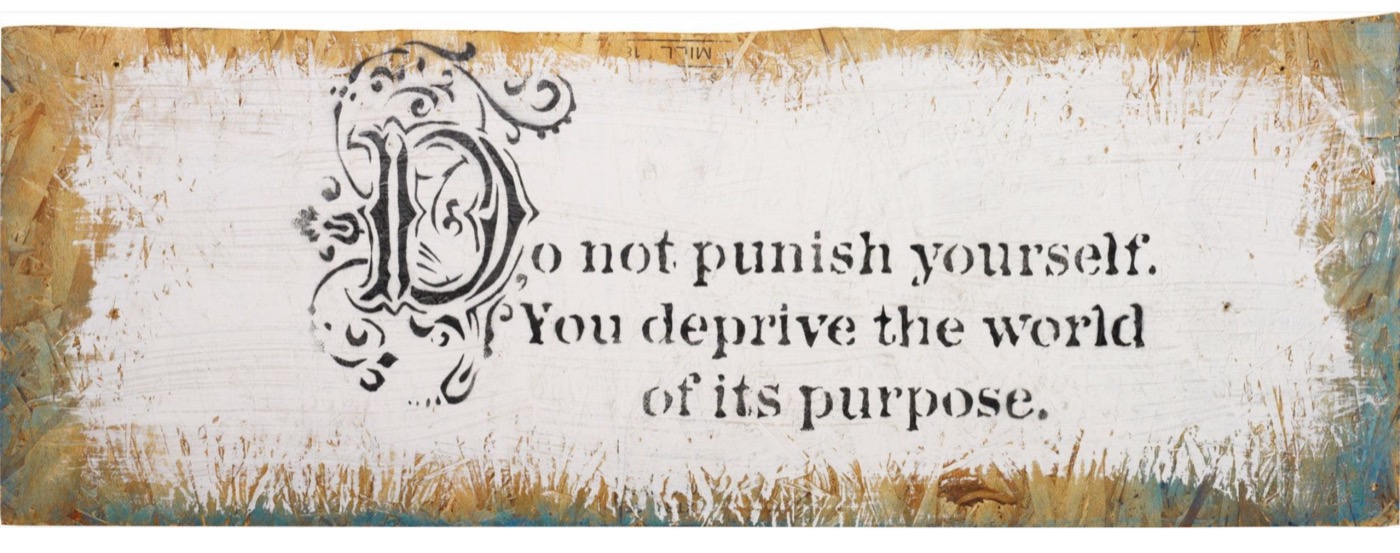
Description
- BANKSY
- Do Not Punish Yourself, 2005
- Stencil spray-paint and emulsion on ply-board
- 43.5 x 122 cm (17 1/8 x 48 inches)
Provenance
- Santa’s Ghetto, London, December 2005
- Private Collection
Auction Results
Prices are inclusive of buyer’s premium unless stated otherwise, as reported by the auction houses.
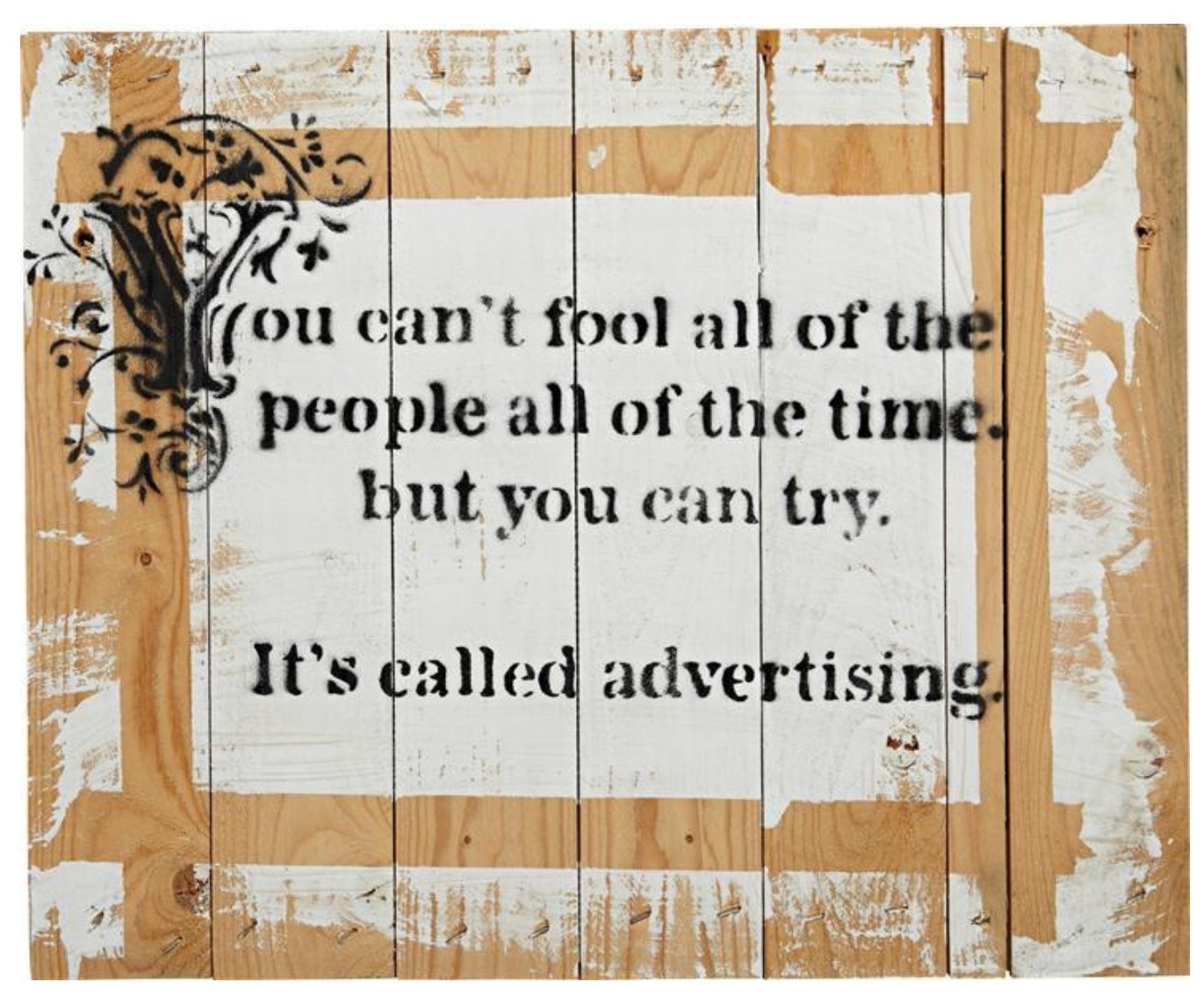
Description
- BANKSY
- You Can’t Fool All The People, 2005
- Spray-paint and emulsion on wood
- 44.2 x 58.2 cm (17 3/8 x 22 7/8 inches)
Auction History
Prices are inclusive of buyer’s premium unless stated otherwise, as reported by the auction houses.
STAY INFORMED
Receive the latest news, exhibitions, artworks and market updates on Banksy.