 BANKSY
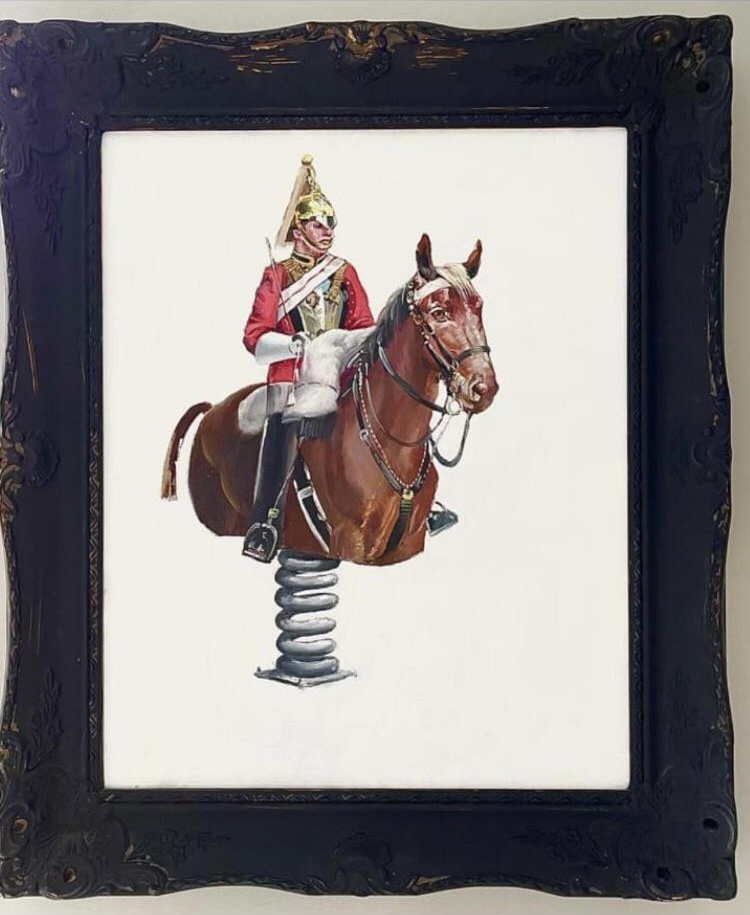
Sprung Horse, 2006
Oil and emulsion on canvas
61 x 54 x 4.5 cm
Unsigned
Exhibited
Barely Legal, Los Angeles, 2006
Catalogue Note
With Sprung Horse, Banksy once again dismantles one of Britain’s most enduring symbols of authority through the disarming language of childhood. A ceremonial Household Cavalry guard, rendered with remarkable painterly realism, appears proudly mounted upon his horse. Yet the noble steed has been replaced by nothing more than a playground spring rider—the familiar coin-operated toy found in countless public parks. The transformation is absurd, humorous and quietly devastating.
Throughout his career, Banksy has repeatedly targeted the visual symbols of institutional power. Policemen, soldiers, monarchs and royal guards appear throughout his oeuvre, not as individuals but as embodiments of authority itself. Here, however, the critique is unusually gentle. Rather than mocking the soldier directly, Banksy reduces the grandeur surrounding him. The magnificent cavalry horse, long associated with military prestige, ceremonial discipline and imperial tradition, becomes a child’s toy balanced precariously on a metal spring. Heroism gives way to play.
The substitution is more profound than it first appears. Childhood occupies a privileged position within Banksy’s art. Children are often the only figures capable of exposing the absurdity of adult conventions because they have not yet learned to accept them unquestioningly. By replacing the military horse with a playground ride, Banksy invites viewers to see state ceremony through the eyes of a child, for whom elaborate uniforms, rigid rituals and displays of power can appear strangely theatrical. Authority, he suggests, often depends upon our willingness to suspend disbelief.
The work also forms a fascinating dialogue with Panto Horse Guard, created the previous year. There, the mounted soldier rode upon a pantomime horse operated by two performers concealed beneath a costume, transforming military dignity into comic theatre. Sprung Horse pushes the same idea even further. The illusion no longer depends upon human actors but upon a piece of playground equipment. Ceremony has been reduced to amusement. The progression illustrates Banksy’s increasingly refined ability to dismantle symbols of power through the smallest possible visual intervention.
Executed for Barely Legal in Los Angeles in 2006, the painting belongs to an exhibition that marked Banksy’s emergence as an international artistic force. Yet even as celebrities, collectors and museums began embracing his work, the artist remained fascinated by the institutions that shape public identity. Royal iconography, military ritual and national mythology became recurring subjects, explored not through confrontation but through wit. Like the finest British satire, Sprung Horse invites laughter before quietly encouraging reflection.
The pristine white background reinforces this strategy. Stripped of architectural setting or ceremonial context, the mounted guard becomes an isolated emblem rather than a narrative scene. Removed from Horse Guards Parade or Buckingham Palace, he appears suspended in a conceptual space where symbols themselves become the subject. Banksy is less interested in a particular soldier than in the enduring performance of authority.
Ultimately, Sprung Horse reminds us that institutions derive much of their power from carefully constructed spectacle. Uniforms, horses, processions and rituals all contribute to an illusion of permanence and inevitability. By replacing one essential element with a children’s playground toy, Banksy demonstrates how surprisingly fragile that illusion can be. A single visual joke is enough to reveal that even the grandest symbols of authority may, at heart, rest upon little more than a spring.