
BANKSY
Stop and Search, 2007
Catalogue Note
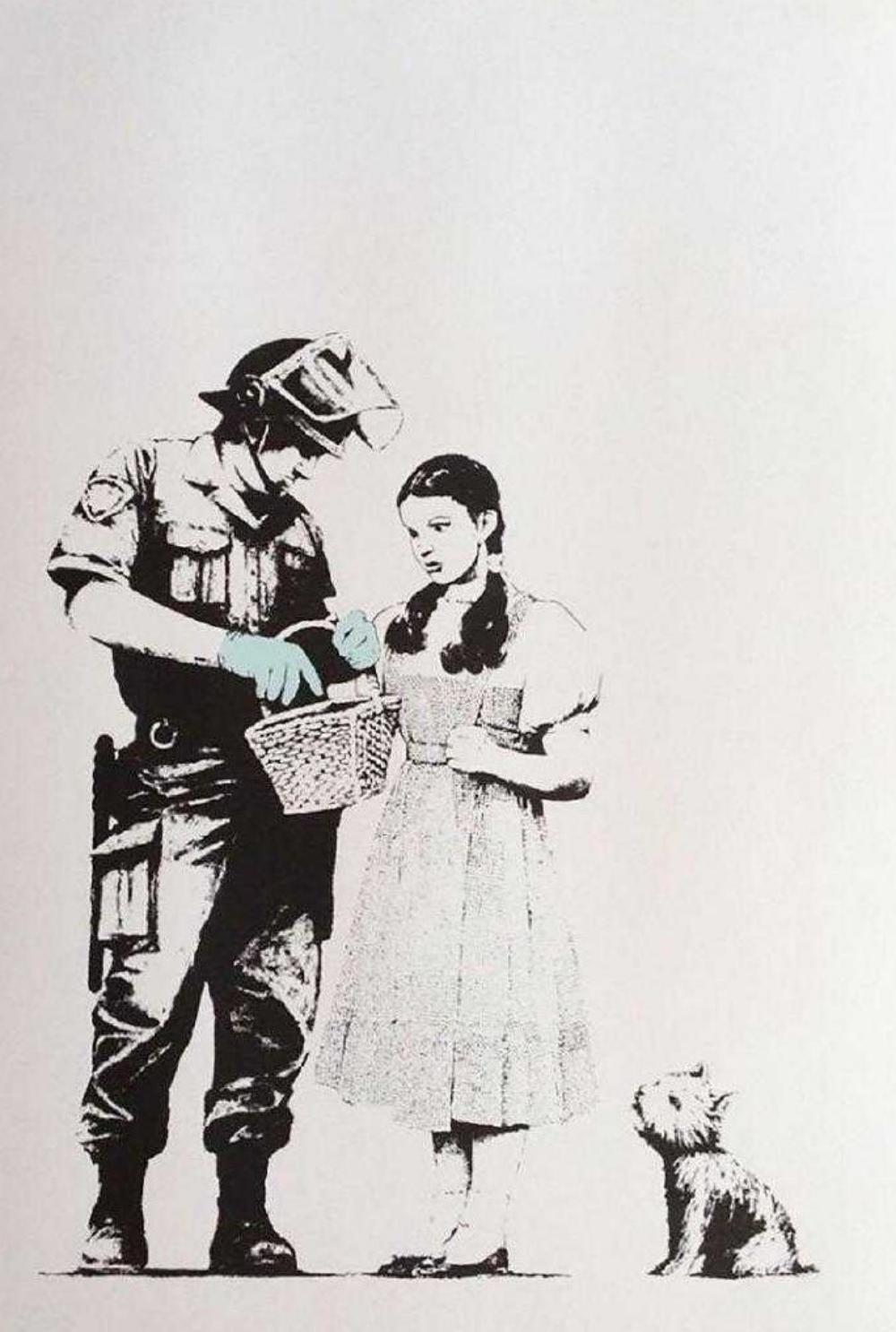
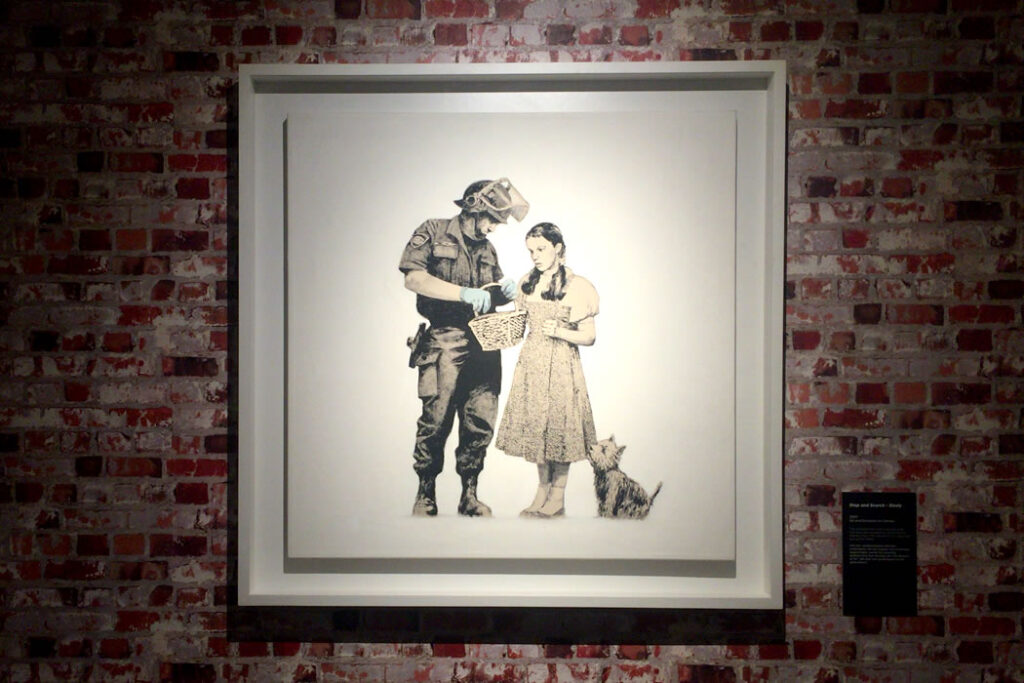
At first glance, Stop and Search appears almost gentle. Dorothy, the innocent heroine from The Wizard of Oz, stands patiently beside Toto while a police officer methodically searches her wicker basket. The only color in the composition comes from the officer’s pale blue latex gloves—a small but striking detail that immediately draws the viewer’s eye. Yet beneath this quiet encounter lies one of Banksy’s most sophisticated critiques of authority.

Dorothy has long embodied innocence, hope and the desire to find one’s way home. She is perhaps one of the least threatening characters in popular culture. By choosing her as the subject of a police search, Banksy deliberately constructs an absurd situation. If even Dorothy can become suspicious, then suspicion itself has become universal. The work suggests a society in which no one is exempt from surveillance or official scrutiny, regardless of age, appearance or innocence.
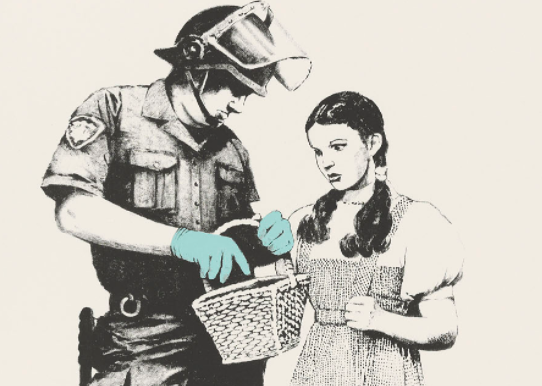
The blue latex gloves are a particularly inspired detail. More than simple protective equipment, they symbolize the bureaucratic and sanitized face of modern authority. The officer is not depicted as overtly violent or aggressive. Instead, he appears professional, procedural and detached. Banksy understands that contemporary power often presents itself not through brutality, but through administrative normality. It is precisely this appearance of routine that makes the encounter so unsettling.
Perhaps the most unsettling aspect of the composition is that the police officer is almost entirely anonymous. His face is concealed beneath his helmet, his expression impossible to read, his individuality erased. Dorothy, by contrast, is instantly recognizable. Banksy gives the viewer access to her vulnerability while denying any emotional connection to the representative of authority. The officer becomes less a human being than the embodiment of an institution—a faceless mechanism carrying out its function without question. In doing so, Banksy shifts the discussion away from individual responsibility and toward something far more troubling: the anonymity of injustice. Oppression rarely presents itself wearing the face of a villain; more often, it arrives disguised as routine procedure, performed by individuals whose identities scarcely matter because the system itself has become the protagonist.
The image was created during a period in Britain when debates surrounding stop-and-search powers, anti-terror legislation and expanding police authority dominated public discourse. Following the attacks of September 11 and the London bombings of July 2005, governments increasingly justified broader surveillance and greater police powers in the name of public safety. Banksy questions where the balance between security and personal liberty should be drawn. By placing an innocent child at the center of the scene, he asks whether societies eventually risk protecting themselves from threats that no longer exist.
|
The choice of The Wizard of Oz is equally significant. Dorothy’s journey is one of discovery, courage and, ultimately, freedom. Banksy interrupts that journey before it can continue. Rather than allowing fantasy to unfold, reality intrudes in the form of state authority. The contrast between childhood imagination and institutional control gives the composition much of its emotional power. The basket Dorothy carries further reinforces the symbolism. Traditionally associated with home, kindness and innocence, it becomes an object of suspicion. In Banksy’s world, even the most harmless possessions are no longer immune from scrutiny.
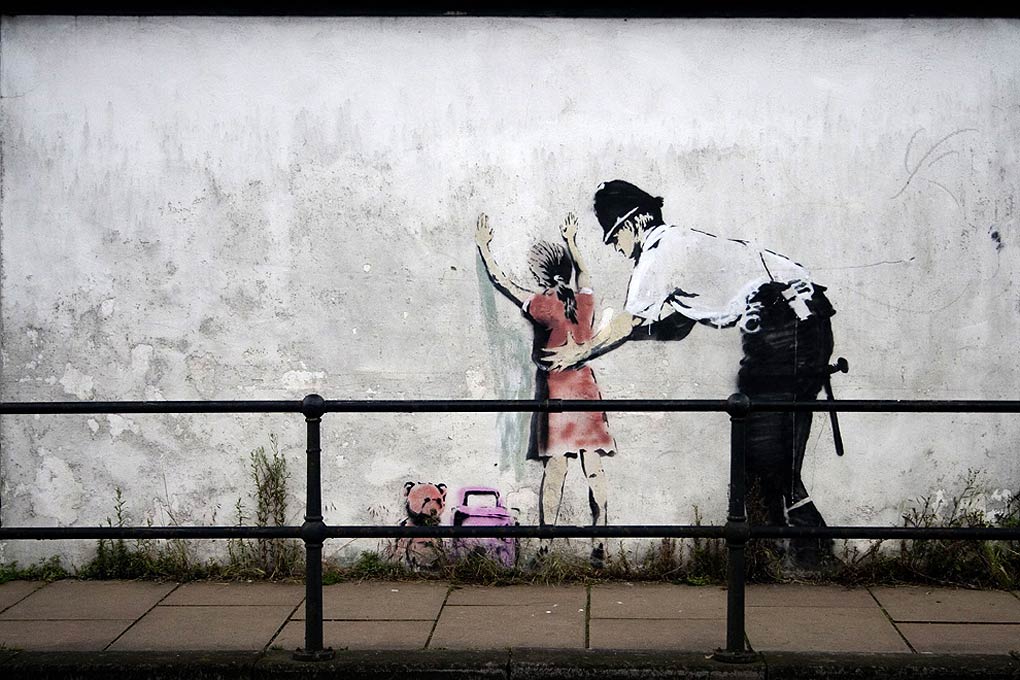
Within Banksy’s oeuvre, Stop and Search marks an important evolution in his treatment of law enforcement. Early works such as Rude Copper (2002) and Flying Copper (2003) openly mocked the police through parody and visual satire. Those works confronted authority head-on, ridiculing its symbols through humour and irreverence. Here, however, Banksy adopts a far subtler approach. The officer is neither caricatured nor ridiculed. The criticism lies entirely in the absurdity of the situation itself. The confrontation has become quieter, more restrained, and ultimately more unsettling. Rather than attacking authority, Banksy exposes how easily ordinary procedures can become instruments of injustice.
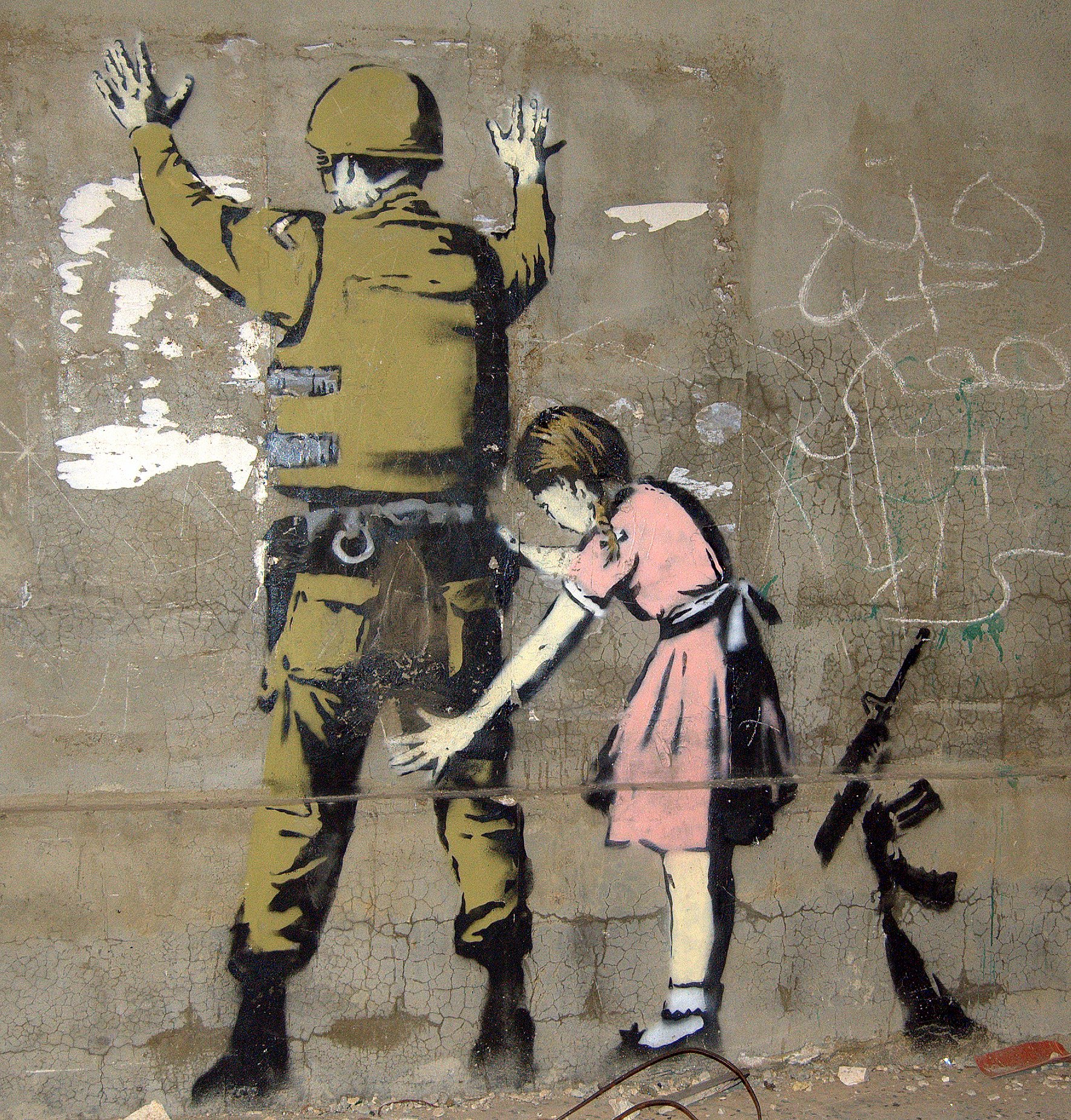
The image proved so enduring that Banksy revisited the concept several years later in one of his most celebrated murals in Bethlehem. There, the roles are reversed: a young girl in a pink dress calmly searches an armed Israeli soldier. The reversal transforms the original premise into an even sharper political statement, demonstrating Banksy’s recurring belief that simply changing perspectives can expose the hidden absurdities of power more effectively than direct confrontation.
Like many of Banksy’s strongest works, Stop and Search succeeds because it never feels ideological or preachy. It does not accuse a particular police officer, government or institution. Instead, it quietly invites viewers to consider how easily exceptional powers become ordinary, and how readily innocence itself can become an object of suspicion. The result is a work that remains every bit as relevant today as when it was first conceived—a meditation on surveillance, authority and the fragile boundary between protection and control.