Study for Happy Chopper, 2003
Private Collection, Vienna
Dorotheum, Wien, Zeitgenossische Kunst, November 28, 2007, Lot 272
Private Collection, New York
Auction History
| Dorotheum Vienna 28 November 2007 Est.: EUR 180,000 – 250,000 |
Price Realized |
Catalogue Note
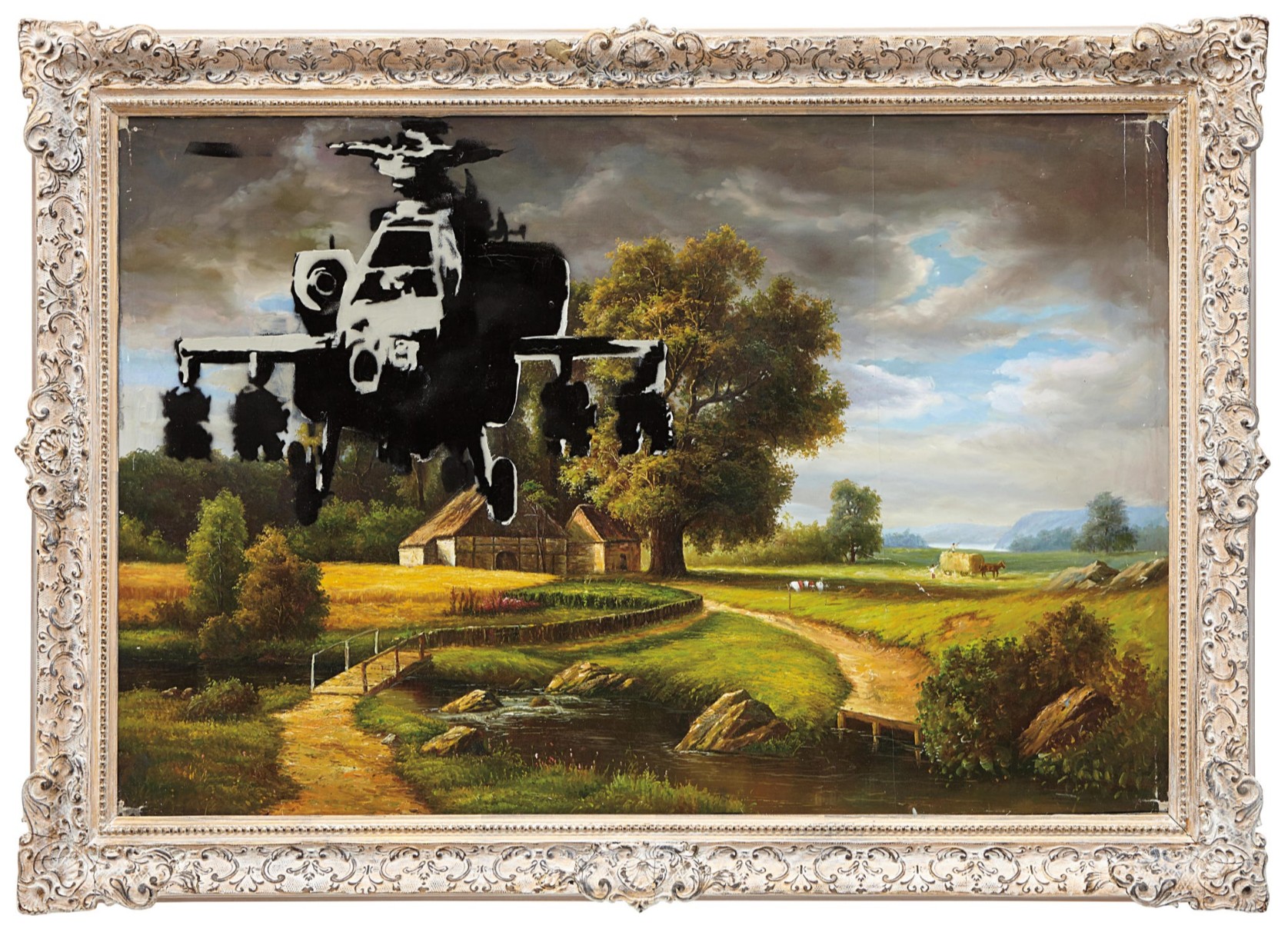
With Study for Happy Chopper, Banksy once again hijacks the comforting conventions of the traditional landscape painting, transforming an idyllic pastoral scene into a meditation on the intrusion of modern warfare. The anonymous oil painting, with its winding river, quiet cottages and luminous countryside, evokes a nostalgic vision of Britain that seems untouched by history. Into this carefully balanced composition crashes the unmistakable silhouette of an Apache attack helicopter, rendered in Banksy’s stark black-and-white stencil. The collision is immediate and irreconcilable: tranquility meets aggression, permanence meets disruption, and the romance of the past confronts the realities of the present.
Unlike the familiar Happy Choppers compositions, there is no playful ribbon softening the aircraft’s menace. The helicopter appears stripped of irony, allowing its sheer scale and imposing presence to dominate the landscape. Hovering low over the countryside, it transforms a scene of rural serenity into an uneasy theatre of occupation, suggesting that even the most peaceful environments are no longer insulated from the machinery of conflict.
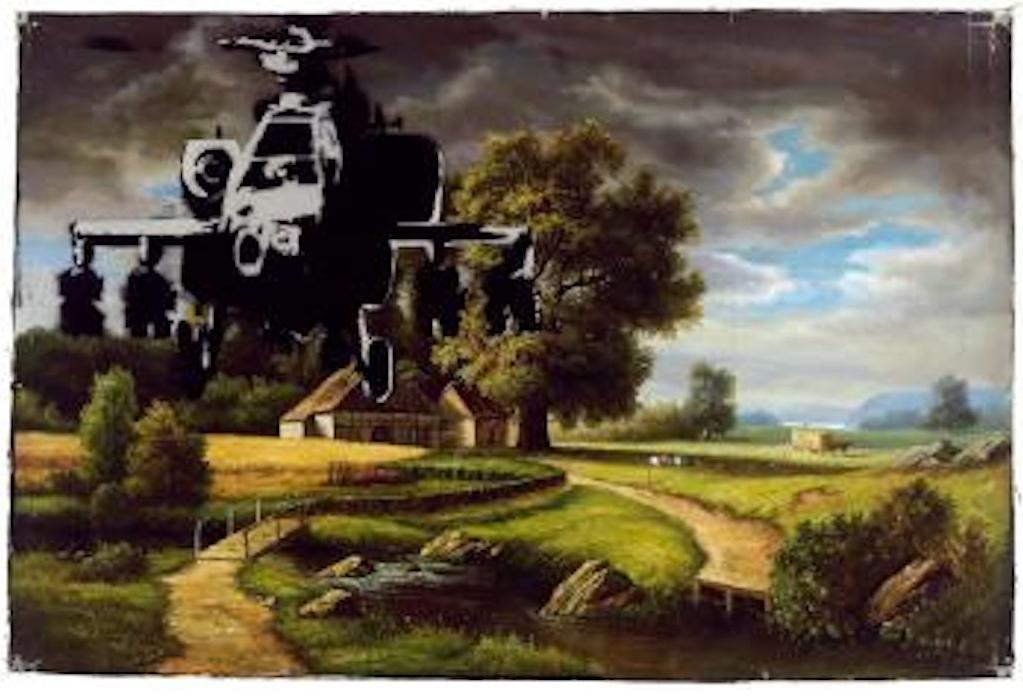
The found painting is essential to the work’s meaning. Throughout the early 2000s, Banksy increasingly appropriated discarded decorative landscapes—works originally intended to provide comfort and escape—and converted them into contemporary political allegories. Rather than destroying the original image, he enters into dialogue with it. The anonymous painter celebrates an idealized past; Banksy reminds us that such innocence can no longer exist untouched. His intervention does not merely alter the composition—it rewrites its entire narrative.
Created during the years leading up to the Iraq War, Study for Happy Chopper belongs to Banksy’s sustained critique of militarism and political interventionism. Yet the work avoids direct polemic. Instead, it speaks through visual contradiction. The helicopter does not fire a shot, nor does it require explanation. Its mere presence is enough to contaminate the idyllic landscape, demonstrating how violence often arrives not through spectacle but through normalization.
This strategy would become one of Banksy’s defining artistic signatures. By inserting unmistakably contemporary symbols into familiar visual traditions, he forces viewers to reconsider images they might otherwise ignore. Here, the pastoral landscape ceases to be a nostalgic retreat and becomes a stage upon which modern anxieties unfold. The result is both humorous and deeply unsettling: a landscape painting that no longer offers escape but instead reflects the increasingly fragile illusion of peace.