SWEEP IT UNDER THE CARPET
Sweep It Under the Carpet
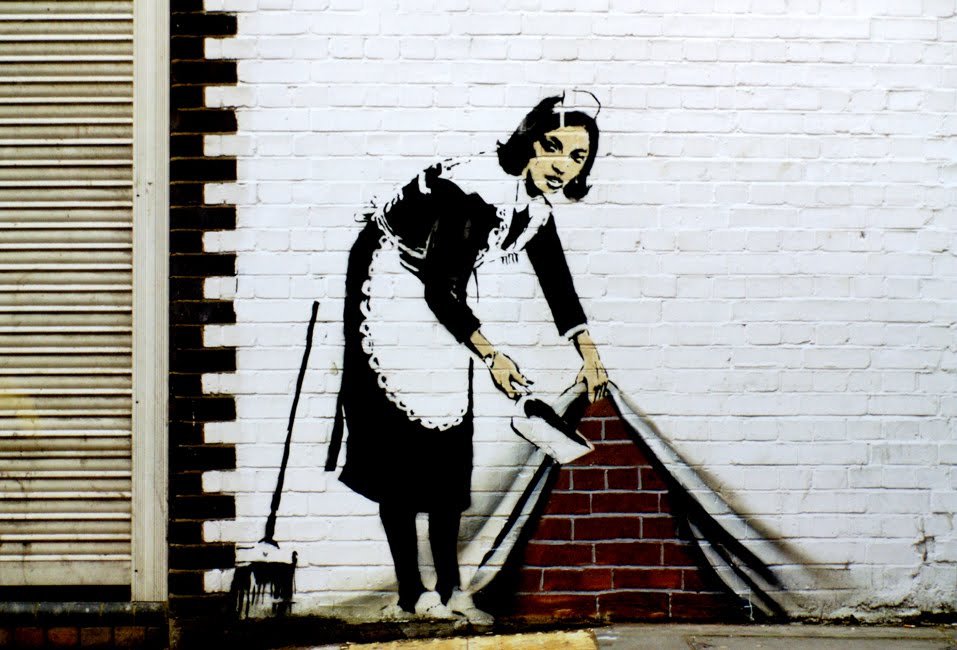
A maid in traditional uniform lifts the surface of a wall as though it were a curtain and calmly sweeps the dirt underneath. Banksy takes the familiar expression “sweeping something under the carpet” and renders it almost literally: the problem has not been removed or resolved, merely pushed somewhere it can no longer be seen.
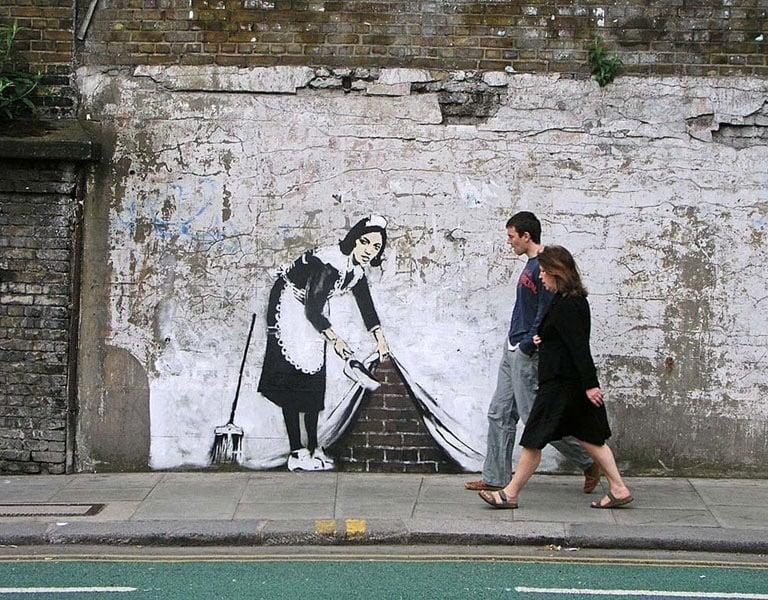
The image appeared in two important London locations in 2006, first around Chalk Farm and also on the exterior of White Cube in Hoxton Square. The repetition is significant because the same stencil acquires subtly different meanings according to the architecture surrounding it. In both cases, Banksy uses the physical wall as part of the illusion, making solid masonry appear flexible enough to be lifted with one hand.
The Chalk Farm Maid
The best-known version appeared in May 2006 at the junction of Chalk Farm Road and Adelaide Road in North London. The maid occupies a battered urban wall, lifting its pale surface to reveal darker brickwork underneath. Cracks, stains and the weathered masonry surrounding the figure contribute to the composition, reinforcing the contrast between the appearance of cleanliness and the considerably messier reality concealed beneath it.
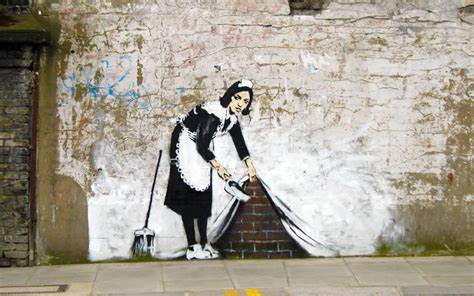
The work became associated with a special edition of The Independent, guest-edited by Bono and devoted to AIDS and poverty in Africa. The newspaper initially presented the mural as a commission, encouraging interpretations of the image as a comment on the tendency of wealthy Western societies and governments to conceal or ignore uncomfortable global realities. Banksy subsequently rejected the claim that the newspaper had commissioned the graffiti. The political reading remains pertinent, but the metaphor is deliberately broader: governments, institutions, corporations and individuals are all capable of making problems disappear from sight without actually solving them.
The White Cube Maid
A second version appeared on the exterior of White Cube in Hoxton Square, then one of London’s most prominent contemporary-art galleries. Here the location considerably changes the joke. Art of the State’s contemporary documentation records that the red brickwork apparently revealed beneath the gallery’s white exterior was itself painted by Banksy. The entire architectural rupture was therefore an illusion.
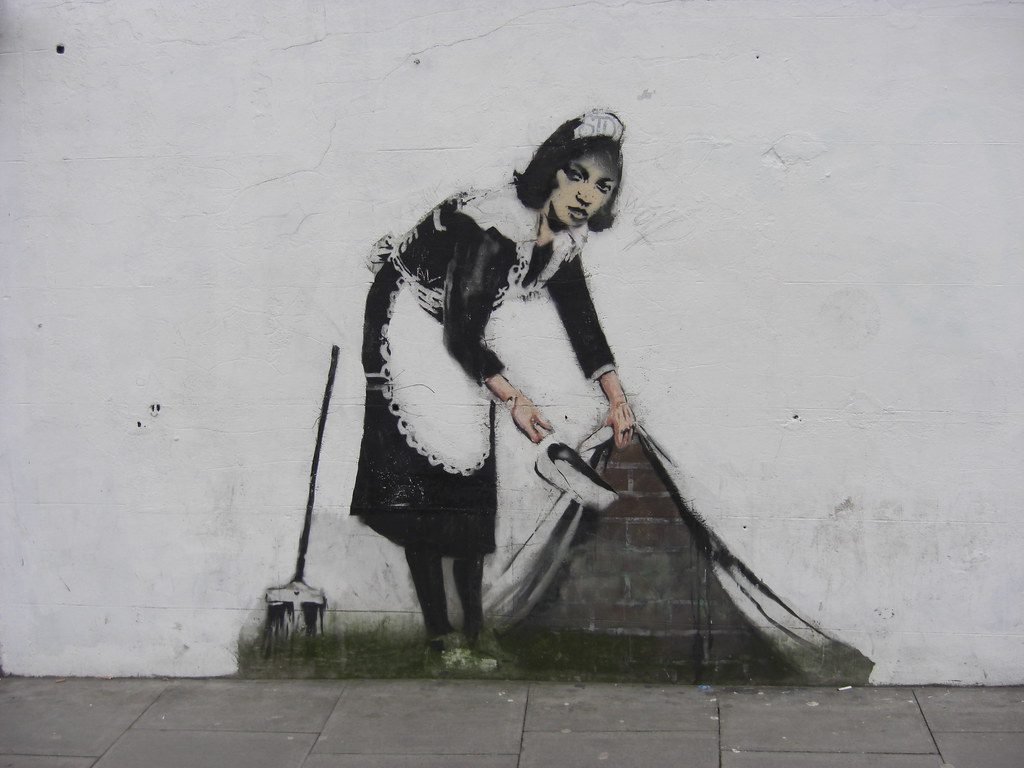
The placement outside White Cube is particularly effective. The pristine white gallery had become emblematic of the controlled environment in which contemporary art is displayed, while the cleaner represents the invisible labor required to maintain such immaculate appearances. Banksy places her outside the institution and has her literally lift its spotless surface to expose something rougher underneath. After Banksy had repeatedly smuggled unauthorized works into museums and galleries, the gesture reverses the relationship: rather than taking his art inside the institution, he leaves it illegally on the outside. The gallery tolerated the work for a period before it was eventually painted over.
Portrait of Leanne
There is also a more personal dimension to the image. Banksy identified the woman as Leanne, a maid who had cleaned his room at a Los Angeles motel, describing her as “quite a feisty lady.” More importantly, he presented the work in the language of portraiture, contrasting the historical tradition of wealthy popes and princes commissioning their portraits with his decision to portray a working woman.
“In the bad old days, it was only popes and princes who had the money to pay for their portraits to be painted, this is a portrait of a maid called Leanne who cleaned my room in a Los Angeles motel. She was quite a feisty lady.”
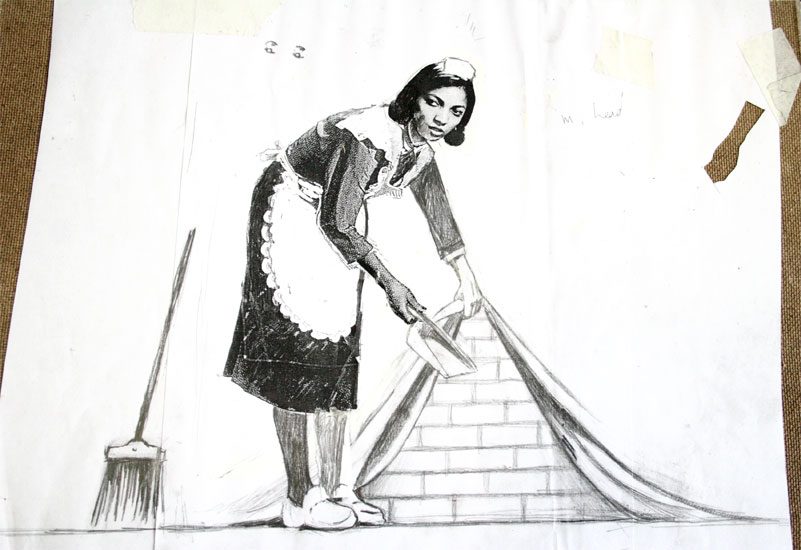
This transforms Leanne from a convenient symbol of cleaning into the actual subject of the work. A hotel maid performs a profession whose success depends partly upon invisibility: she enters after the guest has left, removes the evidence of his presence and restores the room for somebody else. Banksy reverses that relationship by making the normally invisible worker monumental and public. The person responsible for making disorder disappear becomes the person he insists we notice.
From the Street to Damien Hirst
Banksy returned to Leanne in 2007 for Keep It Spotless, placing the maid directly over a Damien Hirst Pharmaceutical spot painting. The transition was remarkably appropriate. Instead of lifting the surface of a London wall, she now pulls back Hirst’s immaculate field of colored spots, apparently revealing ordinary brickwork beneath one of contemporary art’s most recognizable motifs. Sotheby’s later catalogued the work explicitly as a Damien Hirst spot painting that Banksy had “defaced.”
The progression from Chalk Farm to White Cube and finally to Hirst is revealing. On the street, Leanne conceals dirt beneath the city itself; at White Cube she disrupts the immaculate exterior of an art institution; with Hirst she penetrates the pristine surface of contemporary art itself. The metaphor remains essentially unchanged while its cultural target becomes increasingly specific.
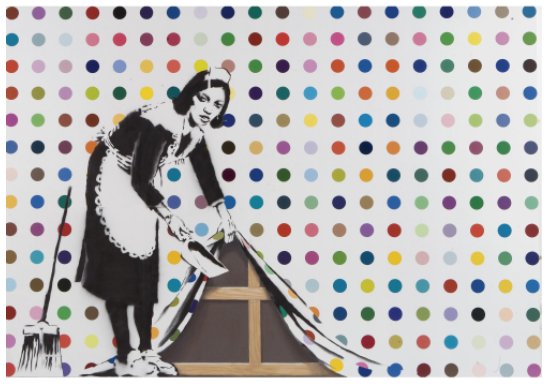
The market added an extraordinary final irony. Keep It Spotless was offered at Sotheby’s New York on 14 February 2008, estimated at $250,000–350,000, and sold for $1.87 million, establishing a new auction record for Banksy. The record remained unbeaten for more than eleven years, until Devolved Parliament sold for £9.88 million in 2019. Banksy had effectively defaced one of Hirst’s paintings and, rather than destroying its value, created an object whose altered surface became immensely desirable in its own right.
Sweep It Under the Carpet demonstrates Banksy’s ability to turn an ordinary expression into a remarkably effective visual proposition. The humor is immediate, but beneath it lies a broader meditation on concealment: the ease with which societies, institutions and individuals can mistake removing something from sight for actually dealing with it.
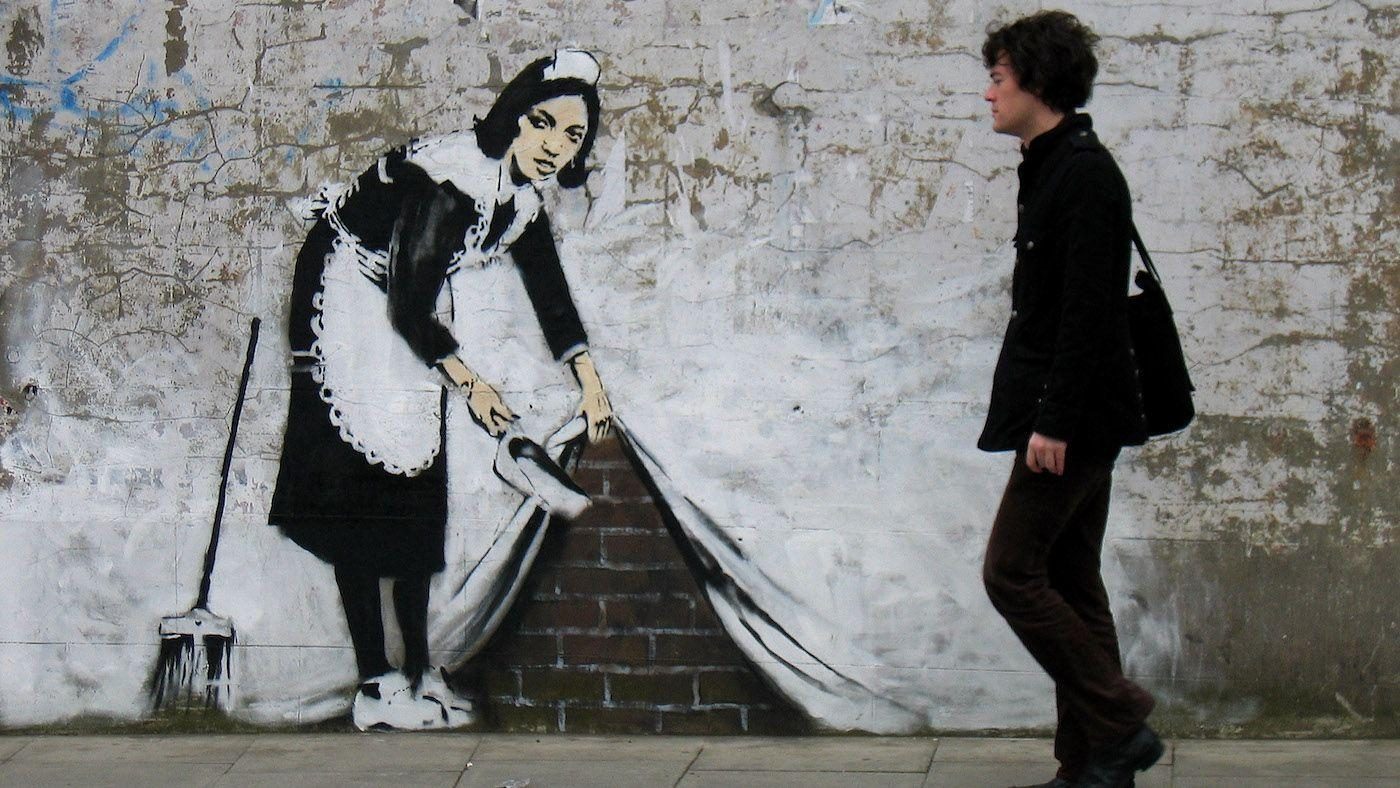
The two London versions also demonstrate how important location is to Banksy’s street practice. Chalk Farm and White Cube employ essentially the same stencil, yet the surrounding walls produce different readings. The later intervention over Damien Hirst extends the idea once more, moving the maid from the street into the heart of the contemporary art market.
The result is a particularly coherent evolution of a Banksy image: from a motel maid, to a London wall, to White Cube, to Damien Hirst, and finally to an auction record.
STAY INFORMED
Receive the latest news, exhibitions, artworks and market updates on Banksy.