BANKSY
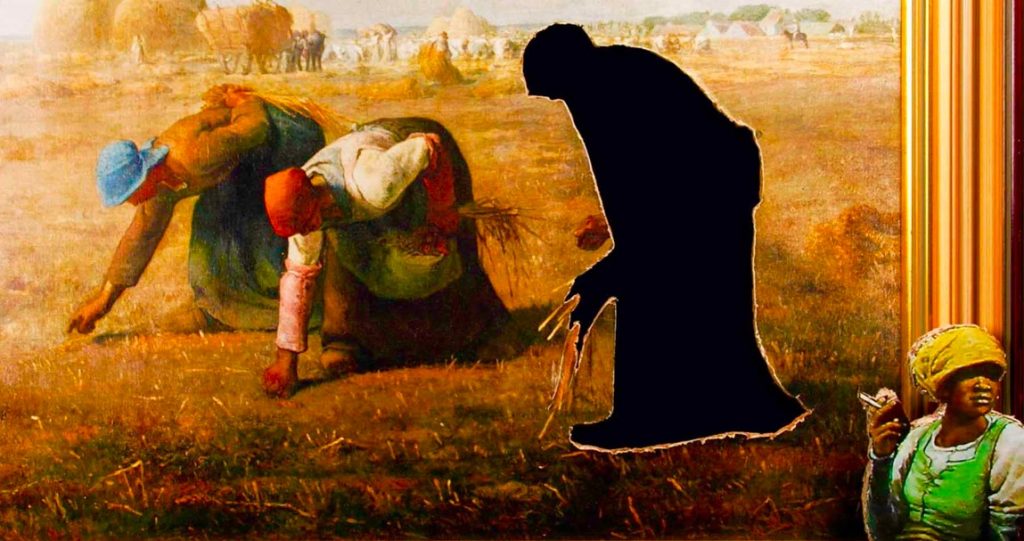
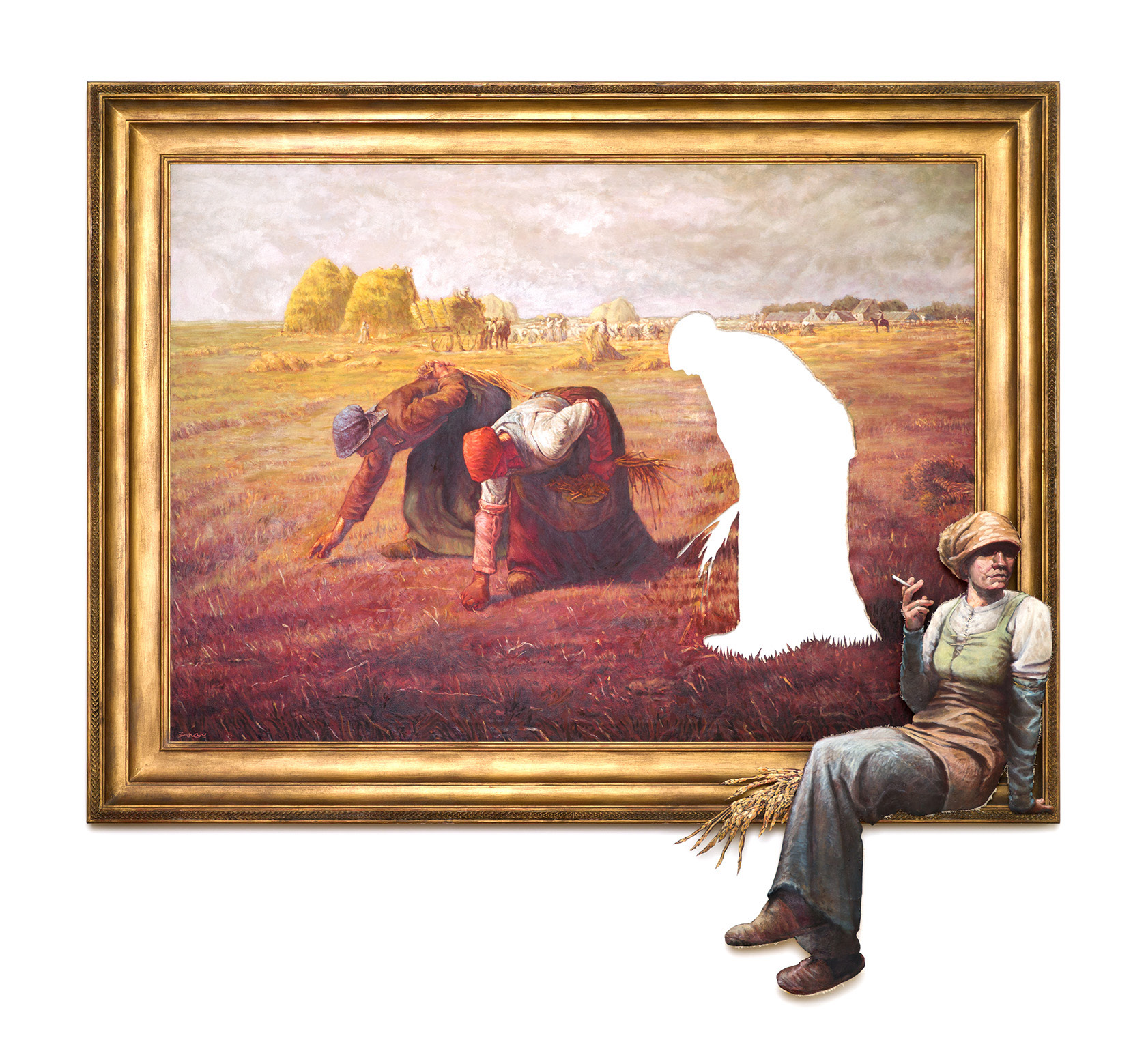
The Gleaners, 2009
Oil on canvas
152×165 cm (60×65 inches)
Exhibited
Banksy vs. Bristol Museum, Bristol Museum, Bristol, 2009
Catalogue Note
Jean-François Millet’s The Gleaners is one of the defining masterpieces of nineteenth-century Realism. Painted in 1857, it depicts three peasant women gathering the remnants of the harvest, transforming an ordinary rural activity into a powerful meditation on labor, poverty, and human dignity. At the time of its exhibition, the painting provoked considerable controversy, as many critics interpreted its sympathetic portrayal of the rural poor as an implicit social and political statement in the aftermath of the French Revolution of 1848.

Banksy approaches this celebrated masterpiece with remarkable audacity. Rather than simply inserting a contemporary object into Millet’s composition, he fundamentally alters its structure. One of the three gleaners has disappeared, leaving behind a conspicuous white silhouette that exposes her absence. The missing figure reappears outside the painting itself, hand-painted by Banksy and seated casually on the frame, cigarette in hand, apparently uninterested in returning to the scene she has abandoned.
It is a deceptively simple intervention, yet one of the most conceptually sophisticated of Banksy’s entire Crude Oils series. Most artists who reinterpret historical masterpieces introduce something new into the original composition. Banksy does precisely the opposite. Instead of adding a character, he removes one. More importantly, he liberates her. After nearly one hundred and fifty years of endlessly performing the same humble task, Millet’s gleaner simply refuses to continue. She steps out of the painting, sits comfortably on its frame, lights a cigarette, and quietly watches the remaining workers carry on without her.
The gesture is humorous, but it also transforms the meaning of the original masterpiece. Millet’s women functioned as symbols of perseverance, labor and rural dignity. Banksy’s gleaner ceases to be a symbol altogether. She becomes an individual capable of making her own choices, rejecting the role assigned to her by both history and the artist who first created her. In a subtle but profoundly original gesture, Banksy grants agency to a figure who had spent generations trapped within one of the most celebrated paintings of the nineteenth century.

Perhaps even more remarkably, Banksy dismantles one of the oldest conventions of Western painting: the boundary between the artwork and the viewer. By allowing the gleaner to physically occupy the frame, the picture is no longer confined to the canvas. The frame itself becomes part of the composition, blurring the distinction between painting, sculpture and installation. Long before Love is in the Bin challenged the physical integrity of the artwork, The Gleaners was already questioning whether a masterpiece must remain imprisoned within its own borders.
This playful irreverence perfectly encapsulates Banksy’s relationship with art history. Rather than treating great paintings as untouchable relics, he approaches them as living works capable of evolving alongside contemporary society. His intervention is neither destructive nor disrespectful. On the contrary, it demonstrates an intimate understanding of Millet’s composition, proving that genuine homage sometimes consists not of preserving the past unchanged, but of allowing it to continue speaking to the present.
Created for the landmark exhibition Banksy vs. Bristol Museum in 2009, The Gleaners occupies a singular place within Banksy’s oeuvre. It bridges his earlier Remixed Masterpieces, inspired by artists such as Monet, Van Gogh and Warhol, with the increasingly ambitious Crude Oils, where historical paintings are transformed through subtle conceptual interventions. Its subsequent inclusion in the 2017 Jean-François Millet retrospective at the Palais des Beaux-Arts in Lille—where it was exhibited alongside Millet’s original masterpiece—confirmed its significance not merely as a work by Banksy, but as a thoughtful and compelling contribution to the continuing dialogue between contemporary art and the history of painting.
Within Banksy’s body of work, The Gleaners stands as one of his most intellectually inventive reinterpretations of a historical masterpiece. By allowing one of Millet’s protagonists to abandon both the composition and the role assigned to her nearly 150 years earlier, Banksy does far more than alter a painting—he sets it free. In doing so, he reminds us that great works of art are never fixed in time. They remain living images, capable of escaping their own history and entering ours.