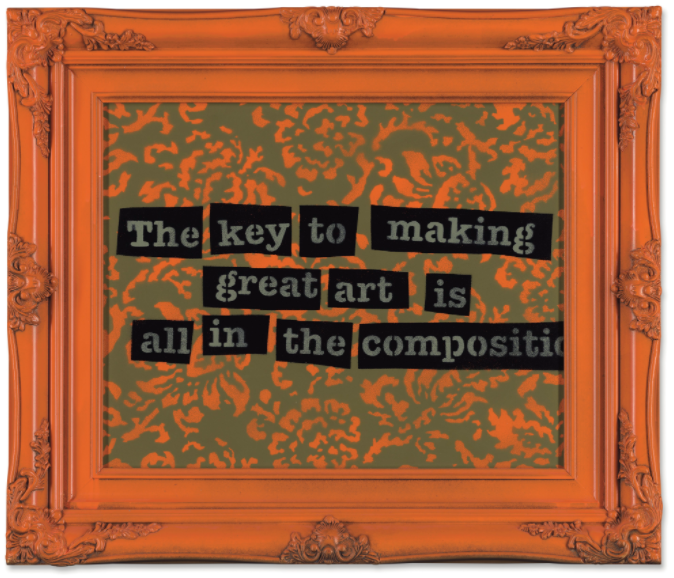
The Key To Making Great Art Is All In The Composition (Orange), 2009
Banksy vs. British Museum, British Museum, 2009
Catalogue Note
With The Key To Making Great Art Is All In The Composition, Banksy turns one of the oldest principles of art into the artwork itself. Set against an ornamental wallpaper and presented within an elaborate painted frame, the familiar statement is assembled from individually cut words arranged like a ransom note. The work is both humorous and quietly self-referential, transforming an elementary lesson in artistic practice into a conceptual exercise.
Composition has traditionally been understood as the careful arrangement of forms, colours and space within a picture. Rather than demonstrating this principle through a landscape or portrait, Banksy constructs the sentence itself as a composition. Every word is deliberately positioned, balanced and aligned, allowing the artwork to illustrate its own argument. Instead of explaining composition, it performs it.
The work also gently satirizes the language of art criticism. Concepts such as composition, balance and harmony are frequently invoked to explain why certain works deserve admiration. Banksy reduces this theoretical vocabulary to a single familiar sentence, exposing how easily artistic authority can be condensed into a cliché. Yet the joke is affectionate rather than dismissive. Composition remains essential; Banksy simply reminds us that understanding a principle and applying it are two very different things.
The ornate frame reinforces this dialogue between tradition and contemporary practice. Associated with Old Master paintings, it lends the work an air of historical importance, while the cut-out typography and decorative wallpaper belong to the visual language of street art and graphic design. As in many of Banksy’s works, high culture and popular culture coexist without hierarchy.
Created for Banksy vs. Bristol Museum in 2009, the work belongs to a group of self-reflective pieces including Boring, You’ve Got To Be Kidding Me and Morons, in which Banksy turns his attention to the mechanisms of the art world itself. Rather than questioning what art looks like, he asks how artistic value and authority are constructed.
The real ingenuity of the work lies in its reversal of expectations. Banksy does not paint an image to demonstrate good composition; he makes composition the image. In doing so, he suggests that art is ultimately defined less by its subject than by the intelligence with which its elements—whether figures, objects or simply words—are brought together.