The Village Pet Store and Charcoal Grill
October 2008
When Banksy Turned a Pet Shop into a Stage
“The world is a stage, but the play is badly cast.”
— Oscar Wilde
“Nothing is funnier than unhappiness.”
— Samuel Beckett
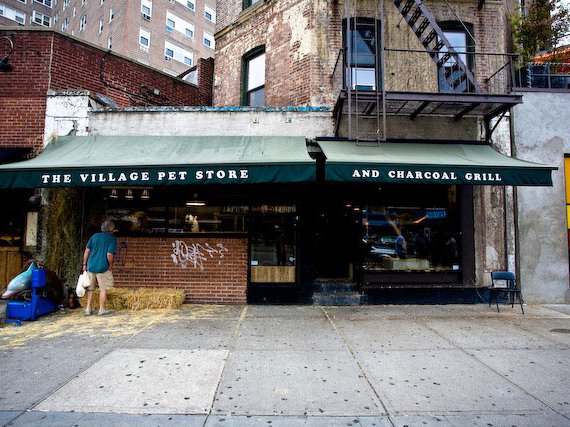
There are exhibitions that display works of art, and there are exhibitions that become works of art in themselves. The Village Pet Store and Charcoal Grill, unveiled quietly by Banksy in New York’s Greenwich Village in October 2008, belongs unequivocally to the latter category. Concealed behind the façade of an unremarkable neighborhood pet shop, this extraordinary installation invited visitors into a world where nothing behaved quite as expected. Fish fingers swam gracefully through illuminated aquariums. Breaded chicken nuggets cheerfully dipped themselves into barbecue sauce. A lonely monkey stared endlessly at a television screen while rabbits meticulously applied make-up before invisible audiences. Every display appeared absurd, almost childish, until one lingered just a little longer. Then the humor began to curdle into discomfort.

To describe The Village Pet Store and Charcoal Grill merely as an exhibition would be to misunderstand its ambition. It was a carefully choreographed theatrical environment, somewhere between sculpture, performance, installation and satire. Banksy did not simply present artworks to be admired; he constructed an autonomous world governed by its own peculiar logic, one in which every enclosure functioned as a miniature stage and every mechanical creature became an actor condemned to perform the same ritual over and over again. Visitors did not merely observe objects; they became spectators in an endlessly repeating performance whose true subject was neither animals nor food, but ourselves.
Few artists have mastered the art of disarming an audience quite like Banksy. His works rarely confront viewers directly. Instead, they seduce through wit, irony and visual simplicity before quietly revealing far more unsettling truths. Here, laughter becomes the opening act rather than the conclusion. The animated tableaux provoke smiles almost instinctively, yet beneath their charming absurdity lies a profound meditation on industrial food production, consumerism, animal welfare, mass entertainment and the curious moral hierarchies through which contemporary society distinguishes between creatures to be loved, creatures to be ignored and creatures to be consumed.
Although frequently overshadowed by later immersive projects such as Dismaland (2015), the Walled Off Hotel (2017) or Gross Domestic Product (2019), The Village Pet Store and Charcoal Grill occupies a pivotal position within Banksy’s artistic evolution. It represents the moment at which the anonymous street artist fully embraced the possibilities of immersive storytelling. Walls alone were no longer sufficient. The artwork had escaped into three dimensions, inviting audiences to walk inside the satire itself.
Historical Context
By the autumn of 2008, Banksy no longer belonged solely to the world of street art. During the previous decade he had engineered one of the most remarkable transformations in contemporary art history, evolving from an anonymous stencil artist operating in the streets of Bristol into an internationally recognized cultural phenomenon. Yet unlike many artists who achieve commercial success only to settle comfortably within the institutional art world, Banksy continued to treat every exhibition as an opportunity to challenge the conventions of exhibition-making itself.
The seeds of this transformation had been planted years earlier. Turf War (2003) introduced live animals into the gallery environment, provoking outrage and fascination in equal measure. Crude Oils (2005) demonstrated his willingness to appropriate and subvert the masterpieces of Western art history, while Barely Legal (2006), staged inside an industrial warehouse in Los Angeles, dramatically expanded the scale of his ambitions. Visitors entered not simply to admire paintings but to inhabit a carefully orchestrated environment populated by sculptures, installations and even a live elephant painted in elaborate decorative patterns. The exhibition blurred distinctions between spectacle and protest, entertainment and activism, leaving audiences uncertain whether they had attended an art exhibition, a political demonstration or an elaborate practical joke.
The Village Pet Store and Charcoal Grill may initially appear more modest than Barely Legal, yet in many respects it proved even more radical. Gone was the monumental scale of Los Angeles. Gone too was the overt theatricality of the painted elephant. Instead, Banksy embraced intimacy. He exchanged vast warehouse spaces for the narrow confines of a small Greenwich Village storefront, demonstrating that genuine artistic impact depends less upon size than upon imagination.
The choice of New York was no coincidence. Few cities better embody the contradictions Banksy has spent his career exploring. It is simultaneously a global center of contemporary art and a monument to consumer capitalism; a city where staggering wealth exists alongside profound inequality, where avant-garde creativity flourishes amid relentless commercialization. Greenwich Village itself, long associated with artistic experimentation and countercultural movements, provided an especially fitting setting. Hidden among ordinary shops and cafés, Banksy’s fictitious pet store appeared almost believable, allowing unsuspecting passers-by to stumble accidentally into one of the year’s most talked-about artistic events.
Unlike conventional museum exhibitions announced months in advance through carefully orchestrated publicity campaigns, Banksy relied upon surprise. The storefront simply appeared. Curious pedestrians entered expecting to browse pets and instead encountered an uncanny menagerie unlike anything they had previously experienced. Word spread rapidly. Long queues formed outside the modest premises, while newspapers, television crews and bloggers attempted to explain exactly what visitors were witnessing. Was it sculpture? Performance? Installation? Social experiment? The inability to answer that question became part of the exhibition’s appeal.
Perhaps this uncertainty reflects Banksy’s greatest strength. Throughout his career he has consistently resisted categorisation. Critics have attempted to define him as a graffiti artist, political activist, satirist, prankster, conceptual artist, filmmaker and entrepreneur. He is all of these things, yet never exclusively any one of them. The Village Pet Store and Charcoal Grill exemplifies this refusal to accept artistic boundaries. It is simultaneously a sculpture exhibition, a puppet theatre, a political cartoon rendered in three dimensions and an immersive theatrical performance in which visitors unknowingly become part of the cast.
A Pet Shop That Was Never About Pets
Every great illusion begins with familiarity.
Banksy understood that the most effective way to destabilize an audience was not through immediate shock but through gradual displacement. The exterior of The Village Pet Store and Charcoal Grill offered precisely the sort of reassuring banality one expects from an ordinary neighborhood business. The signage was modest. The windows appeared conventional. Inside, visitors found cages, aquariums, display cases and carefully arranged merchandise. Everything suggested the comforting predictability of a traditional pet shop.
Yet almost immediately, reality began to fracture.
The animals did not behave as animals should. Some were not animals at all. Others existed in impossible states between life and commodity. Everyday supermarket products had somehow regained biological existence, while living creatures appeared trapped within absurdly human routines. The familiar slowly became uncanny, creating precisely the kind of cognitive dissonance that psychologists describe as the “uncanny valley”—that strange territory where things appear almost normal, yet not quite enough to avoid generating profound unease.
Even the exhibition’s title functions as a conceptual joke of remarkable elegance. A pet shop evokes affection, companionship and care. A charcoal grill evokes cooking, consumption and appetite. By combining these two apparently incompatible ideas within a single title, Banksy quietly exposes one of the most deeply embedded contradictions of modern civilisation. Why do we instinctively cherish certain species while casually consuming others? At what point does an animal cease to become a living creature and become merely food? Who decides these invisible hierarchies?
Rather than answering such questions directly, Banksy allows the exhibition itself to become the argument. Each tableau presents another variation on this central paradox, inviting viewers to confront their own assumptions without ever prescribing the “correct” interpretation.
Here lies one of Banksy’s greatest gifts. He rarely lectures. Unlike overt political propaganda, his work does not seek obedience. Instead, it cultivates uncertainty. His exhibitions are less interested in changing minds than in preventing certainty from becoming too comfortable. Like the finest satirists—from Jonathan Swift to George Orwell—Banksy trusts his audience enough to leave important questions unresolved.
That refusal to provide easy answers is precisely what transforms The Village Pet Store and Charcoal Grill from an amusing curiosity into a work of lasting intellectual significance.
A Walk Through Banksy’s Theatre of the Absurd
“People are always blaming their circumstances for what they are.”
George Bernard Shaw
“The absurd is born of this confrontation between the human need and the unreasonable silence of the world.”
Albert Camus
To walk through The Village Pet Store and Charcoal Grill is not simply to visit an exhibition; it is to attend a performance. Although Banksy has never explicitly associated the exhibition with the Theatre of the Absurd, the comparison feels irresistible. Emerging in post-war Europe through playwrights such as Samuel Beckett and Eugène Ionesco, the movement rejected conventional narrative in favour of repetition, contradiction and seemingly meaningless actions that gradually exposed the irrationality of modern existence. In Waiting for Godot, two men spend an entire play waiting for someone who never arrives. In The Bald Soprano, ordinary conversation slowly collapses into linguistic chaos until language itself loses all meaning. Nothing extraordinary appears to happen, yet everything essential is revealed.
Banksy’s mechanical creatures operate according to remarkably similar principles. Their gestures repeat endlessly. There is no beginning, no climax and no resolution. Chicken nuggets forever dip themselves into barbecue sauce. Fish fingers continue swimming despite having already become processed food. A monkey remains hypnotized by television. Rabbits prepare themselves for an audience that never appears. These performances continue whether visitors are present or not, suggesting that the exhibition possesses a life entirely independent of observation.
Like Beckett’s tramps waiting beneath a barren tree, Banksy’s creatures are trapped within rituals from which there appears to be no escape. Their mechanical repetition gradually strips humor of its innocence until absurdity becomes revelation. The true actors, however, are not the animals. They are us.
Chicken McNuggets

At first glance, the scene is irresistibly amusing. Inside what resembles a brightly lit poultry enclosure, a cheerful family of animated Chicken McNuggets wanders aimlessly across the floor. Their golden breadcrumb coating, identical to the familiar fast-food product served in restaurants around the world, immediately provokes recognition and laughter. Every few moments, one of the nuggets approaches a miniature pot of barbecue sauce, delicately dipping itself inside before continuing its leisurely stroll alongside the others.
The choreography is deceptively simple. Nothing dramatic occurs. The mechanical figures repeat the same sequence endlessly, without purpose or destination. Yet therein lies the tableau’s extraordinary power. Visitors inevitably stop longer than expected, mesmerized by the absurd spectacle unfolding before them. What initially appears as a visual joke slowly acquires an unsettling quality. The longer one watches, the stranger it becomes to witness food behaving like living creatures.
The enclosure itself reinforces the illusion. Carefully arranged as though displaying rare domestic animals, it mimics the reassuring aesthetics of a traditional pet shop while quietly undermining every expectation associated with such a place. The familiar language of animal care has become inseparable from the visual language of industrial food production.
Few works within The Village Pet Store and Charcoal Grill encapsulate Banksy’s artistic philosophy as perfectly as the Chicken McNuggets. The brilliance of the installation lies not in its political message but in its psychological mechanism. Banksy understands that modern food production depends upon a remarkable act of collective abstraction. The more heavily processed an animal becomes, the easier it is to forget that it was ever alive. Industrial manufacturing removes feathers, bones, blood, organs and every physical reminder of the living creature from which the product originated. What remains is a uniform, anonymous object, stripped of biography and individuality.
By reversing this transformation, Banksy performs an act of conceptual resurrection. The McNuggets become animals once more. Not chickens, but something even stranger: processed food endowed with personality. This reversal forces viewers to confront an uncomfortable contradiction. Most people would instinctively recoil at the idea of harming a playful pet yet think little of consuming its processed equivalent. Banksy never condemns this contradiction directly. Instead, he stages it. The absurdity speaks for itself.
Humor becomes an essential component of the work. Had Banksy simply exhibited documentary photographs of industrial farming, the moral argument would have been immediate and predictable. Instead, he disguises ethical reflection beneath comedy. Visitors laugh first, lowering their intellectual defenses, only to discover that the joke has quietly implicated them.
This strategy recalls the tradition of Jonathan Swift, whose eighteenth-century satire A Modest Proposal suggested, with impeccable logic, that impoverished Irish children might solve economic hardship by allowing themselves to be eaten. Swift never intended his audience to accept the proposal; rather, he exaggerated existing social attitudes until their moral bankruptcy became impossible to ignore. Banksy adopts a remarkably similar approach. The absurd image of self-dipping chicken nuggets exposes the equally absurd psychological processes that allow contemporary society to transform sentient animals into anonymous consumer products.
The endless repetition of the mechanical movements further deepens the installation’s significance. There is no beginning and no conclusion. The nuggets will continue their cheerful routine indefinitely, indifferent to the presence or absence of spectators. Like factory production lines, their existence has become one of perpetual automation. They perform the same gesture endlessly because they can do nothing else.
Here the comparison with Samuel Beckett becomes particularly compelling. In Waiting for Godot, characters repeat conversations and actions without apparent progress, exposing the strange emptiness hidden beneath routine. Banksy’s nuggets likewise inhabit a closed universe from which escape appears impossible. Their happiness feels strangely tragic precisely because it is mechanical, predetermined and eternal.
Yet perhaps the most unsettling aspect of the tableau lies elsewhere. The nuggets are not really the protagonists. We are. The enclosure functions as a mirror rather than a stage. Banksy invites us to observe the cheerful products, only to realize that the true object of observation has become our own habits, assumptions and moral blind spots. The installation never asks whether eating chicken is right or wrong. Instead, it poses a subtler and ultimately more profound question: how much psychological distance must separate us from a living being before empathy quietly disappears? In that single question resides the extraordinary sophistication of Banksy’s art.
The Fish Fingers Aquarium

Among the exhibition’s most quietly mesmerizing displays is an apparently ordinary aquarium, softly illuminated by the bluish light familiar to every pet shop. Aquatic plants sway gently beneath the surface while bubbles rise lazily towards the top of the tank. At first glance, the scene appears almost tranquil, inviting visitors to pause for a moment of calm amid the exhibition’s playful chaos.
Then comes the surprise. Swimming gracefully through the water are not tropical fish, goldfish or exotic marine species, but breaded fish fingers. Perfectly rectangular, coated in their familiar golden crust and instantly recognizable as one of the most ubiquitous products found in supermarket freezers, they glide effortlessly through the water with astonishing elegance. Their movements are smooth and unhurried, almost balletic, as they weave silently between rocks and aquatic vegetation. Occasionally they change direction in perfect synchrony before disappearing behind the decorative plants, only to emerge moments later as if nothing about their existence were unusual.
Unlike the Chicken McNuggets, whose playful choreography immediately provokes laughter, the Fish Fingers Aquarium elicits something closer to wonder. Visitors often find themselves watching the tank for several minutes, hypnotized by the graceful rhythm of the mechanical creatures. The absurdity unfolds slowly. Only after prolonged observation does the impossible nature of the scene fully register. What appears beautiful gradually becomes deeply unsettling.
The aquarium itself is immaculate, almost museum-like in its presentation. Every detail reinforces the illusion of authenticity. Banksy invites us to admire these strange inhabitants exactly as we would admire living fish in any public aquarium. Yet the illusion remains permanently unstable, suspended between fascination and disbelief.
If the Chicken McNuggets confront us with the industrial transformation of the chicken, the Fish Fingers Aquarium explores a different form of disappearance. Fish occupy a unique position within our moral imagination. Unlike mammals or birds, they often remain curiously absent from our emotional landscape. We name cows, horses and dogs with ease, yet fish frequently exist as anonymous populations rather than individual beings. Their underwater existence places them beyond everyday human experience, allowing them to become one of the most invisible victims of industrial food production.
Banksy exploits this invisibility with remarkable subtlety.
Fish fingers represent perhaps the ultimate triumph of processing over identity. Their original form has been entirely erased. Bones, scales, fins, eyes and even the distinctive shape of the fish have disappeared beneath a uniform coating of breadcrumbs. Nothing remains that might remind the consumer of the living creature from which the product originated.
The aquarium reverses this process. Instead of transforming fish into food, Banksy transforms food back into fish. It is an act of conceptual resurrection. By restoring movement to objects that should be entirely lifeless, he quietly dismantles one of the great illusions of industrial consumer culture. The fish fingers regain agency. They swim. They explore. They appear almost content within their underwater environment. In doing so, they recover something that modern food production systematically removes individuality.
There is also something unmistakably surreal about the tableau. One cannot help but think of René Magritte, whose paintings repeatedly challenged viewers by placing ordinary objects in impossible situations. Just as Magritte painted locomotives emerging from fireplaces or clouds filling domestic interiors, Banksy constructs an image whose impossible logic feels strangely convincing. The fish fingers belong perfectly within the aquarium and simultaneously not at all. The resulting tension forces the mind into a state of permanent uncertainty.
The endless choreography of the swimming fish fingers also recalls the repetitive movements found throughout The Village Pet Store and Charcoal Grill. Like the actors in Beckett’s plays, they are trapped within an eternal performance from which there is no escape. They circle the tank indefinitely, never reaching a destination, never completing a journey. Their graceful movements become a quiet metaphor for the repetitive cycles of production and consumption that underpin contemporary society.
Perhaps the greatest strength of the installation lies in its refusal to accuse. There are no slogans. No graphic imagery. No explicit political statement. Only an aquarium. Only fish fingers. Only the silent realization that something which should feel perfectly ordinary suddenly appears profoundly strange. This capacity to transform familiarity into unease has become one of Banksy’s defining artistic achievements. Like the finest satirists, he understands that the most effective criticism rarely announces itself. Instead, it invites us to look again at what we believed we already understood. By the time visitors leave the aquarium, many discover that they will never look at a frozen fish finger in quite the same way again.
The Television Monkey

Among the exhibition’s many animated scenes, few possess the quiet psychological intensity of the monkey sitting alone before a television screen. Inside a modest enclosure, a chimpanzee occupies a small domestic interior. Seated motionless on a chair, headphones covering its ears, it stares endlessly at a flickering television. Every so often the animal makes a slight movement—a subtle shift of the head, an almost imperceptible adjustment of posture—before returning immediately to its hypnotic gaze. Nothing dramatic occurs. There is no narrative progression, no climax, no conclusion. The performance simply continues.
The atmosphere is strikingly different from the surrounding tableaux. Gone are the playful absurdities of animated food products or comic visual gags. Instead, a curious stillness settles over the scene. Visitors instinctively lower their voices as they observe the solitary figure, almost as though they were intruding upon an intensely private moment. The enclosure itself resembles an ordinary living room stripped to its bare essentials. The television becomes the only real source of light, bathing the monkey’s face in its cold electronic glow. The surrounding darkness reinforces its isolation, creating an image that feels at once familiar and profoundly unsettling.
Unlike the exhibition’s more spectacular displays, this tableau rarely provokes immediate laughter. Instead, it invites prolonged contemplation. The longer one watches, the less the monkey appears to be the object of observation. Gradually, almost imperceptibly, the roles begin to reverse.
Throughout his career, Banksy has repeatedly returned to the image of the monkey. From Laugh Now, where melancholy chimpanzees wear advertising boards announcing, “Laugh now, but one day we’ll be in charge,” to the satirical chaos of Monkey Parliament, primates occupy a privileged position within Banksy’s visual vocabulary. They are never simply animals. They function as stand-ins for humanity itself.
The monkey has a long history within Western art. Medieval painters frequently employed apes to symbolize vanity, imitation and human folly. Charles Darwin later transformed the ape into a powerful reminder of humanity’s biological origins, challenging long-established assumptions about our place within creation. Banksy embraces both traditions simultaneously. His monkeys are recognizably human without ever ceasing to be animals. Their ambiguity allows them to become mirrors in which viewers quietly recognize themselves.
Nowhere is this more apparent than here. At first glance, the tableau appears to criticize television. Such an interpretation, however, barely scratches the surface. The television itself is almost incidental. The true subject is passive spectatorship. The monkey no longer explores. It no longer climbs. It no longer interacts with the world around it. Its entire existence has been reduced to watching.
Banksy quietly suggests that captivity need not rely upon physical bars. Modern societies increasingly construct invisible cages through entertainment, advertising and endless streams of information that demand attention while discouraging reflection. The headphones further reinforce this withdrawal. They isolate the monkey from every external sound, replacing lived experience with mediated experience. The enclosure becomes less a zoo than a metaphor for contemporary existence.
One might recall Plato’s celebrated Allegory of the Cave. In Plato’s dialogue, prisoners spend their entire lives watching shadows projected onto a wall, mistaking those fleeting images for reality because they know nothing else. Banksy’s monkey occupies a remarkably similar position. The glowing screen replaces the cave wall. The enclosure becomes a modern cave where mediated images substitute for direct experience. Whether intentionally or not, Banksy evokes one of philosophy’s oldest questions: how much of what we perceive is genuine reality, and how much is carefully curated illusion?
The tableau also invites comparison with Charlie Chaplin’s Modern Times. Chaplin portrayed workers reduced to mechanical extensions of industrial machinery, trapped within repetitive routines over which they exercised no control. Banksy’s monkey suffers a comparable fate. It has become part of a different machine—not the factory, but the entertainment industry. Its movements are minimal because active participation has given way to passive consumption.
There is an exquisite irony here. Visitors gather around the enclosure watching a monkey watching television. They become spectators observing another spectator. Banksy subtly transforms the audience into participants within the artwork itself. The monkey stares at the screen while visitors stare at the monkey, rarely noticing that they too have become absorbed by a carefully constructed spectacle. The distinction between observer and observed quietly dissolves.
Samuel Beckett once remarked, “Habit is a great deadener.” Few sentences better encapsulate the power of this tableau. The monkey is not visibly suffering. It appears comfortable, calm, perhaps even content. Yet therein lies the tragedy. The routine has become so complete that captivity no longer feels like captivity. It feels normal. Perhaps this is Banksy’s most unsettling suggestion of all. The monkey is not imprisoned because it cannot leave. It is imprisoned because it no longer thinks to try. And then comes the final, almost unbearable realization. The monkey is not us because we share a common ancestor. The monkey is us because we recognize our own routines, our own screens, our own quiet surrender to passive observation. In the end, the cage surrounds not the animal, but the viewer.
The Rabbit’s Dressing Room

Tucked discreetly inside one of the exhibition’s quieter corners sits an elegant vanity table, illuminated by the soft glow of a dressing-room mirror. Before it, a white rabbit patiently prepares for an invisible performance. With slow, repetitive precision, the animal lifts a lipstick towards its mouth before reaching for a powder puff, mechanically applying cosmetics to its face with meticulous care. Small perfume bottles, brushes and beauty products are neatly arranged across the tabletop, recreating the intimate atmosphere of an actress’s dressing room moments before the curtain rises.
Unlike the more overtly comic tableaux elsewhere in the exhibition, this scene unfolds with remarkable restraint. The rabbit moves gracefully, almost delicately, repeating the same ritual with unwavering concentration. There is no audience to applaud its efforts, no stage awaiting its entrance, and no indication that the performance will ever begin. Nevertheless, the animal continues its preparation with complete devotion, as though the ritual itself has become its sole purpose.
The lighting plays an essential role in the tableau’s emotional power. Warm bulbs surrounding the mirror cast a theatrical glow across the rabbit’s face, contrasting sharply with the sterile atmosphere of the surrounding exhibition. Visitors instinctively recognize the familiar iconography of backstage theatre: the quiet solitude, the ritual of transformation, the fragile moment between private identity and public appearance.
The longer one watches, however, the more unsettling the scene becomes. The repeated gestures gradually lose their charm and acquire an almost obsessive quality. What initially appears playful slowly reveals itself as a performance without end, a preparation for an event that will never arrive.
At first glance, the tableau appears to satirize human vanity. Yet, as is so often the case with Banksy, the first interpretation proves only the beginning. Rabbits occupy a peculiar place within the modern imagination. They are symbols of innocence, vulnerability and gentleness. Children’s literature has long transformed them into reassuring companions, from Beatrix Potter’s Peter Rabbit to Lewis Carroll’s perpetually anxious White Rabbit. Scientific laboratories, by contrast, have cast the rabbit in an altogether different role—that of experimental subject, silently enduring countless cosmetic and pharmaceutical tests in the name of human beauty and consumer comfort.
Banksy quietly allows these two worlds to collide. The cosmetics spread across the dressing table are not simply theatrical props. They evoke one of the beauty industry’s most enduring ethical controversies: animal testing. For decades, rabbits became unwilling participants in laboratory procedures designed to evaluate the safety of products intended to enhance human appearance. The irony is devastating. Here, the very creature historically subjected to cosmetic experimentation now appears voluntarily applying those same products to itself.
The reversal is absurd. It is also profoundly tragic. Like the Chicken McNuggets and the Fish Fingers Aquarium, the installation depends upon inversion. Victim becomes participant. Object becomes subject. Banksy consistently destabilizes established roles until the invisible structures beneath them suddenly become visible.
Yet the tableau reaches far beyond animal rights. The dressing table has long served as one of Western art’s most potent symbols of identity and performance. Painters from Edgar Degas to Henri de Toulouse-Lautrec repeatedly depicted performers preparing backstage, capturing those fleeting moments in which individuals constructed the public versions of themselves. The mirror becomes a place not merely of reflection but of transformation. Banksy’s rabbit performs precisely this ritual. Only there is no audience. No applause. No opening night. The performance has become entirely self-contained.
In this sense, the tableau speaks powerfully to contemporary culture. Increasingly, modern life encourages individuals to curate carefully constructed public identities, endlessly refining appearances for audiences that exist somewhere beyond the screen. Social media, advertising and celebrity culture have transformed self-presentation into a permanent occupation. Preparation never truly ends because performance itself has become continuous. The rabbit never reaches the stage because the stage is everywhere.
Throughout history, dressing rooms have represented spaces of privacy, vulnerability and authenticity. They are where masks are removed before new ones are applied. Banksy’s dressing room, however, offers no such authenticity. Every gesture is mechanical. Every movement predetermined. Even intimacy has become automated.
Samuel Beckett often explored similar themes through characters imprisoned by routine. In Happy Days, Winnie spends her existence repeating increasingly meaningless domestic rituals while physically trapped in a mound of earth. The rituals themselves become acts of resistance against existential uncertainty. Banksy’s rabbit similarly clings to cosmetic routine as though repetition alone might provide meaning.
But perhaps the most poignant aspect of the tableau lies in its extraordinary loneliness. The rabbit is not preparing to deceive others. It is preparing because it no longer knows how not to prepare. Its identity has become inseparable from performance itself. And perhaps that is Banksy’s most uncomfortable observation. Modern society increasingly asks us all to become performers. Employees cultivate professional identities. Influencers curate idealized lives. Consumers purchase not simply products but carefully manufactured versions of themselves. The rabbit’s dressing room becomes less a satire of vanity than a meditation on performance as a condition of contemporary existence. The cosmetics are merely props. The real transformation concerns identity itself.
As visitors quietly leave the tableau, they may find themselves asking an unexpected question. How much of who we present to the world is genuinely ourselves, and how much is simply another carefully rehearsed performance before an audience we can no longer see?
The Leopard Skin

At first glance, the installation appears almost deceptively simple. A tree branch extends across the enclosure, evoking the quiet stillness of an African landscape. Draped lazily over one of its limbs rests the skin of a large spotted cat, its limbs hanging limply on either side of the branch. For a fleeting moment, visitors may mistake it for a living leopard asleep in the midday heat, its body relaxed among the trees as countless wildlife documentaries have taught us to expect.
Then the illusion dissolves. The animal is gone. What remains is only its pelt. The empty skin gently shifts with mechanical movement, as though stirred by an invisible breeze. It rises and falls almost imperceptibly, suggesting the ghost of a creature that no longer exists. The movement is so subtle that it feels less like animation than memory, lending the tableau an almost haunting quality.
Unlike many of the exhibition’s more playful scenes, laughter quickly fades here. The installation is remarkably quiet, almost elegiac. Visitors instinctively lower their voices, confronted not with an animal, but with its absence. The branch still waits for its inhabitant. Only the inhabitant has disappeared.
Among all the tableaux in The Village Pet Store and Charcoal Grill, The Leopard Skin may be the exhibition’s most poignant meditation on absence.
Banksy does not depict violence.
He depicts what violence leaves behind.
Throughout history, animal skins have occupied an ambiguous place within human culture. They have symbolised wealth, conquest, luxury and power. Draped across floors, hung upon walls or worn as garments, they transform living creatures into decorative objects. Their beauty survives even as the life that produced it has vanished.
Banksy quietly reverses that tradition.
Rather than displaying the skin as a trophy, he returns it to the tree.
The gesture is profoundly moving.
The branch becomes both perch and memorial.
The pelt hangs exactly where the living leopard should have rested, exposing the terrible contradiction at the heart of trophy culture. Humanity often claims to admire wild animals while simultaneously celebrating their destruction. The more magnificent the creature, the greater the prestige associated with possessing part of its body.
Banksy’s installation asks a devastatingly simple question.
What remains of our admiration once the animal itself has disappeared?
The work also functions as a meditation on memory.
The slight mechanical movement gives the skin an uncanny presence. It almost appears alive, yet never quite becomes so. The viewer experiences a moment of uncertainty, suspended between recognition and illusion. This liminal state recalls Sigmund Freud’s concept of the uncanny—that strange sensation produced when something appears simultaneously familiar and profoundly wrong. The pelt seems animated, but only enough to remind us that genuine life can never return.
There is also an unmistakable ecological dimension.
By 2008, when Banksy created the exhibition, public awareness of biodiversity loss and habitat destruction had entered mainstream discourse. Images of endangered big cats had become familiar symbols of conservation campaigns. Yet Banksy avoids the visual language of activism. There are no statistics, no slogans, no graphic imagery.
Instead, he allows absence to perform the work.
The missing animal becomes infinitely more powerful than any explicit condemnation.
The tableau also resonates with the long tradition of vanitas painting. Seventeenth-century Dutch artists filled their compositions with skulls, extinguished candles and wilting flowers to remind viewers of the transience of earthly existence. Banksy’s leopard skin functions in much the same way. It is not merely an object but a memento mori—a reminder that beauty, life and power are all profoundly fragile.
Yet perhaps the installation’s greatest achievement lies in its extraordinary restraint.
Nothing dramatic occurs.
No hunter appears.
No gunshot is heard.
No blood is visible.
Only an empty skin resting upon a branch.
The silence becomes almost unbearable.
It allows visitors to imagine the invisible narrative for themselves, understanding instinctively that the true subject of the work is not death but transformation—the irreversible conversion of a living being into an object.
This is a recurring theme throughout The Village Pet Store and Charcoal Grill. Chickens become nuggets. Fish become fingers. Pigs become sausages. Here, the leopard becomes décor.
Each transformation follows the same logic.
Life is reduced to commodity.
Identity gives way to utility.
Presence becomes possession.
And perhaps that is Banksy’s most profound observation.
Civilisation rarely destroys nature because it hates it.
It destroys nature while insisting that it loves it.
The leopard’s skin still adorns the branch with extraordinary beauty.
But beauty alone cannot replace the animal that once moved beneath it.
In the end, the installation asks us not to mourn the skin.
It asks us to mourn the leopard that should still be wearing it.
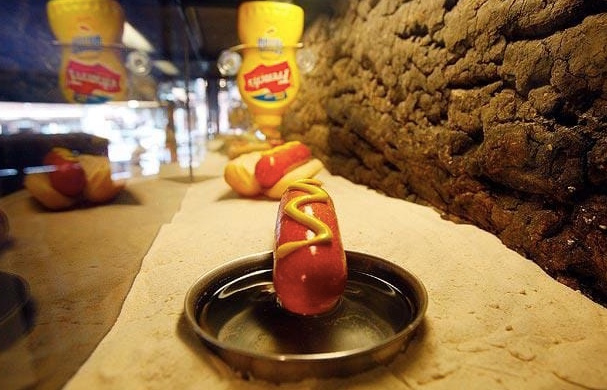
The Sausage Machine
Animatronics