THE WALLED OFF HOTEL, MARCH 2017
THE HOTEL WITH THE WORST VIEW IN THE WORLD
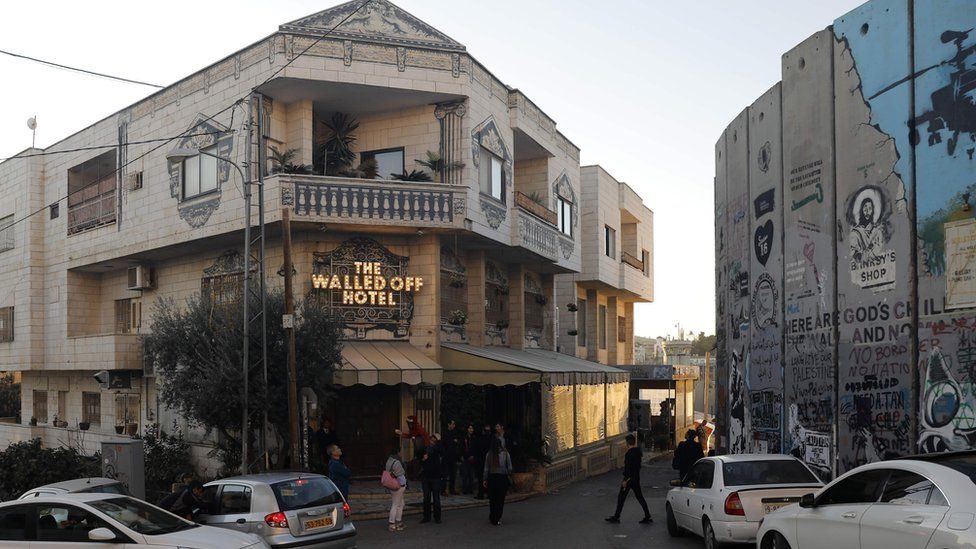
In March 2017, Banksy opened a hotel in Bethlehem. Standing only a few metres from the separation barrier, The Walled Off Hotel advertised itself as offering “the worst view of any hotel in the world.” Its rooms looked directly onto the monumental concrete wall, receiving as little as twenty-five minutes of direct sunlight each day. Yet what initially appeared to be another characteristically provocative Banksy intervention became something considerably more ambitious: a functioning hotel, an installation, a museum, a gallery for Palestinian artists and an extended meditation on the history and politics of the region.
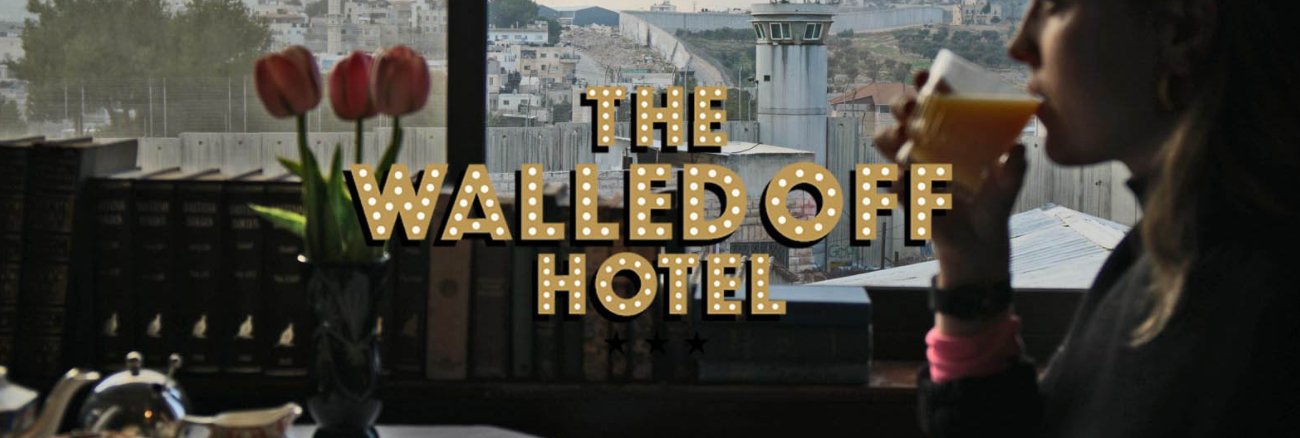
“The hotel boasts floor to ceiling views of graffiti-strewn concrete from almost every room. And for the exhibitionists amongst you, Many are within range of the army watchtower. All scenic rooms are en-suite and equipped with wifi, fridge, radio, personal safe and air conditioning.”
The project marked a new stage in Banksy's long engagement with Palestine. In 2005, he had travelled to the West Bank and painted a series of interventions on and around the newly constructed barrier, transforming its concrete surface through imaginary windows, beaches, children and passages to landscapes beyond. He returned to Bethlehem in 2007 for Santa's Ghetto, creating works including Armoured Dove. A decade later, rather than making another temporary intervention on the wall, Banksy built an institution beside it.
The distinction is important. The Walled Off Hotel did not merely represent the barrier: it required visitors to inhabit its presence. Guests slept beside it, ate breakfast beneath it and encountered it whenever they looked through a window. Architecture, tourism and geography became part of the work itself. The wall was no longer simply Banksy's canvas. It was the view.
“This place is the center of the universe every time God comes to earth it seems to happen near here. The architecture and landscape are stunning, the food delicious and the current situation remarkable and touching. This is a place of immense spiritual and political significance – and very good falafel. We guarantee you won’t be disappointed.”
A COLONIAL HOTEL IN BETHLEHEM
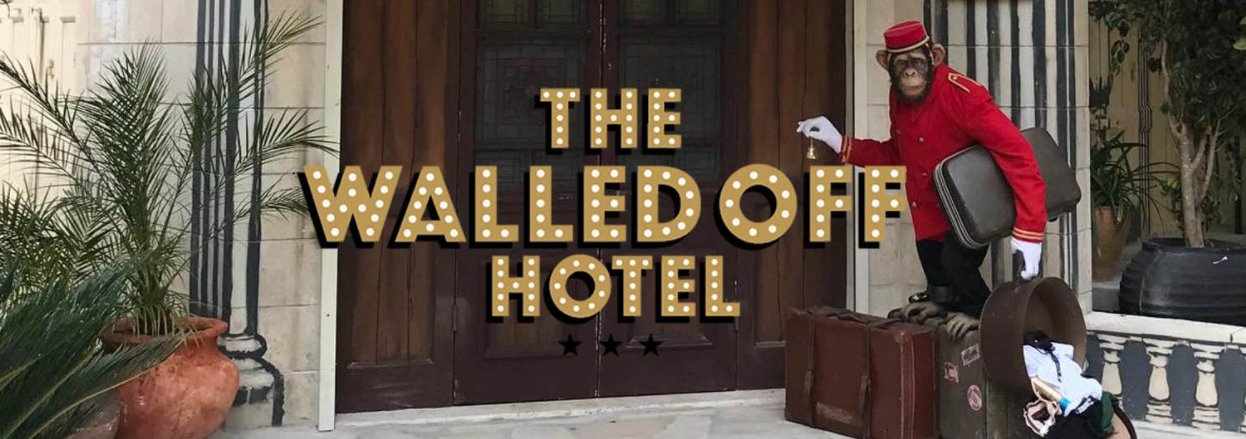
The hotel's title is a characteristically simple piece of Banksy wordplay, transforming the luxury Waldorf into the politically charged Walled Off. Inside, the joke becomes architectural. Banksy conceived the principal rooms in the manner of an old British colonial hotel, with dark wood, leather furniture, ceiling fans, patterned wallpaper, a piano and the carefully cultivated atmosphere of an establishment left behind by the British Empire.
“Britain got its hands on Palestine in 1917 and the piano bar is themed as a colonial outpost from those heady days.”
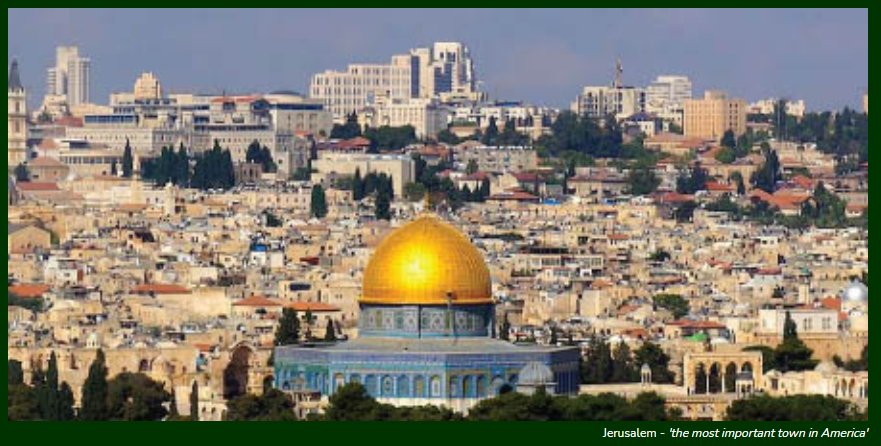
The historical reference was deliberate. The hotel opened during the centenary of 1917, the year British forces took Jerusalem and the British government issued the Balfour Declaration supporting the establishment of a “national home for the Jewish people” in Palestine. Britain's subsequent Mandate over Palestine forms an essential part of the political history explored throughout the project. Banksy's mock-colonial interior therefore transforms British nostalgia into historical discomfort: the furnishings evoke imperial elegance while the museum below examines some of its consequences.
This collision between hospitality and political history runs throughout the hotel. Tea is served on fine china while artworks refer to surveillance, occupation and tear gas. Classical sculptures wear gas masks. Landscapes are interrupted by watchtowers and military machinery. The cultivated language of the luxury hotel remains intact, but almost everything within it has been subtly destabilized.
SLEEPING WITH BANKSY
The guest rooms extend the installation upstairs. Rather than merely hanging Banksy works on the walls of conventional hotel bedrooms, several rooms were conceived as complete environments in which furniture, decoration, art and the view outside operate together.
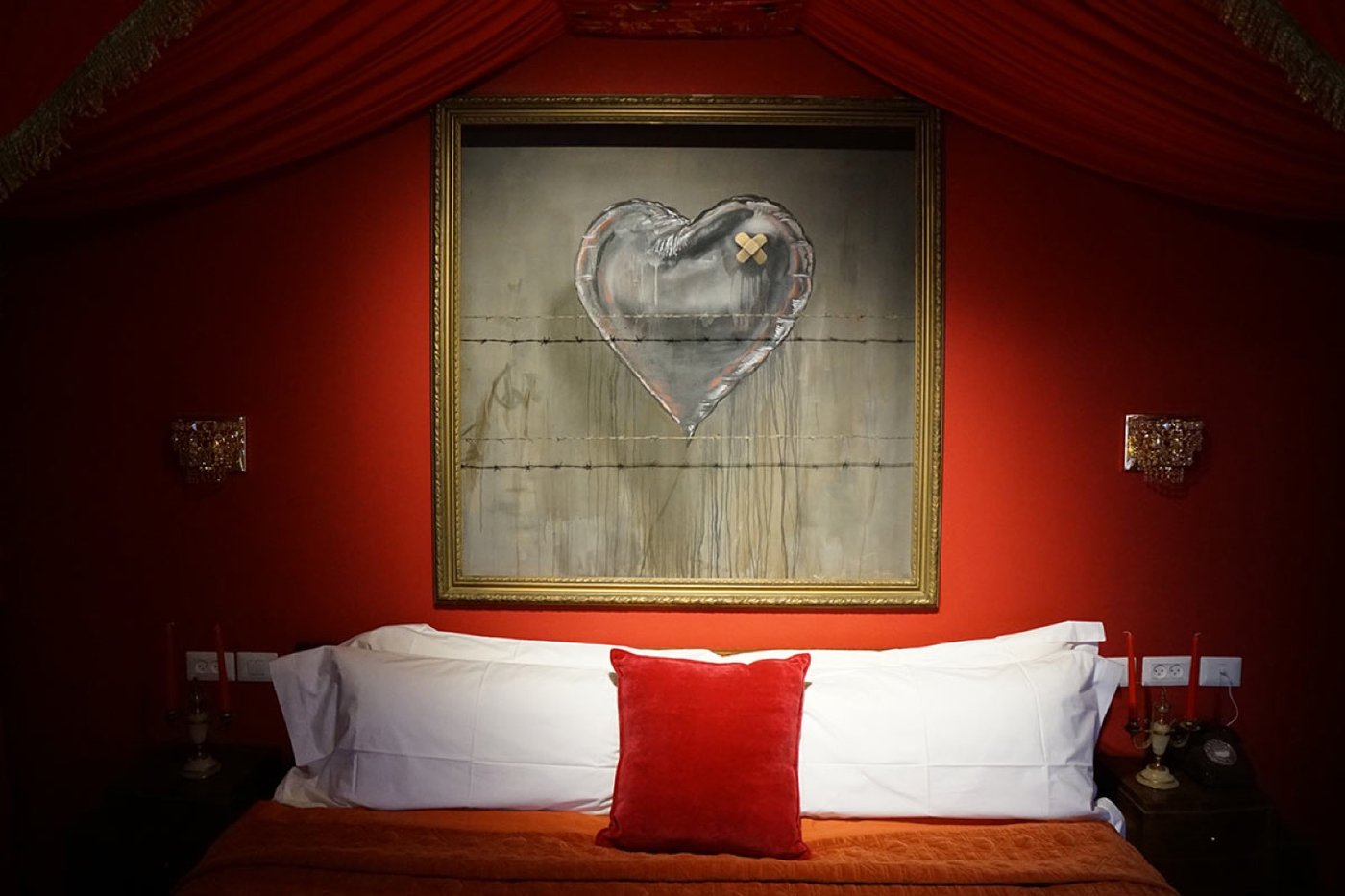
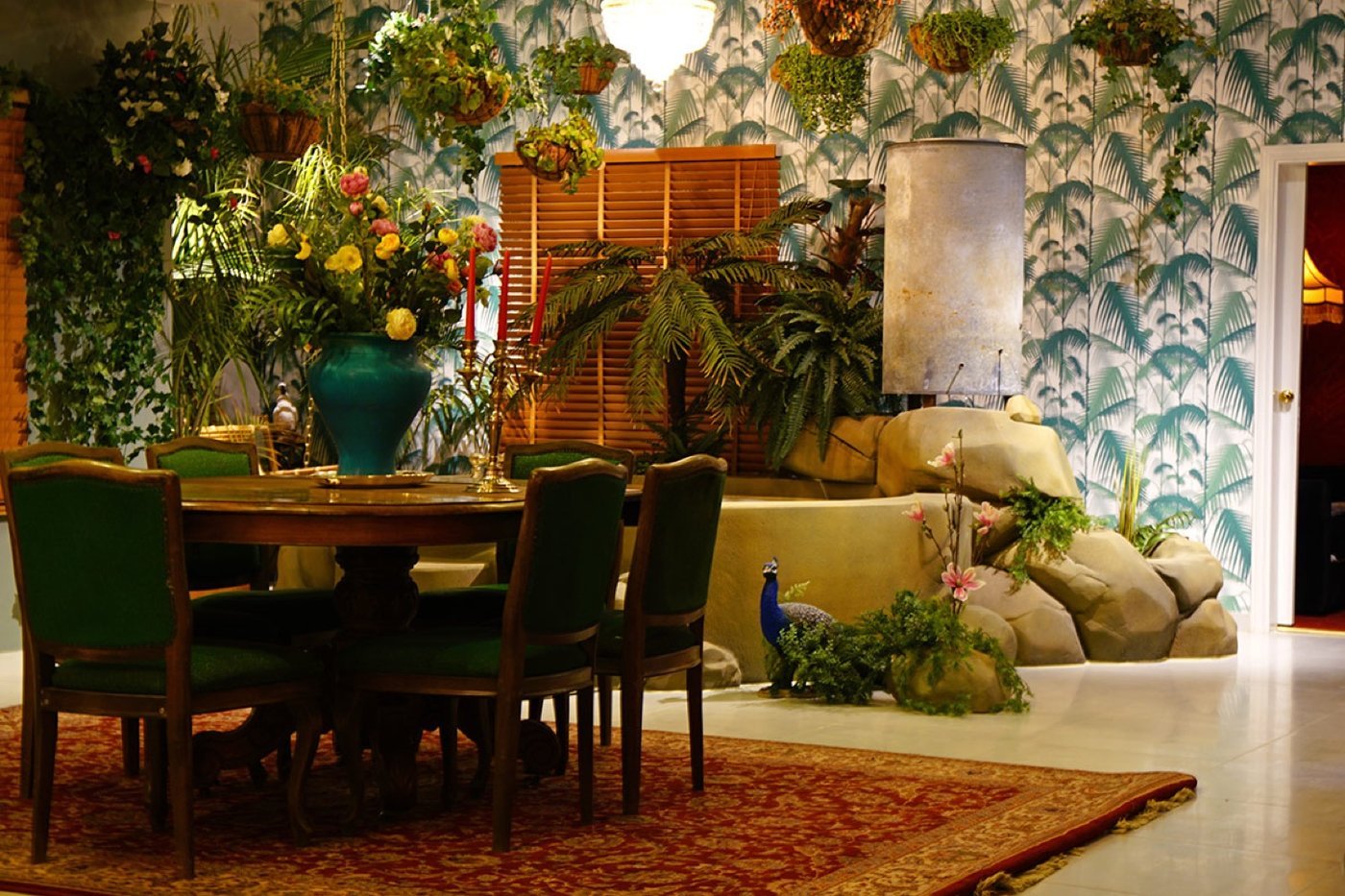
“This palatial suite is equipped with everything a corrupt head of state would need. A plunge bath able to accommodate up to four revelers, original artwork, library, home cinema, roof garden, tiki barn and a water feature made from a bullet riddled water tank. Comes with a complete set of Dead Sea bath minerals. And an in-room dining service available upon request.”
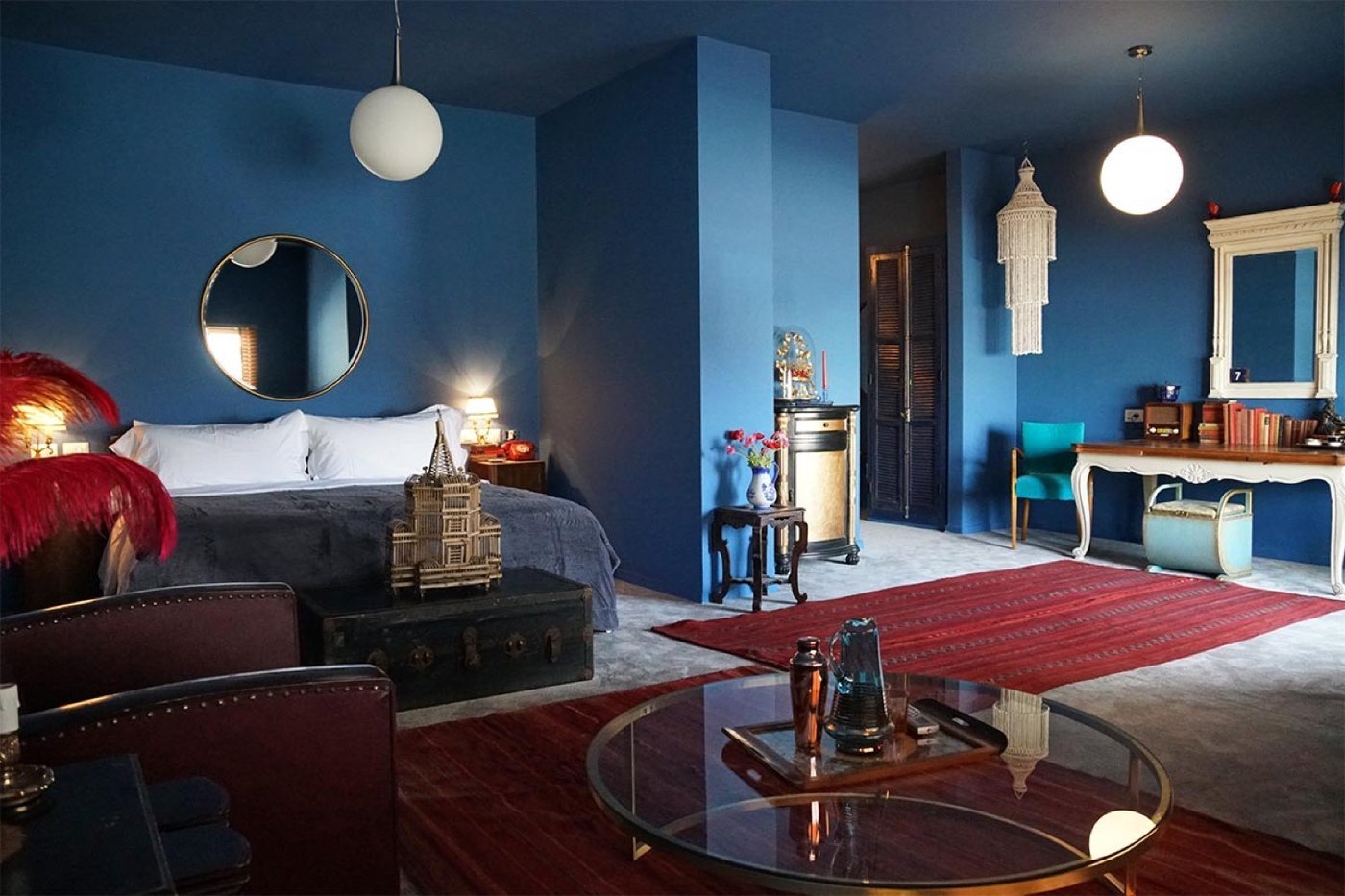
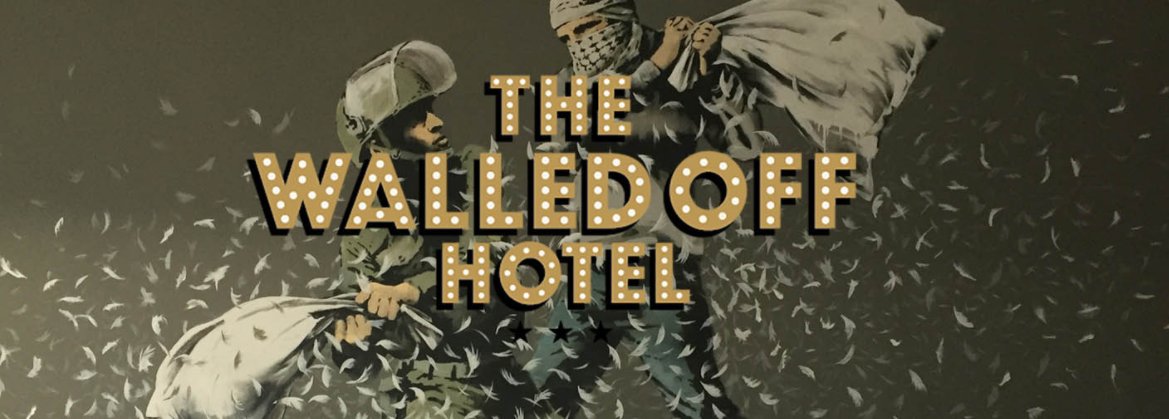
The best known is Banksy's Room, where a Palestinian and an Israeli engage in a pillow fight above the bed. The two masked figures occupy opposing sides of the composition, but their weapons have been replaced by pillows whose feathers explode across the wall. The image translates confrontation into an absurd domestic battle while retaining the visual vocabulary of conflict. By placing the work directly above the bed, Banksy makes the guest physically occupy the space beneath it.
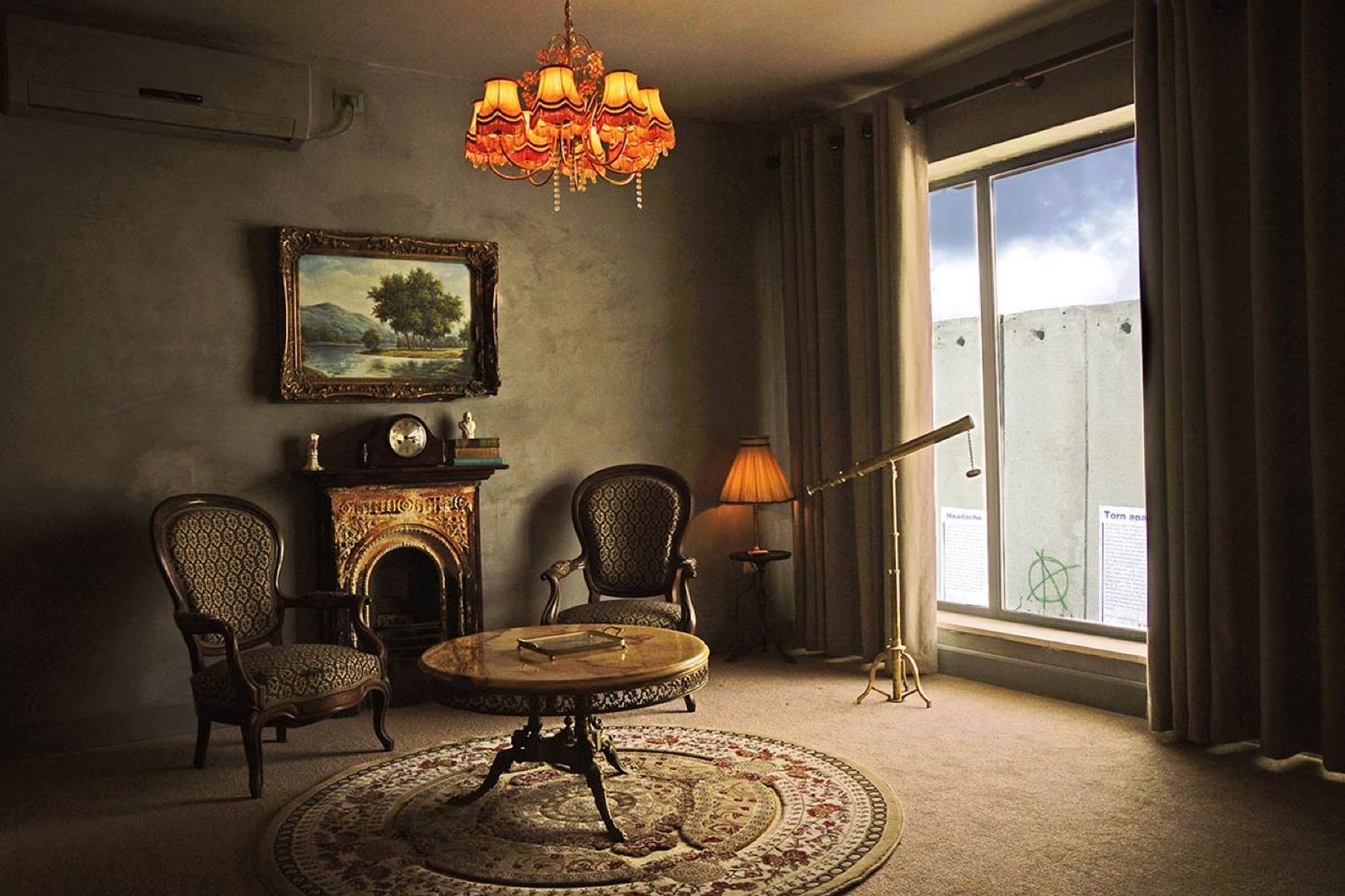
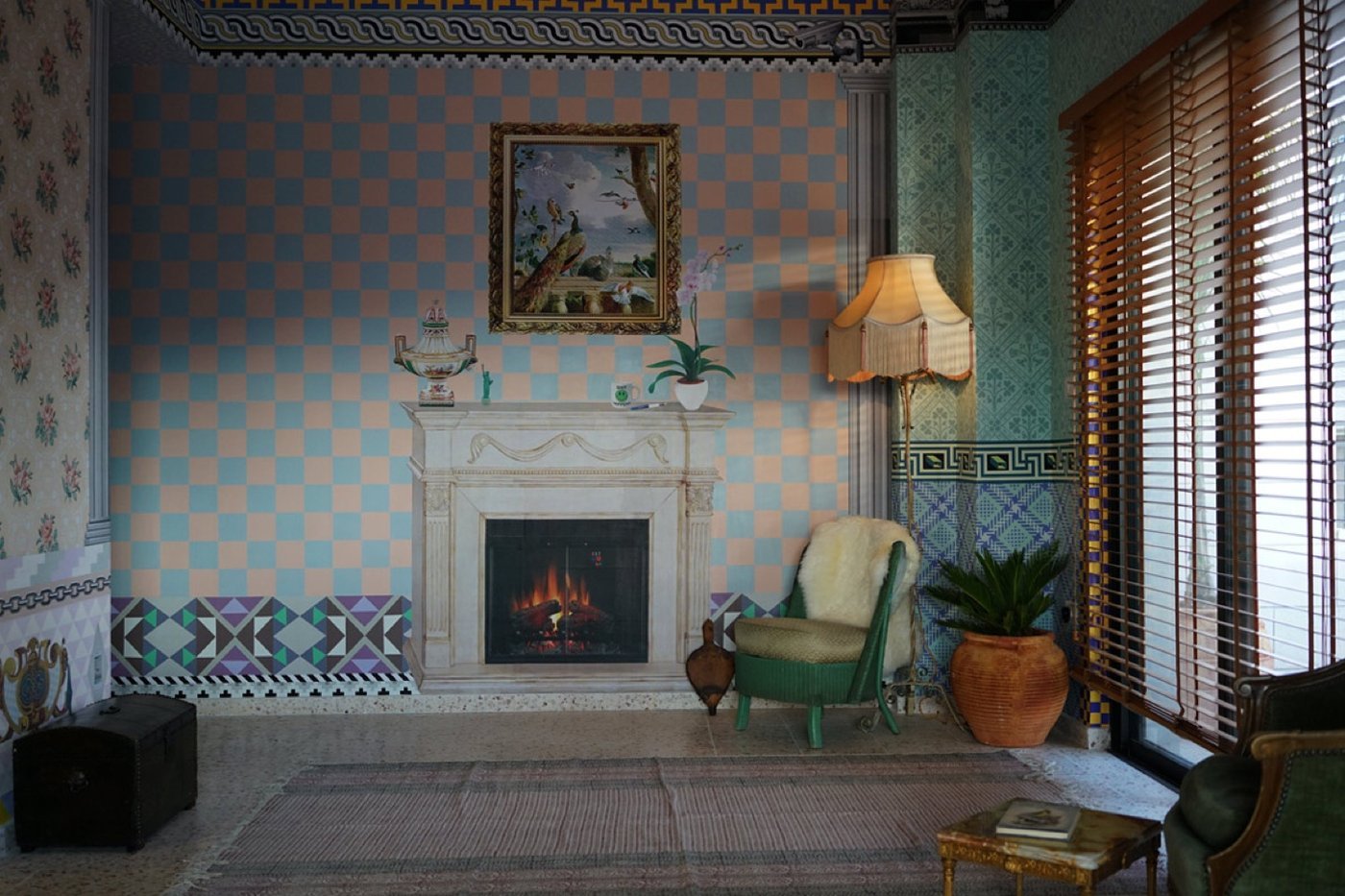
Other rooms developed different aspects of the project. The Scenic Rooms deliberately foregrounded their view of the barrier and nearby watchtower, while the extravagant Presidential Suite parodied the excesses of political power. Even the cheapest accommodation participated in the concept: the hotel offered a military-style dormitory equipped with surplus furnishings reminiscent of barracks. Luxury, tourism and conflict were deliberately forced into uncomfortable proximity.
THE WALL AS THE VIEW
The central artwork of The Walled Off Hotel is ultimately outside the building.
From many of its windows, the separation barrier dominates the field of vision. Begun by Israel in 2002 during the Second Intifada, the barrier combines concrete walls with fences and other security infrastructure. Israel has described it as a security measure against attacks; Palestinians have experienced it as a system that restricts movement and separates communities, land and livelihoods. Its route through and around the West Bank has remained the subject of intense political and legal dispute.
Banksy had already addressed the barrier directly in 2005, but the hotel reverses the relationship between artwork and wall. In the earlier interventions, images attempted metaphorically to penetrate the concrete: a window opened onto mountains, children escaped toward an imaginary beach, and figures pulled back or crossed through the surface. At The Walled Off Hotel, there is no imaginary escape. The wall remains physically present outside the window.
This is what makes the project unusually powerful within Banksy's work. Visitors are not simply shown an image about separation; they travel to Bethlehem and encounter the architecture of separation themselves. Tourism, normally organized around desirable views and pleasurable experiences, becomes a mechanism for directing attention toward something visitors might otherwise choose not to see.
A MUSEUM WITHIN THE HOTEL
Banksy also incorporated a museum devoted to the history of the region. Its presence fundamentally changes the nature of the project. The hotel does not ask Banksy's artworks alone to explain an exceptionally complex conflict; it creates a separate space in which visitors can encounter historical documents, maps, objects and explanatory material.
The museum begins with the British period and follows the political history that produced the contemporary landscape visible outside. Its inclusion reflects a broader development in Banksy's practice. Like Dismaland two years earlier, The Walled Off Hotel is not a single artwork but a constructed environment in which exhibition design, objects, texts, architecture and visitor movement all contribute to the experience.
The approach also allows Banksy's humour to operate alongside historical information rather than replacing it. The jokes attract attention; the museum asks visitors to remain long enough to understand some of what lies behind them.
A GALLERY FOR PALESTINIAN ART
One of the project's most important components was deliberately not devoted to Banksy. The hotel incorporated a gallery exhibiting contemporary Palestinian artists, including established figures such as Suleiman Mansour, alongside younger artists from the region.
This was significant in a project whose international visibility inevitably depended upon Banksy's celebrity. Rather than presenting Palestine exclusively through the work of a visiting British artist, the gallery created a platform within the building for artists whose lives and practices emerged from the place itself. The hotel consequently operated simultaneously as a Banksy destination and as an exhibition space capable of directing its international audience toward Palestinian contemporary art.
That distinction also addresses one of the inevitable tensions surrounding Banksy's interventions in the region: the ability of an internationally famous Western artist to attract attention unavailable to many local artists. The Walled Off Hotel did not eliminate that contradiction, but the Palestinian gallery made it part of the institutional structure of the project rather than ignoring it.
THE PIANO BAR
At the centre of the hotel was its colonial-style piano bar, perhaps the most complete expression of Banksy's theatrical approach to the project. Original works were integrated among sofas, lamps, books, sculptures and paintings rather than isolated within the neutral environment of a gallery.
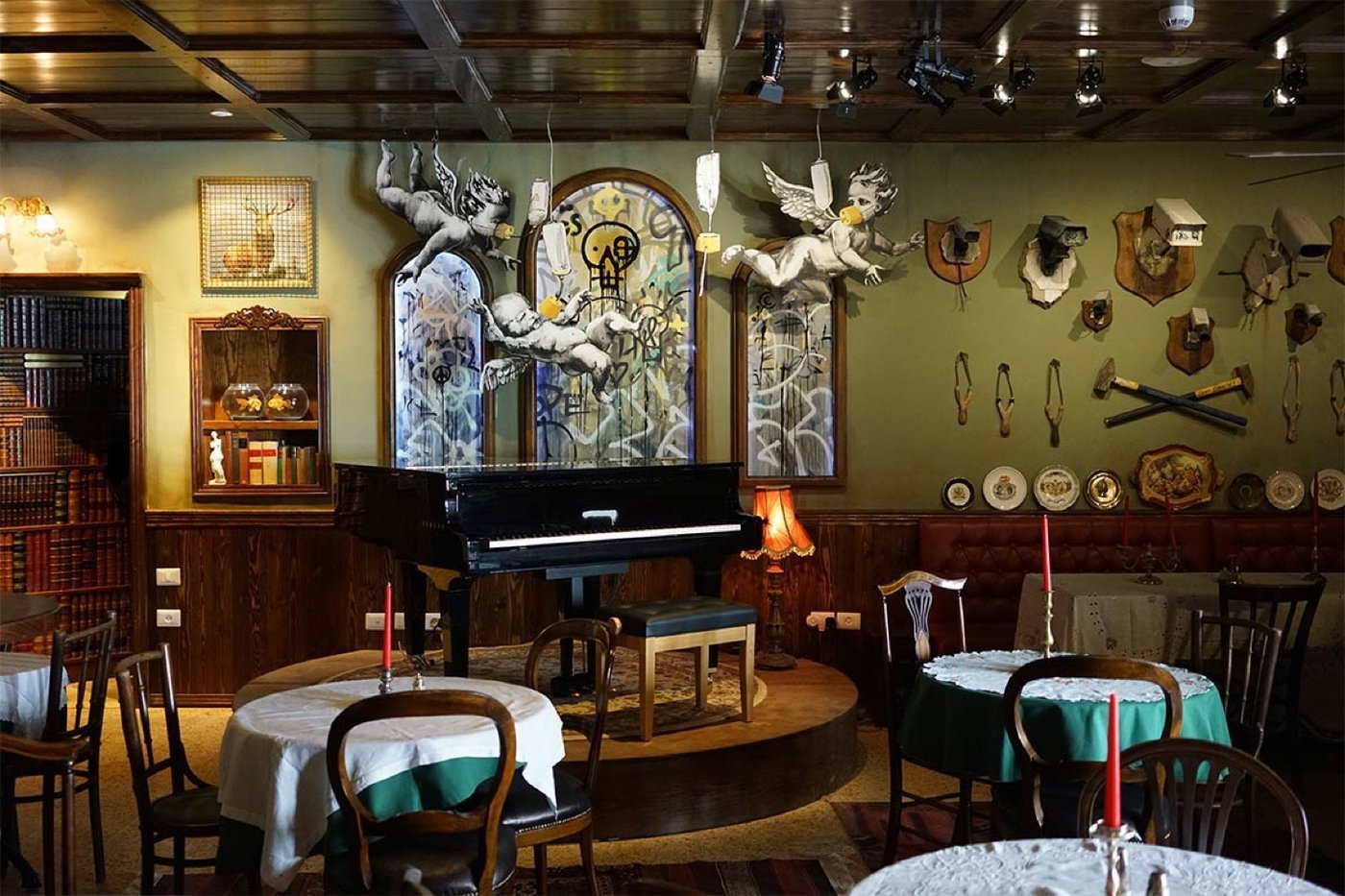
Here Banksy returned to a strategy that runs through his Vandalised Oils: apparently traditional paintings are disrupted by contemporary political or military intrusions. Bucolic landscapes encounter watchtowers; classical figures confront tear gas; familiar forms of European culture are made to coexist with the realities outside the building.
The bar therefore functions almost as a three-dimensional Banksy composition. British decorative taste, colonial history, contemporary conflict and dark humour occupy the same room. Visitors can order tea or a drink while surrounded by objects reminding them that the comfort of the setting is itself part of the joke.
MORE THAN TWENTY ORIGINAL WORKS
The hotel brought together an exceptional concentration of new Banksy works. Among those displayed throughout the building were altered landscapes, sculptures and installations including Leopard and Sheep, Bulldozer, Children Climbing the Heaven's Gate, Watchtower, Flower Behind Bars, Deer Behind Bars, Jesus with Drones, Angels with Oxygen Masks and Adonis with Tear Gas.
Seen individually, many belong to familiar areas of Banksy's vocabulary: surveillance, militarization, childhood, religion, borders and the collision between idyllic imagery and political reality. Seen together inside the hotel, however, they form something closer to an environment than a conventional exhibition. Their meaning continually returns to what lies immediately outside.
This is why The Walled Off Hotel should be understood as an artwork in its own right rather than simply a hotel containing Banksy artworks. The building, its interiors, its collection, its museum, its gallery and its geographical position were conceived as parts of the same experience.
THE GIFT SHOP
“Opened a gift shop today – situated at the back of the Walled Off Hotel. Not to be confused with the “Banksy shop” next door which has nothing to do with me at all. Hand painted mini souvenir separation walls now available.”
In September 2017, Banksy extended the project with an official gift shop at the rear of the hotel. Its existence inevitably played with one of the recurring contradictions of Banksy's career: an artist deeply critical of consumer culture whose own works and objects have become highly desirable commodities.
Among the objects offered were hand-painted miniature sections of the separation wall and the Grappling Hook, a crucifix transformed into a device for climbing over a barrier. Rather than avoiding the language of tourist merchandise, Banksy absorbed it into the project. Bethlehem souvenirs, hotel memorabilia and political objects became deliberately difficult to separate.
The gift shop also needs to be distinguished from unrelated businesses operating nearby under Banksy's name. When announcing it, Banksy explicitly warned visitors not to confuse the hotel's official shop with the neighbouring “Banksy shop,” with which he had no connection.
THE ALTERNATIVITY
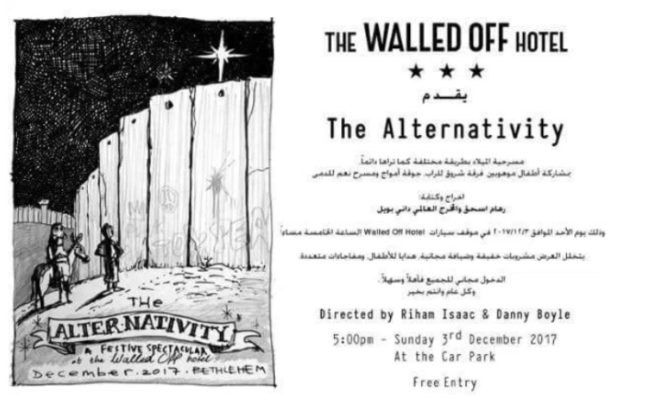
In December 2017, the hotel became the center of another ambitious Banksy project. The Alternativity reimagined the traditional Nativity play in contemporary Bethlehem. Directed by Danny Boyle with Palestinian director and performer Riham Isaac, the production brought together local performers and children and was subsequently documented for British television.
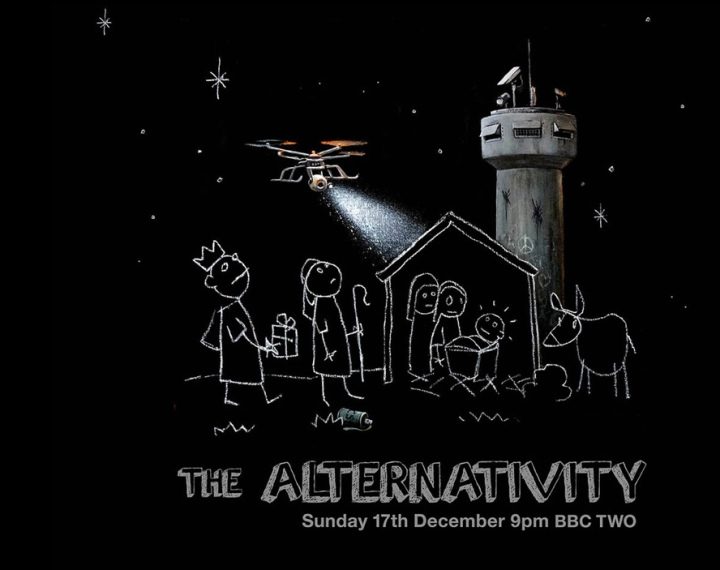
The project extended one of the hotel's central ideas: the extraordinary distance between the Bethlehem of Christian imagination and the contemporary city surrounding the Church of the Nativity. Christmas imagery associated internationally with peace, pilgrimage and celebration was confronted with checkpoints, restricted movement and the separation barrier.
On 3 December 2017, Banksy unveiled two related interventions. Angels on the Wall showed two cherubs attempting to prise apart the separation barrier, using an actual opening in the concrete as part of the composition. Peace on Earth — Terms and Conditions Apply appeared on a doorway near the Chapel of the Milk Grotto, transforming one of Christianity's most familiar Christmas messages into the language of a contractual disclaimer. These were not murals created for the hotel's March opening, but later works belonging specifically to the December Alternativity project.
TAKING PALESTINE TO THE TRAVEL INDUSTRY
Banksy carried the project's mixture of tourism and political commentary into another unlikely setting in November 2018: London's World Travel Market. He created a replica section of the separation barrier for the Palestine stand at the international tourism trade fair and advertised the appearance with the characteristic observation that neighbouring exhibitors had complained that his wall was too tall.
Opening my first ever stall at a trade fair next week. I’ve painted a replica separation barrier to promote the Walled Off hotel, ironically the neighbors have complained it’s too tall. We’ll be at Palestine stand giving away free stuff, World Travel Fair, London Excel center 6th and 7th November. Free to get in if you register online today and pretend to be a travel agent.
The gesture completed an interesting reversal. In Bethlehem, Banksy had used a hotel to bring tourists toward the wall. In London, he reconstructed the wall inside the commercial machinery of international tourism in order to promote travel to Palestine.
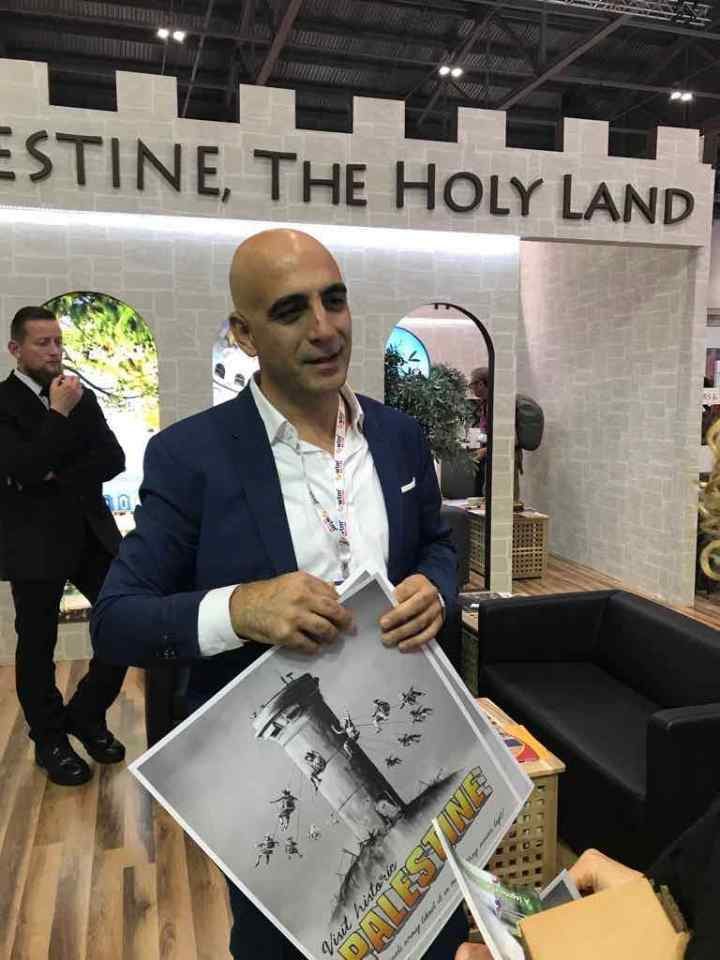
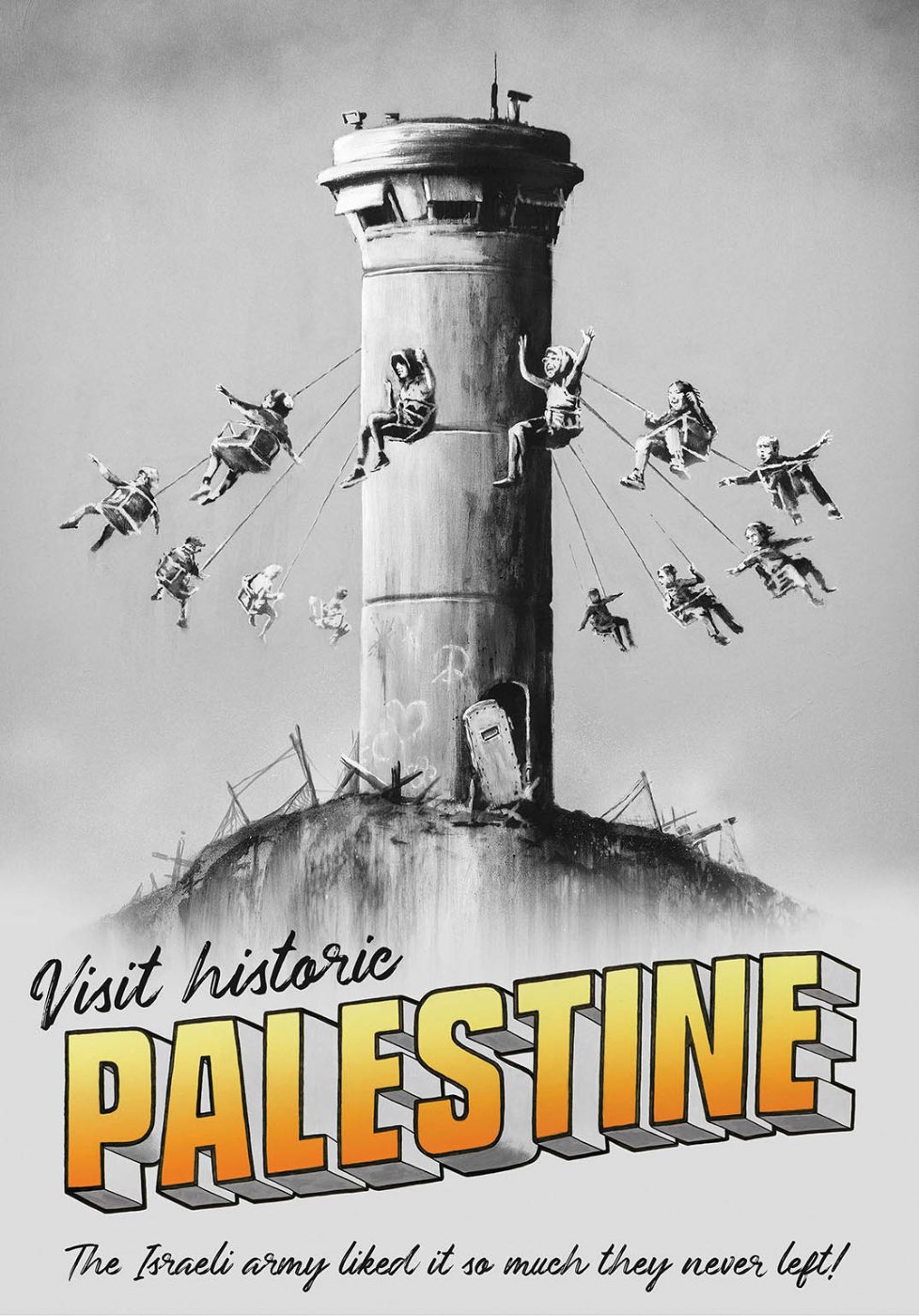
The hotel distributed Banksy's Visit Historic Palestine poster at the fair, adopting the visual language of vintage tourism advertising while directing attention toward the contemporary political landscape. Tourism was no longer incidental to Banksy's intervention; it had become one of its principal media.
Free Palestine poster. Be advised we only have 1000 posters to hand out each day at the tourist fair.
THE SCAR OF BETHLEHEM
Banksy returned to the hotel's Christmas theme in December 2019 with Scar of Bethlehem, a modified Nativity scene installed inside the hotel. Mary, Joseph and the infant Jesus appear before miniature concrete sections of the separation barrier. Above them, a large impact mark pierces the wall, its radiating cracks forming the shape traditionally occupied by the Star of Bethlehem.
The work condensed much of the hotel's conceptual programme into a single image. A scene that has made Bethlehem one of the world's most recognizable pilgrimage destinations is placed against the architecture that defines much of the contemporary experience of the city. The star remains visible, but as a wound.
A PERMANENT BANKSY PROJECT
What began in 2017 as an extraordinary experiment ultimately became one of Banksy's longest-running projects. Unlike Dismaland, The Village Pet Store and Charcoal Grill or Better Out Than In, the hotel was not designed simply to disappear after a few weeks. It established a continuing physical presence in a place Banksy had first engaged with more than a decade earlier.
Its importance lies partly in that duration, but more fundamentally in the expansion of what a Banksy artwork could be. The artist had moved from stencil to installation, from installation to exhibition, and eventually from exhibition to institution. A hotel could contain bedrooms, a museum, a gallery, a shop, a bar and original artworks while the political landscape outside remained inseparable from all of them.
The project also preserves the contradictions characteristic of Banksy's work rather than resolving them. It turns conflict into a tourist destination while questioning political tourism; it sells souvenirs while satirizing consumption; it uses Banksy's international celebrity while providing space for Palestinian artists; and it transforms a place of division into a place where visitors are invited to stay.
The Walled Off Hotel therefore stands alongside Dismaland and Better Out Than In as one of Banksy's most ambitious major projects. Yet its defining feature is something neither of those projects possessed: the landscape outside is not scenery constructed by the artist. It is real. Banksy's most consequential intervention was to build a place from which it could no longer be ignored.
ORIGINALS EXHIBITED
STAY INFORMED
Receive the latest news, exhibitions, artworks and market updates on Banksy.