
Thomas The Tank Engine, 2008
Banksy vs. Bristol Museum, Bristol, 2009
Art In The Streets, MOCA Los Angeles, 2011
Catalogue Note
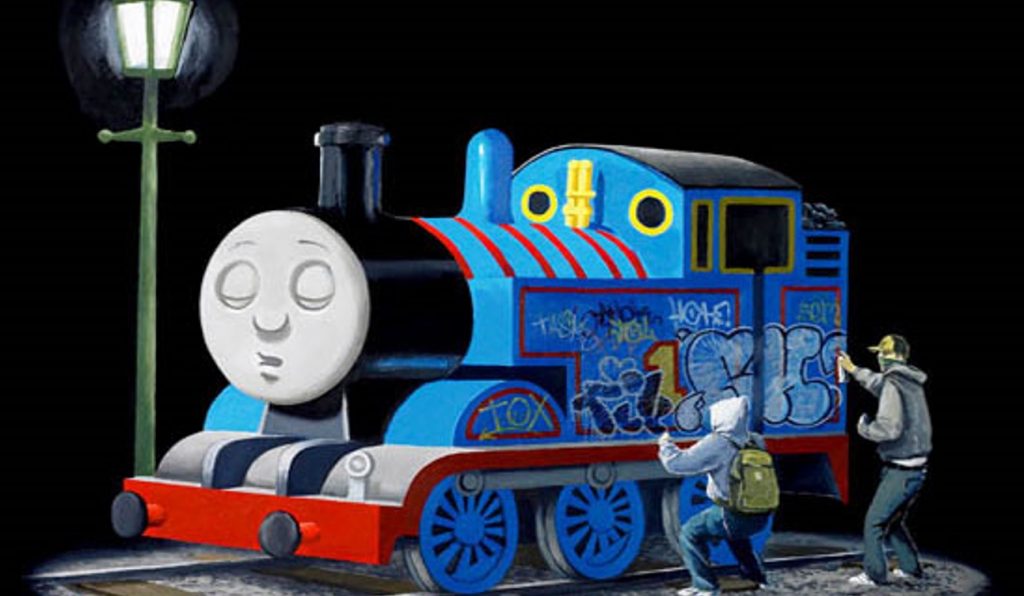
At first glance, Thomas the Tank Engine appears playful, almost nostalgic. Against a deep black background, the world’s most recognizable children’s locomotive sits patiently beneath a solitary streetlamp while two graffiti writers carefully spray-paint its bright blue body. Thomas himself seems entirely untroubled by the intrusion. His familiar smile has become one of quiet contentment, as though he willingly accepts the transformation taking place before him.
The image immediately draws upon one of the oldest traditions in graffiti culture. Long before murals adorned galleries and museums, trains served as moving canvases for writers seeking visibility across entire cities. Beginning in New York during the 1970s and flourishing throughout the 1980s, painted subway cars carried graffiti across boroughs, allowing an artist’s name to travel far beyond the neighbourhood in which it was created. In many respects, trains became the original social media of street art. By choosing perhaps the most beloved fictional locomotive in popular culture, Banksy humorously reconnects his own practice to the very origins of graffiti itself.
Yet the work goes considerably further than a historical tribute. Thomas has always represented obedience, order and good behaviour. Created to teach children lessons about responsibility, cooperation and discipline, he belongs to a carefully controlled universe where every train has its assigned role and every story concludes with moral certainty. Graffiti represents precisely the opposite values: spontaneity, rebellion, appropriation of public space and creative freedom. Banksy brings these two worlds together without conflict. Rather than resisting the intervention, Thomas appears to embrace it.
That quiet acceptance transforms the painting into something far more subtle than an act of vandalism. Graffiti is no longer portrayed as an assault upon innocence but as its natural evolution. The street artists are not destroying Thomas; they are giving him a new identity. What was once considered an act of criminal damage becomes an act of cultural renewal.
The composition can also be read as a reflection upon Banksy’s own career. By 2008, the artist had travelled a remarkable distance from his anonymous beginnings on the walls of Bristol. Street art had begun entering major museums, collectors were competing to acquire works that once would have been scrubbed from public walls, and Banksy himself occupied the unusual position of simultaneously representing graffiti’s rebellious origins and its growing institutional acceptance. Thomas, the ultimate symbol of mainstream childhood culture, becomes an unlikely metaphor for that transformation. Graffiti no longer exists solely outside the establishment; it has quietly entered it.
Capture of Banksy’s website in 2008
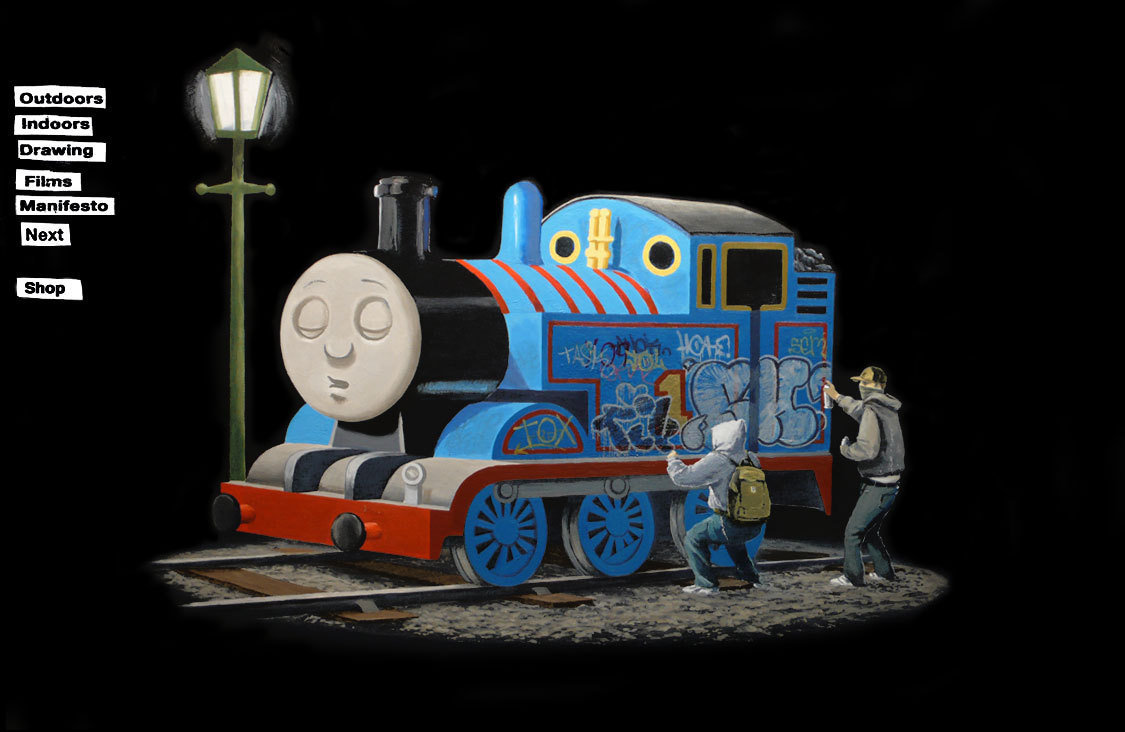
The dramatic black background reinforces this theatrical quality. Removed from any recognisable landscape, Thomas appears almost like an actor illuminated on a stage. The surrounding darkness isolates the scene, encouraging the viewer to concentrate entirely on the relationship between the train and the artists. Even the solitary streetlamp functions symbolically, recalling the nocturnal conditions under which graffiti has traditionally been created while simultaneously casting the scene in an almost reverential light.
There is also a delightful irony embedded within the work. Graffiti writers traditionally painted real trains so that their work could travel across entire railway networks, reaching audiences they would never otherwise encounter. Here, Banksy paints a fictional train that has already travelled around the world through books and television. Thomas has always been mobile; Banksy simply changes the cargo he carries. Instead of transporting passengers, he now carries the history of graffiti itself.
Ultimately, Thomas the Tank Engine is less about vandalism than about cultural inheritance. It acknowledges the pioneers of train graffiti while celebrating the extraordinary journey street art itself has undertaken—from railway depots and abandoned sidings to museums, collectors’ walls and art history. Thomas remains the same cheerful engine children have loved for generations. The only difference is that he has finally acquired the markings of the world through which he travels. In Banksy’s hands, graffiti ceases to be an act of destruction and becomes a rite of passage, proving that even the most orderly symbols of childhood can make room for rebellion.