BANKSY
Untitled, 2002
Acrylic and spray enamel on canvas
43.2 x 43.2 cm (17×17 inches)
Stenciled ‘Bansky’ (on the overlap)
Signed, inscribed and dated ‘Banksy LA 2002 3/5’ (on the stretcher)
This work is number three from an edition of five
Provenance
33 1/3 Gallery, Los Angeles, USA
Auction History
| Christie’s London 20 October 2008 Est.: GBP 20,000 – 30,000 | Price Realized |
Catalogue Note
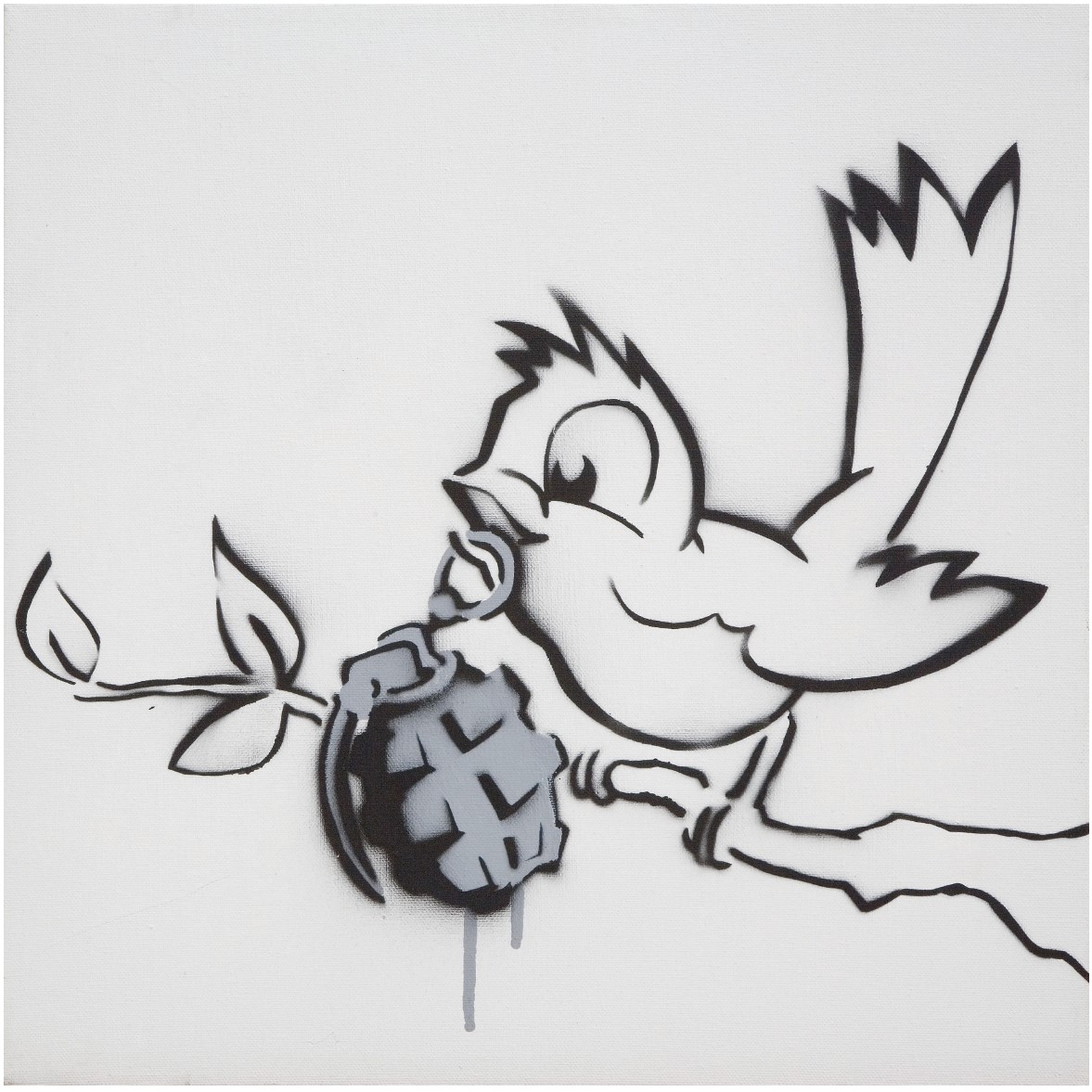
Few artists are capable of expressing the absurdity of war with such remarkable economy. In Untitled (Bird with Grenade), Banksy reduces one of humanity’s oldest aspirations—peace—to a single fragile moment suspended between hope and catastrophe.
Perched innocently upon a branch, a small cartoon-like bird grasps not a worm or a twig, but the pin of a hand grenade. The explosive hangs beneath its beak, motionless yet charged with imminent danger. The image appears playful, almost charming, until the viewer realizes the unbearable tension upon which the entire composition rests: should the bird release its grip for even a fraction of a second, peace would literally let go of war.
That simple inversion transforms a familiar symbol into something profoundly unsettling. Traditionally, birds have represented innocence, freedom and reconciliation. The olive branch carried by the dove has long served as one of civilization’s most enduring emblems of peace. Banksy quietly replaces that branch with a live grenade, suggesting that in the modern world peace no longer arrives free from danger. It survives only through constant vigilance.
The genius of the composition lies in its ambiguity. Is the bird consciously preventing the explosion, courageously holding the pin in place? Or is it blissfully unaware of the burden it carries? Banksy refuses to answer. Like so much of his work, the image balances precariously between optimism and fatalism, leaving the viewer suspended between hope and anxiety.
Executed with the visual clarity of an animated illustration, the bird possesses an almost childlike innocence. Its exaggerated eye, rounded body and simplified outlines recall classic cartoons, making the deadly military object appear even more jarring. This collision between innocence and violence became one of Banksy’s defining visual strategies throughout the early 2000s. Rather than depicting the horrors of war directly, he exposes their absurdity by allowing symbols of childhood and tenderness to collide with instruments of destruction.
Birds occupy a singular place throughout Banksy’s oeuvre. They frequently embody freedom, migration, vulnerability and resilience, appearing whenever the artist wishes to remind us that nature often serves as the silent witness to human folly. Here, the tiny creature becomes an unlikely custodian of peace, suggesting that the preservation of life may ultimately depend upon those least equipped to bear such responsibility.
Like Love Is In The Air, Happy Choppers, Bomb Hugger, and Every Time I Make Love to You I Think of Someone Else, Bird with Grenade belongs to the remarkable body of anti-war imagery Banksy developed during the years surrounding the invasion of Iraq. Yet while many of those works rely on satire and overt irony, this composition achieves something quieter and perhaps even more profound. It contains no soldiers, no governments, no slogans and no explosions. Only a bird, a grenade, and a single suspended moment.
Ultimately, Bird with Grenade is less a picture about war than about the extraordinary fragility of peace. Banksy reminds us that peace is rarely a permanent condition. It is an unstable equilibrium, forever dependent upon the smallest gesture, the slightest restraint, the decision not to let go. Among his earliest masterpieces, the work demonstrates his extraordinary ability to compress complex political ideas into images of unforgettable simplicity—images that continue to resonate long after their first glance has passed.

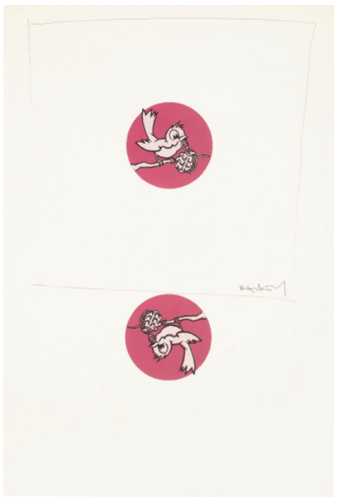
Bird and Grenade, 2002
Signed
This work is an artist’s proof and unique in this format
Exhibited
Banksy: The Unauthorized Retrospective, S/2 London, curated by Steve Lazarides, 2014