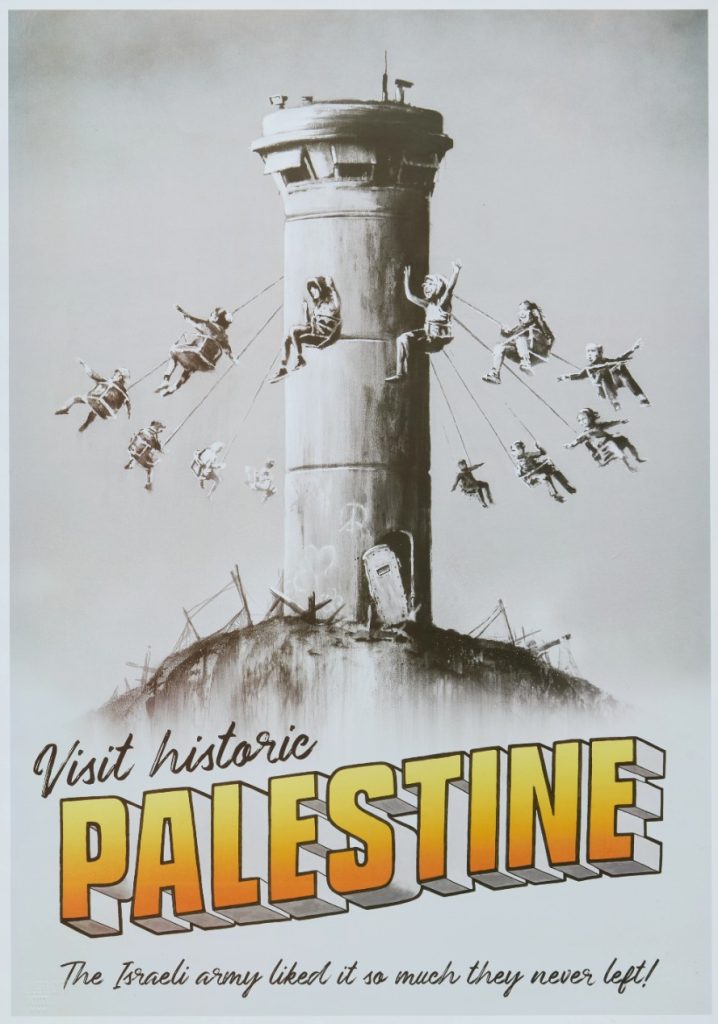
Visit Historic Palestine
Year: 2018
Medium: Offset lithograph in colors
Sheet: 70×50 cm (27-1/2 x 25-5/8 inches)
Edition: Unknown
Some are stamped on the reverse with the Walled off Hotel stamp in pink
1000 posters were handed out each day on the 6th and 7th of November 2018 at the “World Trade Fair” in London
Blindstamped copies available from the Walled Off Hotel
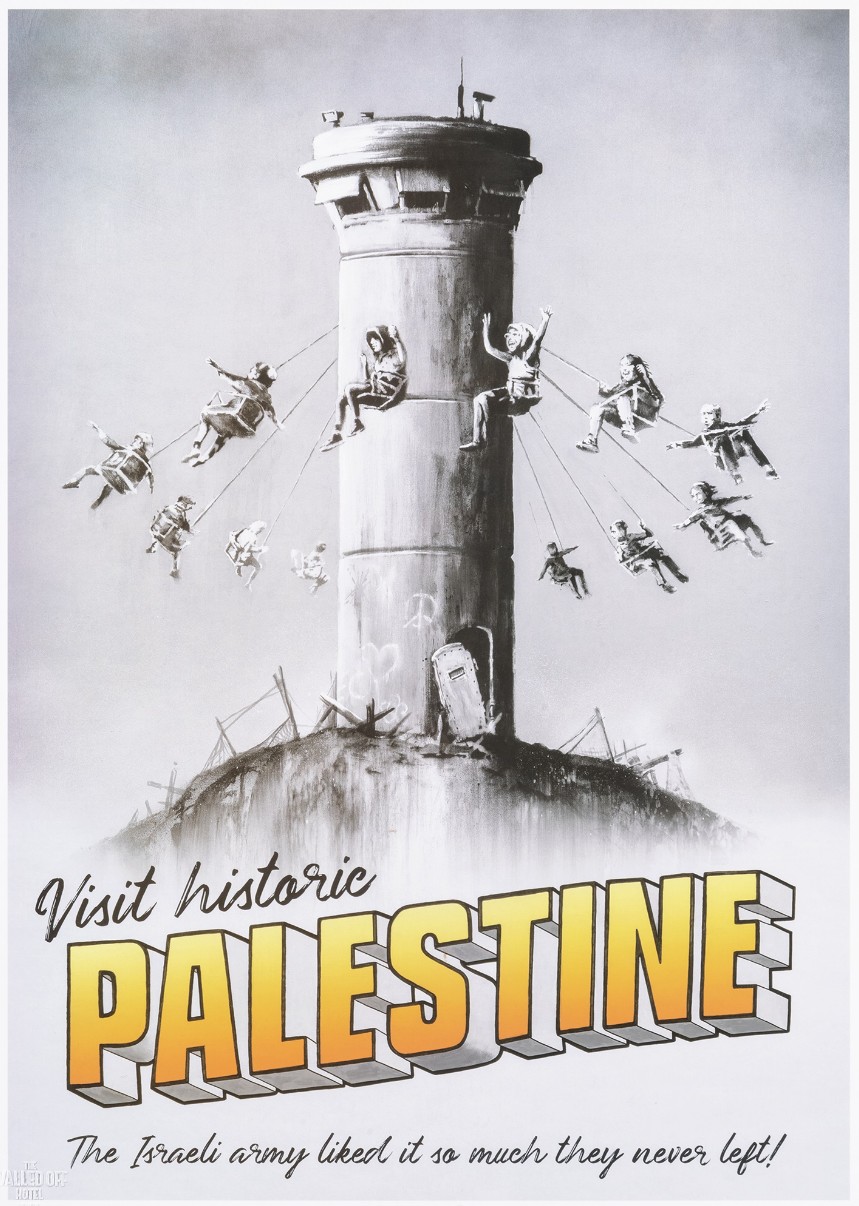
Released in 2018, Visit Historic Palestine is one of Banksy’s most overtly political collectibles and a powerful extension of his long-standing engagement with the Israeli–Palestinian conflict. Produced as an offset lithographic poster and distributed in conjunction with the Walled Off Hotel in Bethlehem, it transforms the familiar language of vintage tourism advertising into a devastating piece of political satire. Rather than promoting idyllic landscapes or cultural heritage, Banksy invites viewers to visit a country whose history, identity and territory remain fiercely contested. As is often the case with his finest work, the humor arrives first, only to reveal an uncomfortable truth beneath it.
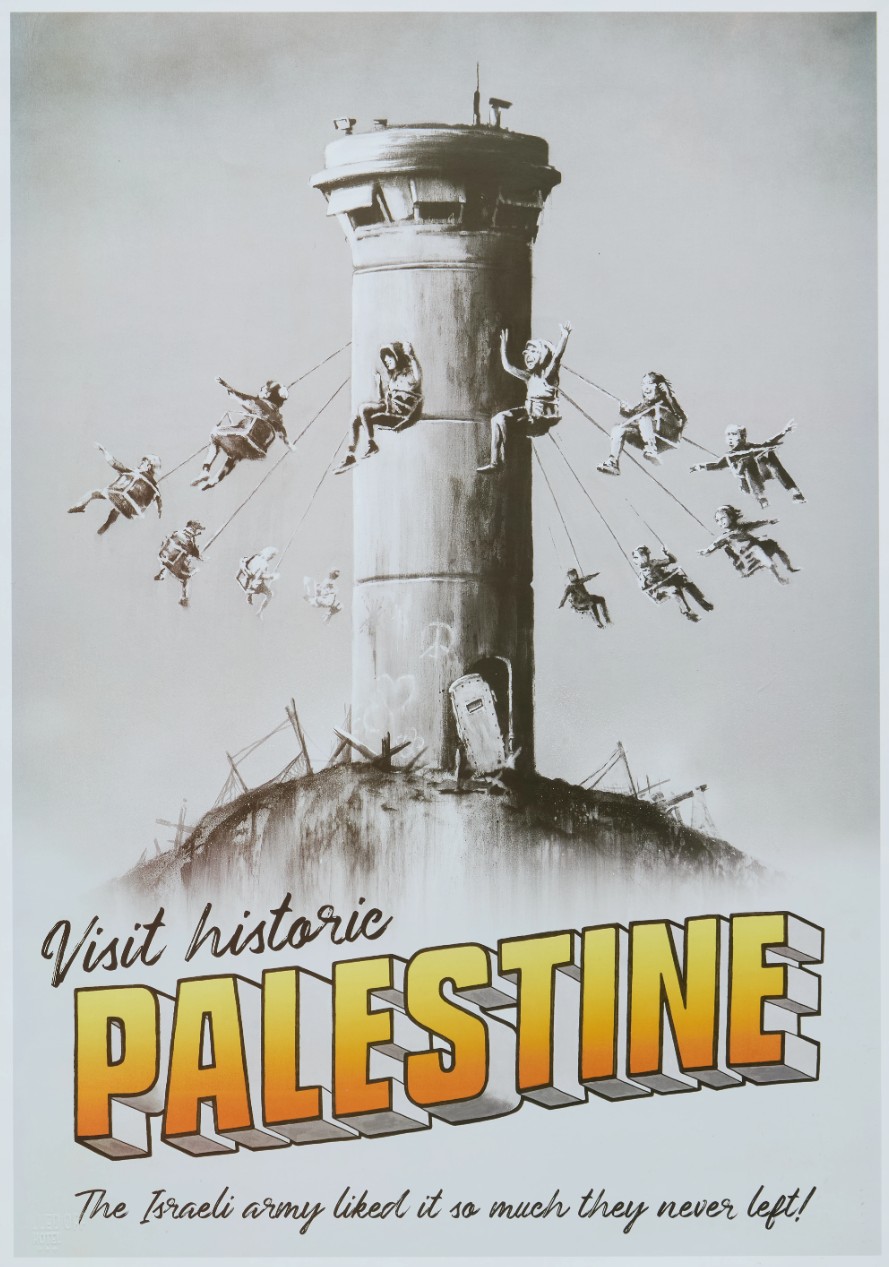
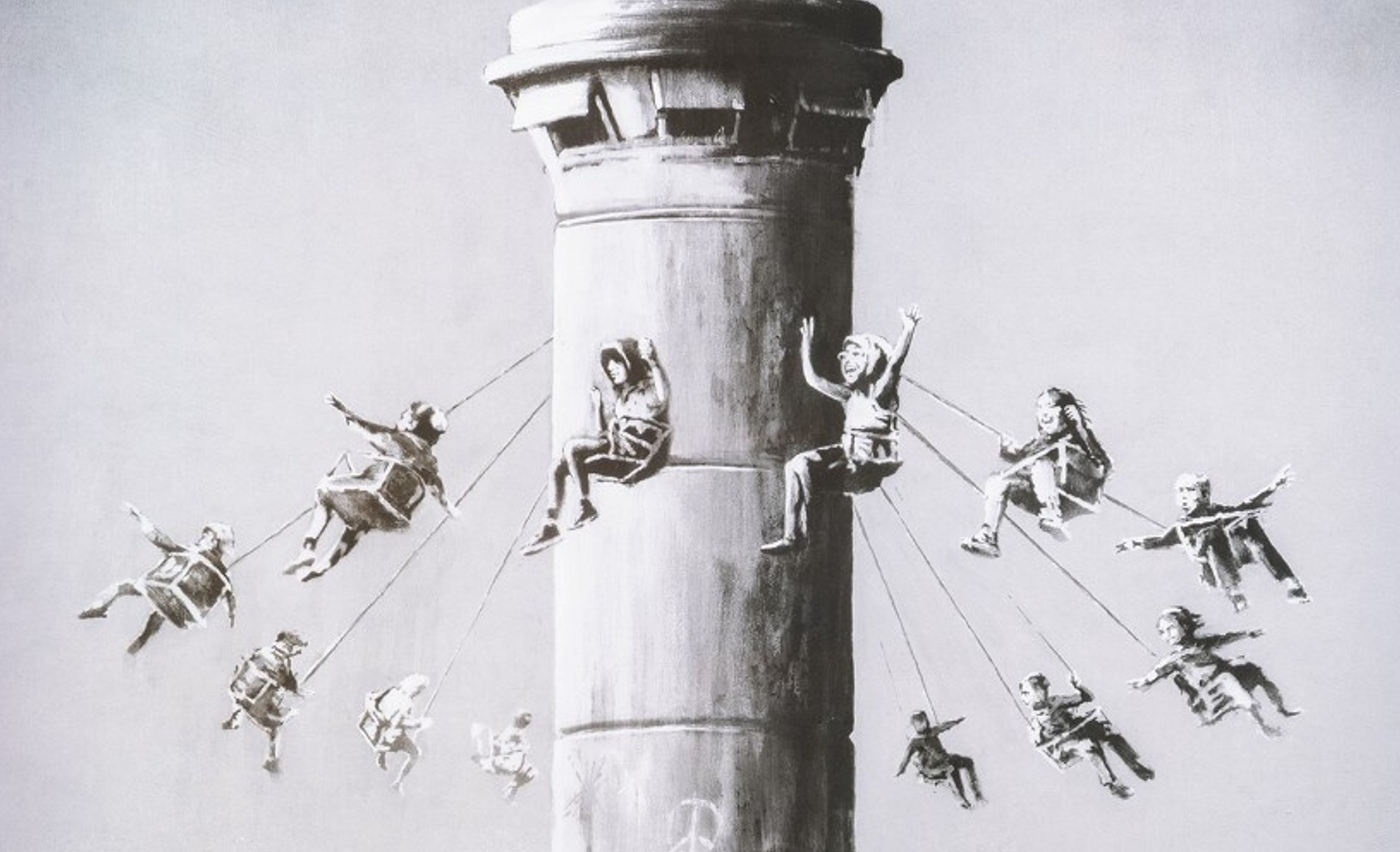
The composition centers on a concrete military watchtower rising from a bleak landscape of fences and ruined structures. Instead of serving its intended purpose of surveillance and control, the tower has been imaginatively transformed into a giant swing ride, with children suspended from cables circling the structure as though enjoying an amusement park attraction. Their expressions convey carefree delight, creating a striking contrast with the architecture of occupation that dominates the scene.
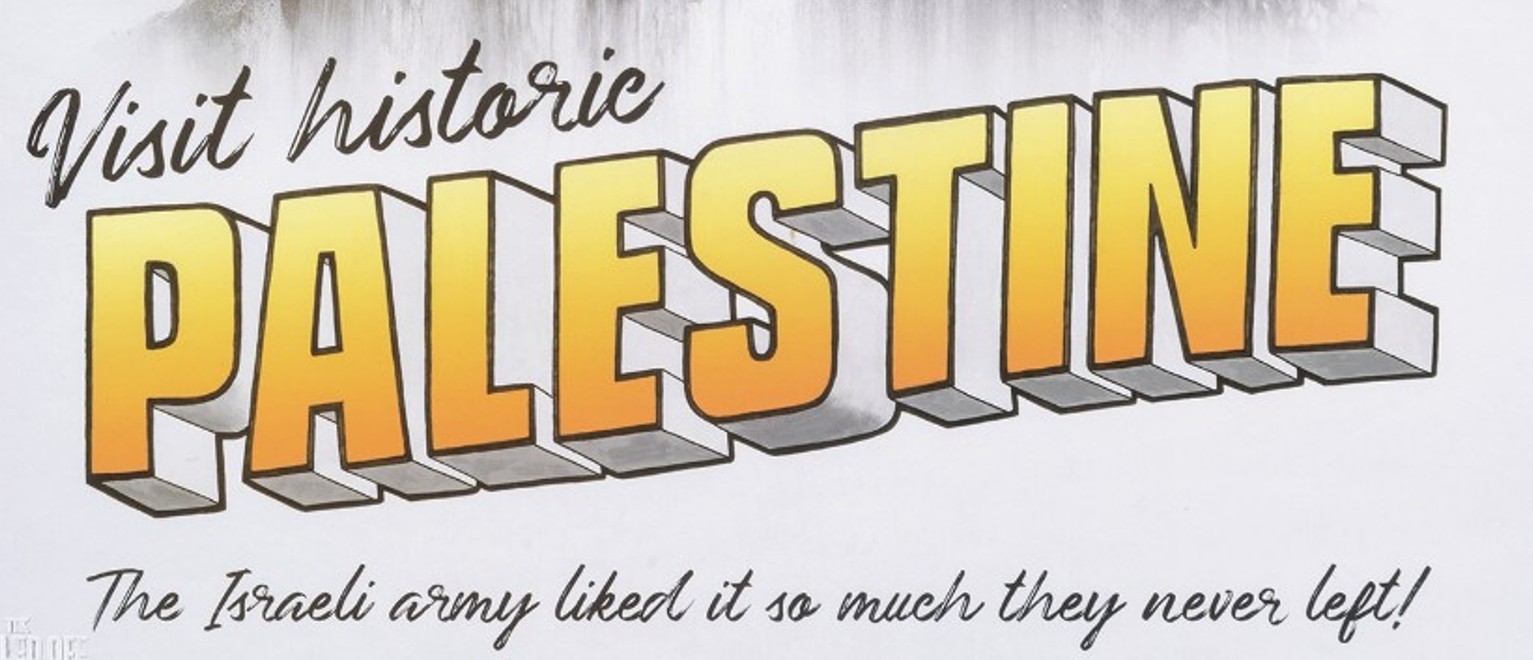
Beneath the image appears the bold slogan “Visit Historic Palestine”, rendered in the optimistic typography of mid-century travel posters. The illusion is shattered by Banksy’s unmistakable punchline: “The Israeli army liked it so much they never left!” The sentence compresses decades of political conflict into a single sardonic remark, simultaneously functioning as tourism slogan, historical commentary and biting political criticism.
Banksy has repeatedly returned to Palestine throughout his career, beginning with his interventions on the West Bank Barrier in 2005 and continuing with projects that include Santa’s Ghetto, the Walled Off Hotel, and numerous murals exploring life under occupation. Visit Historic Palestine belongs firmly within this body of work yet distinguishes itself by appropriating one of the most recognizable visual languages of the twentieth century: the travel poster.
Traditional tourism posters promise escape, leisure and discovery. Banksy subverts every one of these expectations. The monumental watchtower—designed to monitor movement and reinforce separation—is absurdly reinvented as a fairground ride. The children demonstrate a remarkable capacity to adapt and play even in the harshest environments, suggesting both resilience and tragedy. Childhood imagination transforms an instrument of military authority into a playground, yet the viewer remains painfully aware that this transformation exists only within the image.
The phrase “Historic Palestine” itself carries considerable political resonance. Rather than referring simply to a geographical destination, it evokes questions of memory, identity, displacement and contested narratives. Banksy deliberately leaves these tensions unresolved, inviting reflection rather than offering simplistic answers.
The concluding sentence exemplifies his gift for compressing complex geopolitical issues into deceptively simple humor. Like many of his greatest works, the joke is disarming precisely because it exposes an uncomfortable reality. Laughter becomes an entry point into a far more serious conversation.
Although Banksy is widely celebrated for universal images such as Girl with Balloon, Love Is In The Air, or Laugh Now, some of his most significant artistic achievements arise from direct engagement with specific political contexts. Palestine occupies a unique position within his career, representing one of the few places to which he has returned repeatedly over more than two decades.
Visit Historic Palestine should therefore be understood not merely as a souvenir but as part of an evolving artistic dialogue with the region. It complements earlier murals depicting openings in the Separation Wall, children escaping imagined landscapes, and symbolic gestures of hope beyond physical barriers. Collectively, these works reveal Banksy at his most openly activist, using public art not simply to provoke debate but to draw sustained international attention to a humanitarian issue that rarely permits easy conclusions.
Unlike many of his prints and editions, whose primary audience consists of collectors, this poster was conceived first and foremost as a vehicle for communication. Its inexpensive production method and broad distribution reflect Banksy’s enduring belief that powerful images should circulate widely rather than remain confined within the art market.
Despite being produced as a poster, Visit Historic Palestine occupies an important place within Banksy’s catalogue of official collectibles. The copies distributed during the World Travel Market represent a distinct historical event connected directly to the opening years of the Walled Off Hotel project, while the blind-stamped hotel editions provide an additional level of provenance for collectors.
The posters were handed out personally by the Walled Off Hotel Manager Wissam Salsaa.
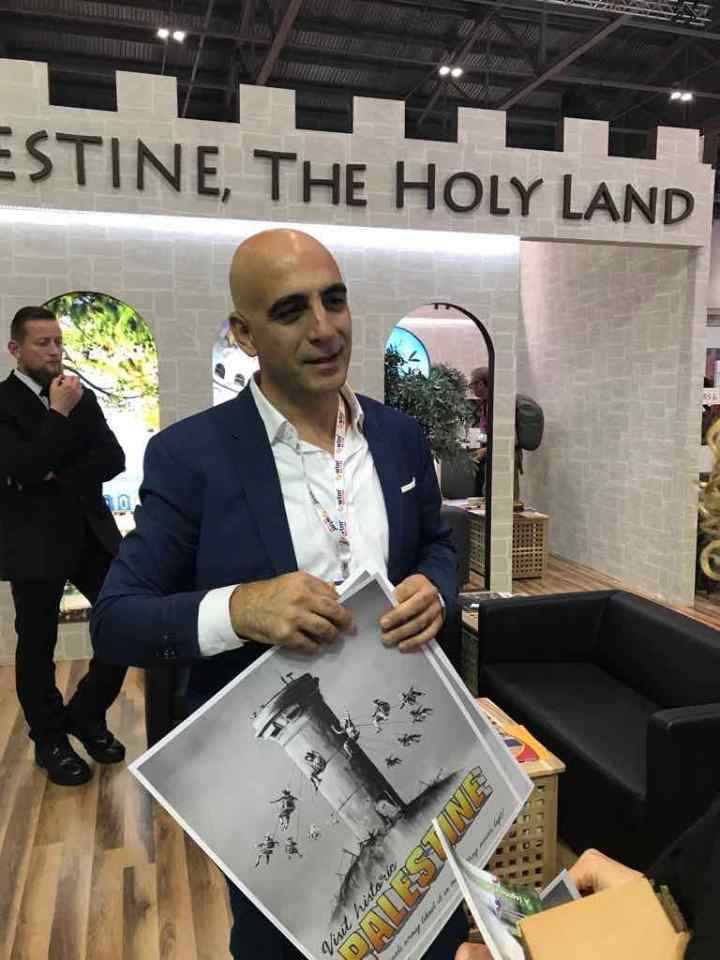
Condition is naturally a significant consideration, as many examples were folded, rolled or displayed rather than preserved. Posters retaining their original dimensions, clean margins, reverse stamps or blindstamp, and strong color saturation command particular attention.
Increasing institutional interest in Banksy’s Palestinian projects has further elevated the importance of objects associated with this period. Rather than existing as isolated memorabilia, these posters document one of the artist’s most ambitious long-term political interventions.
Visit Historic Palestine perfectly encapsulates Banksy’s extraordinary ability to combine graphic simplicity, biting wit and profound political observation. In a single image, an austere military watchtower becomes a carousel, children transform oppression into play, and the cheerful optimism of a vintage travel advertisement gives way to one of the sharpest pieces of political satire in Banksy’s entire oeuvre.
More than a collectible, the poster serves as a document of an artistic campaign that sought to challenge perceptions of one of the world’s most enduring conflicts. It reminds us that Banksy’s greatest strength has never been merely producing memorable images, but revealing how the familiar can be reimagined until it exposes truths that have become almost invisible through repetition. In Visit Historic Palestine, even tourism becomes an act of political reflection, demonstrating once again that, in Banksy’s hands, humor is never simply entertainment—it is one of the most effective forms of dissent.
Selected Auction Results
WORK IN PROGRESS
Roseberys London: 1 July 2026
Estimated: GBP 300 – 500
GBP 394 / USD 525
BANKSY (British b.1974-)
Visit Historic Palestine
Offset lithograph in colors
Stamped on the reverse with the Walled off Hotel stamp in pink
Tate Ward Auctions: 14 October 2020
Estimated: GBP 150 – 250
GBP 1,125 / USD 1,485
AUCTION RECORD FOR VISIT HISTORIC PALESTINE
BANKSY (British 1974-)
‘Visit Historic Palestine‘, 2018
Offset lithograph in colors on paper