BANKSY
The Waterfall, 2006
Vandalized oil painting
118.5 x 109.5 cm (46.7 x 43.1 inches)
Signed
Barely Legal, Los Angeles, 2006
Banksy vs. Bristol Museum, Bristol, 2009
Catalogue Note
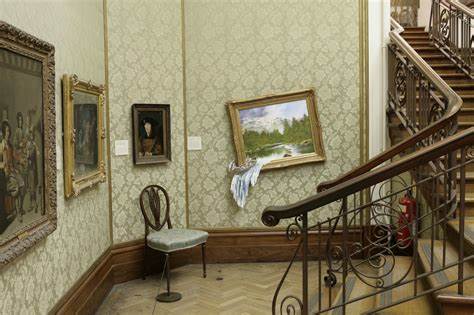
With The Waterfall, Banksy pushes the concept of the Crude Oils series into entirely new territory. Rather than merely intervening within a traditional landscape painting, he ruptures the very boundaries of the picture plane. A canoe carrying two unsuspecting figures glides peacefully toward a waterfall that suddenly bursts through the bottom of the frame, spilling into real space in a cascade of sculpted water. The illusion of the painted world literally overflows into ours.
This playful intervention represents a decisive evolution in Banksy’s practice. Throughout the Crude Oils series, the artist appropriated traditional paintings by inserting contemporary imagery—gas masks, helicopters, surveillance cameras or acts of vandalism—into otherwise idyllic scenes. Here, however, the disruption is no longer confined to the image itself. Banksy attacks the conventions of painting as an object, transforming the frame from a passive boundary into an active participant in the composition. The artwork refuses to remain contained.
The piece also reflects Banksy’s enduring fascination with illusion and deception. Classical landscape painting has traditionally sought to create the convincing illusion of depth, inviting viewers to imagine a window onto another world. Banksy reverses this centuries-old convention. Instead of drawing us into the painting, he allows the painting to invade our own space. The waterfall no longer belongs to the fictional landscape but becomes a tangible sculptural element, collapsing the distinction between representation and reality.
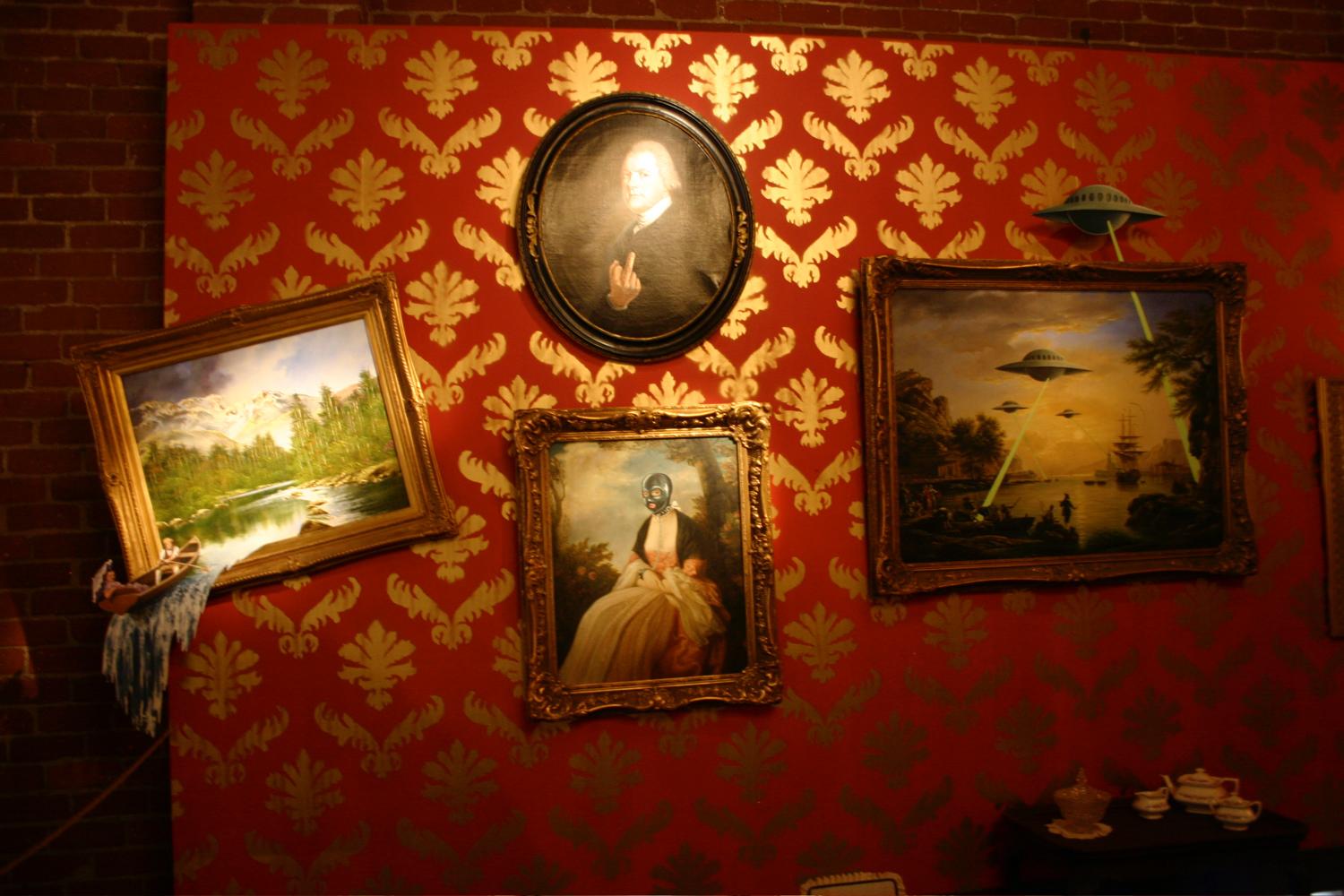
Barely Legal, Los Angeles, 2006
The intervention possesses a characteristic sense of understated humour. The two figures continue rowing with complete serenity, apparently unaware that they have reached the edge of their painted universe. Like many of Banksy’s protagonists, they remain oblivious to the catastrophe unfolding around them. The comedy arises precisely from this contrast between quiet normality and impossible circumstance. It is an image of human complacency, where disaster often arrives unnoticed until the point of no return.
Created for Barely Legal in Los Angeles in 2006, The Waterfall demonstrates the extraordinary ambition of an exhibition that expanded Banksy’s practice far beyond graffiti. Visitors encountered modified oil paintings, monumental installations, sculptures, live animals, and immersive environments that blurred the boundaries between street art, conceptual art and theatrical spectacle. Works such as Bullet Proof David, Vandalized Phone Box, UFO, and The Waterfall revealed an artist increasingly interested in challenging not only images but the physical experience of viewing itself.
The work also anticipates many of Banksy’s most celebrated later interventions. The partially self-destructing Love is in the Bin (2018), the immersive installations of Dismaland (2015), and even the theatrical displays of Cut & Run all share the same impulse: to liberate art from its traditional confines and transform it into an event rather than merely an object. The Waterfall occupies an important place within this evolution, marking one of the earliest moments when Banksy treated the picture frame itself as a material to be manipulated.

Banksy vs. Bristol Museum, Bristol, 2009
Beyond its technical ingenuity lies a quietly philosophical observation. Water has long symbolized the passage of time, the unstoppable flow of history and the impossibility of permanence. By allowing the river to escape its painted confines, Banksy suggests that reality cannot forever be contained within carefully constructed narratives. Eventually, life spills beyond the frame, dissolving the comforting boundaries we attempt to impose upon it.
Ultimately, The Waterfall is both a visual joke and a meditation on the limits of art itself. It reminds us that the frame is an artificial invention, separating art from life only because we have agreed that it should. Banksy simply refuses to accept that convention. With one ingenious gesture, the landscape ceases to be something we observe from a distance and becomes something that enters our world, carrying with it all the unpredictability, humour and subversive imagination that define his oeuvre.