BANKSY
Bomb Middle England, 2001
Acrylic and spray-paint stencil on canvas
92×183 cm (36 1/4 x 72 inches)
Tagged ‘BANKSY’ on the right overlap
Provenance
Acquired directly from the artist in 2001
Sotheby’s Olympia, ‘Contemporary Art’, 7 February 2007, lot 529
Acquired from the above sale by the present owner
Auction History
| Phillips London 14 February 2013 Est.: GBP 100,000 – 150,000 |
Price Realized GBP 229,250 / USD 355,405 Banksy Contemporary Art Evening Sale |
Catalogue Note
Few works encapsulate Banksy’s early political vision with such deceptive simplicity as Bomb Middle England. Against a vast expanse of empty white space, three elderly ladies quietly enjoy what appears to be one of England’s most quintessentially peaceful pastimes: a leisurely game of lawn bowls. Only upon closer inspection does the unsettling twist emerge. The polished wooden bowls have been replaced by live aerial bombs.
Like the finest political cartoons, the image requires almost no explanation. Banksy replaces a single object, yet the entire meaning of the scene collapses. Recreation becomes warfare; leisure becomes violence; everyday normality reveals its hidden complicity.
The title is essential to understanding the work. In Britain, “Middle England” refers less to geography than to a social and political ideal: respectable, comfortable, patriotic, middle-class England, often associated with conservative values and quiet faith in established institutions. Rather than attacking individuals, Banksy questions the collective complacency of a society capable of treating military intervention with the same emotional detachment as a weekend pastime. War has become just another game.
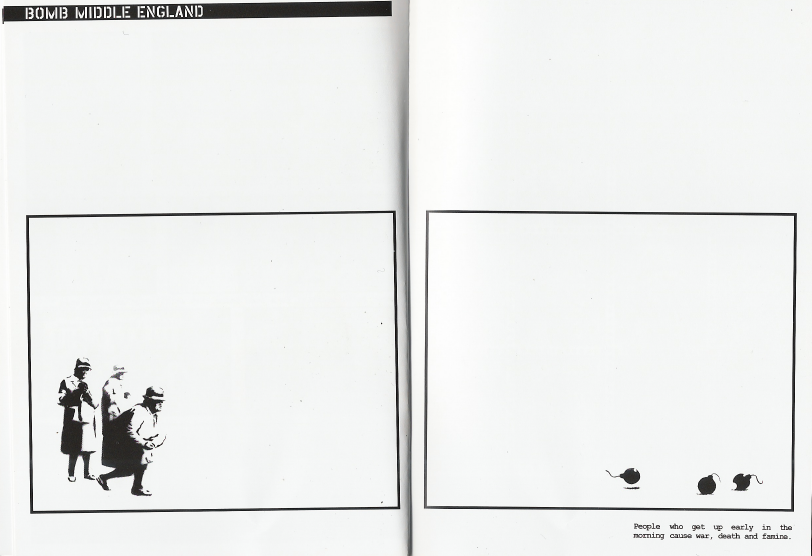
The composition itself reinforces this unsettling idea. The three figures occupy only a tiny corner of the canvas, dwarfed by an immense field of empty space. This deliberate imbalance creates an atmosphere of silence and isolation. Nothing distracts from the trajectory of the bombs scattered across the immaculate green. Their small scale makes them appear almost harmless—until the viewer remembers what they actually are. Banksy exposes one of modern society’s greatest contradictions: the ease with which extraordinary violence can become visually ordinary.
Created in 2001, the work belongs to a remarkable series of early anti-war images that would establish many of the artist’s defining themes. Alongside Happy Choppers, Bomb Hugger, Heavy Weaponry, Girl Frisking Soldier, and ultimately Love Is In The Air, Banksy repeatedly stripped weapons of their traditional symbolism, surrounding them instead with innocence, humor or domestic familiarity. His aim was never to glorify conflict, but to reveal how language, politics and media sanitize it.
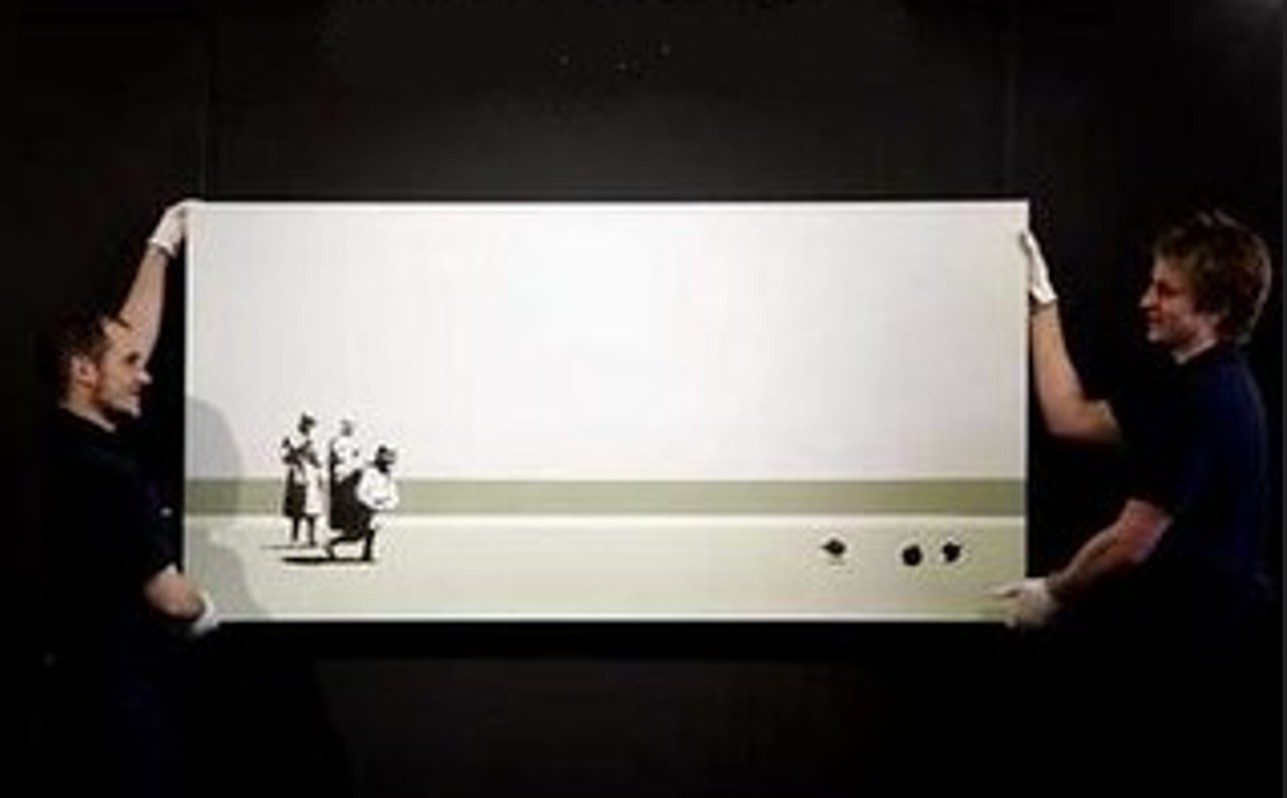
The visual restraint is equally important. There are no explosions, no bloodshed, no victims. Banksy understands that suggestion is often more powerful than spectacle. The bombs remain motionless, almost elegant in their placement across the green, allowing the viewer to complete the narrative. It is precisely because nothing has happened yet that the image feels so unnervingly calm.
More than two decades after its creation, Bomb Middle England remains one of Banksy’s clearest statements on the normalization of violence. It asks an uncomfortable question that still resonates today: at what point do societies become so accustomed to the language of war that they begin treating instruments of destruction with the same casual familiarity as the objects of everyday life? In Banksy’s world, the greatest danger is rarely violence itself, but the quiet ease with which ordinary people learn to live alongside it.