BANKSY
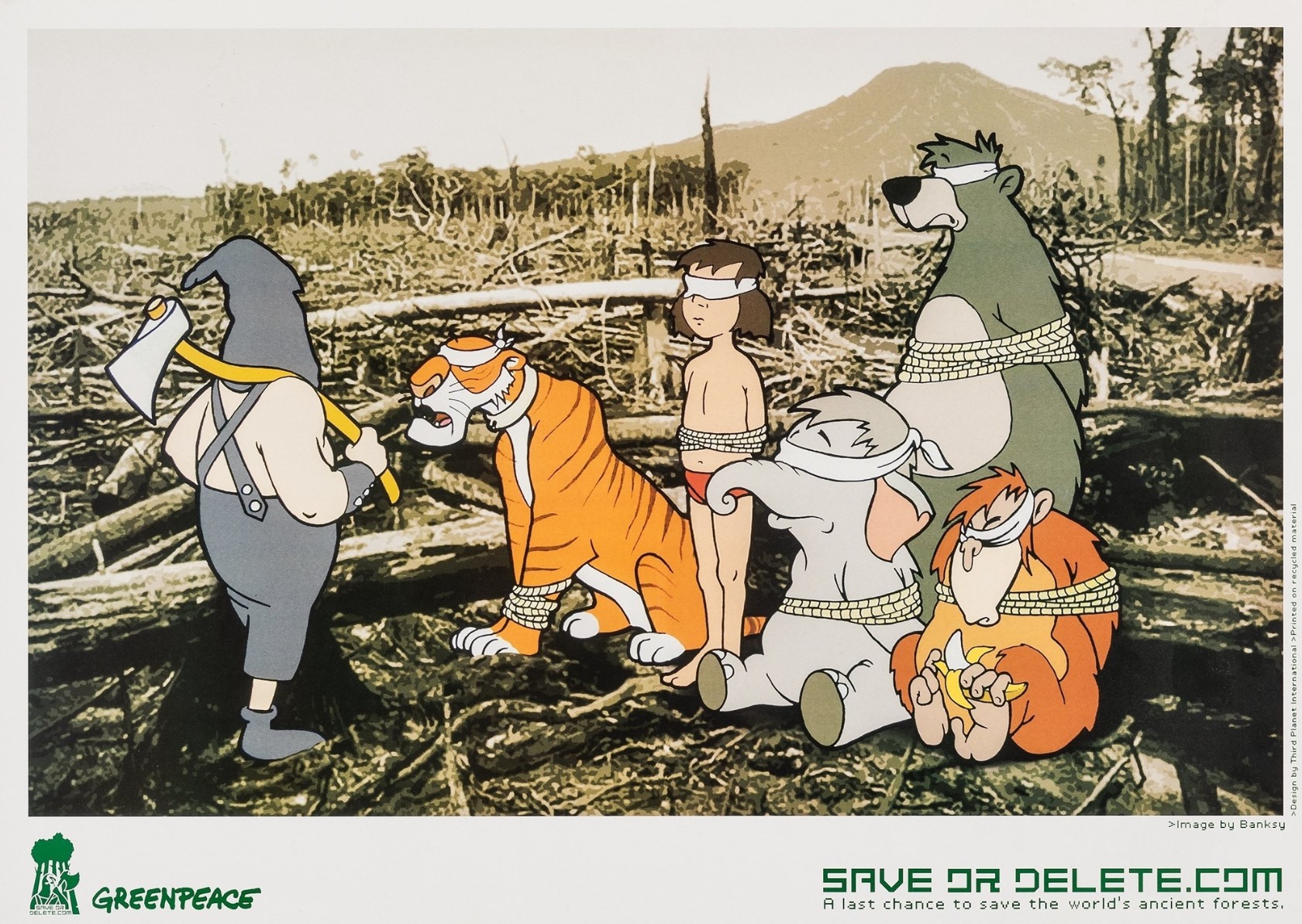
Save or Delete (Greenpeace Poster), 2002
Offset lithograph printed in colors on recycled paper
Approximately: 42 × 59.4 cm
Edition: Open, unsigned and unnumbered campaign edition
Greenpeace for the Save or Delete campaign
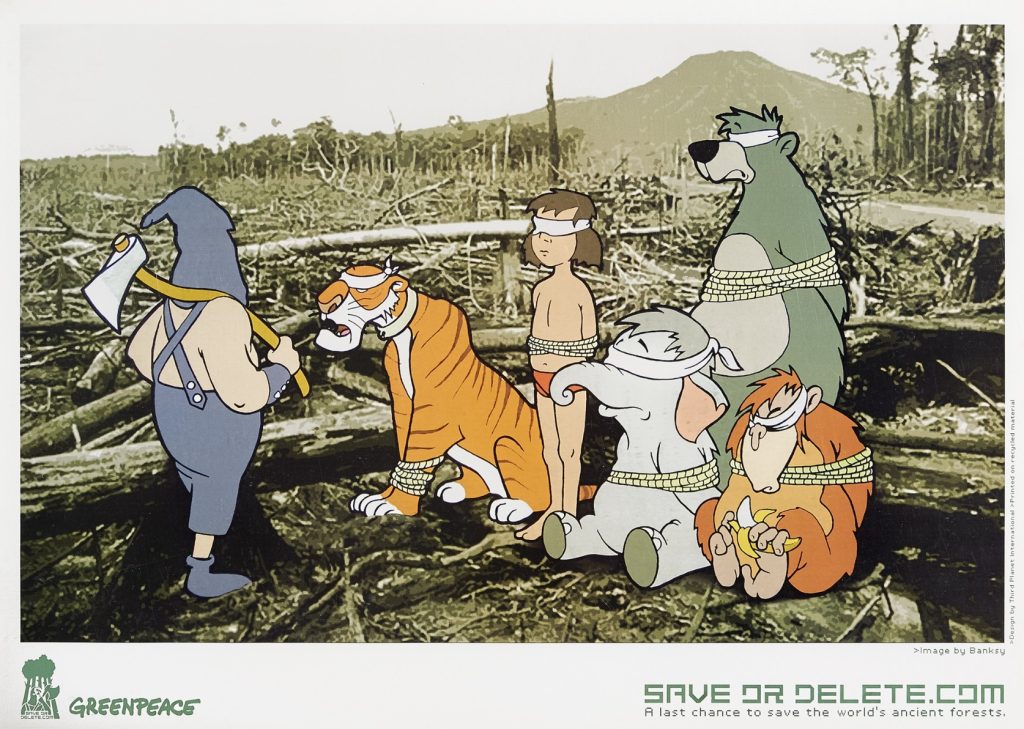
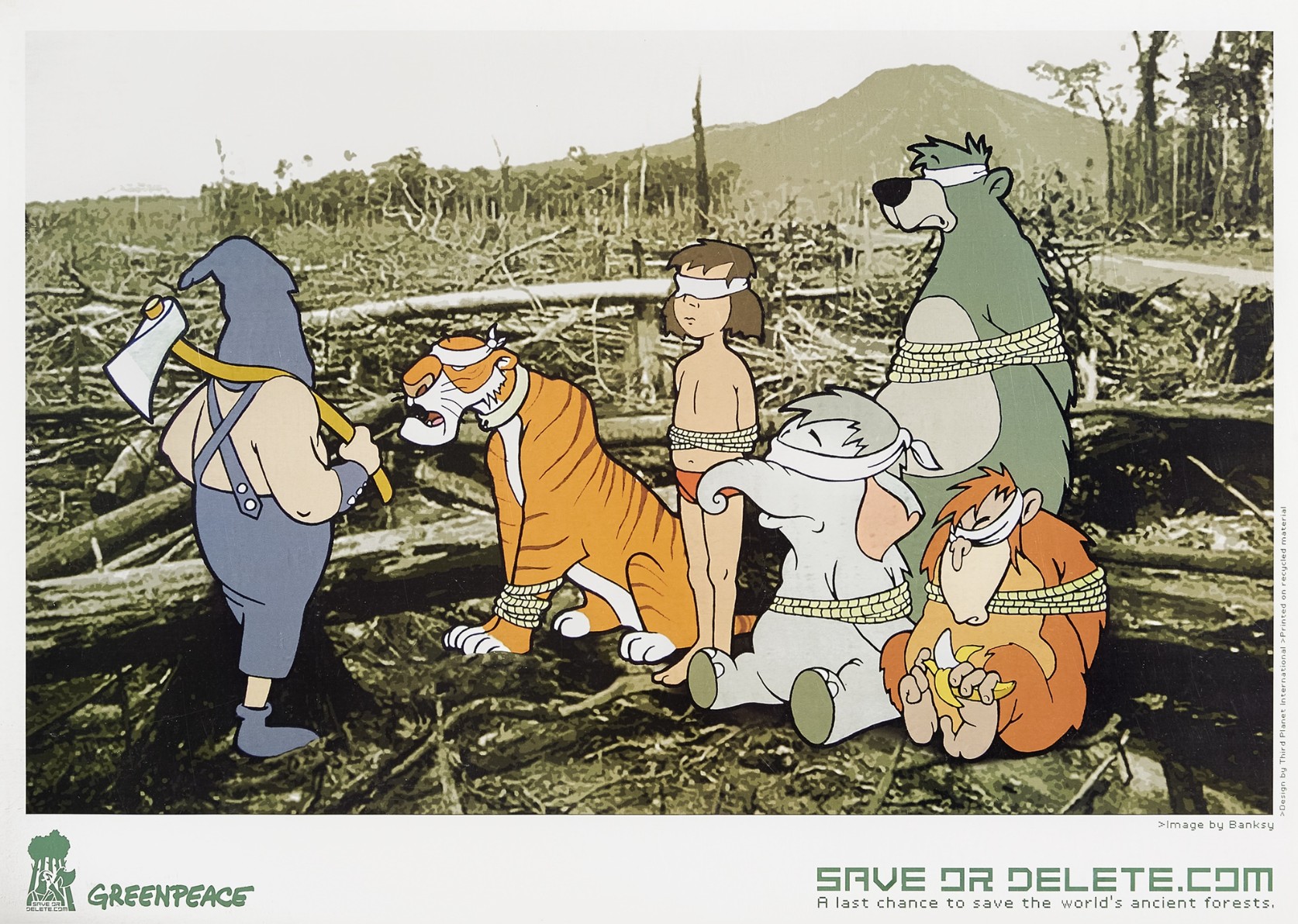
Save or Delete presents one of the most arresting and intellectually layered images from Banksy’s early career. Against the bleak photographic backdrop of a recently clear-felled forest, a group of familiar figures from Disney’s The Jungle Book sit bound, blindfolded and awaiting an uncertain fate. Mowgli stands stripped to the waist with his hands tied behind him. Baloo, King Louie, Shere Khan and Colonel Hathi are similarly restrained, deprived of movement, sight and agency. To the left, an anonymous executioner or logger carries an axe over his shoulder, his face concealed beneath a pointed hood.
The contrast is immediate and brutal. Characters associated with childhood adventure, friendship and the benevolent abundance of the jungle have been transported into an environment from which the jungle itself has almost entirely disappeared. Behind them lies not an enchanted wilderness but a landscape of stumps, fallen trees and ecological devastation. The cheerful visual language of animation collides with documentary evidence of destruction. Banksy places fictional animals before the viewer as though they were prisoners of war. Their blindfolds imply that judgment has already been passed; the axe-bearing figure suggests that the destruction of their habitat will soon become their own destruction. The image does not merely illustrate deforestation. It stages the execution of childhood itself.
At the bottom of the poster, the instruction “SAVE OR DELETE” adopts the language of a computer command. The phrase offers a binary choice with no room for hesitation: preserve the forest or erase it. Beneath it appears the campaign’s warning, “A last chance to save the world’s ancient forests.” The rhetoric is deliberately urgent. This is not presented as an abstract environmental debate but as a final decision whose consequences may be irreversible.
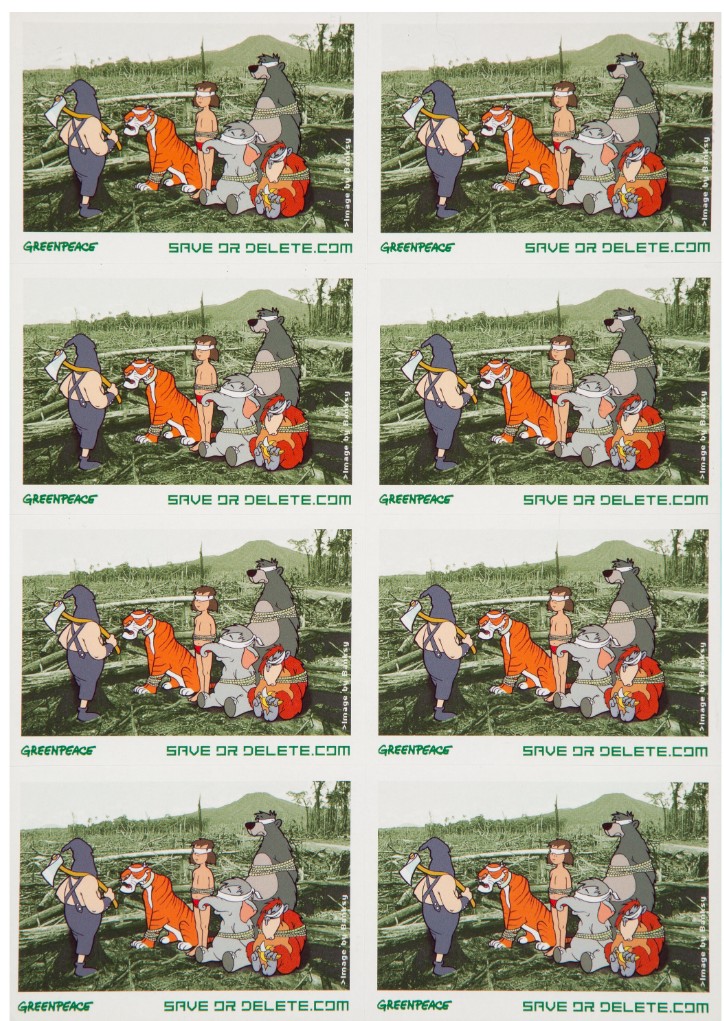
Save or Delete 8-part sticker sheet
The image was commissioned by Greenpeace for its Save or Delete campaign, launched in the early 2000s to draw attention to the destruction of ancient forests and the international trade in timber associated with illegal and destructive logging. At this stage of Banksy’s career, his reputation was expanding beyond Bristol and London’s street-art circles, yet he remained closely connected to activist culture and alternative methods of communication. The Greenpeace commission provided an ideal context for his visual language. Rather than producing a conventional environmental poster filled with statistics or worthy slogans, Banksy created an image capable of delivering the campaign’s argument in a single, unsettling glance.
The poster was printed in color on recycled paper and was accompanied by related campaign material, including adhesive stickers reproducing details from the composition. The edition was neither signed nor numbered and appears to have been conceived as campaigning material rather than as a commercial fine-art release.
Its distribution history, however, was complicated by the use of copyrighted Disney characters. Accounts of the project indicate that concerns surrounding intellectual-property rights prevented the campaign image from circulating as broadly as originally intended. The irony is exquisite: a campaign defending the survival of ancient forests was constrained by the legal ownership of imaginary jungle inhabitants. This tension has become inseparable from the object’s history. What was designed as a mass-distributed activist poster ultimately became relatively scarce campaign ephemera, and therefore far more collectible than its original purpose would have suggested.
The Execution of Innocence
Banksy’s appropriation of The Jungle Book is central to the work’s emotional force. These characters are not neutral illustrations of wildlife. They belong to the visual memory of generations of children. They evoke humor, friendship, musical exuberance and a fantasy of harmonious life within nature.
By binding and blindfolding them, Banksy transforms familiarity into vulnerability. The viewer does not encounter anonymous endangered animals but cultural companions whose personalities are already known. Baloo is no longer carefree. Shere Khan is no longer powerful. King Louie is no longer comic. Even the elephant, ordinarily an emblem of strength, has been rendered helpless. The work therefore converts environmental destruction into an intimate betrayal. The ruined forest is not somewhere distant and abstract; it is the place where childhood stories once lived.
Fantasy Confronts Reality
The characters are rendered in clean, flat fields of color, while the forest behind them is photographic, grey and materially real. This collision between animation and documentary imagery creates a deliberate visual rupture.
Disney’s jungle is a world of fantasy in which nature exists as an inexhaustible setting for entertainment. Banksy inserts its inhabitants into the actual consequences of industrial extraction. The characters discover, too late, that the jungle imagined by mass culture offers no protection to the real forests on which that fantasy depends.
The result is not simply an attack on deforestation. It is also a critique of cultural distance. Popular entertainment allows audiences to consume idealized images of nature while remaining largely detached from the political and economic systems destroying it.
The Axe and the Hood
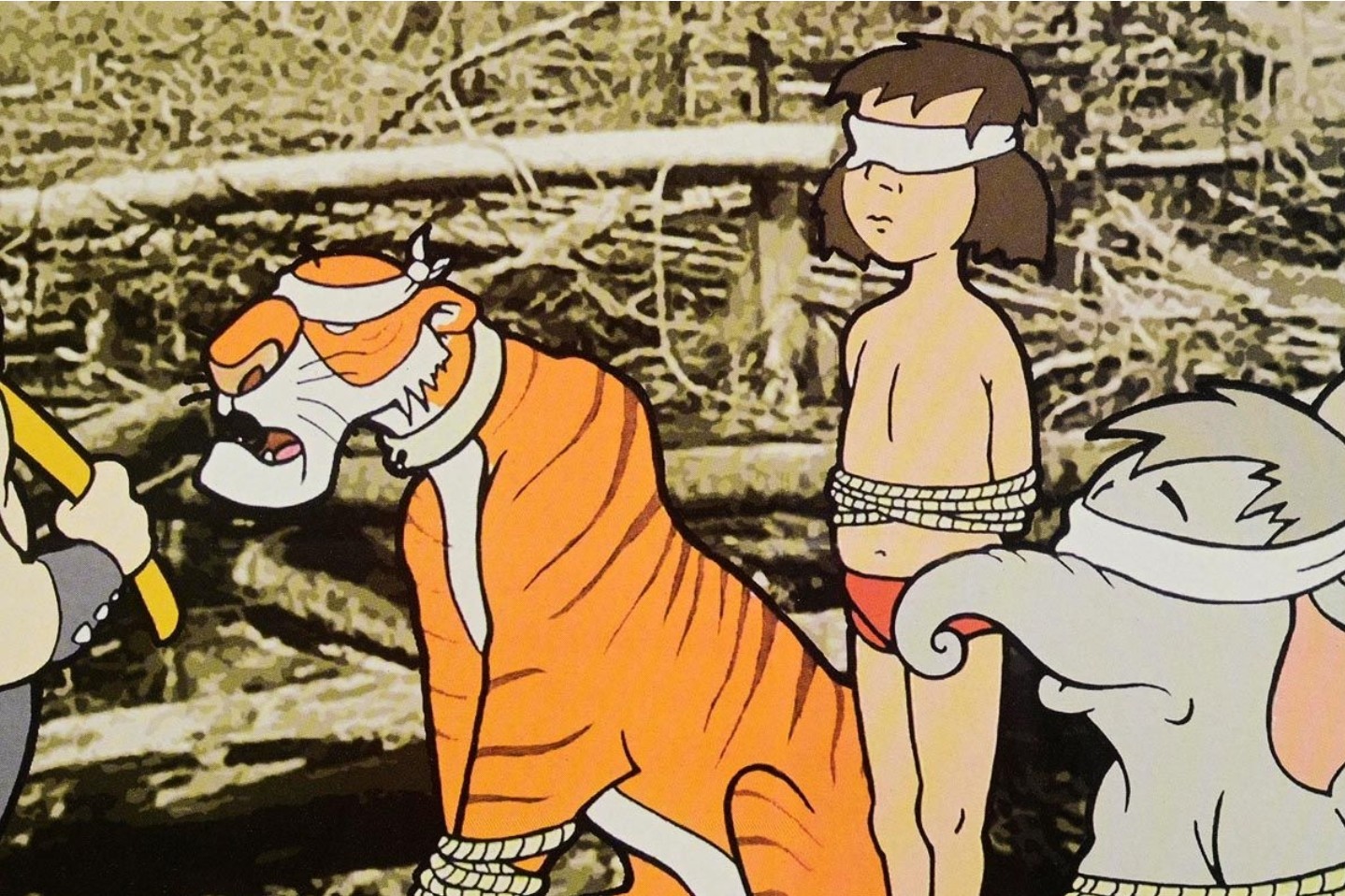
The executioner is an ambiguous figure. His axe identifies him as a logger, yet his pointed hood transforms him into something more sinister: an anonymous agent of organized violence.
Banksy refuses to give him an individual identity. He may represent the logging industry, political indifference, corporate consumption or the ordinary consumer who purchases timber without questioning its origin. His anonymity prevents the viewer from assigning guilt to a single villain. The figure becomes systemic rather than personal.
The hood also reverses the moral order of the image. The cartoon animals, although fictional, appear vulnerable and human. The human figure, by contrast, has become faceless and mechanical. Civilization has turned savage, while the jungle’s inhabitants have become its innocent victims.
Save or Delete
The title borrows the vocabulary of digital technology. A computer user may save or delete a file with a single movement, often without considering the permanence of the decision. Banksy applies this casual binary command to ecosystems that have developed over thousands of years.
The phrase exposes the grotesque imbalance between the ease of destruction and the complexity of what is destroyed. A forest may take centuries to form and only days to erase. The language of the computer interface reduces this ecological catastrophe to a choice between two buttons.
There is also an implicit challenge to the viewer. The poster does not ask whether ancient forests are beautiful or deserving of sympathy. It asks what action will be taken. Observation alone is insufficient. One must save—or, through passivity, permit deletion.
Disney, Copyright and Corporate Power
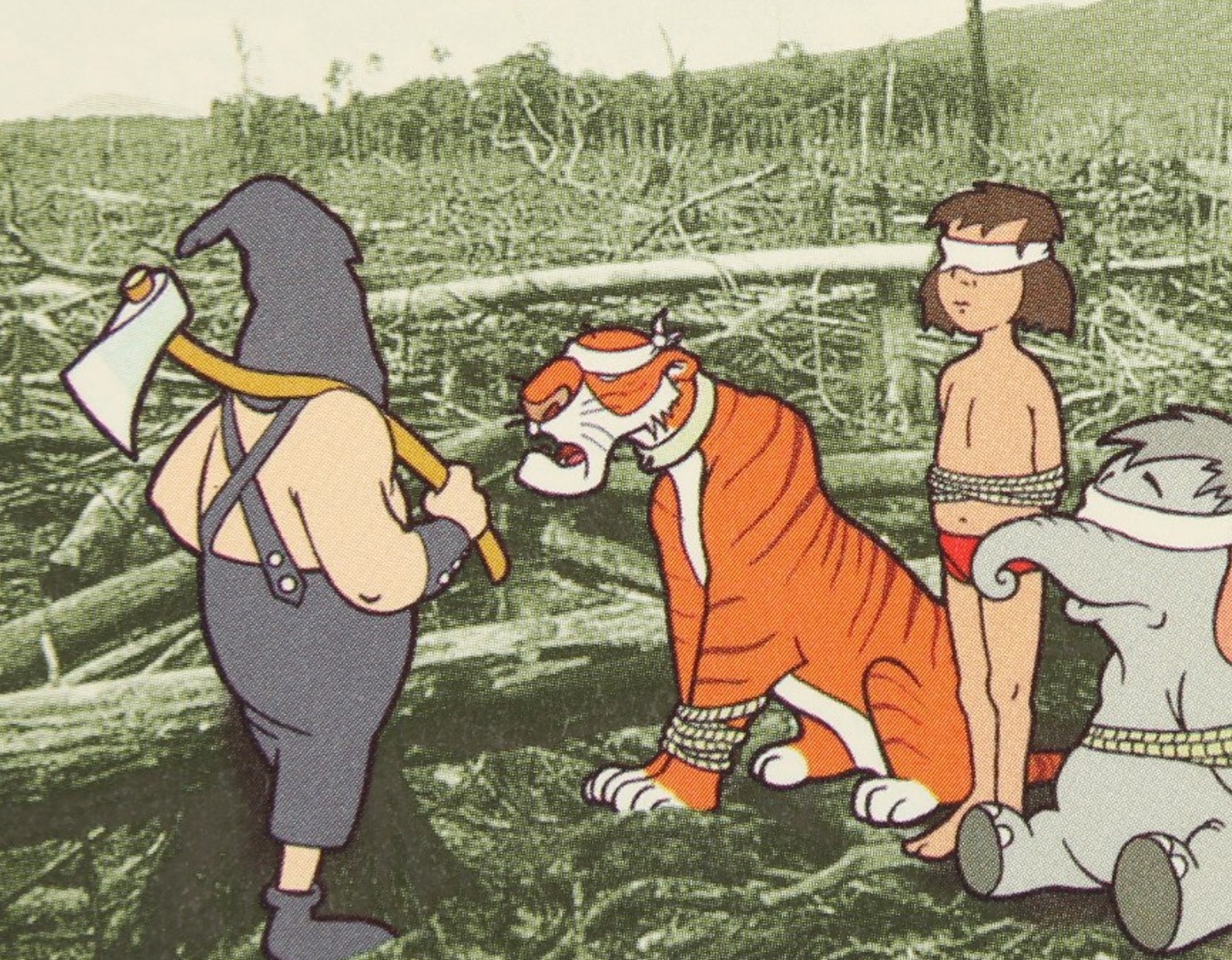
The appropriation of Disney imagery adds another crucial layer to the work. Disney has built an immense commercial empire through the transformation of folklore, animals and natural environments into intellectual property. Its version of The Jungle Book converted a literary narrative into one of the most recognizable and profitable animated worlds of the twentieth century. Banksy then appropriated those protected characters and returned them to a devastated approximation of the natural world from which they had been imaginatively extracted.
The gesture creates a sharp conceptual paradox. Disney could legally defend its cartoon representation of a jungle, while the destruction of real ancient forests continued. Fictional nature was protected by copyright; actual nature remained vulnerable to commerce. Whether or not Banksy intended this legal confrontation from the beginning, it has become one of the work’s most compelling dimensions. The poster exposes how modern systems of value may defend brands with greater efficiency than ecosystems.
Save or Delete belongs to an important group of early Banksy works in which popular characters are appropriated and forced into politically charged situations. Throughout his career, Banksy has repeatedly borrowed imagery from mass entertainment, advertising and childhood culture. By altering familiar symbols, he uses the viewer’s existing emotional relationship with an image as the foundation for a new and often disturbing meaning. The tactic appears in works involving Mickey Mouse, Ronald McDonald, Winnie-the-Pooh and numerous other recognizable figures.
The Greenpeace poster is particularly significant because the appropriation is not merely comic. It is narratively complete. Banksy does not add a slogan to a familiar character; he constructs an entire scene in which the characters’ world has collapsed around them.
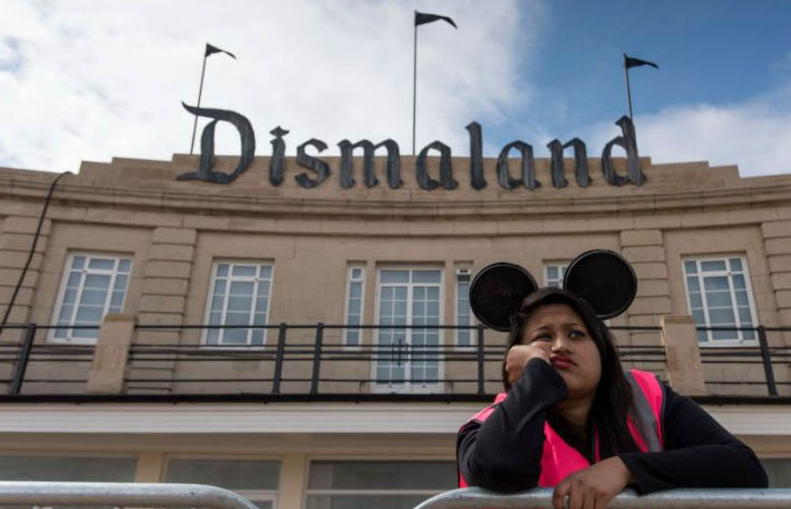
The work also anticipates later projects in which Banksy would dismantle the promises of childhood entertainment. Most notably, Dismaland would transform the fantasy of the amusement park into a landscape of political failure, environmental anxiety and social disillusionment. In Save or Delete, that process is already fully visible: the magical kingdom has been clear-cut, its inhabitants arrested, and the happy ending cancelled.
The image furthermore reveals Banksy’s early willingness to work directly with campaign organizations. His art here functions not as detached commentary but as an instrument of activism. The poster was designed to circulate, persuade and provoke action. It belongs simultaneously to the histories of street art, graphic design, environmental campaigning and political satire.
The Poster as an Activist Object
Unlike a signed print produced primarily for collectors, Save or Delete was created to operate in public life. Its value originally resided in its capacity to reproduce and distribute an idea. This distinction is essential. The poster should not be understood merely as a less expensive version of a Banksy artwork. It is the artwork in its intended activist form. Its paper, scale, typography and Greenpeace branding are not peripheral additions but integral components of the work’s meaning.
The object’s later migration into galleries, auction houses and private collections creates a characteristically Banksy-like contradiction. An image designed to oppose commercial exploitation has itself become commercially desirable. A poster intended for public campaigning now survives partly because collectors have preserved it. Banksy’s work repeatedly generates such paradoxes. Objects conceived as disposable become valuable; critiques of consumerism become commodities; illegally appropriated characters acquire legitimacy within the art market. Rather than neutralizing the work, these contradictions keep its questions alive.
Save or Delete Jungle Book, 2001
Bonhams London: 11 January 2011
Estimated: GBP 60,000 – 80,000
GBP 78,000 / USD 121,865
Bonhams : Banksy (British, born 1975) ‘Save or Delete Jungle Book’, 2001
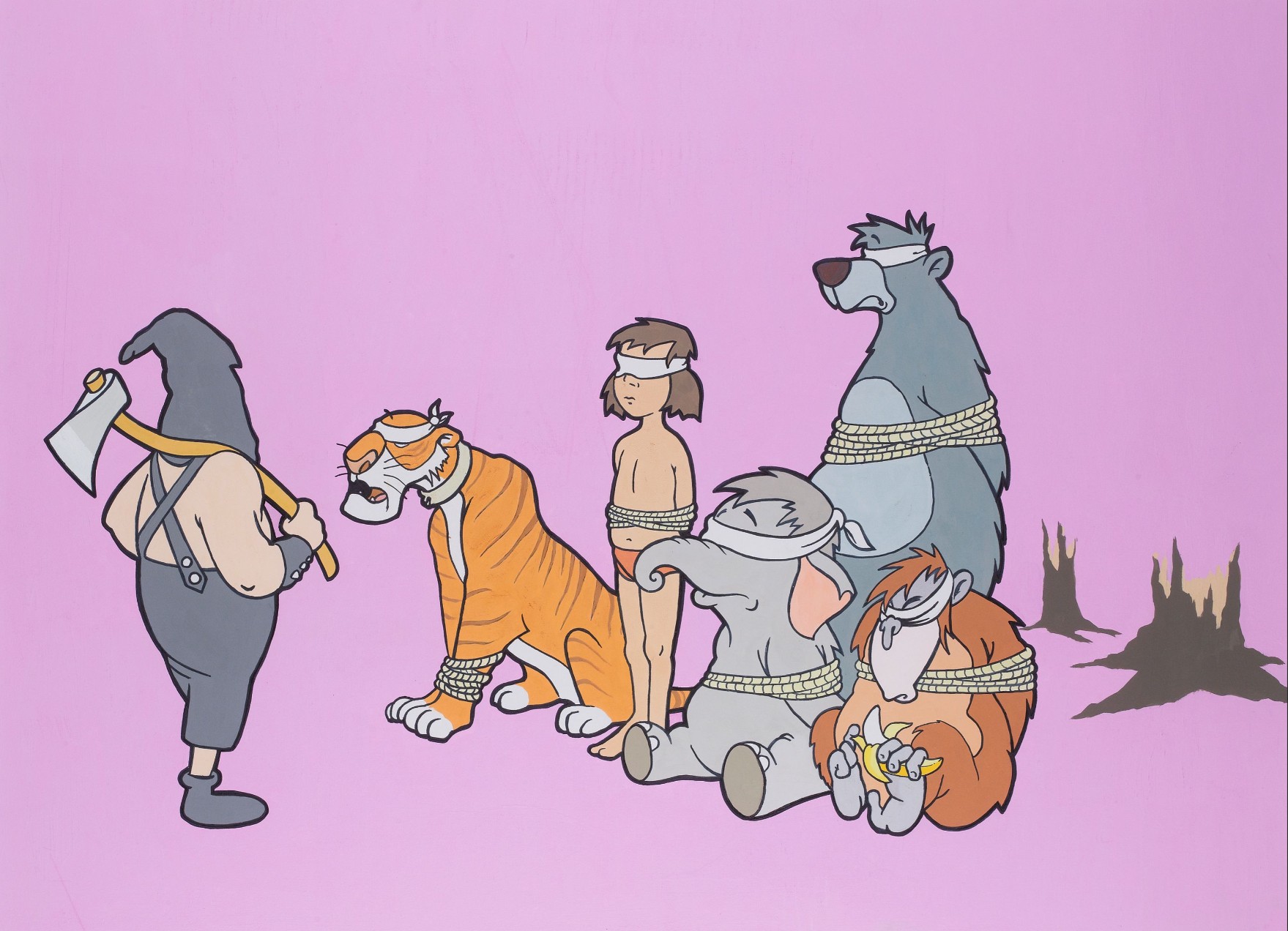
BANKSY (British, born 1975)
‘Save or Delete Jungle Book’, 2001
Acrylic and permanent marker pen on card
66×90 cm (26 x 35 7/16 inches)
Mounted together with a digital print of the design for the planned Greenpeace campaign
The original Greenpeace poster was issued as an unsigned and unnumbered campaign edition. Surviving examples frequently display handling marks, folds, edge wear or other evidence of their original use and distribution. Such characteristics should be evaluated in relation to the object’s history as campaign material rather than solely according to the standards applied to fine-art prints. Examples retaining strong color, clean margins and minimal creasing are particularly desirable. Collectors should also distinguish between the original Greenpeace poster, related sticker sheets, later reproductions and unauthorized copies.
As with much early Banksy ephemera, provenance and physical examination are essential. The work was not released as a conventional Pest Control-authenticated edition, and commercial descriptions can vary substantially. Its authenticity is therefore established through printing characteristics, paper, dimensions, campaign provenance and comparison with documented examples.
Why does it matter?
Save or Delete matters because it demonstrates how completely Banksy understood the persuasive power of popular culture at an early stage in his career. He recognized that an image of devastated woodland might inspire concern, but that the threatened execution of Baloo, Mowgli and their companions would provoke something more personal. By converting beloved fictional characters into ecological hostages, he collapsed the distance between environmental destruction and cultural memory.
The work also exposes a central contradiction of modern society: we celebrate idealized nature through films, brands and entertainment while participating in economic systems that destroy the real environments those fantasies represent. The jungle is protected as intellectual property but endangered as habitat.
What began as a Greenpeace campaign poster has consequently become one of Banksy’s clearest early statements about the relationship between corporate power, consumer culture and environmental violence. It is witty without being frivolous, accessible without being simplistic and emotionally direct without surrendering its conceptual complexity.
Most importantly, Save or Delete proves that Banksy’s political intelligence never depended upon obscurity. The message can be understood immediately by a child, yet its implications remain uncomfortable for an adult. The forest has already been cut down. The characters are already bound. The axe is already raised. The only question remaining is whether the viewer chooses to save—or merely watches as everything is deleted.
Selected Auction Results
Artcurial Paris: 3 April 2026
Estimated: EUR 400 – 600
EUR 344 / USD 395
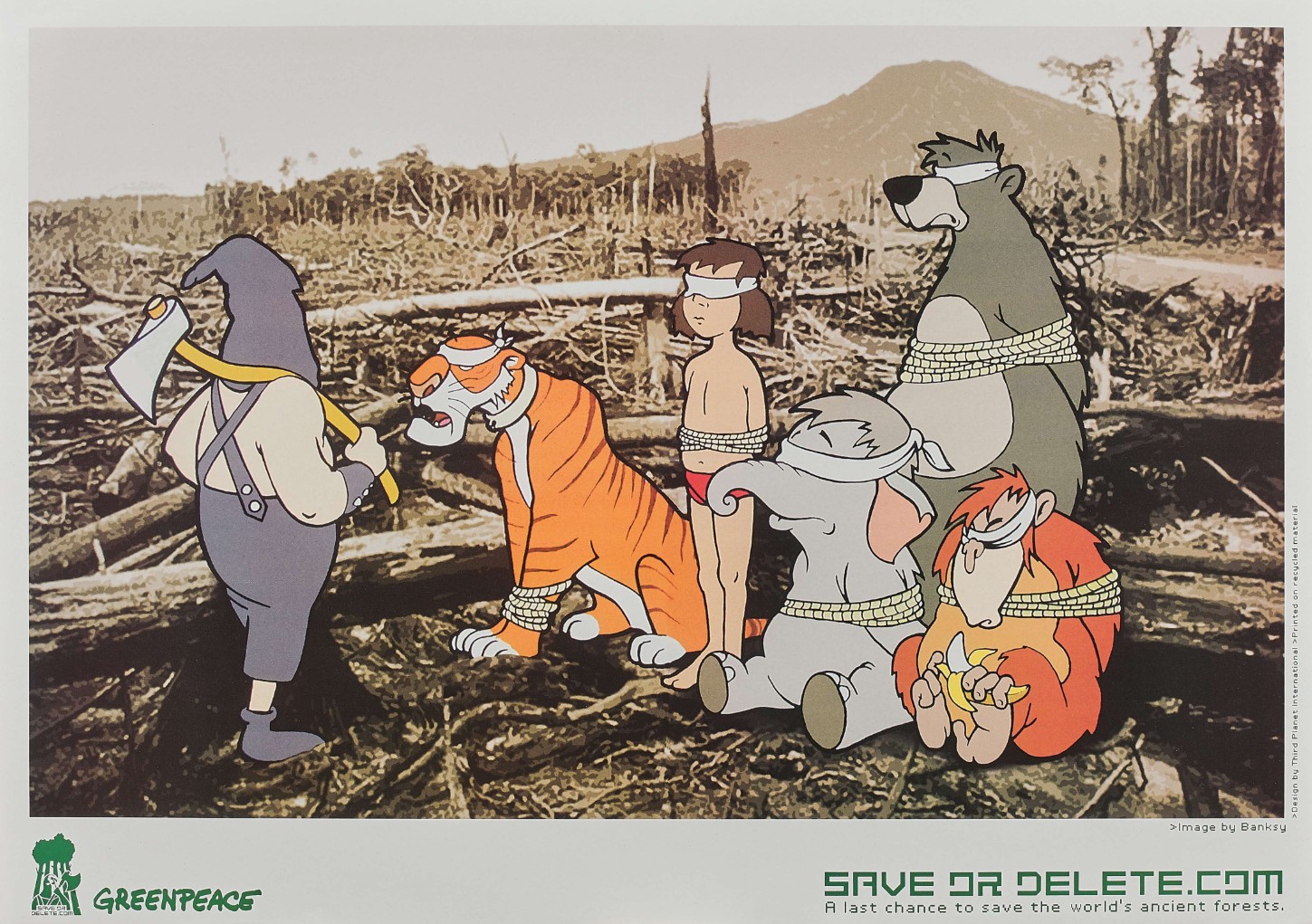
BANKSY (1974-)
Save or Delete- Greenpeace, 2002
Offset lithograph in colors, 8 stickers and postcard
XXXXXXXXXX
Chiswick Auctions: 3 July 2025
Estimated: GBP 150 -250
GBP 214 / USD 290
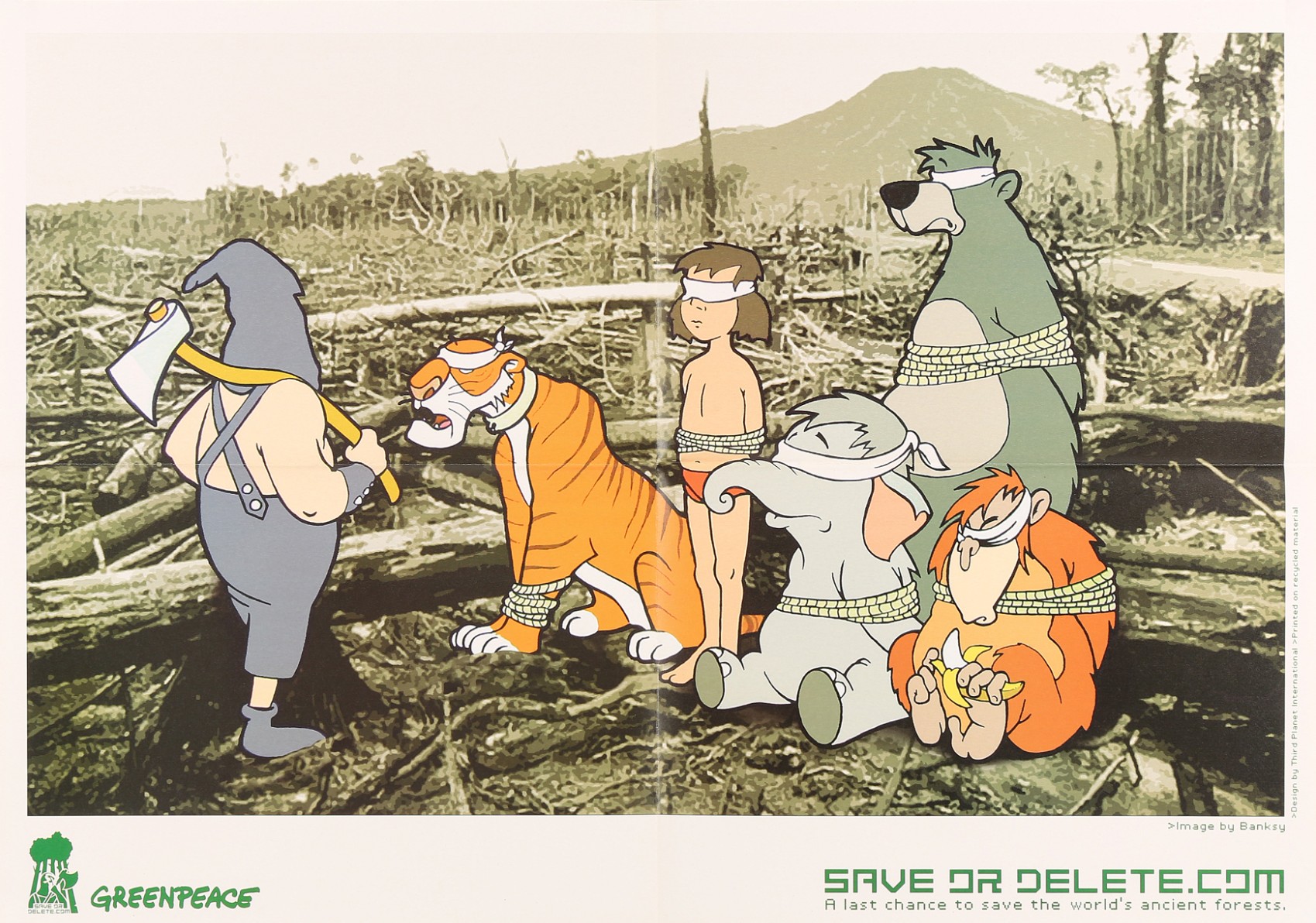 BANKSY (British b.1974)
Save or Delete, 2002
Offset lithographic poster in colors on recycled wove
Commissioned by Greenpeace
Together with a sticker sheet with the same design
XXXXXXXXXX
Morgan O’Driscoll Dublin: 29 October 2024
Estimated: EUR 400 -600
EUR 700 (Hammer)
EUR 840 / USD 980
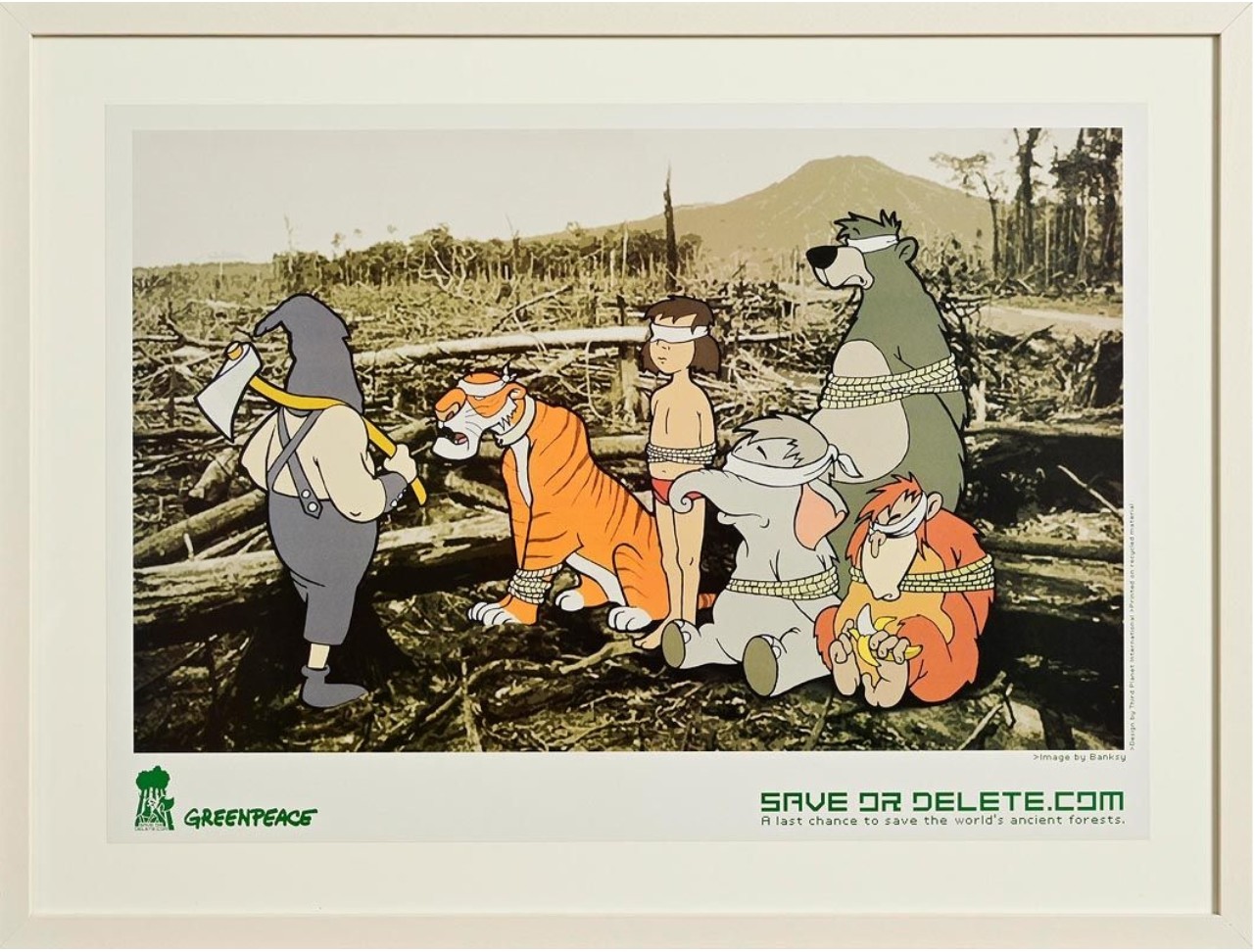
BANKSY (British b.1974)
Save or Delete, 2002
Offset lithographic poster in colors on recycled paper
XXXXXXXXXX
Chiswick Auctions: 17 October 2024
Estimated: GBP 300 -500
GBP 756 / USD 985
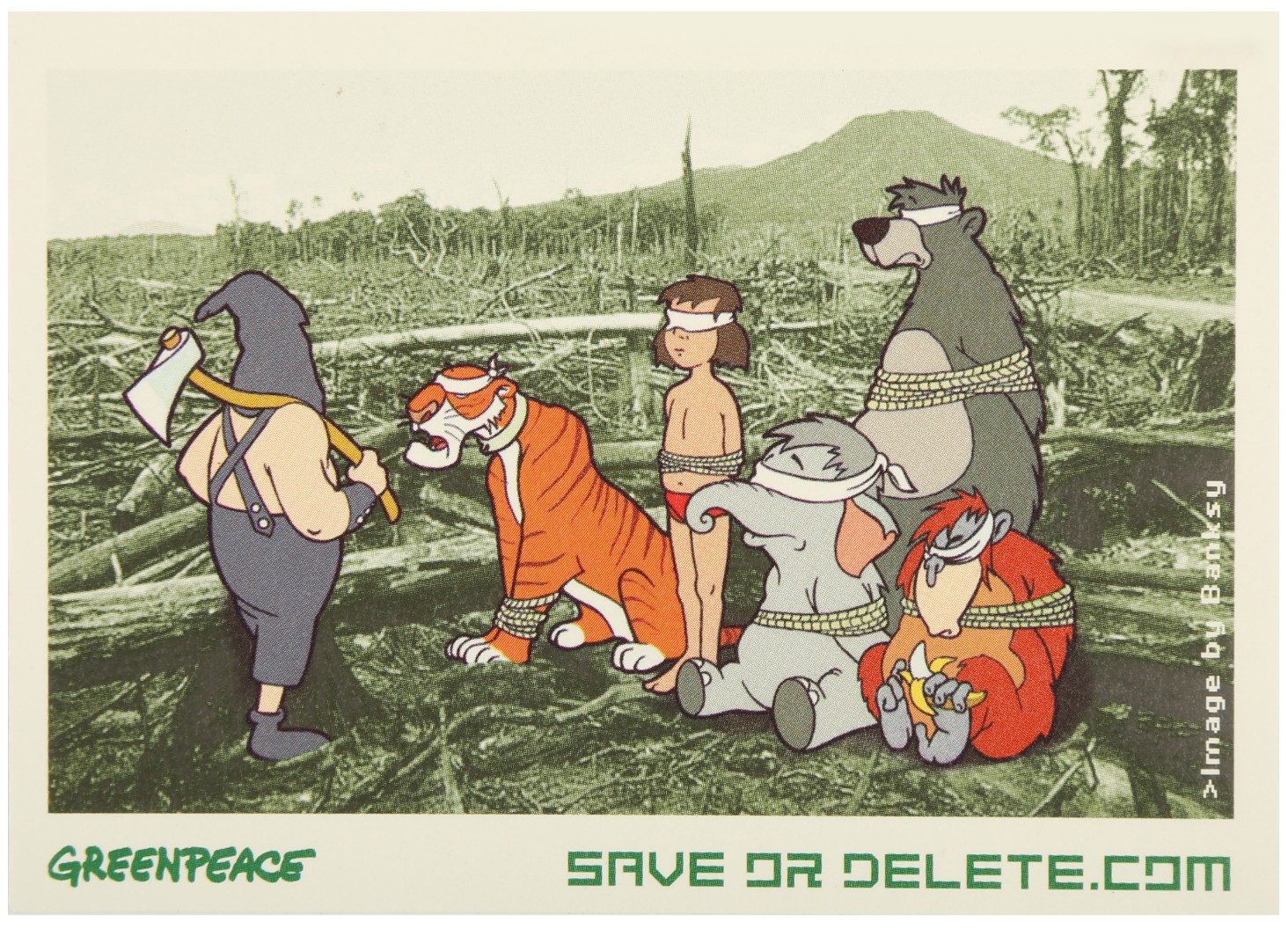
BANKSY (BRITISH B.1974)
Save or Delete, 2002
Offset lithographic poster in colors on recycled wove
Commissioned by Greenpeace
XXXXXXXXXX
Whyte’s Dublin: 1 July 2024
Estimated: EUR 700 – 1,000
EUR 2,600 (Hammer)
EUR 3,120 / USD 3,350
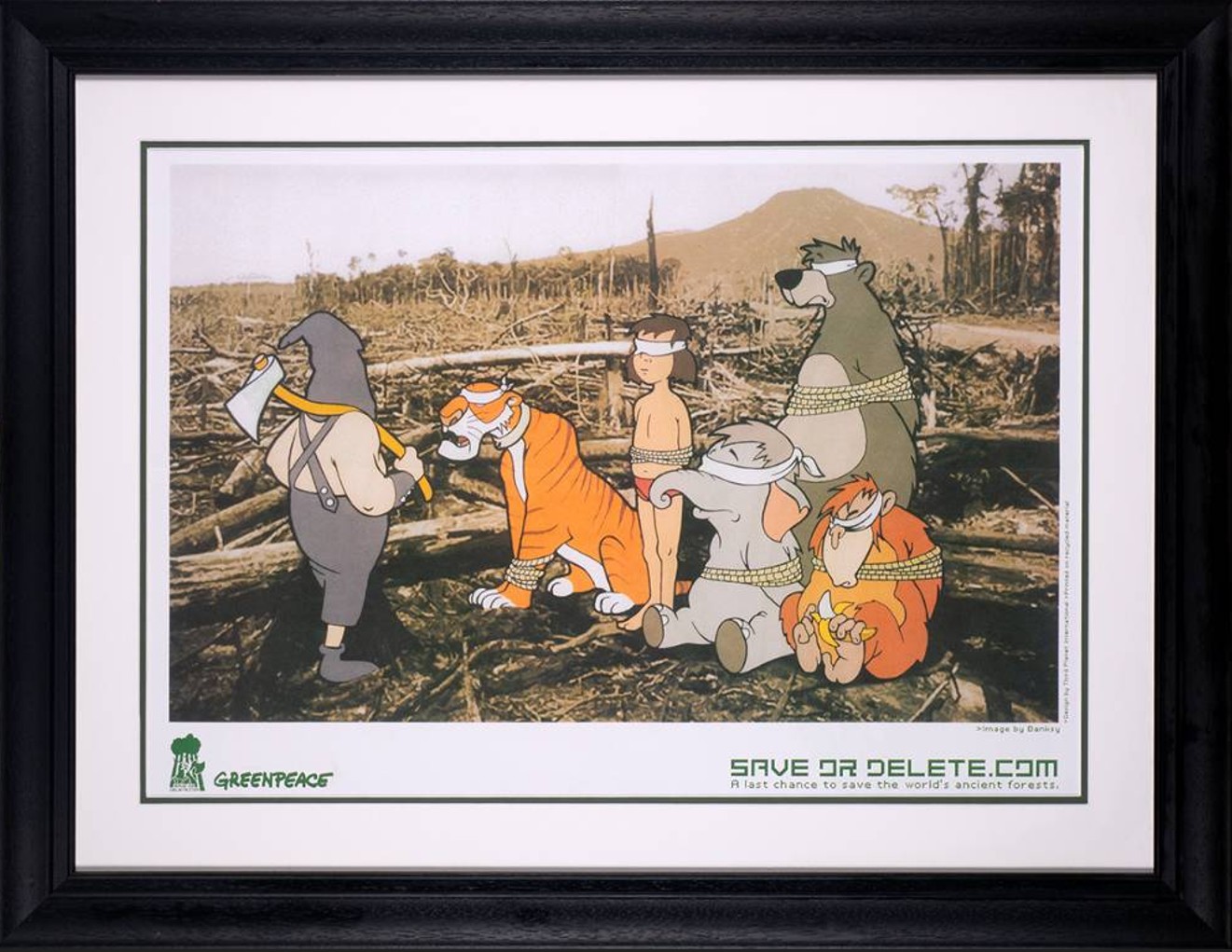
BANKSY (British, b.1974)
SAVE OR DELETE, 2002
Offset lithograph on recycled paper
Accompanied by Save or Delete eight-part sticker sheet
XXXXXXXXXX
Tate Ward Auctions: 13 July 2022
Estimated: GBP 600 – 800
GBP 1,750 / USD 2,085
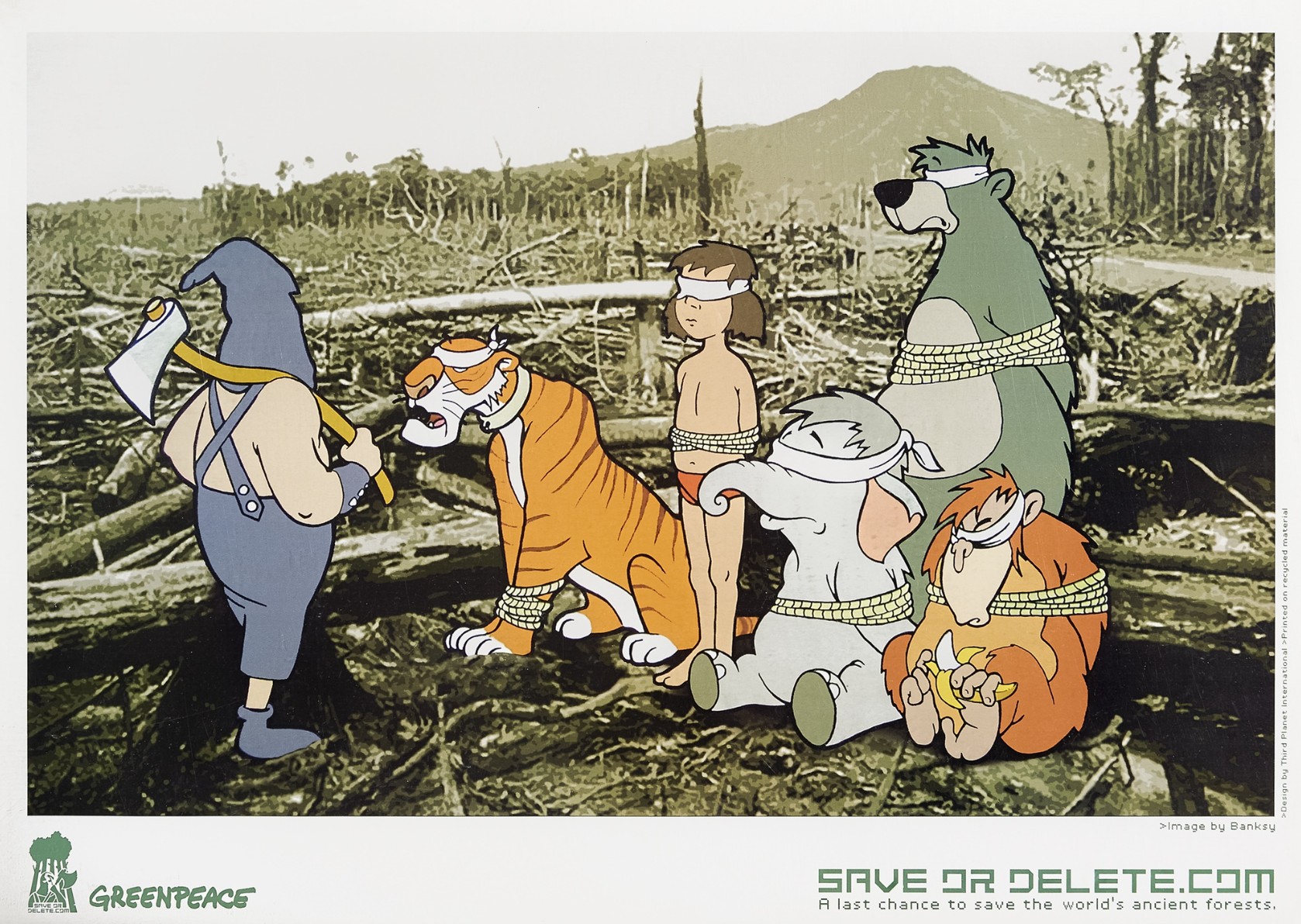
BANKSY (British 1974-)
‘Save Or Delete’, 2002
Offset lithograph in colors on recycled paper
Together with the original sticker sheet and stencil
XXXXXXXXXX
Tate Ward Auctions: 14 October 2020
Estimated: GBP 300 – 500
GBP 2,375 / USD 3,095
BANKSY (British 1974-)
‘Save Or Delete’, 2002
Offset lithograph in colors on recycled paper
Together with the original sticker sheet and stencil
XXXXXXXXXX
Swann Auction Galleries: 3 May 2018
Estimated: USD 2,000 – 3,000
USD 3,640
AUCTION RECORD FOR SAVE OR DELETE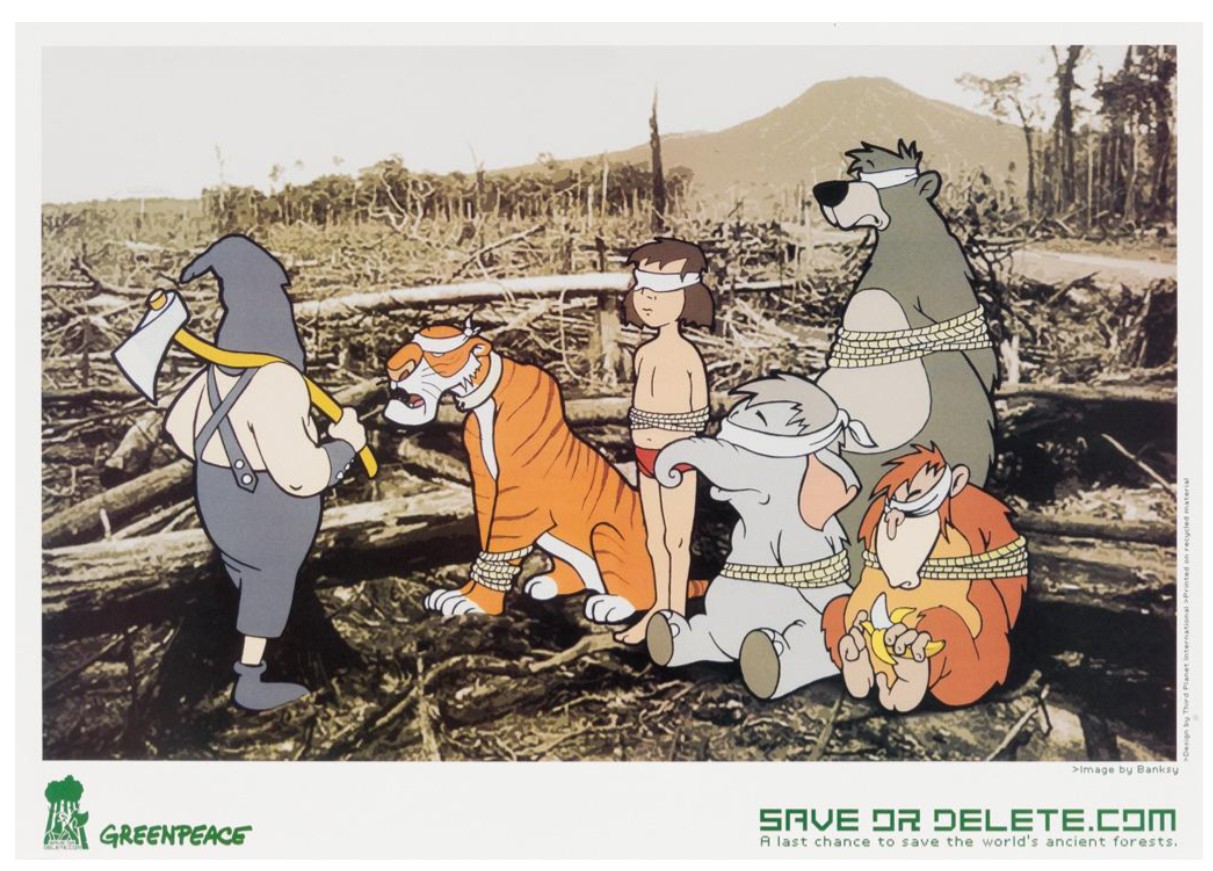
BANKSY (DATES UNKNOWN)
GREENPEACE / SAVE OR DELETE.COM, 2002
Offset lithograph