Banksy’s Dialogue with Art History
INTERNAL WORKING DRAFT
“If you want to survive as a graffiti writer when you go indoors I figured your only option is to carry on painting over things that don’t belong to you there either.”
Few artists have challenged the history of art with the audacity of Banksy. While his murals transformed city walls into sites of political protest and social commentary, another, quieter revolution was unfolding in his studio. Beginning around 2000, Banksy started acquiring discarded oil paintings from flea markets, charity shops and antique dealers, only to alter them with his unmistakable visual language. Serene pastoral landscapes suddenly became theatres of environmental catastrophe. Picturesque villages welcomed riot police, shopping trolleys or military helicopters. Classical portraits acquired gas masks, traffic cones or irreverent twists that collapsed centuries of artistic convention into a single image.
At first glance these interventions appear almost mischievous, as though Banksy were simply vandalising forgotten paintings for comic effect. Yet beneath their humour lies one of the most sophisticated bodies of work in his entire career. The Crude Oils and the later Vandalized Oils are not attacks on painting but conversations with it. They question originality, authorship, cultural memory and the authority of museums, while inviting viewers to reconsider works that had long since slipped into obscurity.
Ironically, Banksy rarely chose masterpieces. Instead, he sought anonymous decorative paintings that had become almost invisible through familiarity and neglect. By intervening on these modest landscapes and portraits, he demonstrated that artistic value does not reside solely in technical skill or historical prestige, but in an artwork’s ability to speak meaningfully to its own time. In doing so, he rescued forgotten paintings from obscurity while simultaneously transforming them into entirely new works of contemporary art.
This series follows the evolution of Banksy’s modified paintings from their earliest appearances in 2000 through the landmark Crude Oils exhibition in London in 2005 and the many Vandalized Oils that followed. More than a catalogue, it is an exploration of one of the artist’s richest and most intellectually ambitious projects—a lifelong dialogue between graffiti and galleries, vandalism and conservation, tradition and reinvention.
Rewriting Art History
Before examining individual paintings, it is essential to understand the ideas that unite them. Banksy’s modified oils are often dismissed as visual jokes, yet together they constitute a coherent artistic philosophy. They explore originality, appropriation, authorship and cultural memory while questioning the authority traditionally granted to museums and the history of art itself. Far from rejecting painting, Banksy reclaims it, demonstrating that even forgotten works can once again become culturally relevant.
The origins of the series predate the celebrated 2005 exhibition by several years. Around 2000, Banksy began experimenting with found paintings, discovering that inexpensive landscapes and portraits offered an unexpected canvas upon which contemporary anxieties could be projected. These early interventions reveal the gradual emergence of ideas that would later define one of the most original chapters of his career.
Created in 2001, Vandalized Oil #001 marks the beginning of one of Banksy’s most influential artistic series. Rather than painting onto an empty canvas, the artist appropriates a traditional landscape painting and intervenes with his unmistakable stencil technique, transforming an anonymous decorative artwork into a sharp commentary on contemporary society. It is one of the earliest examples of Banksy’s fascination with reinterpreting art history through the language of street art.
By painting directly onto an existing artwork, Banksy also questions the authority of artistic tradition itself. Rather than treating historical paintings as untouchable masterpieces, he regards them as living objects capable of generating new meanings. His intervention recalls the strategies of Marcel Duchamp and the Situationists, who challenged conventional ideas of originality by reappropriating existing images rather than creating entirely new ones.
This dialogue between classical painting and contemporary graffiti would become one of the defining characteristics of Banksy’s career. Far from mocking the past, he revitalizes it, demonstrating that even the most conventional landscapes can become powerful vehicles for contemporary political commentary.
Vandalized Oil #001 occupies a pivotal position in Banksy’s artistic development. It represents the genesis of the celebrated Vandalized Oils series, which would culminate in the landmark exhibition Crude Oils: A Gallery of Re-mixed Masterpieces, Vandalism and Vermin in 2005. From this point onward, Banksy would repeatedly revisit found paintings, introducing shopping carts, CCTV cameras, police tape, warning signs and environmental disasters into otherwise idyllic landscapes.
These works also anticipate some of his most celebrated later reinterpretations of art history, including Show Me the Monet (after Claude Monet), Sunflowers from Petrol Station (after Vincent van Gogh) and Home Sweet Home. Together, they reveal Banksy’s conviction that great art should not merely preserve the past but continually engage with the present.
The subversive gag at the heart of the Vandalized Oils series is that these gilt-framed works might hang in a museum or esteemed private gallery and pass unnoticed to the unobservant spectator. Indeed, Banksy’s history of intervention in the scared space of the museum in this manner extends back to his early 2000s pranks at institutions like the Tate Britain in London, where he entered in disguise and hung his own artwork alongside nineteenth-century paintings, managing to keep his work undetected for hours. Later, in 2004, Banksy installed a “vandalised” version of the Mona Lisa in the Louvre in a gag that similarly disrupted the institutionalized space and the museum’s most iconic work. Subject to Availability thus serves as the natural apotheosis of this impulse to disrupt this space that is so often bogged down by bureaucracy and the rules of its governing body, finally receiving permission to do so from the museum and turning himself into the curator who has free reign to install his work as he wishes.
Banksy’s “vandalization” of another artist’s work also refers to a deep art historical lineage of artists’ reframing the work of their forebears, especially as can be seen in the Dadaist work of Marcel Duchamp and his infamous 1919 work L.H.O.O.Q, for which Duchamp drew a moustache and goatee on a cheap postcard reproduction of the world’s most famous painting, Leonardo da Vinci’s Mona Lisa. One might also recall Robert Rauschenberg’s Erased de Kooning Drawing, consisting of a work Rauschenberg took from the artist and then erased, reframing it as his own and putting to question the boundaries of what constitutes an artwork and who has ultimate authorship over one. The Vandalised Oils also take precedent from Asger Jorn’s tactic of detournement, for which a pre-existing image was subverted through the insertion of a new dissonant element. The most apposite example for Banksy’s work is Jorn’s series of ‘modification’ paintings; overpainted pictures originally bought in junk shops, many of which now reside in prestigious museum collections worldwide.
Crude Oils – London, 2005
The Crude Oils exhibition marked the moment Banksy’s private experimentation entered the public sphere. Staged in a disused Notting Hill shop complete with two hundred live rats and modified classical paintings, the exhibition challenged conventional ideas of artistic value and museum culture. It remains one of the defining exhibitions of twenty-first-century British contemporary art, revealing Banksy’s ability to provoke both laughter and reflection in equal measure.

London, 100 Westbourne Grove, Crude Oils: A Gallery of Re-mixed Masterpieces, Vandalism and Vermin, October 2005 © Banksy
In 2005, Banksy staged his first conventional gallery exhibition, the now seminal Crude Oils: A Gallery of Re-mixed Masterpieces, Vandalism and Vermin, a radical intervention in the traditional exhibition format that remains a defining moment in his career. Held in a disused shop on Westbourne Grove in Notting Hill, the show marked Banksy’s transition into a more formal gallery setting while maintaining the subversive ethos of his antics in the streets. Crude Oil (Vettriano) was prominently displayed in the window, immediately setting the tone for an exhibition that challenged the hierarchies of the art world. Now considered a milestone in the artist’s oeuvre, the show featured Crude Oil (Vettriano) alongside three other fully hand-painted ‘remixes’ of canonical works: a despondent, bloomless version of Van Gogh’s Sunflowers; a reinterpretation of Edward Hopper’s Nighthawks in which a Union Jack-clad hooligan shatters the bar’s glass window; and Show Me the Monet, a caustic reimagining of Claude Monet’s idyllic Japanese footbridge, transformed into a scene of contemporary detritus. Despite his immense popularity, Vettriano, much like Banksy, remains conspicuously absent from major institutional collections, a disconnect that sharply highlights the enduring schism between mass appeal and critical discord. For Banksy, this cultural paradox – where an artist’s work is revered by the public yet dismissed by the art world elite – has long served as a source of fascination and critique. By placing Vettriano’s The Singing Butler in direct dialogue with Van Gogh, Hopper, and Monet – artists firmly embedded in the institutional canon – Banksy staged a deliberate provocation, questioning the arbiters of taste and the exclusionary nature of the art establishment.
Across the gallery’s back wall of the shop, these large-scale reinterpretations were juxtaposed with a series of modified found paintings; traditional oil canvases sourced from flea markets and altered by Banksy to reflect the social anxieties of contemporary Britain. Quaint pastoral landscapes were interrupted by burning cars and police tape; a Renaissance Madonna and Christ child casually listened to an iPod; refined portrait sitters were recast as gas mask-clad figures. Further extending this anarchic approach, Banksy also ‘vandalised’ classical sculpture, transforming a serene Venus into a tattooed figure with a traffic cone over her head and outfitting a marble bust with a military-style balaclava. Yet perhaps the exhibition’s most outrageous gesture lay not in its visual content, but in its live component: 164 rats released into the space, their scurrying presence reinforcing the exhibition’s underlying spirit of disorder and defiance. Crude Oils was not simply an exhibition but an irreverent and punk manifesto, a statement that art, much like the rodents that roamed its floors, refuses to be contained by convention.

Louise Jury, “Rats to the Arts Establishment,” The Independent, 14 October 2005
In his Sunday Times Culture review of the 2005 exhibition, Waldemar Januszsak compared Banksy’s Crude Oils to a Surrealist or situationist happening, describing the production as an elaborate and engaging mise en scene: “So, the scene has been set, the evocation evoked. We’re in a dilapidated museum overrun by rats that have eaten the attendant and set a melodramatic post-Holocaust mood that continues into the paintings” (Waldemar Januszsak, ‘Who’s afraid of the big bad guy?’, The Sunday Times, 23 October 2005, p. 9).

Waldemar Januszczak, “Who’s afraid of the big bad guy?” The Sunday Times, 16 October 2005
Couched in humor, it is precisely this mood that pits Banksy beyond the cynical punster he is often perceived to be. Crude Oil (Vettriano) and the wider Crude Oils brilliantly attest to this. Indeed, from the mid-2000s onwards, Banksy began tackling an overt geopolitical agenda with increasing intent. Despite the cynical puns and sharp punchlines, there is an authenticity to Banksy’s project. This is what makes his work so powerful, appealing, and ultimately what will see him stand the test of time. Though retaining anonymity in order to continue making street art that is deemed illegal, he is widely discussed in the media and appreciated well beyond the usual confines of the art world. A vigilante painter of our times, Banksy has adopted a heroic position for his own generation and those to come.

MARCEL DUCHAMP, MONA LISA (L.H.O.O.Q.), 1919
PHILADELPHIA MUSEUM OF ART, PHILADELPHIA
IMAGE: © 2020 THE PHILADELPHIA MUSEUM OF ART/ART RESOURCE/SCALA, FLORENCE
ARTWORK: © ASSOCIATION MARCEL DUCHAMP / ADAGP, PARIS AND DACS, LONDON 2025 www.scalarchives.com
Via an unapologetic appropriation of its established icons and historical movements, Banksy engages a direct dialogue with other punk and provocative players throughout art history. Banksy’s appropriation and subversion of Vettriano’s The Singing Butler finds its conceptual precedent in the work of Marcel Duchamp, particularly his seminal 1919 piece L.H.O.O.Q. In this infamous intervention, Duchamp defaced a mass-produced postcard of Leonardo da Vinci’s Mona Lisa by adding a moustache and goatee, undermining the sanctity of one of Western art’s most revered icons. The work’s title, when vocalized in French, forms a crude pun, further destabilizing traditional notions of beauty and cultural veneration. By targeting the Mona Lisa, Duchamp satirized the bourgeois cult of Jocondisme – a phenomenon of early twentieth-century France in which the Mona Lisa was idolized as a symbol of artistic and national heritage.

John Higginson, “A warning for the ratist in residence,” Metro, 14 October 2005
The 2005 exhibition did not conclude this artistic investigation. Over the following years Banksy continued to revisit modified paintings, developing increasingly sophisticated compositions that broadened both their technical execution and conceptual ambition. The later Vandalized Oils demonstrate that this was never a short-lived experiment but an enduring strand running through his career.
Remixing Masters
Every modified painting exists in dialogue with another artist. Some reference celebrated masterpieces, while others transform anonymous landscapes whose original creators remain unknown. In each case, Banksy appropriates existing imagery not to erase its history but to continue it. His paintings belong to a long tradition of artistic borrowing that stretches from Marcel Duchamp and Asger Jorn to Pop Art and Situationism, while remaining unmistakably his own.
Show Me The Monet, 2005
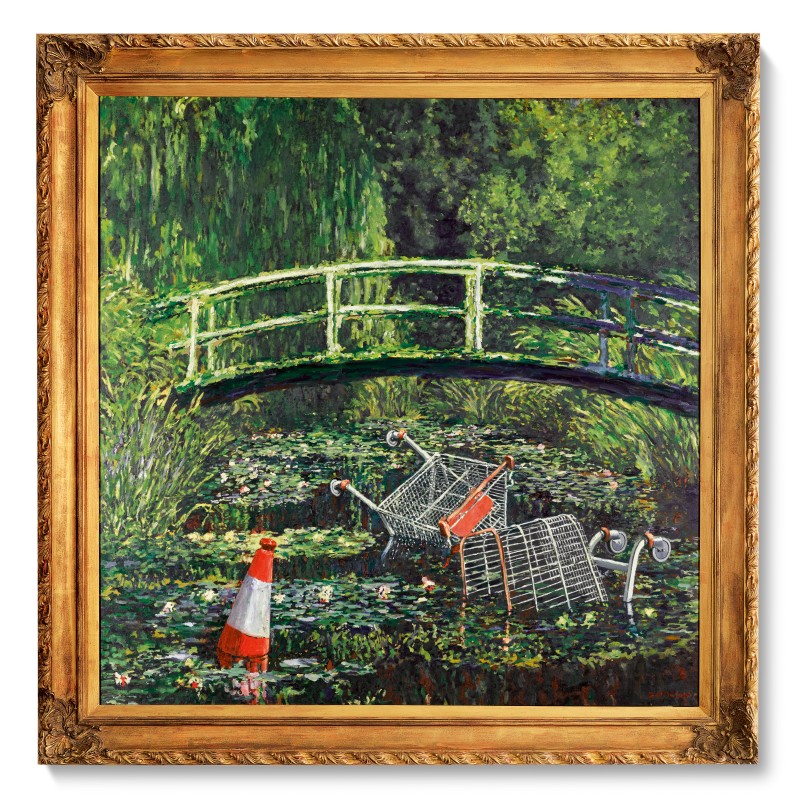
BANKSY
Show Me The Monet, 2005
Oil on canvas in artist’s frame
143.1×143.4cm (56 3/8 x 56 1/2 inches)
Signed
| Sotheby’s London 21 October 2020 Est.: GBP 3,000,000 – 5,000,000 |
Price Realized GBP 7,551,600 / USD 9,968,110 SHOW ME THE MONET | Sotheby’s |
Crude Oil (Vettriano), 2005
Sotheby’s London: 4 March 2025
Estimated: GBP 3,000,000 – 5,000,000
GBP 4,260,000 / USD 5,452,800
Crude Oil (Vettriano) | Modern & Contemporary Evening Auction | 2025 | Sotheby’s

BANKSY (b. 1974)
Crude Oil (Vettriano), 2005
Oil on canvas, in artist’s frame
Canvas: 91×122 cm (35 7/8 x 48 inches)
Tagged (lower right)
Signed, partially titled and dated Oct 2005 (on the overturn edge)
Crude Oil (Vettriano) stands as one of the most instantly recognizable and audacious works in Banksy’s provocative oeuvre – a rare, entirely hand-painted canvas that epitomises the artist’s role as a cultural agitator and sharp-witted social commentator. Rooted in the anti-establishment ethos of punk, Banksy’s output has always been a performative act of defiance; a rejection of the rigid structures of the art world and the institutions that dictate taste, cultural and commercial value. From his early days tagging the streets of Bristol to the guerrilla-style interventions that catapulted him into the international spotlight, his practice has remained a direct challenge to authority, hierarchy, and convention. Crude Oil (Vettriano) was first unveiled in Banksy’s landmark exhibition in 2005, Crude Oils: A Gallery of Re-mixed Masterpieces, Vandalism and Vermin, and sees Banksy remix an image deeply embedded in the canon of Modern British Painting: Jack Vettriano’s The Singing Butler from 1992: a scene of desirable elegance and a vision of romance set against the elemental force of wind and rain. Then and now, Banksy continues to teeter on the periphery of institutional acceptance. Fittingly bearing provenance worthy the rock and roll hall of fame, Crude Oil (Vettriano) has resided in the collection of blink-182 frontman Mark Hoppus since 2011: a performer whose own thirty-year long career has been shaped by the same irreverent, outsider spirit that defines Banksy’s work.

Jack Vettriano, The Singing Butler, 1992
A couple, dressed in evening attire, waltz barefoot across a desolate beach, their poised movements seemingly impervious to the storm that rages around them. Bathed in a golden light that defies the overcast sky. The Singing Butler captures an atmosphere of escapist fantasy, its dreamlike quality resonating with an audience drawn to its fusion of nostalgia, glamour, and quiet defiance of reality. Here, recasting Vettriano’s elegantly attired dancers against a backdrop of environmental devastation, Banksy replaces Vettriano’s genteel nostalgia with a dystopian vision that speaks to contemporary anxieties. Vettriano’s popular painting has been painstakingly re-invented by Banksy, now featuring a sinking oil liner and two men in hazmat suits wheeling a barrel of toxic waste. Scalding the art world with humour and irony, Banksy delivers a complex dialogue that tackles prescient issues of our time, such as the environment, pollution, and the capitalist landscape. In this act of visual disruption, Crude Oil (Vettriano) embodies the very principles that define Banksy’s practice: an irreverent yet deeply considered challenge to the structures of power, taste, and authority that govern the art world and beyond.
“If you want to survive as a graffiti writer when you go indoors your only option is to carry on painting over things that don’t belong to you there either.”
By appropriating The Singing Butler and subverting its idyllic imagery, Crude Oil (Vettriano) operates as a wry commentary on both the sanitisation of popular culture and the selective validation of artistic legitimacy. One of the most widely disseminated pictures of a generation, The Singing Butler became the most expensive painting ever sold at auction by a Scottish artist when it achieved £744,800 at Sotheby’s in 2004, the record price for any painting sold in Scotland at the time. The sale, however, was met with an air of ambivalence from the art world establishment, a sentiment captured in The Guardian’s headline the following day: “Painting by ridiculed but popular artist sells for £744,800” (The Guardian, 20 April 2004, online). Vettriano’s disconnection between his enthusiastic reception by the masses – confirmed by the longevity of the picture and the myriad of paraphernalia emblazoned with The Singing Butler – and rejection by the art establishment struck a nerve with Banksy, who has long assailed the hegemony of the art world elite.
Banksy’s engagement with Vettriano operates within this same lineage of irreverent critique, aligning with the Dadaist tradition of dismantling artistic hierarchies. Much like Punk, Dada is a rejection of rationality and logic, a movement that praises intuition, and that relinquishes, opposes, negates all forms of control from art critiques to politicians.

Mark Hoppus photographed with the present work in his home in Los Angeles, February 2025
Growing up in Southern California, Mark Hoppus found a sense of belonging in the countercultural communities of skateboarding and punk music, where self-expression and rebellion against the mainstream were central tenets. His first significant encounter with fine art came through an art history course in college, where a passionate professor illuminated punk rock radicalism embedded in works from Caravaggio to Jackson Pollock. A field trip to LACMA and MOCA introduced him to the broader possibilities of contemporary art, but it was the Helter Skelter: LA Art in the 90s exhibition that delivered a pivotal revelation – Raymond Pettibon who was behind American punk rock band Black Flag’s iconic album covers, was featured in a major museum show. This moment crystallised for Mark the interconnectedness of punk, street art, and the institutional art world.Years later, this connection was reaffirmed when he attended Art in the Streets at MOCA in Los Angeles, an exhibition that marked a turning point in the legitimisation of graffiti and street art. The show included work by Shepard Fairey, Kenny Scharf, and Banksy, among others, celebrating artists who had transitioned from the underground to the institutional stage. In Mark’s home, surrounded by music, skateboarding, and counterculture, Crude Oil (Vettriano) became more than an artwork; it was a lived presence and daily reminder of the shared lineage between punk, street art, and the DIY ethos that unites them. In Mark’s collection, over time, Crude Oil (Vettriano) came to encapsulate the very notion of life imitating art, a testament to the enduring power of subversion, rebellion, and the refusal to conform.
Sunflowers from Petrol Station, 2005
Christie’s New-York: 8 November 2021
Estimated: USD 12,000,000 – 18,000,000
USD 14,558,000

BANKSY
Sunflowers from Petrol Station, 2005
Oil on canvas, in artist’s frame
102.6 x 87.5 cm (40.6 x 34.4 inches)
Held for its entire life in the collection of legendary British fashion designer Sir Paul Smith, Sunflowers from Petrol Station is an icon within Banksy’s oeuvre. Witty, irreverent and subversive, it offers a wry reimagining of Vincent Van Gogh’s celebrated Sunflowers, transforming the Dutch master’s radiant yellow blooms into a cluster of dried, wilted stems. Against a backdrop of thickly-wrought impasto, dead petals accumulate around the base of the vase, which bears the artist’s name—in place of Van Gogh’s—in blue lettering. A rare and exquisitely rendered example of Banksy’s coveted hand-painted oils, the work formed part of the artist’s seminal 2005 exhibition Crude Oils: A Gallery of Re-mixed Masterpieces, Vandalism and Vermin in London. There, it took its place alongside other art-historical reworkings by Banksy, including Show me the Monet—a parody of Claude Monet’s Japanese Bridge paintings—as well as alternative versions of Edward Hopper’s Nighthawks and Jack Vettriano’s The Singing Butler. Acquired by Smith directly from the exhibition, it is an outstanding demonstration of Banksy’s virtuosity as a painter, and his acerbic flair as a satirist. Through the comedic pathos of withered petrol station flowers—a modern-day memento mori—the artist implicates the pollution of both art and nature at the hands of consumerism: neither, he warns, will last forever in its clutches.

‘If you want to survive as a graffiti writer when you go indoors your only option is to carry on painting over things that don’t belong to you there either.’

BANKSY
Tesco Value Soup Can, 2004
Oil on canvas
121.9 x 91.5 cm (48×36 inches)
Stenciled with the artist’s name on the overturn edge
Signed, dated “07/11/04” on the stretcher
Provenance
Private Collection, United Kingdom (acquired from the artist)
Bonhams, London, Urban Art, 23 October 2008, Lot 49
Acquired from the above by the present owner
Exhibited
Crude Oils, London, October 2005
Auction History
| Sotheby’s London 5 October 2017 Est.: GBP 200,000 – 300,000 |
Price Realized GBP 392,750 / USD 515,620 (#47) Banksy |
Catalogue Note


BANKSY
Venus, 2006
Oil on canvas
97.7 x 121.5 cm (35 3/4 x 47 7/8 inches)
Stenciled-signed “BANKSY”, lower right
Further signed and dated “Sep 2006” on the overlap
Provenance
Lazarides Gallery, London
Acquired directly from the above by the present owner in 2006
Exhibited
Barely Legal, Los Angeles, 2006
Auction History
| Sotheby’s London 27 June 2013 Est.: GBP 150,000 – 200,000 |
Price Realized GBP 146,500 / USD 223,165 (#325) Banksy |
Catalogue Note
Venus is one of the most important examples of Banksy’s highly significant and internationally celebrated series of Corrupted Oils, in which masterpieces of the Western Art Historical tradition are vandalized through frequently humorous additions. Brilliantly provocative and boldly witty in its appropriation of probably the most iconic image of beauty, Banksy’s Venus transforms Velazquez’s The Rokeby Venus(1647-51) into a pithy commentary on the commercialization of looks and appearance in the modern age.
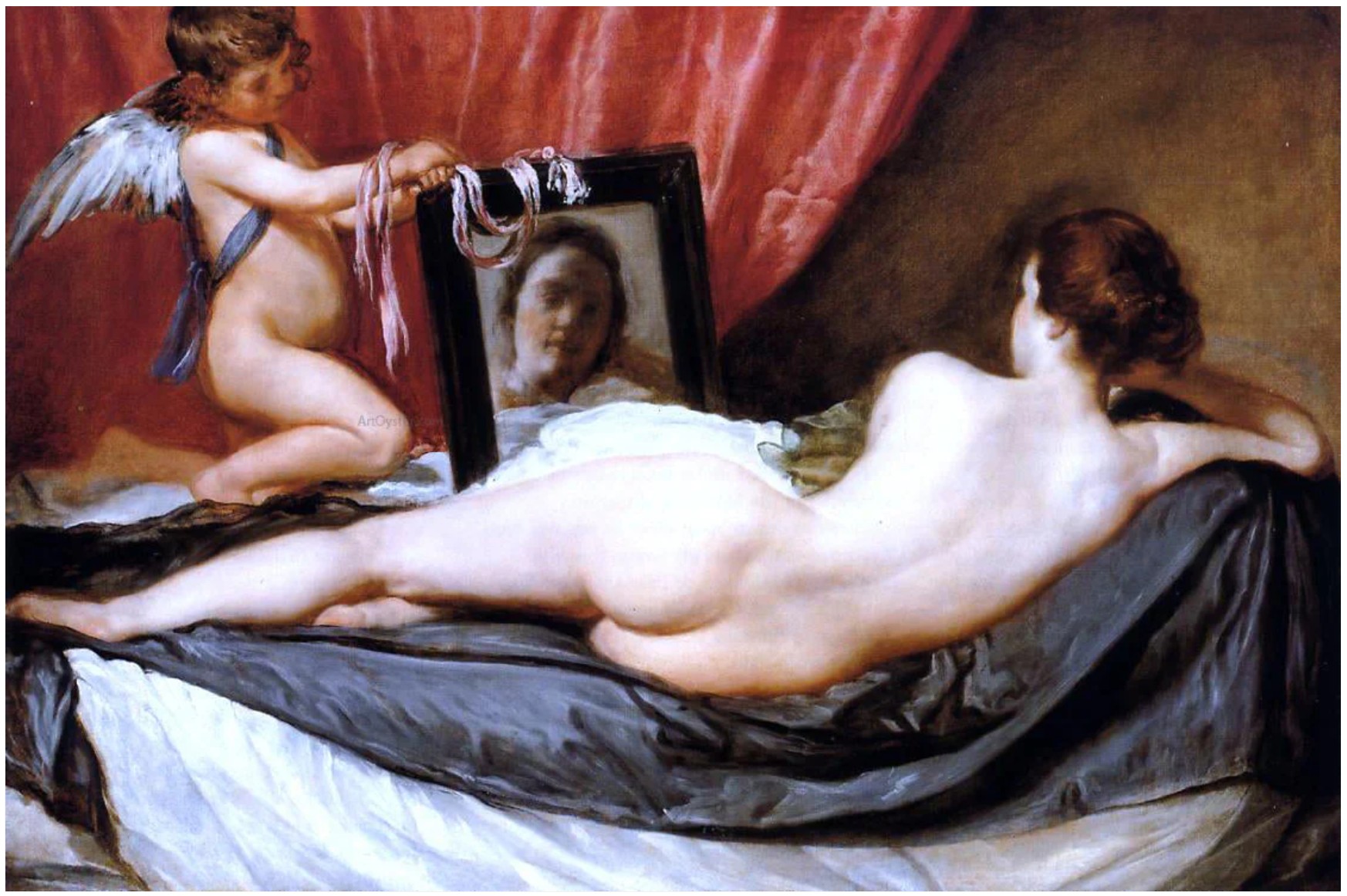
Rokeby Venus, Diego Velazquez, oil on canvas, 1647-1651
Whilst the original painting – in which the languidly reclining goddess of Love admires herself in the mirror held up by her son Cupid – is an unabashed meditation on female beauty, Banksy’s Venus subverts this message with exquisite irony. Venus, the most beautiful of the gods, is here rendered delightfully fallible through the presence of a bandage on the bridge of her nose, clearly indicating that a woman considered the acme of feminine perfection has succumbed to the lure of cosmetic enhancement. Through this small but loaded addition, Banksy thus transforms the goddess into a recognizably mortal woman, one who turns trustingly to the modern phenomenon of cosmetic surgery as an instinctively accepted solution.
BANKSY
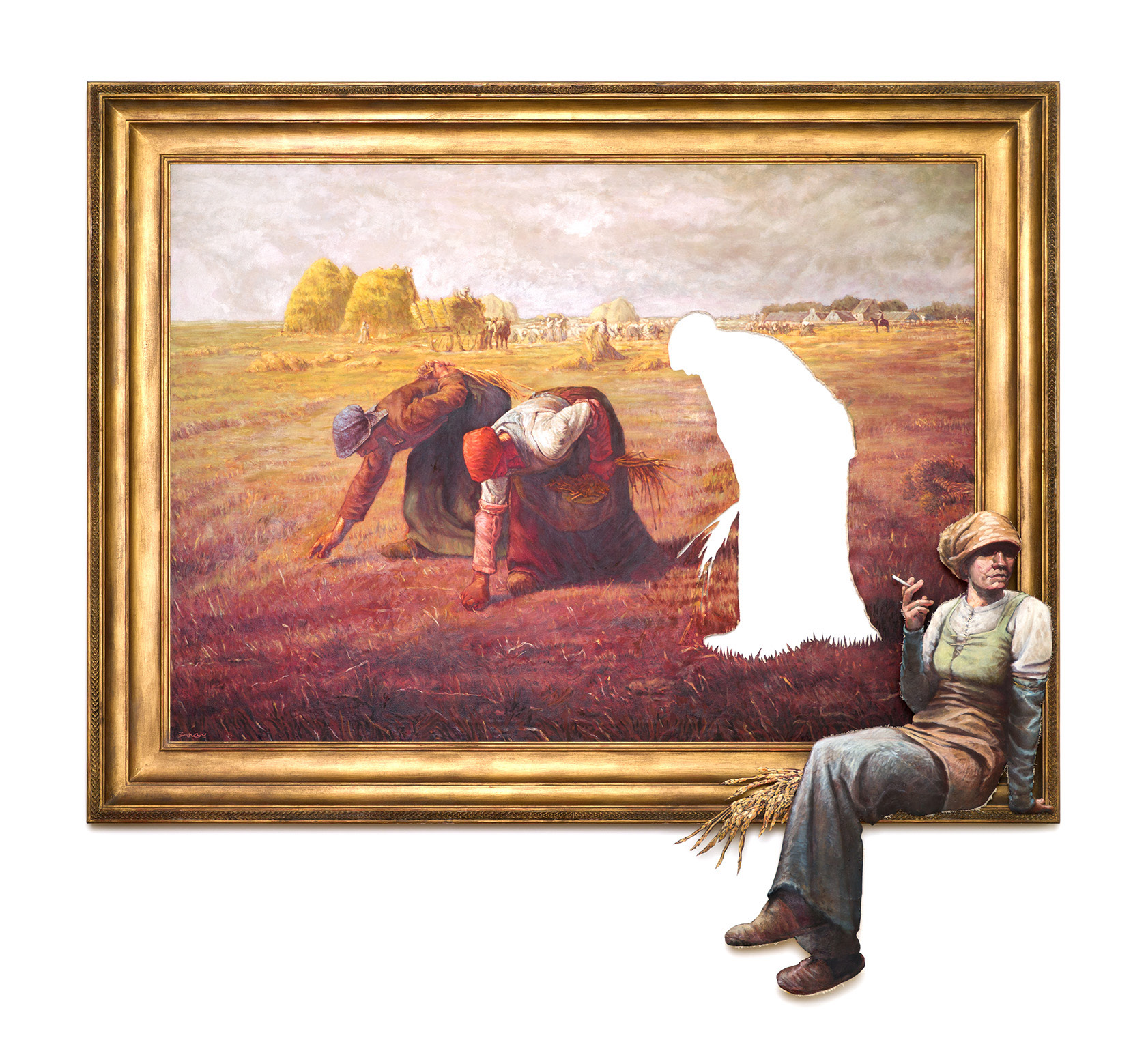
The Gleaners, 2009
Oil on canvas
152×165 cm (60×65 inches)
Exhibited
Banksy vs. Bristol Museum, Bristol Museum, Bristol, 2009
Catalogue Note
Jean-François Millet’s The Gleaners is one of the defining masterpieces of nineteenth-century Realism. Painted in 1857, it depicts three peasant women gathering the remnants of the harvest, transforming an ordinary rural activity into a powerful meditation on labor, poverty, and human dignity. At the time of its exhibition, the painting provoked considerable controversy, as many critics interpreted its sympathetic portrayal of the rural poor as an implicit social and political statement in the aftermath of the French Revolution of 1848.

Banksy approaches this celebrated masterpiece with remarkable audacity. Rather than simply inserting a contemporary object into Millet’s composition, he fundamentally alters its structure. One of the three gleaners has disappeared, leaving behind a conspicuous white silhouette that exposes her absence. The missing figure reappears outside the painting itself, hand-painted by Banksy and seated casually on the frame, cigarette in hand, apparently uninterested in returning to the scene she has abandoned.
It is a deceptively simple intervention, yet one of the most conceptually sophisticated of Banksy’s entire Crude Oils series. Most artists who reinterpret historical masterpieces introduce something new into the original composition. Banksy does precisely the opposite. Instead of adding a character, he removes one. More importantly, he liberates her. After nearly one hundred and fifty years of endlessly performing the same humble task, Millet’s gleaner simply refuses to continue. She steps out of the painting, sits comfortably on its frame, lights a cigarette, and quietly watches the remaining workers carry on without her.
The gesture is humorous, but it also transforms the meaning of the original masterpiece. Millet’s women functioned as symbols of perseverance, labor and rural dignity. Banksy’s gleaner ceases to be a symbol altogether. She becomes an individual capable of making her own choices, rejecting the role assigned to her by both history and the artist who first created her. In a subtle but profoundly original gesture, Banksy grants agency to a figure who had spent generations trapped within one of the most celebrated paintings of the nineteenth century.

Perhaps even more remarkably, Banksy dismantles one of the oldest conventions of Western painting: the boundary between the artwork and the viewer. By allowing the gleaner to physically occupy the frame, the picture is no longer confined to the canvas. The frame itself becomes part of the composition, blurring the distinction between painting, sculpture and installation. Long before Love is in the Bin challenged the physical integrity of the artwork, The Gleaners was already questioning whether a masterpiece must remain imprisoned within its own borders.
This playful irreverence perfectly encapsulates Banksy’s relationship with art history. Rather than treating great paintings as untouchable relics, he approaches them as living works capable of evolving alongside contemporary society. His intervention is neither destructive nor disrespectful. On the contrary, it demonstrates an intimate understanding of Millet’s composition, proving that genuine homage sometimes consists not of preserving the past unchanged, but of allowing it to continue speaking to the present.
Created for the landmark exhibition Banksy vs. Bristol Museum in 2009, The Gleaners occupies a singular place within Banksy’s oeuvre. It bridges his earlier Remixed Masterpieces, inspired by artists such as Monet, Van Gogh and Warhol, with the increasingly ambitious Crude Oils, where historical paintings are transformed through subtle conceptual interventions. Its subsequent inclusion in the 2017 Jean-François Millet retrospective at the Palais des Beaux-Arts in Lille—where it was exhibited alongside Millet’s original masterpiece—confirmed its significance not merely as a work by Banksy, but as a thoughtful and compelling contribution to the continuing dialogue between contemporary art and the history of painting.
Within Banksy’s body of work, The Gleaners stands as one of his most intellectually inventive reinterpretations of a historical masterpiece. By allowing one of Millet’s protagonists to abandon both the composition and the role assigned to her nearly 150 years earlier, Banksy does far more than alter a painting—he sets it free. In doing so, he reminds us that great works of art are never fixed in time. They remain living images, capable of escaping their own history and entering ours.
BANKSY
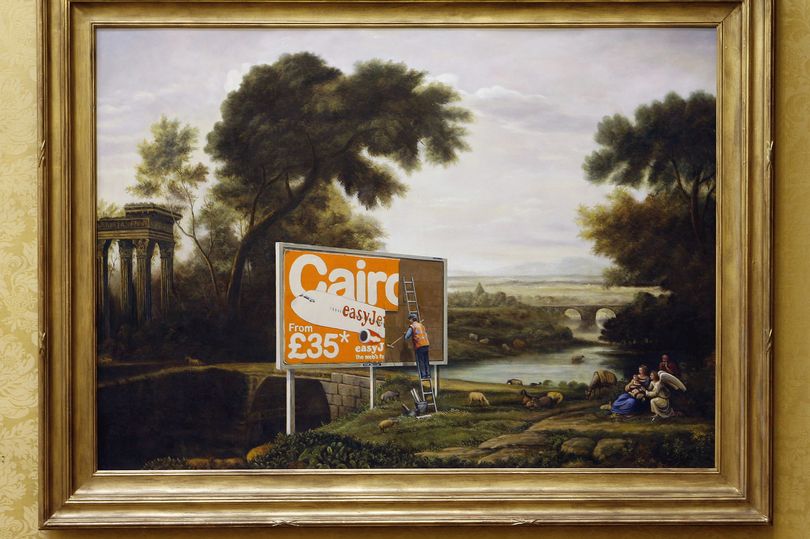
Flight To Egypt, 2009
Vandalized oil on canvas
173×125 cm
Few artists have demonstrated Banksy’s ability to insert contemporary society into the visual language of classical painting as seamlessly as Flight to Egypt. Based on Nicolas Poussin’s celebrated seventeenth-century depiction of the Holy Family fleeing to Egypt, Banksy interrupts the tranquil biblical landscape with a large EasyJet advertising billboard being installed by a workman. The intervention is characteristically minimal, yet its consequences are profound. A timeless scene of exile, faith, and divine protection suddenly collides with the language of low-cost tourism and commercial branding.
The contrast is immediately striking. Poussin’s original composition invites contemplation, presenting nature as a harmonious refuge for one of Christianity’s most significant narratives. Banksy introduces a contemporary intrusion that dominates the foreground, partially obscuring both the landscape and the sacred story unfolding behind it. The billboard becomes a literal barrier between the viewer and history, suggesting that commercial imagery increasingly occupies the visual space once reserved for culture, religion, and collective memory.
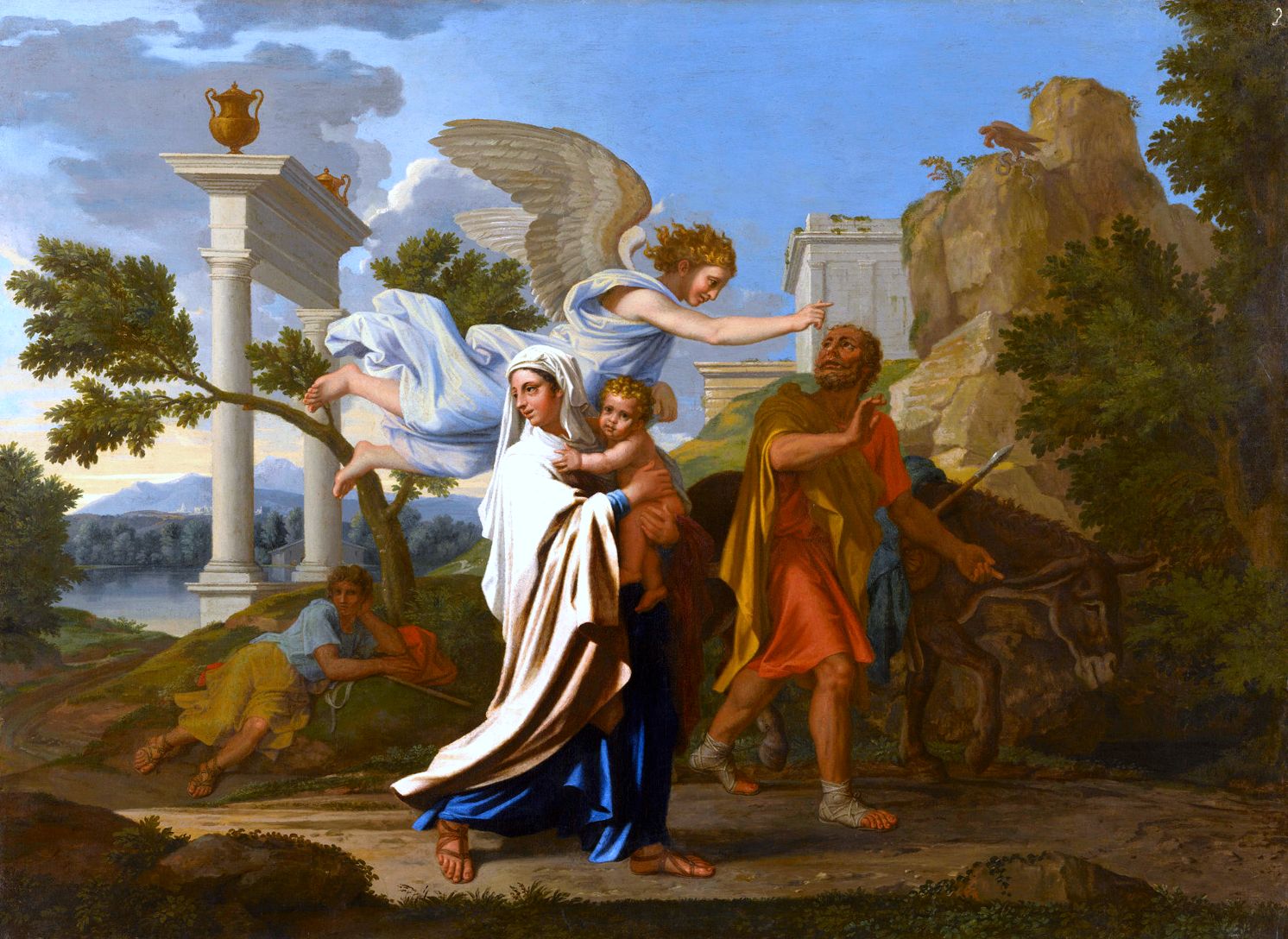
Fight Into Egypte by Nicolas Poussin – Œuvre appartenant au musée des Beaux-Arts de Lyon
As with many of the works from the Crude Oils series, Banksy demonstrates remarkable restraint. Rather than repainting the entire composition, he inserts a single object whose visual language feels entirely alien to the surrounding canvas. The crisp typography, vivid orange branding, and industrial steel supports clash violently with Poussin’s muted palette and classical serenity. The collision between these two worlds generates the work’s enduring tension. The billboard does not simply exist within the landscape; it overwhelms it.
Yet the choice of advertisement is particularly significant. The biblical Flight into Egypt tells the story of refugees escaping persecution, forced to leave their homeland to protect the infant Jesus from King Herod’s massacre of the innocents. Banksy replaces this desperate journey with the promise of effortless leisure travel. The slogan advertising inexpensive flights transforms an act of survival into a consumer choice, exposing the vast distance between voluntary tourism and forced migration. In doing so, the painting quietly asks whether contemporary society has become so accustomed to advertising that it risks trivializing even the most profound human experiences.
The work also reflects Banksy’s long-standing interest in the colonization of public space by commercial imagery. Throughout his career, he has repeatedly challenged the omnipresence of advertising, arguing that corporations occupy our visual environment without invitation. Here, the billboard literally colonizes a masterpiece of European painting, just as modern advertising increasingly colonizes our cities, landscapes, and everyday lives. The intervention becomes a visual metaphor for a culture in which commercial messages compete with—and often eclipse—history, spirituality, and art itself.
Created for the landmark exhibition Banksy vs. Bristol Museum in 2009, Flight to Egypt belongs to the artist’s mature series of altered oil paintings, in which historical masterpieces are subtly transformed through contemporary interventions. Unlike works that rely primarily on humor, this painting achieves its effect through quiet dissonance. Nothing is destroyed, yet everything has changed. A single billboard is sufficient to rewrite the emotional and symbolic meaning of an entire landscape.
Within Banksy’s oeuvre, Flight to Egypt stands alongside works such as Subject to Availability, Hanging Klansman, Home Sweet Home, and Devolved Parliament, all of which explore the uneasy coexistence of historical tradition and modern ideology. It demonstrates Banksy’s extraordinary ability to engage with the history of art while remaining unmistakably contemporary, revealing how the language of commerce has become one of the defining visual forces of the twenty-first century.
Corrupted Landscapes
Among the most recognisable works of the series are idyllic countryside scenes interrupted by unmistakably contemporary intrusions. Riot police, shopping trolleys, crashed vehicles, helicopters and industrial pollution invade peaceful landscapes, exposing the fragile illusion of harmony that traditional painting often celebrated. These works transform nostalgic escapism into sharp reflections on consumerism, environmental destruction and the uneasy relationship between civilisation and nature.

Oil on canvas in the artist’s frame
68.5 x 78.7 cm (26 15/16 x 31 inches)
Auction History
Bonhams London: 29 June 2023
Estimated: GBP 1,200,000 – 1,800,000
GBP 1,681,900 / USD 2,121,735
Congestion Charge from 2004 is a unique and rare example of Banksy’s Vandalized Oil series also referred to as Crude Oils. Bought from Santa’s Ghetto by Sir Paul Smith in 2004, the work has remained in the British fashion icon’s distinguished private collection ever since and comes to auction for the very first time. Made famous through a now iconic show in 2005 with the same title, the Crude Oils consist of reimagined old master paintings such as such as Show Me The Monet and Sunflowers From Petrol Station alongside modified traditional oils on canvas like the present work. Bought at flea markets around London, Banksy would add his own subversive touches to classical canvas paintings, a congestion charge sign in an otherwise idyllic traditional landscape, injecting new paradoxical meaning into the outdated artwork. This act of subversion serves as a commentary on the commercialization of art and the collective memory of historical and present events. Banksy’s modifications challenge the original context and narrative of the paintings, highlighting the power of art to disrupt and provoke critical thought about societal issues and the role of art in shaping collective consciousness.
First introduced in 2003, the year before the present work was executed, congestion charge is a fee imposed on vehicles entering certain areas of London during peak hours to reduce traffic and promote public transportation. Banksy’s artwork ridicules the policy, suggesting an absurd placement of the charge sign in a remote farm path that is unusable due to flooding. As with many of Banksy’s works, Congestion Charge has a playful and thought-provoking nature. It captures attention and prompts viewers to question the effectiveness and consequences of urban policies. Around the same time, Banksy famously placed some of his Vandalized Oils in prominent galleries, where they would hang unnoticed amongst the institutions permanent collection, at times for days. At the British Museum for example, he secretly placed a modified version of a prehistoric cave painting, adding a figure pushing a shopping cart and a barcode. The act drew attention to the commercialization of art and the consumer-driven society we live in with the modified artwork remaining on display for several days before being discovered and removed by museum officials. The act allowed Banksy to circumvent the traditional art world and its gatekeepers, making a direct impact on the public sphere and challenging the notions of ownership, authenticity, and the commercialization of art. His disruptive tactics challenged viewers to re-evaluate their perceptions of art and the institutions that house it.
As Banksy’s profile and collectability has developed, unique works of exceptional history and quality become still more prized. Presented here for sale is such a painting that demonstrates the British artist’s indisputable and enduring currency as social commentator and contemporary artist that has remained in the highly distinguished art collection of Sir Paul Smith for nearly two decades. In common with many of Banksy’s most successful works, Congestion Charge intends to amuse the viewer, yet it also aims to engender thought provoking discourse within a broader socio-political context.
Countryside CCTV, 2006

BANKSY
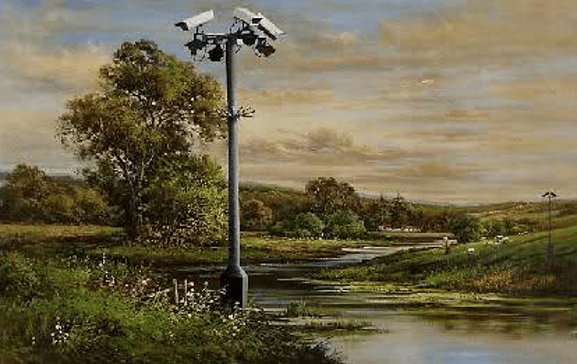
CCTV, 2004
In CCTV, Banksy transforms an anonymous pastoral landscape into a meditation on surveillance and the gradual erosion of privacy. The original painting depicts an idyllic English countryside: a tranquil river, lush vegetation and a peaceful village bathed in soft evening light. Nothing disturbs this vision of rural harmony except a single surveillance camera standing prominently in the foreground. Its stark industrial silhouette instantly fractures the illusion of innocence.
The brilliance of the work lies in its restraint. Unlike many of Banksy’s interventions, no explosions, policemen or monkeys invade the composition. A single object is enough to alter the entire narrative. The CCTV camera functions almost like a modern obelisk, silently dominating the landscape while suggesting that even the most peaceful places have become subject to observation. The countryside, traditionally associated with freedom and escape, becomes another monitored environment where anonymity no longer exists.
Like the finest works from the Crude Oils series, CCTV questions not only society but also painting itself. Banksy appropriates an idealized nineteenth-century vision of England and inserts a contemporary symbol of state control, collapsing two centuries into a single image. The result is quietly humorous yet profoundly unsettling. Paradise has not been destroyed; it has simply been placed under surveillance.

Landscape with Incident Sign
BANKSY
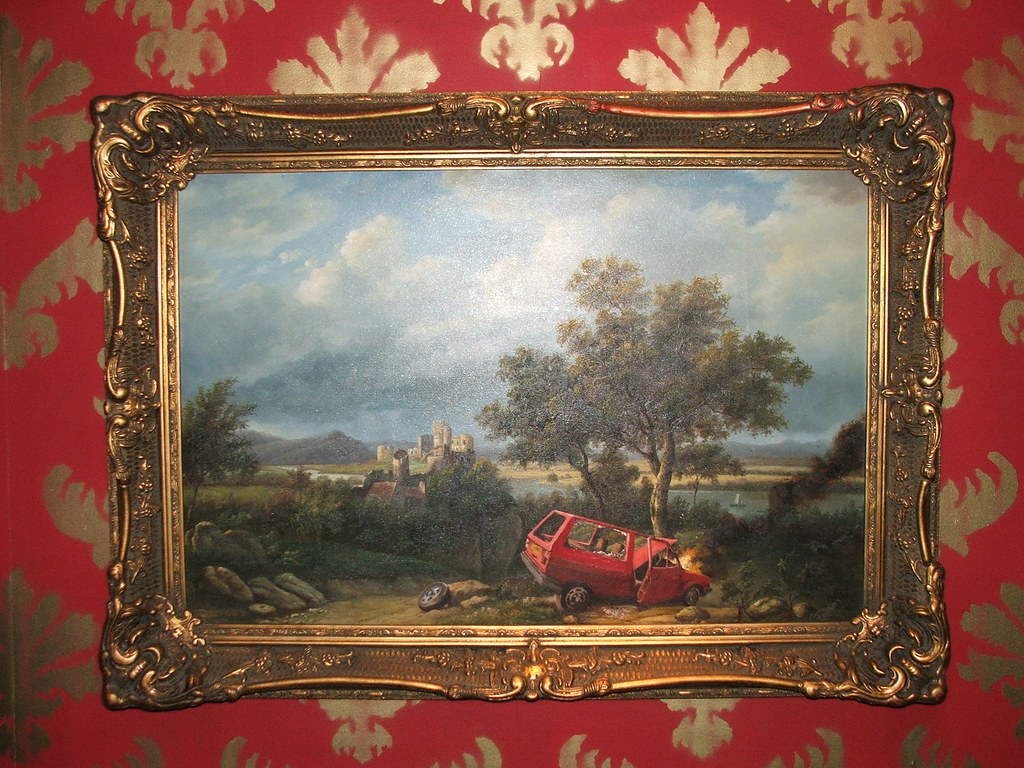
Landscape with Crashed Car, 2006
Exhibited
Barely Legal, Los Angeles, 2006
Catalogue Note
With Landscape with Crashed Car, Banksy once again appropriates the visual language of the nineteenth-century pastoral landscape only to disrupt its quiet harmony with an unmistakably contemporary intrusion. Nestled among rolling hills, ancient ruins and peaceful trees sits a small red van that has veered off the road, its door hanging open and smoke gently rising from the engine. The accident is strangely understated. There are no victims, no drama, no visible panic—only the quiet evidence that something has gone wrong.
This subtle intervention exemplifies one of Banksy’s most sophisticated artistic strategies. Rather than overwhelming the original painting with overt political symbolism, he inserts a single contemporary object into an otherwise timeless landscape. The collision between centuries is immediate. The pastoral idyll, traditionally conceived as a refuge from modern life, is quietly contaminated by one of its most familiar products. The van appears almost absurd in its surroundings, yet it also feels strangely inevitable.
The abandoned vehicle becomes a metaphor for modern civilization itself. Cars have long symbolized progress, freedom and technological achievement, but here that promise has literally broken down. Isolated in a landscape that has survived for centuries, the wreck suggests the fragility of the contemporary world when measured against the permanence of nature and history. The medieval ruins in the distance have already witnessed countless generations rise and fall; the van, by contrast, already looks obsolete.
Like several works from the Crude Oils and Barely Legal exhibitions, the painting explores the uneasy relationship between romantic idealism and contemporary reality. Traditional landscape painting often presented nature as ordered, harmonious and eternal. Banksy introduces a quiet reminder that the modern world cannot simply be excluded from that vision. Pollution, consumer culture, abandoned machinery and human error inevitably find their way into even the most idyllic settings.
The choice of a modest red van rather than a spectacular luxury automobile is equally significant. Banksy consistently avoids glamour. The vehicle belongs to everyday life rather than fantasy, reinforcing his fascination with ordinary objects that quietly reveal broader social truths. The accident could have happened yesterday, or decades ago. Its very banality makes it believable.
Created for Barely Legal in Los Angeles in 2006, Landscape with Crashed Car belongs to Banksy’s celebrated series of vandalized landscapes, alongside works such as Landscape with Car Wreck, Modified Oil Painting #12 (CCTV Countryside), Frontier, The Waterfall, and Guantanamo Bay. Together these paintings demonstrate that Banksy’s interventions are rarely acts of destruction. Instead, they function as temporal collisions, allowing contemporary anxieties to enter compositions originally conceived as visions of permanence and tranquillity.
The work also reflects one of Banksy’s recurring philosophical concerns: the illusion of progress. Modern society often imagines itself moving inexorably forward, yet the crashed van suggests another possibility—that progress can stall, lose direction or simply end up in a ditch. The surrounding landscape remains serene and indifferent, continuing its slow rhythm while human technology sits abandoned in silence. Nature neither celebrates nor mourns our achievements; it simply outlasts them.
Ultimately, Landscape with Crashed Car reminds us that paradise is rarely destroyed by grand catastrophes. More often, it is interrupted by the quiet accumulation of ordinary human mistakes. A single vehicle is enough to fracture the timeless illusion of the pastoral landscape, just as a single contemporary object can transform the meaning of an entire painting. In Banksy’s hands, that modest red van becomes less an accident than a gentle meditation on the precarious place of modern civilization within the much longer history of the natural world.

BANKSY
Landscape with Abandoned Car, 2006
At first glance, the landscape appears reassuringly familiar. Majestic trees frame a peaceful clearing, sunlight filters gently across the grass, and a lone shepherd quietly tends his flock in the distance. The scene evokes the Romantic tradition of landscape painting, celebrating harmony between humanity and nature. Yet this illusion is quietly broken by the abandoned vehicle occupying the foreground. Its presence feels strangely intrusive—not because it dominates the composition, but because it simply does not belong.
Unlike Landscape with Car Wreck or Landscape with Crashed Car, where the damaged vehicles suggest sudden catastrophe, Landscape with Abandoned Car speaks instead of neglect. The violence has already occurred. Whatever story brought the automobile into this peaceful setting has long since disappeared, leaving only its silent remains. Banksy replaces the spectacle of disaster with its aftermath, inviting viewers to contemplate the traces that modern civilization leaves behind.
The abandoned car functions almost as an archaeological object. It is simultaneously evidence of human mobility and of human failure. Designed to symbolize freedom, technological progress and personal independence, the automobile has instead become a discarded relic slowly being reclaimed by nature. The work subtly reverses the traditional hierarchy between civilization and landscape. Rather than humanity mastering the environment, the environment patiently absorbs humanity’s inventions.
Throughout the Crude Oils series, Banksy repeatedly challenged the idealized vision of nature found in classical landscape painting. The nineteenth-century countryside was often presented as untouched, harmonious and eternal. Banksy reminds us that no landscape remains immune from contemporary society. Roads, pollution, consumer goods and abandoned technology have become inseparable from the natural world. The countryside itself has become another casualty of modernity.
This recurring motif of damaged or abandoned vehicles occupies an important place within Banksy’s oeuvre. Cars traditionally represent mobility, prosperity and progress—some of the defining myths of twentieth-century consumer culture. By repeatedly depicting them wrecked, abandoned or absurdly misplaced, Banksy quietly questions whether technological progress has fulfilled the promises it once made. The automobile becomes less a symbol of freedom than one of impermanence.
Its inclusion in Barely Legal reinforces the exhibition’s broader dialogue between classical art history and contemporary life. Throughout the exhibition, Banksy repeatedly inserted elements of the modern world into inherited visual traditions, exposing the growing distance between idyllic cultural myths and present-day reality. Here, the intervention is remarkably restrained. Unlike the dramatic vandalism of his modified portraits or overt political imagery, the abandoned car whispers rather than shouts. Its quiet presence proves more unsettling precisely because it feels plausible.
The painting also reflects one of Banksy’s recurring artistic strategies: allowing absence to speak louder than action. There are no figures associated with the vehicle, no visible accident, no explanation. The narrative has already ended before the viewer arrives. We are left only with the evidence, forced to imagine the story ourselves. In that sense, Landscape with Abandoned Car becomes less about a specific event than about the lingering consequences of modern civilization.
Ultimately, the work suggests that humanity rarely destroys paradise in dramatic moments. More often, it leaves things behind. A forgotten object, a neglected machine, a discarded technology—small interventions that gradually accumulate until even the most idyllic landscape bears the unmistakable fingerprints of contemporary life.

Graffiti Village
Corrupted Portraits
Portraiture has historically celebrated power, beauty and social identity. Banksy overturns those conventions by introducing absurdity, vulnerability and humour into otherwise conventional figures. Aristocrats, children, religious imagery and anonymous sitters are subtly transformed until familiar symbols begin to reveal entirely new meanings. Through minimal intervention, Banksy demonstrates how identity itself can be rewritten.

BANKSY
Rembrandt, 2009
Googly eyes, acrylic on canvas
102.3 x 77 x 9.3 cm (40 1/4 x 30 3/8 x 3 5/8 inches)
Signed “BANKSY” lower right
Further signed “BANKSY 09” on the reverse
Provenance
Private Collection, Australia
Exhibited
Banksy vs. Bristol Museum, Bristol Museum, Bristol, 2009
Auction History
| Phillips London 10 February 2014 Est.: GBP 150,000 – 250,000 |
Price Realized
GBP 398,500 / USD 654,310 |
Catalogue Note
“If you want to survive as a graffiti writer when you go indoors your only option is to carry on painting over things that don’t belong to you.”
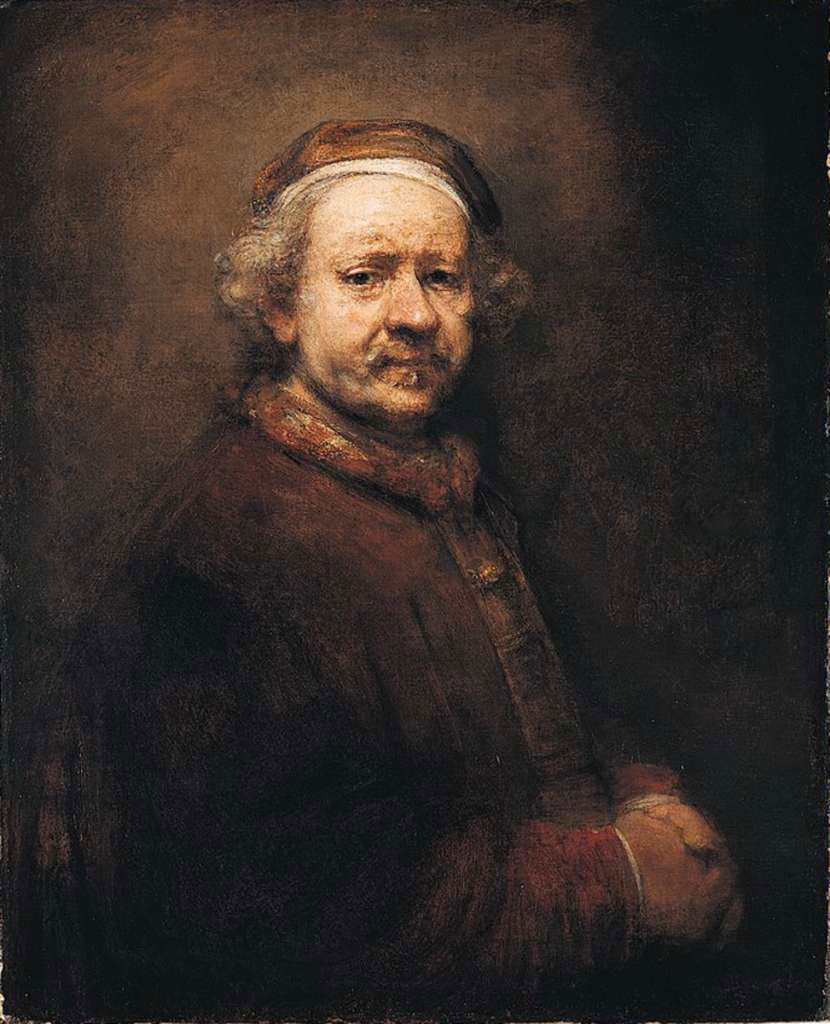
Rembrandt, Self-Portrait, 1669
However, this practical joke is not without forethought. His appropriation of Rembrandt’s nationally beloved self-portrait invites the viewer to question why this act seems so audacious, why this painting is valued so highly and, foremost, what constitutes great art. As a street artist, Banksy is no stranger to graffiti being deemed ‘low art’ or even ‘vandalism’. Consequently, he aims to subvert what we consider ‘high art’ by taking a famous painting, catching the viewer’s interest with attention grabbing googly eyes and creating a piece that is entertaining, thought provoking and progressive.
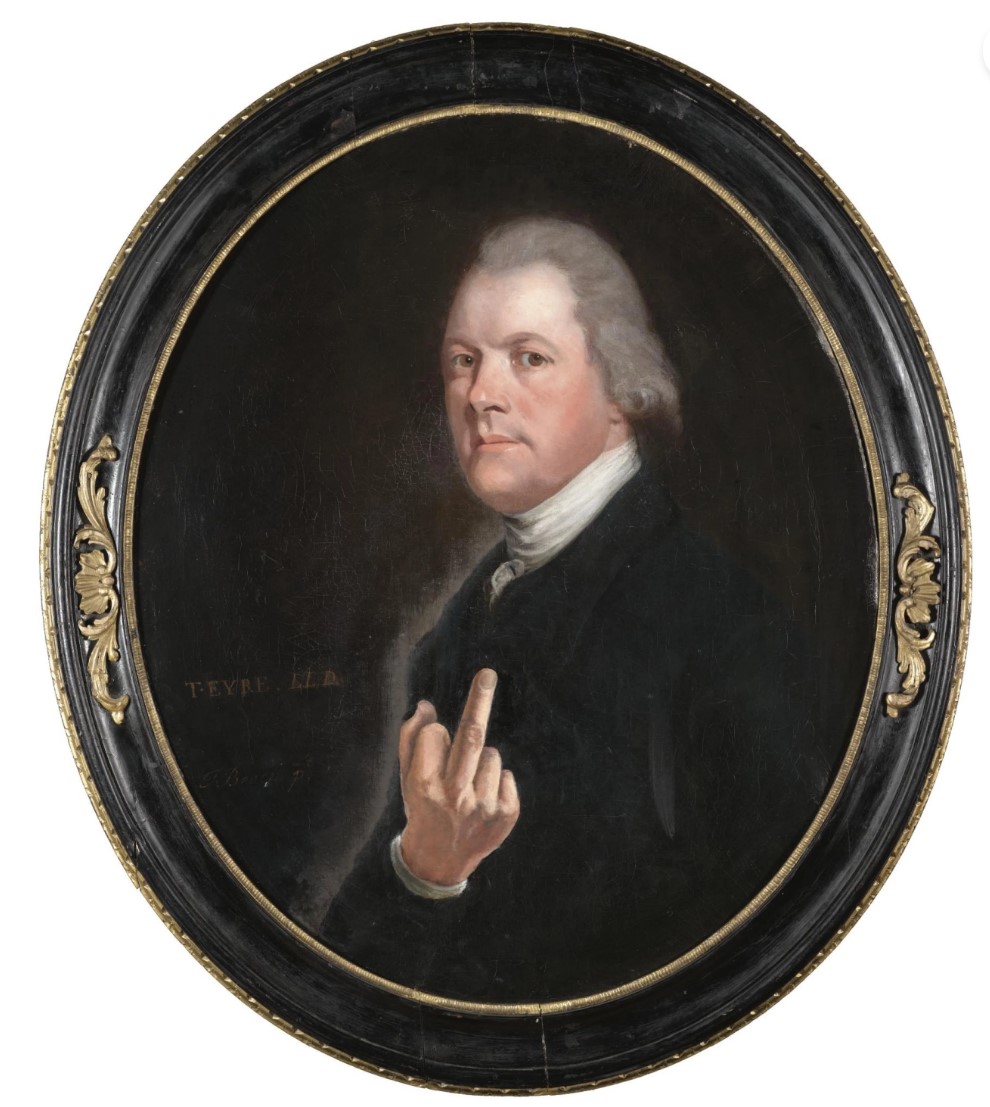
BANKSY
The Rude Lord, 2006
Oil on canvas in original artist’s frame
88.6 x 76.8 cm (35 x 30 1/4 inches)
Provenance
Lazarides Gallery, London
Acquired directly from the above by the present owner
Exhibited
Barely Legal, Los Angeles, 2006
Auction History
| Sotheby’s London 12 October 2007 Est.: GBP 150,000 – 200,000 |
Price Realized GBP 322,900 / USD 654,555 (#9) Banksy |
Catalogue Note
BANKSY
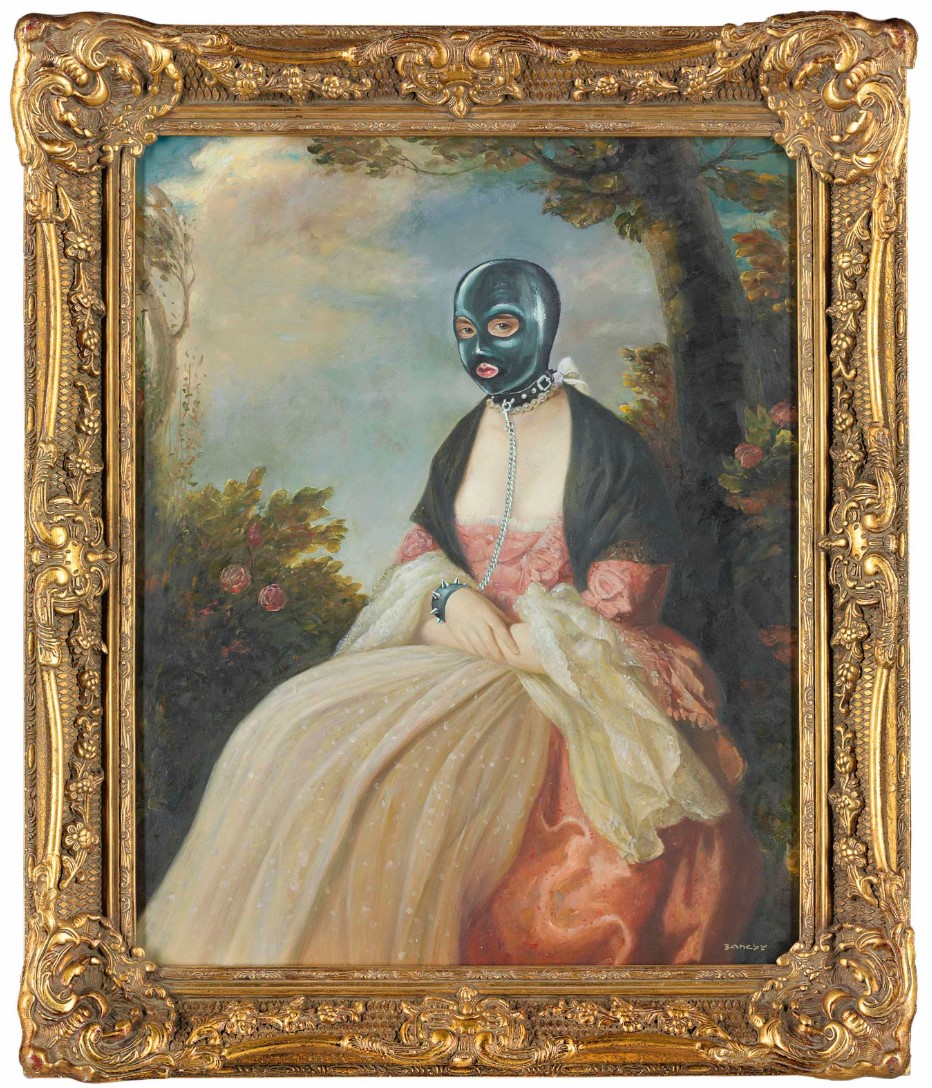
Fetish Lady, 2006
Oil on found canvas
94.7 x 79 cm (37 1/4 x 31 1/8 inches)
Signed “BANKSY”, lower right
Further signed and dated “BANKSY 2006” on the reverse
| Christie’s London 14 February 2012 Est.: GBP 150,000 – 200,000 |
Price Realized
GBP 265,250 |
With Fetish Lady, Banksy infiltrates the genteel world of classical portraiture and laces it with delicious subversion. The image mimics a Rococo-style painting—an aristocratic woman posed with genteel grace against a pastoral backdrop, complete with satin dress and demure hands. But the elegance screeches to a halt at her face: she’s wearing a shiny black gimp mask, complete with zipper mouth and leather collar.
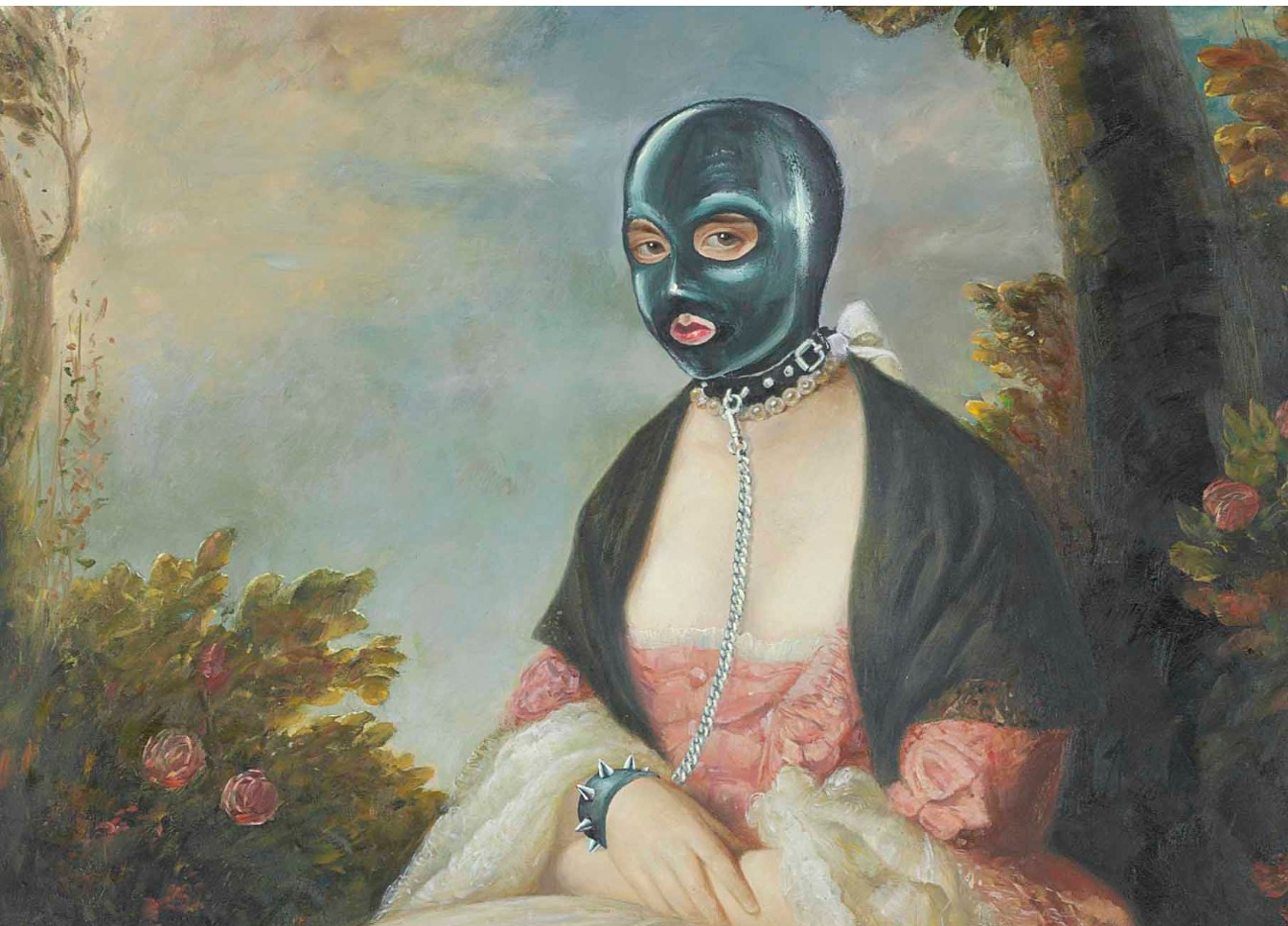
The tension between 18th-century refinement and 21st-century kink is jarring, hilarious, and uncomfortably revealing. Banksy does not just deface tradition: he repurposes it, highlighting the hypocrisies and buried desires beneath polished surfaces. The gilded frame, left intact, only intensifies the joke: it’s not just the painting that’s bound: it’s our expectations of class, propriety, and taste.
Fetish Lady is a masterclass in aesthetic sabotage, a cheeky critique of both repression and the art world’s fetish for “the classic.” Banksy reminds us that even the most genteel facades may be stitched over something wilder.
Humour as a Weapon
Humour is often the first thing viewers notice, but it is rarely the destination. Banksy’s jokes are carefully constructed mechanisms that lower our intellectual defences before confronting us with uncomfortable truths. The laughter provoked by these paintings quickly gives way to questions about politics, war, consumerism and the contradictions of modern society. Comedy becomes criticism, and parody becomes philosophy.
Choppers
Corrupted Oil marks one of the defining moments in Banksy’s artistic development. Around 2000, he began purchasing inexpensive second-hand landscape paintings and “corrupting” them with stenciled interventions, creating a body of work that bridged graffiti, conceptual art and painting. Rather than rejecting art history, Banksy appropriated it, transforming forgotten decorative canvases into sharp political allegories.
Corrupted Oil, circa 2000

BANKSY (b. 1975)
Corrupted Oil, circa 2000
Oil and spray enamel on found canvas in artist’s frame
69.5 x 99.6 cm (27 3/8 x 39 1/4 inches)
Stenciled ‘BANKSY’ (lower right)
Signed and dated ‘BANKSY 200?’ (on the overlap)
| Christie’s London 21 October 2008 Est.: GBP 80,000 – 120,000 |
Price Realized GBP 145,250 / USD 244,600 Banksy (b. 1975) , Corrupted Oil | Christie’s |
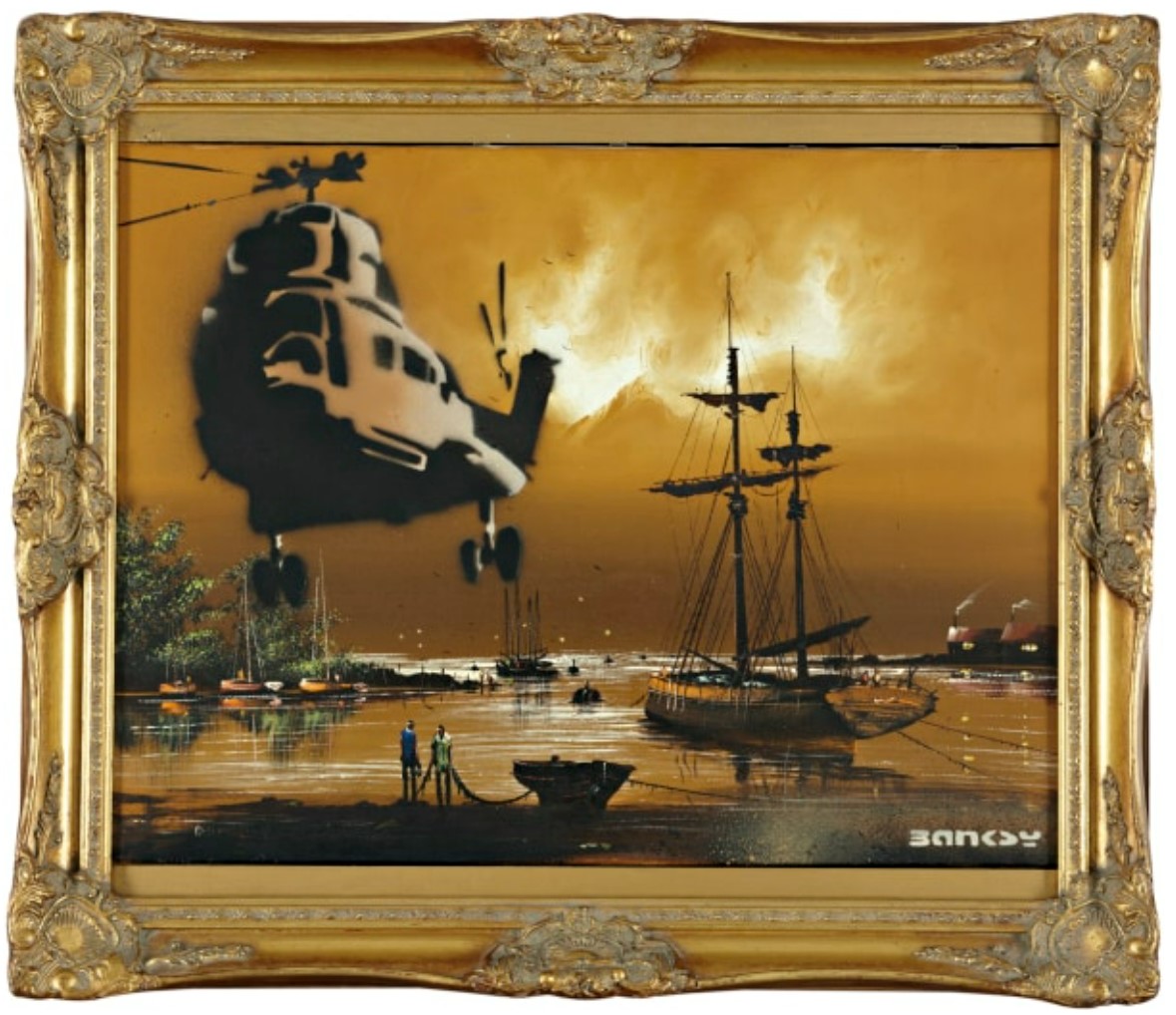
Vandalized Oil #001, 2001
Stencil-signed “BANKSY” lower right
| Phillips London 12 February 2010 Est.: GBP 60,000 – 80,000 |
Price Realized GBP 121,250 / USD 189,945 |
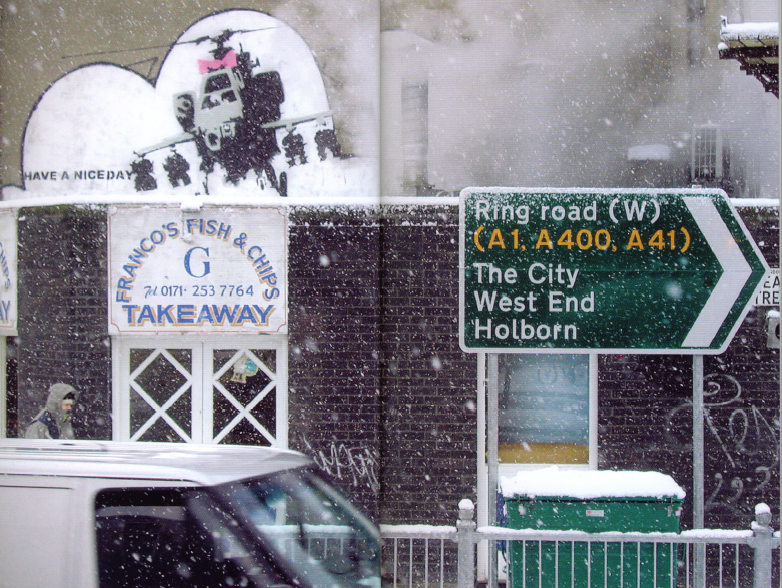
The tranquil harbor scene is suddenly interrupted by the dramatic arrival of a military helicopter, hovering above the peaceful landscape as smoke rises in the distance. The intervention is startlingly economical. With only a few stenciled additions, Banksy shatters the illusion of pastoral serenity and replaces it with the unsettling reality of modern conflict.
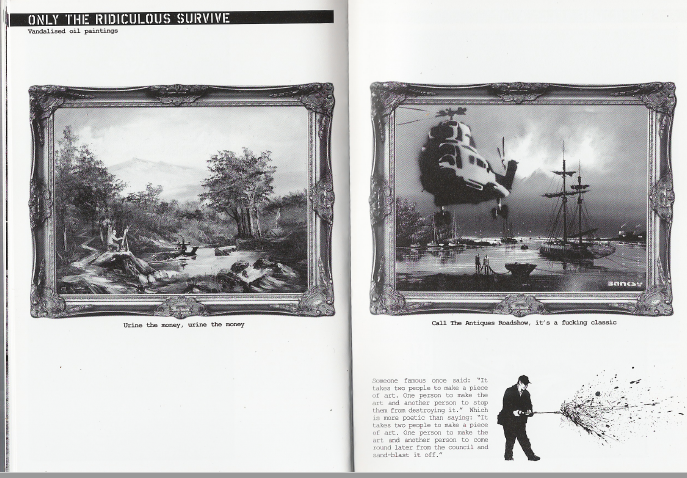
Banksy, Banging Your Head Against A Brick Wall, November 2001
The success of Vandalized Oil #001 lies in the collision of two incompatible worlds.
The original painting belongs to the long European tradition of idyllic landscape painting, celebrating nature as a place of harmony, contemplation and escape. Banksy abruptly introduces the imagery of modern warfare, forcing two centuries of artistic idealism to confront the realities of the twenty-first century.
The helicopter appears almost like an intruder from another dimension. It does not simply alter the composition—it changes the entire narrative. What was once a peaceful harbor now becomes the backdrop to an unfolding military operation, reminding us how fragile the notion of paradise has become in an age defined by geopolitical conflict.
Vandalized Oil #001 perfectly encapsulates Banksy’s ability to transform familiar images through the lightest of interventions. By inserting a military helicopter into an otherwise peaceful landscape, he reminds us that modern history has made it increasingly difficult to view paradise without also seeing the conflicts that threaten it.
More importantly, the work marks the birth of one of Banksy’s most significant artistic innovations. It demonstrates that vandalism, in his hands, is not an act of destruction but one of reinvention—a way of breathing new life into forgotten paintings and proving that even the quietest landscapes still have contemporary stories to tell.
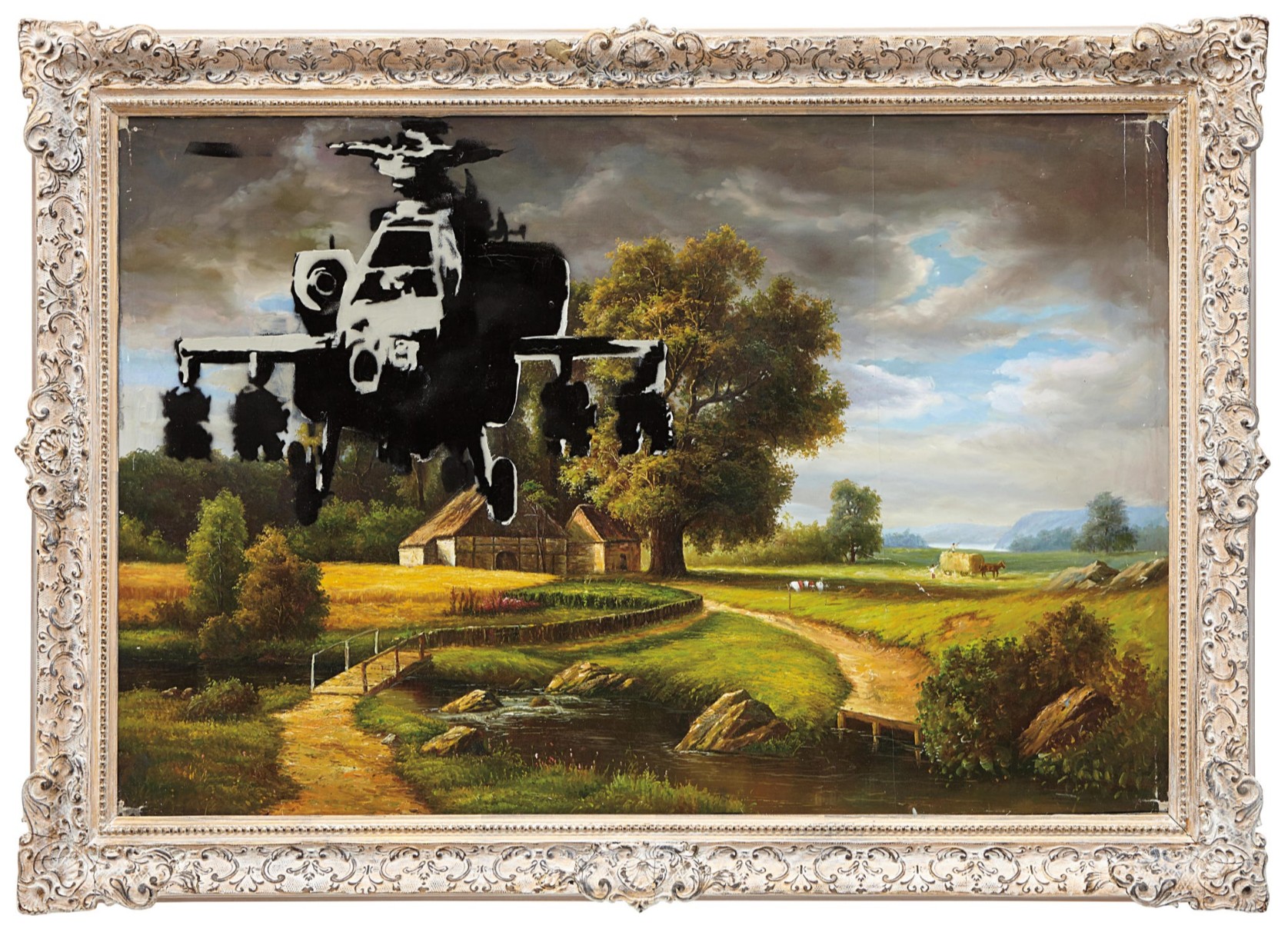
Vandalised Oil (Choppers), 2006


Corrupted Animals
In Bird and Grenade, Banksy transforms an anonymous pastoral landscape into a meditation on the extraordinary fragility of peace. Painted over a found canvas depicting an idyllic English countryside, the work juxtaposes two radically different visual languages: the sentimental realism of a decorative landscape and the bold immediacy of Banksy’s unmistakable stencil.
Bird and Grenade, 2002

BANKSY
Bird and Grenade, 2002
Oil and spray enamel on found canvas
68.5 x 99 cm (27×39 inches)
Tagged in white spray ‘banksy’ (lower right)
| Christie’s London 13 September 2011 Est.: GBP 30,000 – 50,000 |
Price Realized |
BANKSY
Monkey Poison, 2004
Oil and spray enamel on found canvas in artist’s frame
61x91cm (24 x 35 5/8 inches)
Stenciled-signed “BANKSY”, lower left
Further signed and dated “Banksy 2004” on the stretcher
| Phillips New-York 2 July 2020 Estimated: USD 1,800,000 – 2,500,000 |
Price Realized |
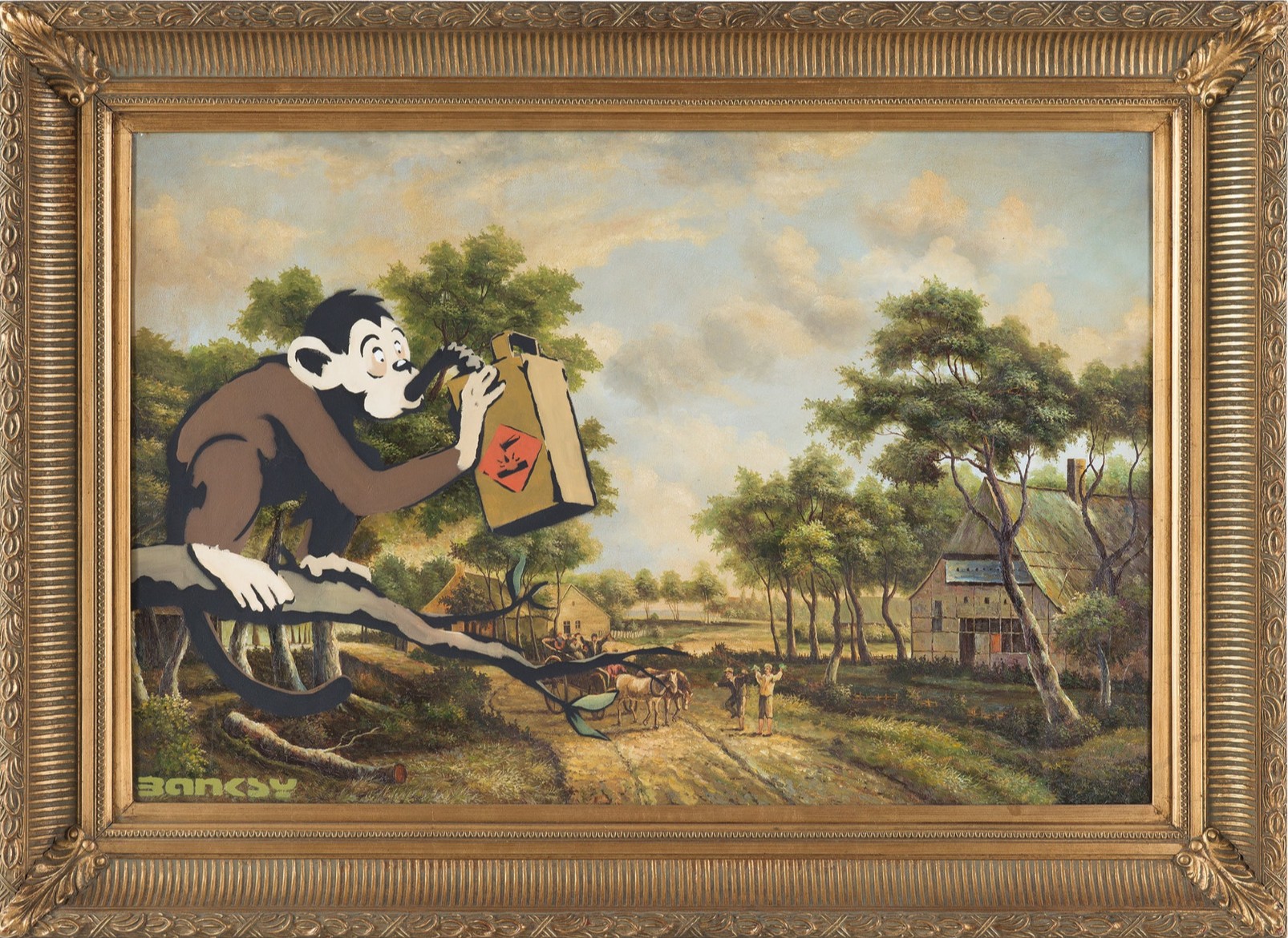
With Monkey Poison, Banksy once again invades the reassuring world of the Old Masters, transforming an anonymous pastoral landscape into a contemporary moral fable. Perched upon the branch of a tree overlooking an idyllic countryside, one of his familiar chimpanzees calmly drinks from a can of gasoline marked with a hazardous warning symbol. The gesture is absurd, humorous and immediately alarming. Like so many of Banksy’s most successful images, the joke arrives first; the realization follows moments later.
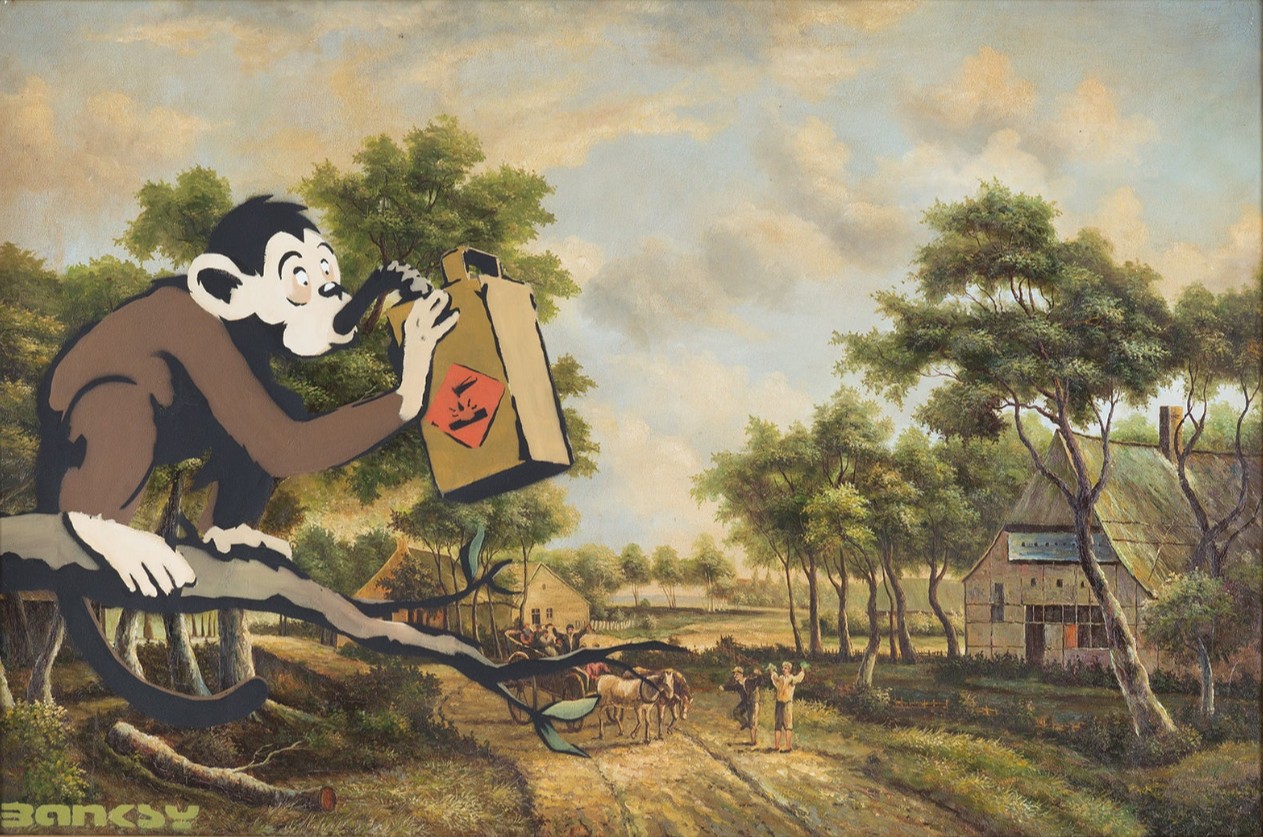
The monkey has occupied a central place in Banksy’s visual vocabulary since the early 2000s. Appearing in works such as Laugh Now, Monkey Queen, and ultimately Devolved Parliament, it serves as a thinly veiled surrogate for humanity itself. Rather than depicting mankind directly, Banksy invites us to observe ourselves through our closest evolutionary relative. Here, the chimpanzee is neither rebellious nor threatening. Instead, it appears perfectly content, innocently consuming the very substance that will ultimately destroy it. The image becomes an unsettling allegory for modern civilization, willingly feeding its dependence on fossil fuels, consumerism and unsustainable progress without fully acknowledging the consequences.

BANKSY
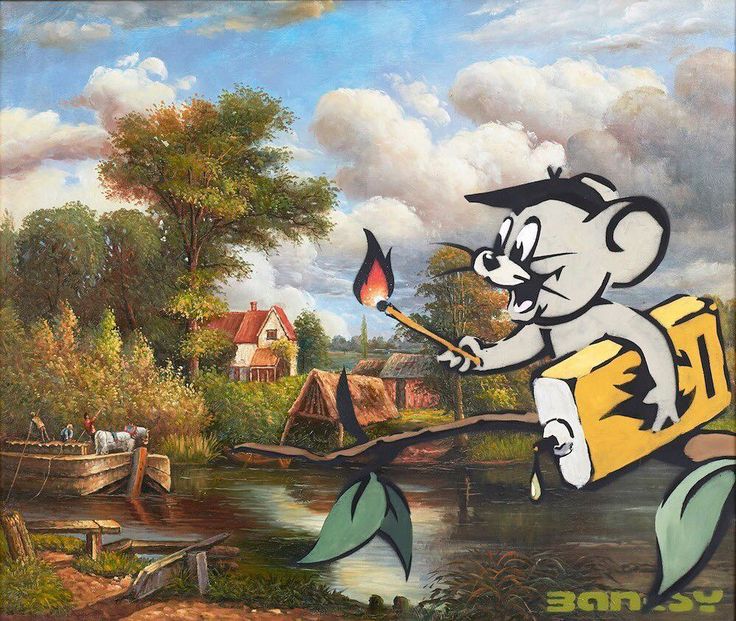
Crude Oil Jerry, 2004
Oil and spray enamel on found canvas in artist’s frame
Stenciled-signed “BANKSY”, lower right
Crude Oils, London, 2005
Catalogue Note
Subject to Availability
Subject to Availability, 2011
Sotheby’s Diriyah: 8 February 2025
Estimated: USD 800,000 – 1,200,000
USD 1,200,000
Subject to Availability | Origins | 2025 | Sotheby’s

BANKSY (b. 1974)
Subject to Availability, 2011
Oil and spray paint on canvas in an artist’s frame
50×91 cm (19 5/8 x 35 7/8 inches)
Signed Banksy (on the edge of the frame)
An outstanding example of Banksy’s celebrated series of Vandalized Oil paintings, Subject to Availability reflects the artist’s career-long practice of infusing his works with satire to both subvert the fine art establishment and comment on many of today’s most pressing sociopolitical issues. Atop a serene Hudson River School painting of a pastoral landscape dotted with pine trees leading into snowcapped mountains above, Banksy inserts an asterisk near the top of the mountain, captioning the work “*Subject to availability for a limited period only.” In the spirit of many of the members of the Hudson River School, Banksy wittily remarks that these very mountaintops that were once so revered are now at risk of extinction, their snowy peaks and lush surroundings diminishing as we push our natural world to the brink.

Born and raised in Bristol, England, Banksy has achieved a mythical status that teeters between acclaim and notoriety for his distinctive style of satirical street art and graffiti. His work is rich in dark humor and frequently captioned with subversive epigrams that provide commentaries on socio-political aspects of contemporary life. Seeking to disrupt the status-quo through his anti-establishmentarian practice, Banksy has epitomised his own mission saying: “Art should comfort the disturbed and disturb the comfortable.” Regularly upending the norms of the art world while maintaining a decidedly outsider presence as an anonymous artist, Banksy’s practice operates on the edge of fine and street art, often integrating the two as one. Banksy’s initial forays into the fine art world began with the exhibition of his Crude Oils series in 2005, paintings that “re-mixed” masterpieces like Edward Hopper’s Nighthawks and Vincent Van Gogh’s sunflowers with dark, often surreal elements. Banksy would later expand upon these appropriations in his Vandalized Oils series, of which the present work is part of, taking generic landscapes fashioned by other artists and subtly infusing them with social commentary.

Albert Bierstadt, Mount Corcoran, c. 1876-1877, The National Gallery of Art, Washington D.C.
Image © Museum Purchase, Gallery Fund / Bridgeman Images
Global neglect of our natural surroundings has long been a source of concern to Banksy, whose work often comments on pressing contemporary sociopolitical issues including police brutality, anti-war activism and the global refugee crisis. At the end of the The 2009 United Nations Climate Change Conference that failed to reach an agreement, Banksy painted the words “I don’t believe in global warming” sinking into the water of Regent’s Canal in London, a reference at climate change skeptics’ willingness to deny environmental changes despite seeing them in front of their eyes. Most recently, in May of 2024, Banksy unveiled a mural in North London’s Finsbury Park directly behind a tree that had been heavily pruned by the city just as the Spring season was beginning. Behind the tree, Banksy spray painted a person who is themself seemingly spray painting green back onto the tree’s limbs to replace its lost leaves, commenting on the artificial steps mankind has begun to take to feign a kind of normalcy even in a world where our environment is gradually degrading to the point of no return.
Subject to Availability extends this tradition into the gallery space, connecting a phrase typically associated with consumerism to the natural surroundings that have been impeded by this same capitalist-driven society. While from a distance, the painting solely appears as a generic and idyllic landscape, a discerning eye immediately captures the text emblazoned on the work as a built-in caption, a phrase typically used for cheap, tradeable goods and promotions that has been refashioned, much like the painting itself, to imply nature’s own slow demise. While nature is seen in the painting laden with a Romantic grandiosity typical of the late 19th and early 20th century and mankind’s interpretation of our natural surroundings at the time, it has now been diminished to nothing more than an expiring asset.

Marcel Duchamp, L.H.O.O.Q., 1919. Musée National d’Art Moderne, Centre Pompidou, Paris. Art © 2025 Artists Rights Society (ARS), New York / ADAGP, Paris / Estate of Marcel Duchamp
Further solidifying Subject to Availability’s importance within Banksy’s oeuvre, the painting was featured in the seminal 2011 exhibition at the Museum of Contemporary Art in Los Angeles Art in the Streets, the first major U.S. museum survey of graffiti and street art. The exhibition, curated by former MOCA director Jeffrey Deitch, sought to trace the development of the long-overlooked movement from its inception in the 1970s to its present iterations, and would end up heavily contributing to a global reappraisal of street art as a legitimate art form in and of itself. Banksy’s involvement in the show was especially significant, as he made a special arrangement with the museum for his crew to work late at night with the security cameras shut off after everyone else had left the building. Banksy then created a new show within his previous installation, disrupting what had previously been seen by museumgoers by not only moving his sculptures around but by also installing new works onto the walls, one of which included the present work.
In the same way that Banksy “vandalizes” public spaces by graffiting them with his work, Subject to Availability sees the artist using the same precedent on the painted image, forcing audiences to reckon with how they have sought to both safeguard and build up the manmade world while the natural one continues to suffer at its expense. A masterful combination of social commentary, art historical precedent, and satire, Subject to Availability represents the unique opportunity of acquiring a work that combines so many of the pioneering facets of Banksy’s practice that have made the artist as infamous as he is today.
Home Sweet Home, 2006
Phillips London: 2 March 2023
Estimated: GBP 1,500,000 – 2,500,000
GBP 1,742,000 / USD
Banksy – 20th Century & Contemporary A… Lot 21 March 2023 | Phillips

BANKSY
Home Sweet Home, 2006
Modified oil on canvas, in artist’s frame
80×110 cm (31 1/2 x 43 1/4 inches)
Signed and dated ‘Bansky 06’ on the reverse
No stranger to staging interventions in public space and sparking debates about its uses and abuses, in 2009 Banksy took this practice indoors for the landmark exhibition Banksy vs The Bristol Museum. Taking over the historical building and its collection, Banksy transformed the space into ‘a menagerie of Unnatural History’, disrupting the curatorial logic of the museum as a way of provoking a conversation around who decides which objects belong in museums and why. Alongside larger installations and sculptural pieces ‘adjusted’ in characteristic Banksy fashion, the exhibition took advantage of its location to place objects from the collection into direct dialogue with examples of Banksy’s Vandalized Oils series, radically extending the underlying premise of this body of work as a witty challenge to the art historical canon and the broader cultural assumptions that it maintains. Loaned by the current owner to the Moca Museum in Barcelona, Home Sweet Home has also been included in some of Banksy’s most notorious exhibitions including his Los Angeles debut, Barely Legal and Banksy vs the Bristol Museum.
Set within a heavy gilt frame evoking museum walls and Old Master paintings, the work is composed of an appropriated canvas featuring a bucolic and typically English landscape complete with a chocolate box cottage and a lilting stone bridge over a gently running stream in a manner that directly references John Constable’s The Hay Wain – a quintessential image of both England and Englishness as it exists in popular imagination. Brightly colored and richly detailed, the work has something of a Disney idealism to it, further emphasizing the gap between fantasy and reality in definitions of England or ‘Home’ today. Unlike some of the Vandalized Oils in which the subversive message is spraypainted over the canvas with the aid of a stencil, Home Sweet Home is a rare example of Banksy’s hand-painted additions, comparable to its sister painting, Exit Through the Gift Shop, which was installed alongside the present work in the Banksy vs Bristol exhibition.

John Constable, The Hay Wain, 1821, The National Gallery, London. Image: © The National Gallery, London/Scala, Florence
In its clever combination of humor, appropriation, and the pointed conflation of so-called high and low art forms, Home Sweet Home follows in the disruptive mode of Situationist artists such as Asger Jorn. Appropriating reproductions of well-known paintings and the canvases of amateur artists, Jorn applied thick, gestural marks and compositional additions, altering the meaning communicated by the original work in the process. Following Jorn, Banksy’s recontextualization of these original canvases serves to emphasize that ‘the meaning of old-fashioned paintings had not yet been exhausted but could be renewed by means of new and unexpected pictorial inserts.’
“The vandalised paintings reflect life as it is now. We don’t live in a world like Constable’s Haywain anymore and, if you do, there is probably a travellers’ camp on the other side of the hill. The real damage done to our environment is not done by graffiti writers and drunken teenagers, but by big business… exactly the people who put gold-framed pictures of landscapes on their walls and try to tell the rest of us how to behave.”
Finding innovative ways to translate a graffiti sensibility onto canvas, the defaced oil paintings represent a significant moment in the development of Banksy’s practice, and of the scope of his institutional critique. They also shine a light on our definitions of the notion of vandalism itself. Typically defined as a negative and anti-social act, ‘vandalism’ is the catch-all term used to describe the work of graffiti artists and used to punish offenders by law. Embracing these definitions, Banksy’s Home Sweet Home extends the guerrilla tactics that he honed as a street artist, speaking truth to power and asking pointed and pertinent questions about the distinctions between preservation and vandalism, and who, ultimately polices such distinctions.
Sorry The Lifestyle You Ordered Is Currently Out Of Stock, 2012
Phillips London: 14 October 2022
Estimated: GBP 1,200,000 – 1,800,000
GBP 1,837,500 / USD 2,059,977
Banksy – 20th Century & Contemporary… Lot 21 October 2022 | Phillips

BANKSY
Sorry The Lifestyle You Ordered Is Currently Out Of Stock, 2012
Spray paint on found canvas on graffed board, in artist’s frame
106.7 x 166.4 cm (42 x 65 1/2 inches)
Signed ‘BANKSY’ lower right; signed and dated ‘BANKSY 12’ on the reverse
Audacious and provocative, in Sorry The Lifestyle You Ordered Is Currently Out Of Stock guerrilla street artist Banksy collapses high culture and street art, applying the pointed satire of his site-specific graffiti to a direct critique of the connections between the art market, consumer capitalism, and environmental issues. Set within a heavy gilt frame evoking museum walls and Old Master paintings, the work is composed of an appropriated canvas featuring a romantic mountain landscape, defaced with the slogan ‘Sorry The lifestyle you ordered is currently out of stock’ and attached to a densely spraypainted board behind. Uniting these different elements within the work Banksy forges unexpected dialogues between them, communicating his message with characteristic economy and wit.

Asger Jorn, Hirschbrunft im Wilden Kaiser (Deer in Heat in the Wilder Kaiser), 1960,
Nationalgalerie – Staatliche Museen, Berlin. Image: Scala, Florence/bpk, Bildagentur fuer Kunst, Kultur und Geschichte, Berlin, Artwork: © Donation Jorn, Silkeborg / DACS, London 2022
In it’s a clever combination of humor, appropriation, and the pointed conflation of so-called high and low art forms, Sorry The Lifestyle You Ordered Is Currently Out Of Stock follows in the disruptive mode of Situationist artists such as Asger Jorn. Appropriating reproductions of well-known paintings and the canvases of amateur artists, Jorn applied thick, gestural marks and compositional additions, altering the meaning communicated by the original work in the process. Borrowing the vocabulary of advertising and consumerism to identify the hypocrisy involved in promoting a discourse of England as a ‘green and pleasant land’ while allowing profit-seeking enterprises to simultaneously dismantle that landscape, the work is a product of what Gianni Mercurio has described as Banksy’s mode of ‘brandalism’: ‘a rebellion against the great corporations that manage our lives, our forms of consumption, even the space in which we live, through choices that are exclusively aimed at making profit.’
 First appearing in a large-scale stenciled work on the side of an empty building on the corner of East India Dock Road in London’s East End in 2011, the text ‘Sorry! The lifestyle you ordered is currently out of stock’ playfully wraps political commentary in the familiar language of commodity consumption. Although simple, the interaction of the message with its location made a powerfully pointed statement about gentrification in the East End, and the wild property speculation that followed the closure of the docks in the early 1980s. Littered with estate agent boards, the abandoned building appears to have been a casualty of this aggressive growth, stalled when the 2008 financial crisis started to bite. Ironically invoking slogans associated with our own consumer experience, Banksy shifts our focus out to a more global level, using the familiar to open our eyes to global inequalities and existing power structures that operate in the background of our day to day lives. Having applied it in a critique of the economic forces and social inequalities played out in urban space, Banksy quickly adopted the slogan in a sharp critique of the art world, most pointedly in his 2013-14 collaboration with fellow Bristol-born artist Damien Hirst, defacing an immediately recognisable Spot Painting with grey spray paint and overlaid with the same white text we see in the present work. While this work played very deliberately with Hirst’s reputation as representative of the market forces driving contemporary art to record prices, Sorry The Lifestyle You Ordered Is Currently Out Of Stock returned to an earlier conflation of art, the environment, and the ethics of late capitalism that Banksy first deployed in his infamous 2005 Crude Oils exhibition.
“The vandalised paintings reflect life as it is now. We don’t live in a world like Constable’s Haywain anymore and, if you do, there is probably a travellers’ camp on the other side of the hill. The real damage done to our environment is not done by graffiti writers and drunken teenagers, but by big business… exactly the people who put gold-framed pictures of landscapes on their walls and try to tell the rest of us how to behave.”
Littered with stenciled cctv cameras, rubbish, burnt-out cars, and military helicopters, the broader group of ‘vandalised paintings’ to which the present work belongs made their first appearance alongside some 200 live rats in a disused commercial space in London’s affluent Notting Hill in Banksy’s Crude Oils exhibition. In their own way, these works are highly representative of our contemporary landscape, Sorry The Lifestyle You Ordered Is Currently Out Of Stock in particular articulating something that might not be visible, but is keenly felt in a period of economic and socio-cultural upheaval. Evoking the language of high culture and advertising and exposing the ways in which both are exploited by the dominant hegemonic order as tools for exercising and maintaining power, Banksy attacks established value systems and exposes the hypocrisy and disingenuity that characterize the times we live in. Finding innovative ways to translate a graffiti sensibility onto canvas, the defaced oil paintings represent a significant moment in the development of Banksy’s practice, and of the scope of his institutional critique. In the words of the artist, ‘if you want to survive as a graffiti writer when you go indoors your only option is to carry on painting over things that don’t belong to you.’
This is Not a Photo Opportunity, 2007
Sotheby’s New-York: 19 May 2022
Estimated: USD 2,000,000 – 3,000,000
USD 2,690,000 / USD 2,079,751
This is Not a Photo Opportunity | The Now Evening Auction | 2022 | Sotheby’s (sothebys.com)

BANKSY
This is Not a Photo Opportunity, 2007
Spray paint on found oil painting, in artist’s frame
62×72 cm (24.1 x 28.1 inches)
Distilling his signature criticality of society’s predilections into a lush pastoral scene and stenciled deadpan phrase, This is not a photo opportunity demonstrates the enduring prescience of Banksy’s practice. Part of his Vandalized Oils series, the present work juxtaposes contemporary graffiti and stenciling with the archetypal painted landscape. Disrupting art historical convention, the piece also sees a Duchampian appropriation, with a found painting serving as the basis for Banksy’s mocking chide. Created several years before the formation of social media platforms such as Instagram, This is not a photo opportunity has increased resonance today, as the taking and sharing of photos has become a pivotal part of the formation of contemporary identity.

THOMAS COLE, VIEW FROM MOUNT HOLYOKE, NORTHAMPTON, 1836. IMAGE © THE METROPOLITAN MUSEUM OF ART, NEW YORK / ART RESOURCE, NY
Nestled within a gilded frame, the present work sees a quaint and slightly saccharine rural landscape lovingly rendered by the since-forgotten “Randall,” whose signature is readily legible in the lower right corner of the work. Superimposed over this John Constable-inspired idyll is Banksy’s rebuke, sprayed in white across the canvas: “This is not a photo opportunity.” This phrase has been used many times in Banksy’s urban interventions over the years, on the South Bank of the Thames opposite the Houses of Parliament, or at a viewpoint overlooking the Eiffel Tower in Paris. Indeed, Martin Bull’s monograph on the artist’s most notable street artworks shares the title of the present work, attesting to its emblematic importance.
Subject to Availability, 2009
Estimated: GBP 3,000,000 – 5,000,000
GBP 4,582,500 / USD 6,326,798

BANKSY
Subject to Availability, 2009
Oil on canvas, in artist’s frame
159.5 x 220.3cm (62.7 x 86.7 inches)
Witty, satirical and timely, Subject to Availability is an important work from Banksy’s celebrated series of vandalised oil paintings. Hijacking an 1890 painting of Mount Rainier in Seattle by the German-American artist Albert Bierstadt, Banksy inserts an asterisk next to the volcano at the centre of the composition, captioning it ‘*subject to availability for a limited period only’. Bierstadt was a leading member of the Hudson River School, who railed against the industrial revolution’s destruction of nature. Operating over a century later, Banksy updates the political commentary of his forebear: the sweeping panorama, suffused with Romantic heroism and grandeur, is reduced to a terminal commodity, poised on the brink of expiry. Painted in 2009—the year of the UN Climate Change Conference in Copenhagen—the work was included in Banksy’s legendary exhibition Banksy versus Bristol Museum, alongside his monumental Devolved Parliament. Its message was hauntingly prophetic: in February 2020, Mount Rainier National Park was forced into temporary closure due to extreme flooding and mudslides. Humankind’s disregard for nature has long been a keen concern for Banksy, whose creations operate as a form of social commentary. Situated within a trajectory that extends from William Hogarth’s eighteenth-century satire to Grayson Perry’s ceramic vases, his works hold a mirror up to the world, frequently using humor as a means of speaking the truth to power. Over the years, Banksy has addressed a host of contemporary issues, including police brutality, knife crime, poverty, the Israeli-Palestinian conflict, Brexit, migration and—most recently—the COVID-19 pandemic. The environment is a recurring theme within this practice: in 2009, to mark the end of the Copenhagen conference, Banksy mocked climate change sceptics by painting the words ‘I don’t believe in global warming’ sinking into the water of Regent’s Canal in North London. In 2018, he painted a mural on the corner of a garage in the Welsh town of Port Talbot—home to one of Europe’s largest steelworks plants—depicting a young boy breathing in ash from a flaming skip. In the present work, Banksy’s deliberate nod to the Romantic era—a period that glorified the sublime majesty of nature—serves to underscore the tragic reality latent in his asterisked quip.
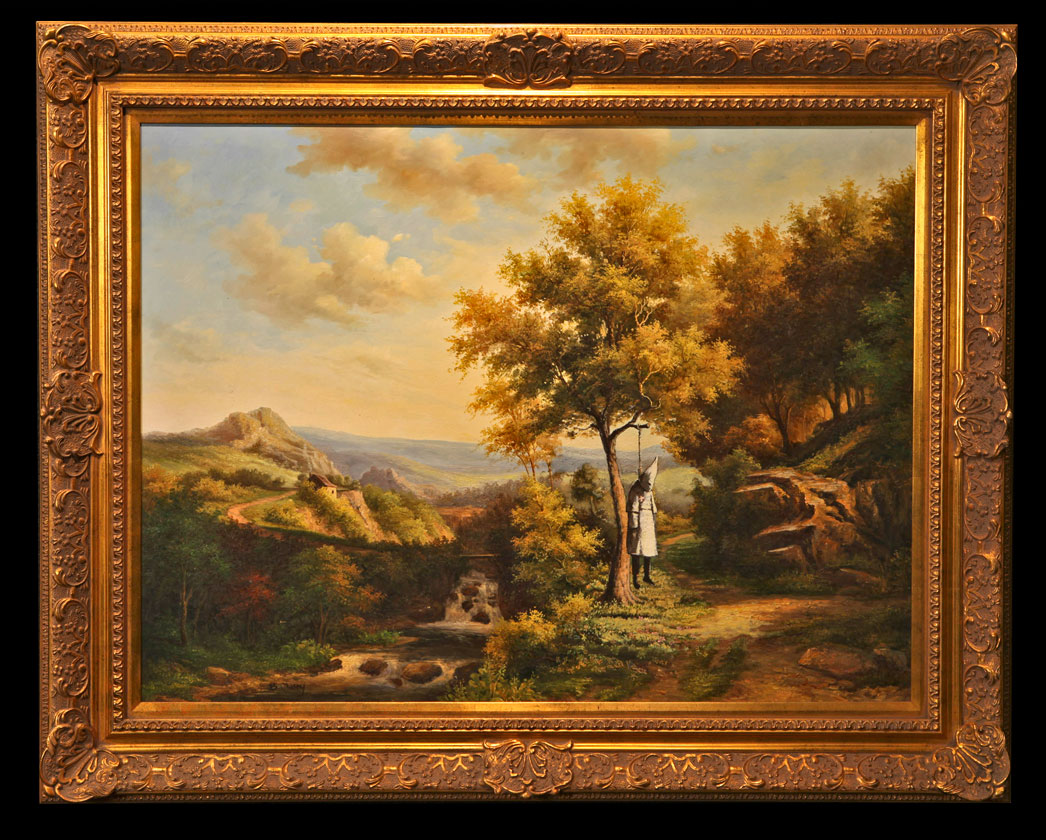
BANKSY
Hanging Klansman, 2009
Banksy vs. Bristol Museum, Bristol Museum, Bristol, 2009
Catalogue Note
Few images capture Banksy’s talent for disrupting artistic conventions as effectively as Hanging Klansman. At first glance, the composition appears to be a perfectly ordinary nineteenth-century Romantic landscape. A peaceful valley unfolds beneath a luminous sky, a winding stream meanders through the countryside, and towering trees frame an idyllic rural scene painted with remarkable technical sensitivity. Only after a moment does the eye discover the small, almost inconspicuous figure suspended from one of the trees: a member of the Ku Klux Klan hanging lifeless at the very center of this tranquil landscape.
The power of the work lies precisely in this delayed revelation. Rather than confronting the viewer with explicit violence, Banksy allows the painting’s serene beauty to lower our defenses before introducing an image of profound historical horror. The contrast between the idyllic landscape and the lynched Klansman creates an unsettling tension in which beauty and brutality coexist within the same frame.
Like many works from the Crude Oils series, Hanging Klansman demonstrates Banksy’s fascination with appropriating traditional painting only to undermine its original message through a single, carefully placed intervention. Here, the anonymous landscape painter celebrated nature as a place of harmony and contemplation. Banksy transforms that same landscape into a meditation on memory, justice and the darker chapters of human history. The intervention is remarkably restrained; nothing else in the composition has been altered, making the solitary figure all the more disturbing.

The identity of the victim introduces an additional layer of ambiguity. Banksy deliberately depicts a member of one of history’s most notorious white supremacist organizations, forcing viewers to confront conflicting emotional responses. The image evokes the horror of lynching while simultaneously presenting the execution of someone associated with racial terror. Rather than offering a straightforward moral lesson, the work raises uncomfortable questions about vengeance, justice, and whether violence can ever erase the legacy of hatred. Banksy refuses to resolve this tension, leaving the viewer suspended between satisfaction and unease.
Created in 2009 for the landmark exhibition Banksy vs. Bristol Museum, Hanging Klansman belongs to the artist’s mature exploration of altered oil paintings. Unlike works that rely primarily on humor, this painting demonstrates Banksy’s growing confidence in using silence and understatement as artistic strategies. The intervention occupies only a tiny fraction of the canvas, yet it completely transforms the emotional reading of the landscape, proving once again that the smallest gesture can profoundly alter the meaning of an image.
Within Banksy’s oeuvre, Hanging Klansman sits comfortably alongside works such as Vandalized Oil (Choppers), Subject to Availability, Home Sweet Home, and Devolved Parliament, where inherited visual traditions are appropriated not to mock the past, but to expose the uneasy relationship between history, ideology, and collective memory. It exemplifies one of Banksy’s greatest strengths as an artist: his ability to make us look twice, and in doing so, to discover that what initially appeared peaceful was never truly innocent.

Auction Ranking
#1. Girl and Balloon on Found Landscape, 2012 |
| Fair Warning Auction: 20 May 2026 USD 17,940,000 |
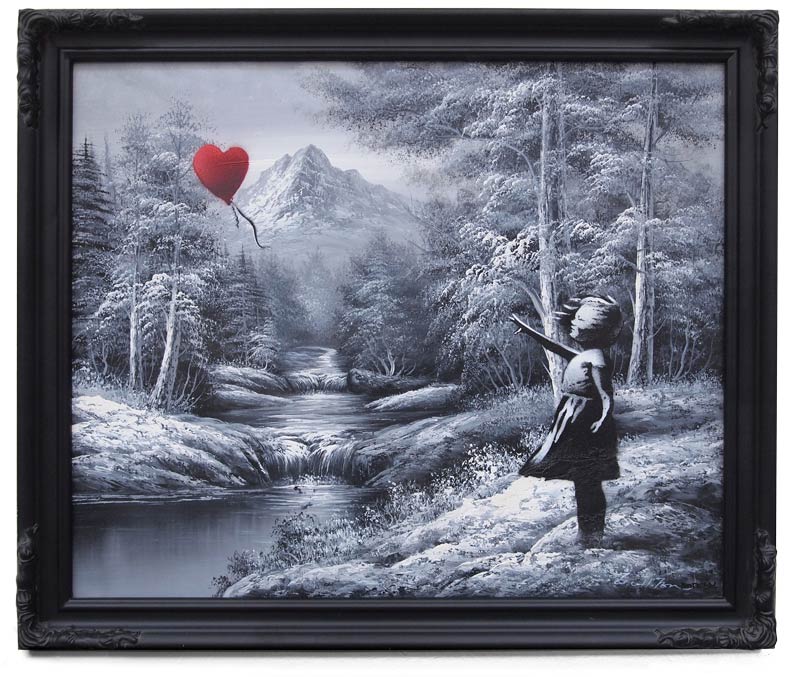
BANKSY
Girl and Balloon on Found Landscape, 2012
Spray paint on canvas
59 x 69.5 cm (23-1/4 x 27-3/8 inches)
Signed on the front and on the reverse
#2. Sunflowers from Petrol Station, 2005 |
| Christie’s New-York: 8 November 2021 USD 14,558,000 |
BANKSY
Sunflowers from Petrol Station, 2005
Oil on canvas, in artist’s frame
102.6 x 87.5 cm (40.6 x 34.4 inches)
Signed ‘Banksy’, center left
Further signed and dated ‘BANKSY OCOTBER 2005’, on the stretcher
#3. Show Me Monet, 2004 |
| Sotheby’s London: 21 October 2020 GBP 7,551,600 / USD 9,888,615 |

BANKSY
Show Me The Monet, 2005
Oil on canvas, in artist’s frame
Framed: 143.1 x 143.4 cm (56.4 x 56.5 inches)
#4. Subject to Availability, 2009 |
| Christie’s London: 29 June 2021 GBP 4,582,500 / USD 6,345,000 |
BANKSY
Subject to Availability, 2009
Oil on canvas, in artist’s frame
159.5 x 220.3cm (62.7 x 86.7 inches)
#5. Vandalised Oil (Choppers), 2005 |
| Sotheby’s London: 3 March 2022 GBP 4,384,900 / USD 5,845,060 |

BANKSY
Vandalised Oil (Choppers), 2005
Oil and spraypaint on canvas
94×61 cm (37×24 inches)
#6. Crude Oil (Vettriano), 2005 |
| Sotheby’s London: 4 March 2025 GBP 4,260,000 / USD 5,452,800 |
BANKSY (b. 1974)
Crude Oil (Vettriano), 2005
Oil on canvas, in artist’s frame
Canvas: 91×122 cm (35 7/8 x 48 inches)
Tagged (lower right)
Signed, partially titled and dated Oct 2005 (on the overturn edge)