BANKSY
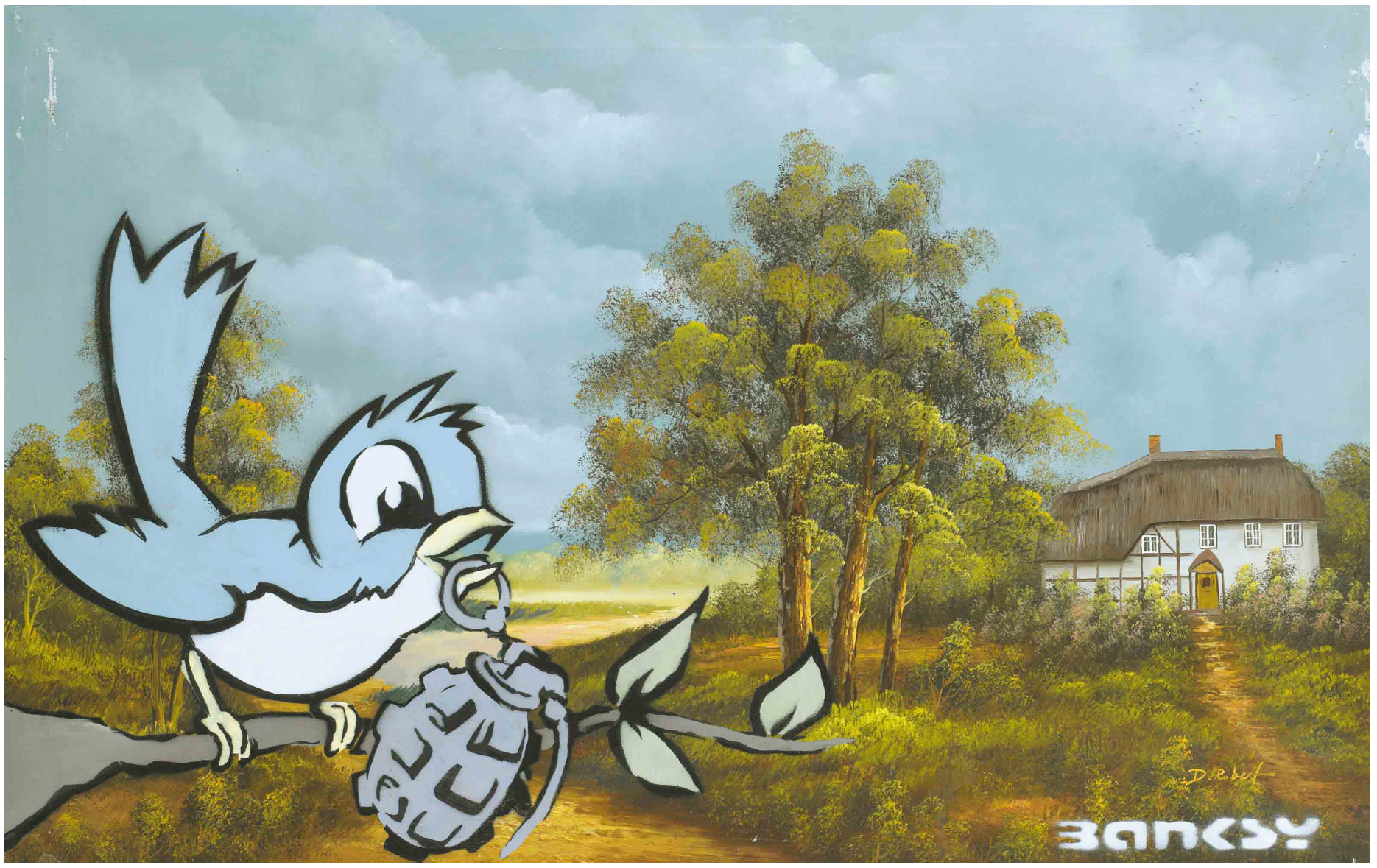
Bird and Grenade, 2002
Oil and spray enamel on found canvas
68.5 x 99 cm (27×39 inches)
Tagged in white spray ‘banksy’ (lower right)
Provenance
Galerie Surface to Air, Paris
Acquired from the above by the present owner in 2003
Exhibition History
London, The Dragon Bar, Santa’s Ghetto, 2002
Auction History
| Christie’s London 13 September 2011 Est.: GBP 30,000 – 50,000 |
Price Realized |
Catalogue Note
In Bird and Grenade, Banksy transforms an anonymous pastoral landscape into a meditation on the extraordinary fragility of peace. Painted over a found canvas depicting an idyllic English countryside, the work juxtaposes two radically different visual languages: the sentimental realism of a decorative landscape and the bold immediacy of Banksy’s unmistakable stencil.
The original painting presents a vision of perfect tranquility. Beneath soft clouds, a thatched cottage nestles among flourishing trees while a quiet country path disappears into the distance. It is the sort of comforting image designed to reassure rather than provoke, celebrating an idealized vision of rural harmony. Banksy leaves almost all of it intact. Instead of destroying the picture, he quietly introduces a single disruptive element.
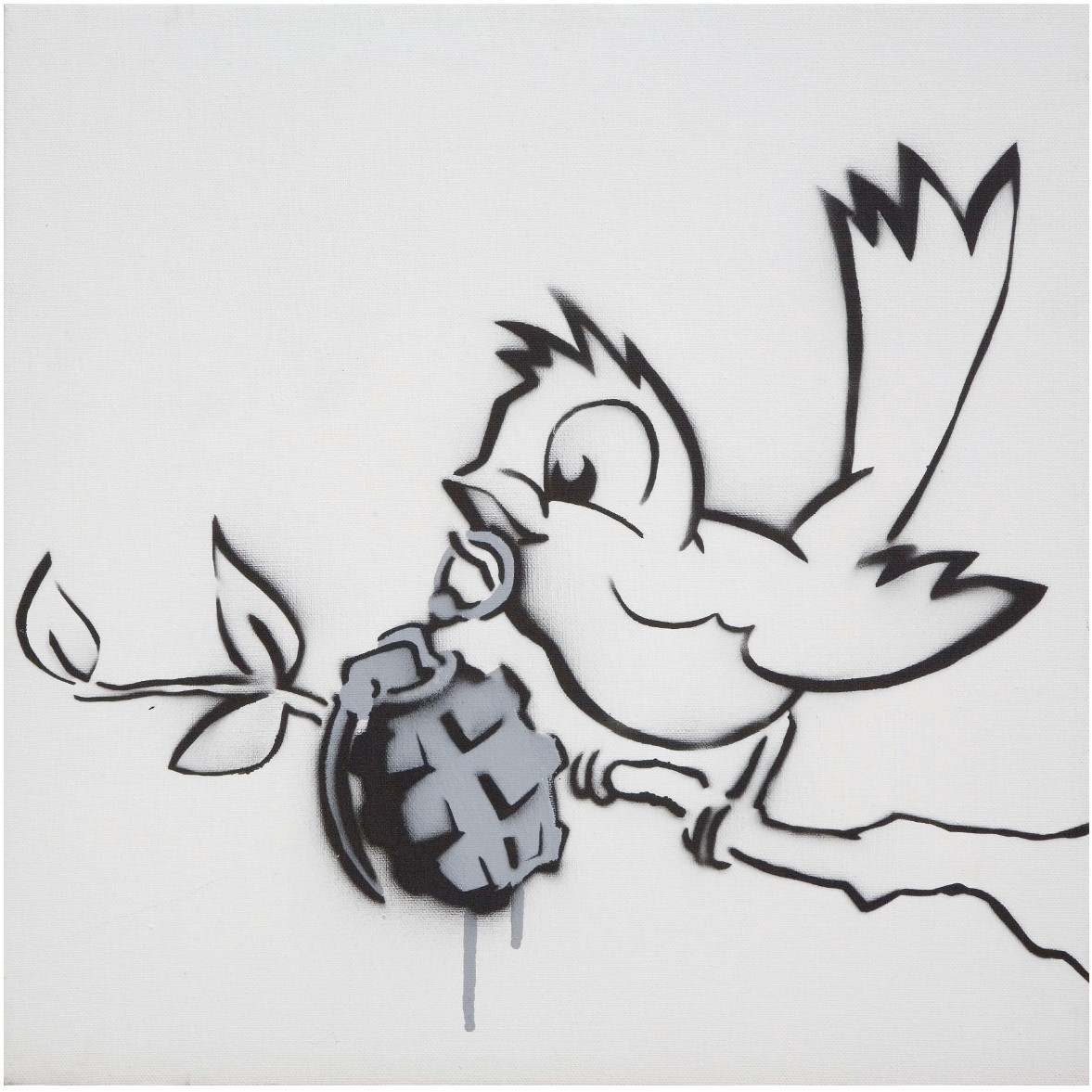
Perched prominently in the foreground, a cartoon-like blue bird delicately grips the pin of a hand grenade suspended beneath its beak. The bird appears entirely innocent, almost cheerful, seemingly unaware that the slightest movement would unleash catastrophe. The image is humorous at first glance, but its comedy quickly gives way to unease. Peace survives only because the bird has not yet let go.
The work brilliantly inverts one of Western art’s oldest symbols. Traditionally, birds carrying branches evoke reconciliation, hope and new beginnings. Here, the olive branch has become a live grenade. Rather than suggesting that peace has disappeared, Banksy proposes something far more unsettling: that peace has become inseparable from the constant possibility of violence. The tranquil landscape is therefore revealed not as genuine serenity, but as an unstable equilibrium maintained by chance.
The found painting plays an essential role in this transformation. Banksy does not treat it merely as a support but as an active collaborator. By appropriating an inexpensive, sentimental landscape—precisely the kind of decorative painting overlooked in flea markets and thrift stores—he exposes the comforting illusions such images often represent. Beneath their picturesque surfaces lies a world no less vulnerable to conflict than anywhere else. Violence is not confined to distant battlefields; it quietly inhabits even our most idyllic fantasies.
This strategy would become one of the defining characteristics of Banksy’s practice. Rather than creating from a blank canvas, he frequently intervenes upon existing objects and images, allowing new meanings to emerge through collision rather than replacement. Here, the romantic conventions of landscape painting collide with the visual language of street art, producing a dialogue between nostalgia and contemporary political anxiety.
Executed during the years surrounding the invasion of Iraq, Bird and Grenade belongs to the remarkable cycle of anti-war works that includes Love Is In The Air, Happy Choppers, Bomb Hugger, and Every Time I Make Love to You I Think of Someone Else. Yet unlike those more overt satires, this composition whispers rather than shouts. There are no soldiers, no slogans and no explosions—only the quiet tension of a single suspended moment.
Ultimately, Bird and Grenade reminds us that peace is rarely permanent. Like the fragile pin held delicately in the bird’s beak, it is something that must be protected continuously, never assumed. With extraordinary visual economy, Banksy transforms an overlooked landscape into a timeless allegory, demonstrating once again his unique ability to compress profound political ideas into images of deceptive simplicity.