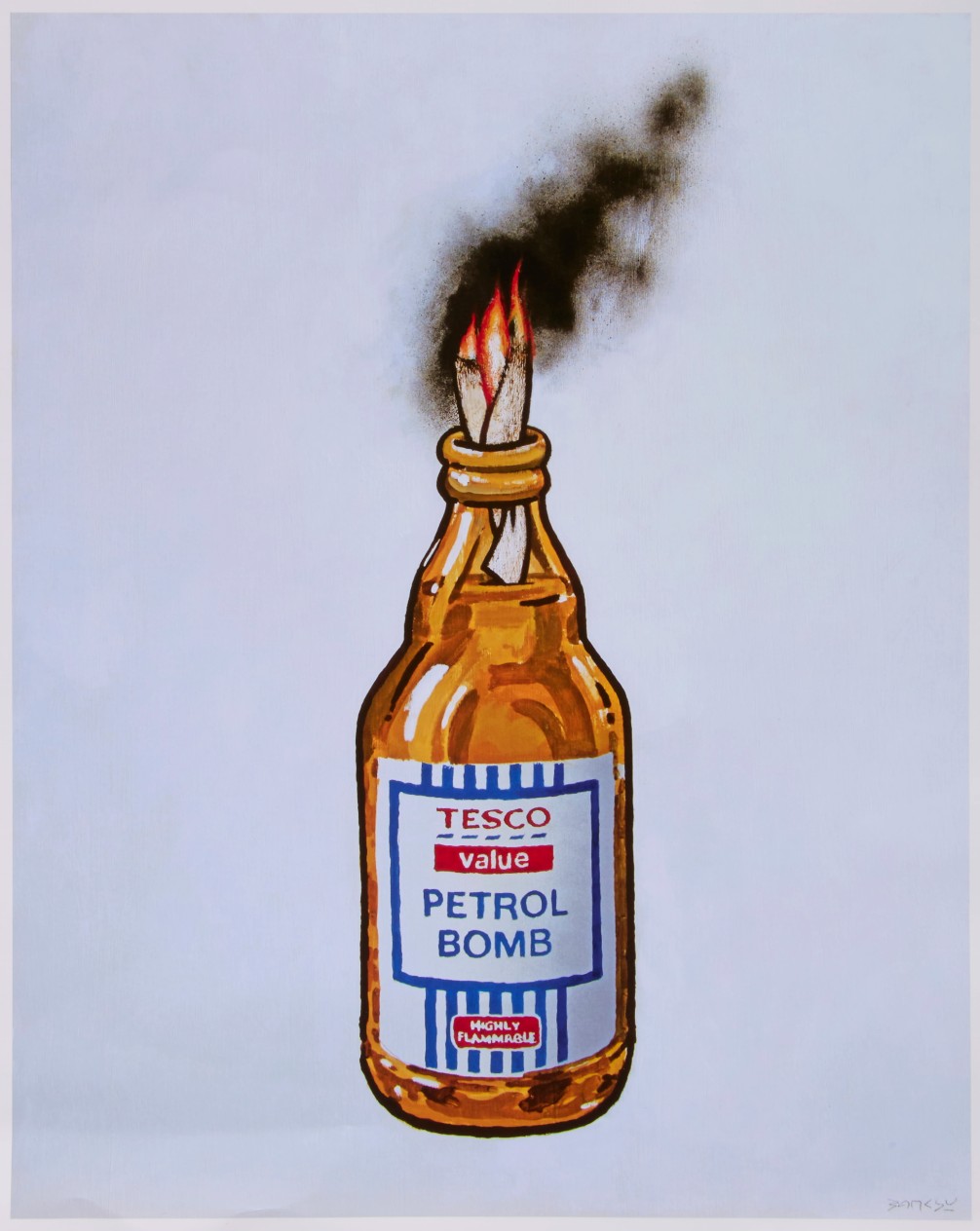
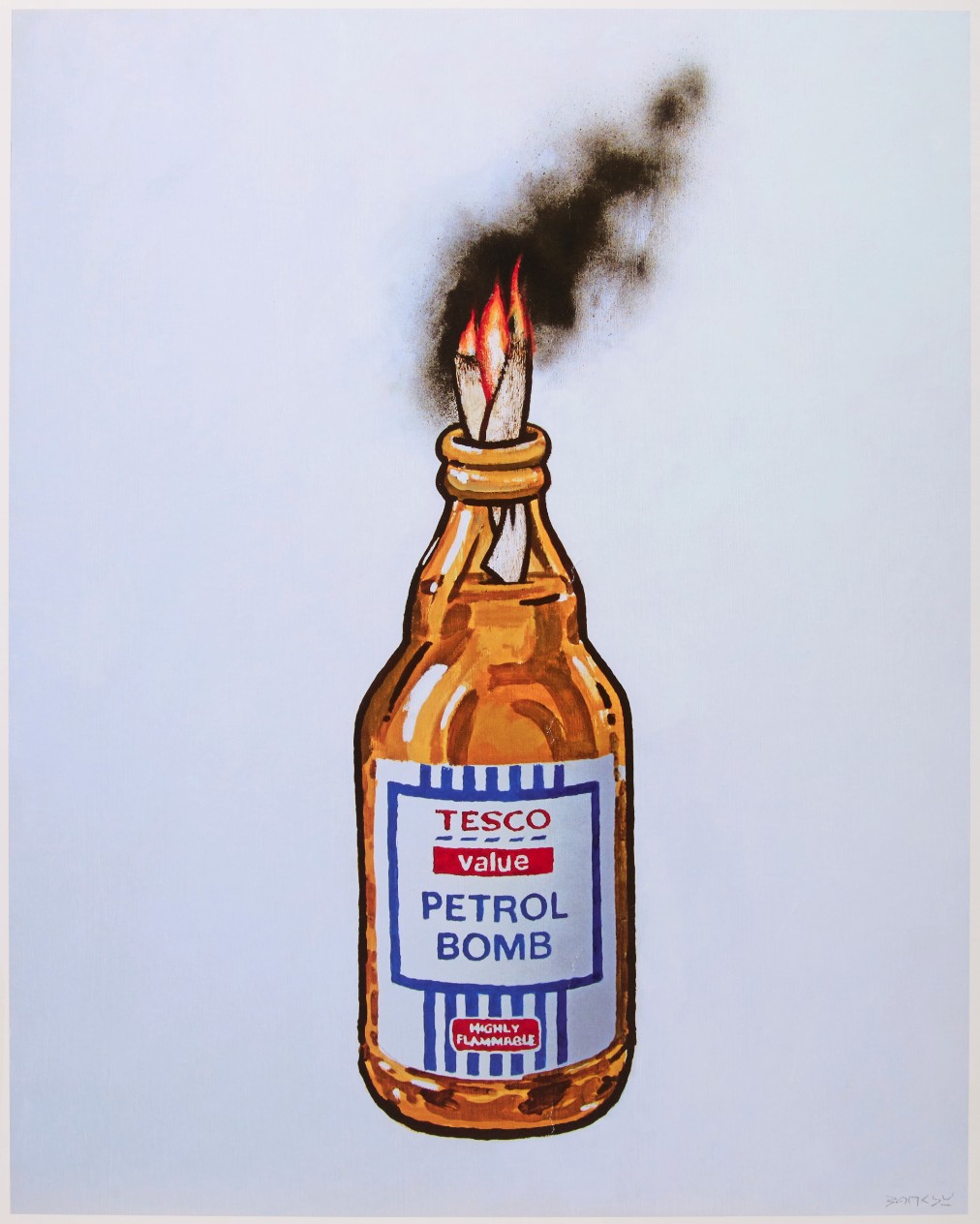
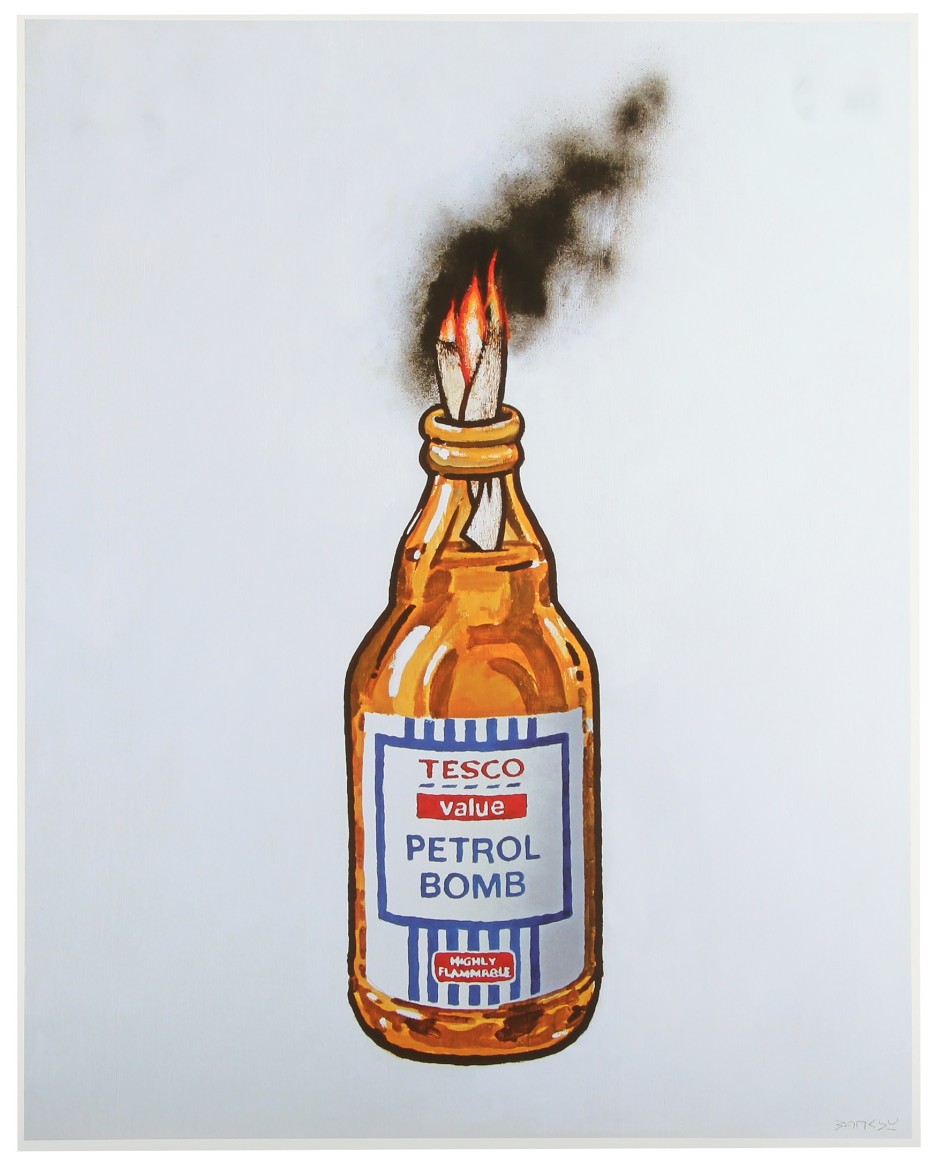
Tesco Value Petrol Bomb
Medium: Offset lithograph in colors on satin white paper
Year: 2011
Sheet: 50×40 cm (19 5/8 x 15 7/8 inches)
Edition: 2,000, unnumbered
Signed in plate lower right
Unlike many of Banksy’s most sought-after prints, Tesco Petrol Bomb was issued as an offset lithograph in an edition of 2,000, deliberately accessible in both format and price point. The works are plate-signed rather than hand-signed and are not numbered, reinforcing the idea of mass production. This is not a precious object designed for exclusivity; it is a poster: something closer to propaganda, or at least to public communication. This choice is entirely consistent with the work’s message. A critique of consumerism would lose its force if confined to rarity. Instead, Banksy embraces reproducibility, allowing the image to circulate widely, much like the corporate branding it parodies.
A Weapon Disguised as a Product
Banksy’s Tesco Petrol Bomb (2011) stands as one of the artist’s most incisive responses to contemporary urban tension, where corporate expansion, local identity, and civil unrest collide. Conceived in the immediate aftermath of the Stokes Croft riots in Bristol, the work distills a complex socio-political moment into a single, striking image—at once familiar and deeply unsettling. Through the language of branding and mass consumption, Banksy transforms an object of protest into a symbol of systemic critique, reaffirming his ability to capture the pulse of a specific event while elevating it into a broader commentary on modern society.
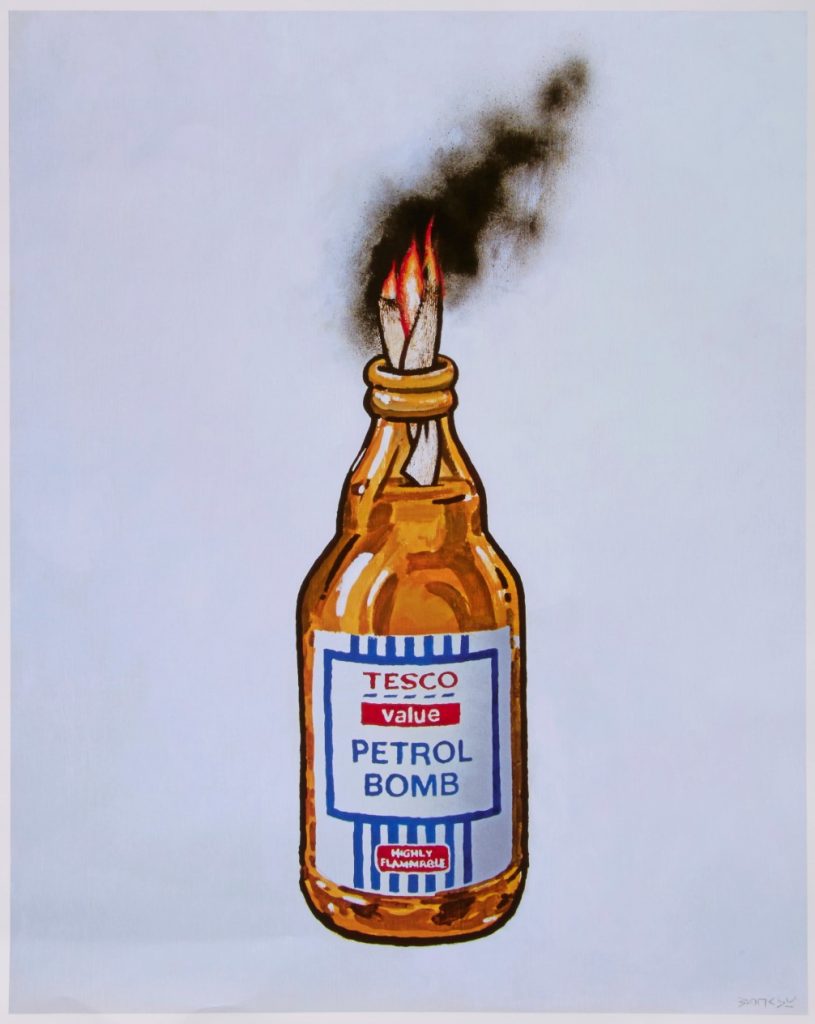
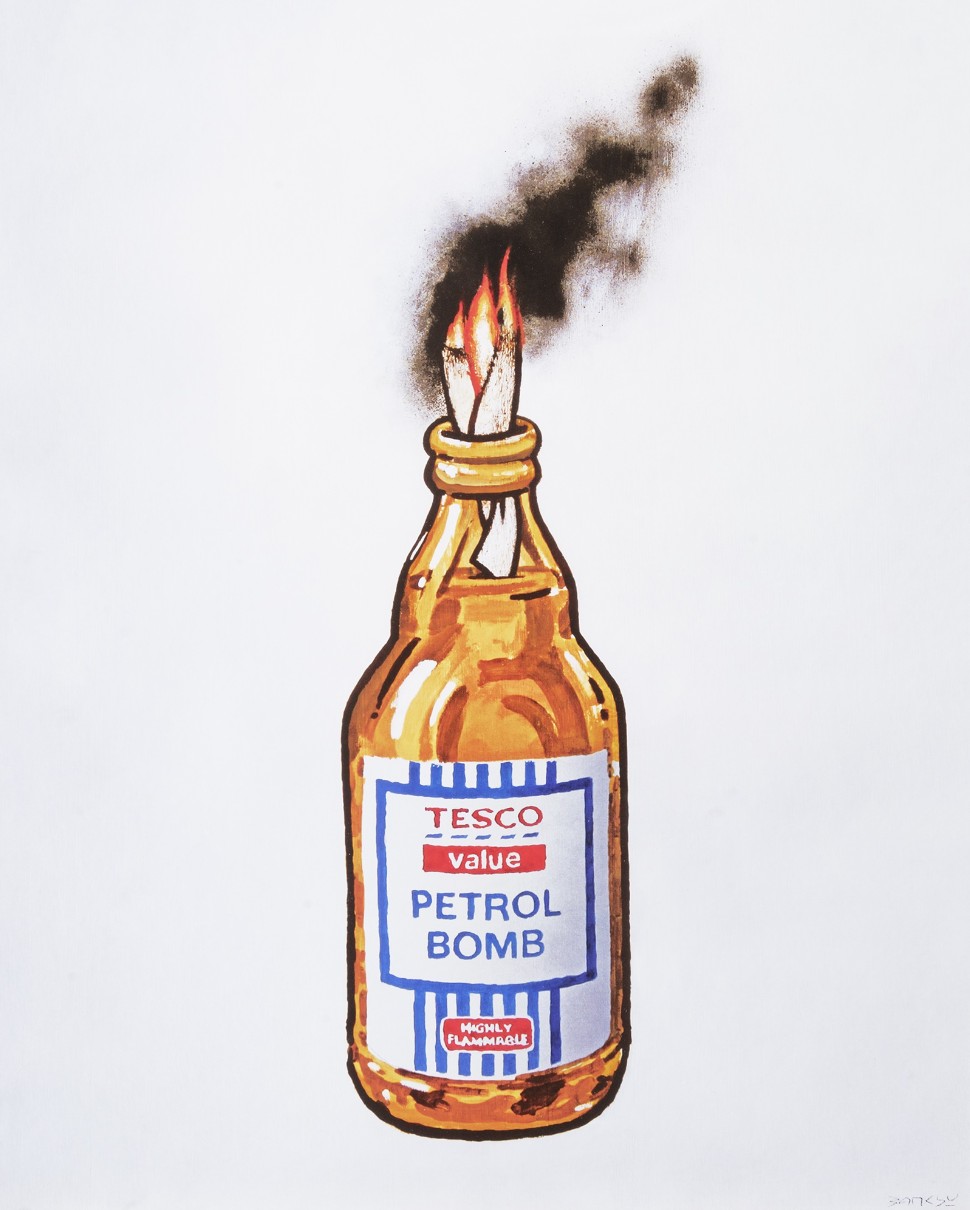
At first glance, the image is deceptively simple: a glass bottle rendered in warm amber tones, filled with liquid and fitted with a rag that burns at its tip. The flame is vivid, orange and red licking upward, while a cloud of black smoke drifts diagonally into the otherwise empty white background. The composition is isolated, almost clinical, giving the object the status of a product shot.
“Banksy has produced this fine commemorative souvenir poster.”
But the label changes everything. The bottle is branded “Tesco Value,” the budget range of the British supermarket giant Tesco. Beneath the familiar blue-and-white striped design appears the absurd yet chilling designation: “Petrol Bomb”, accompanied by a small warning: “Highly Flammable.” The typography and layout mimic mass-market packaging with uncanny precision, transforming a weapon into a commodity.
Banksy’s line work is deliberately loose compared to his stencil-based murals. The object feels hand-rendered, almost illustrative, yet the branding is sharp enough to remain instantly recognizable. This tension, between handmade image and corporate identity, is essential to the work’s impact.
From Everyday Consumption to Civil Unrest
This poster was produced in direct response to the events in Stokes Croft, Bristol, in April 2011: an area long associated with independent culture, activism, and resistance to corporate homogenization.
The opening of a Tesco Express store in the neighborhood, despite strong local opposition, became a flashpoint. When police raided a nearby squat under suspicion that petrol bombs were being assembled, tensions escalated rapidly. Protests erupted, leading to violent clashes, damaged property, and a highly mediatic confrontation between residents and authorities.
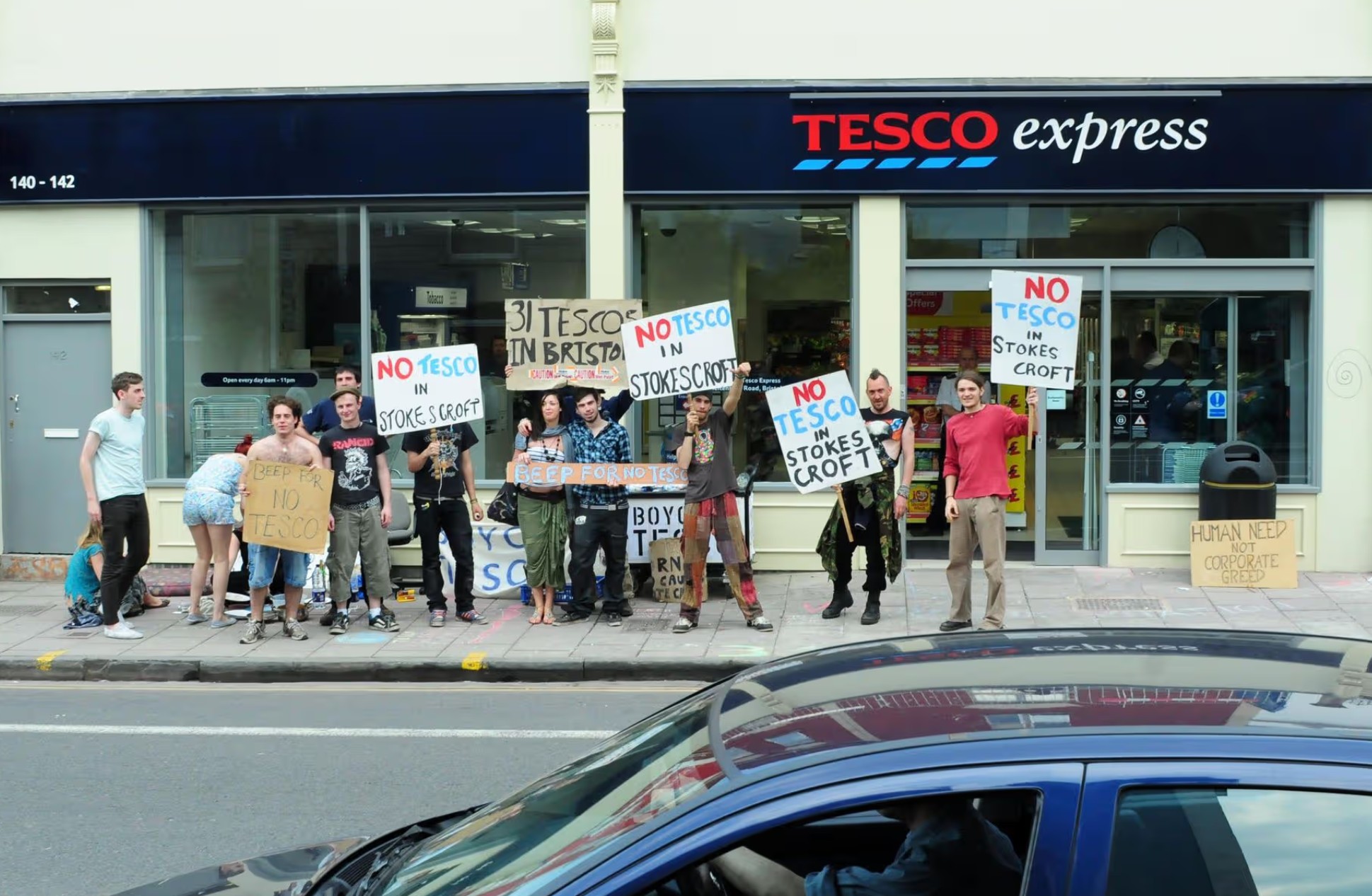
Banksy, whose ties to Bristol are well established, responded almost immediately. Rather than producing a mural, he released this image as a poster, accompanied by a sharply ironic statement:
“Banksy has produced this fine commemorative souvenir poster.”
The phrasing is key. It frames the unrest not as tragedy or crisis, but as something packaged, memorialized, and, implicitly, commercialized.
A Brutal Satire of Consumer Culture
The brilliance of Tesco Petrol Bomb lies in its conceptual inversion. A petrol bomb, an improvised weapon associated with revolt, is here presented as a mass-produced, budget supermarket item. Violence becomes just another product line. Rebellion itself is absorbed into the logic of consumption.
Banksy suggests several layers simultaneously. First, that large corporations, by imposing themselves onto local communities, can act as catalysts for social unrest. The petrol bomb is not just a weapon; it is a byproduct of corporate expansion. Second, that consumer culture has reached a point where even dissent risks being commodified. The aesthetic of protest becomes something that can be packaged, branded, and circulated. And finally, that the distinction between everyday life and violence is disturbingly thin. The same bottle that might hold a harmless drink becomes, with minimal alteration, a tool of destruction. The shift is almost banal: just as the shift from community shop to corporate chain can be.
Tesco Petrol Bomb occupies a crucial place within Banksy’s broader exploration of anti-corporate critique, alongside works targeting brands, institutions, and systems of control. However, it stands apart in its immediacy. This is not a generalized statement: it is a direct reaction to a specific event, almost journalistic in its timing. In that sense, it recalls the tradition of political prints and posters, from revolutionary propaganda to punk graphics. The work also marks a moment where Banksy steps slightly outside his usual stencil vocabulary, adopting a more illustrative approach that enhances the illusion of a commercial product.
Ultimately, Tesco Petrol Bomb is less about the object it depicts than the system it exposes. It captures a moment when tensions between community identity and corporate expansion reached a visible breaking point—and reframes that moment with unsettling clarity.
Tesco Petrol Bomb was not only released online; it was also physically distributed at the Bristol Anarchist Bookfair in 2011, a context that is far more than anecdotal: it is conceptually precise. The Bristol Anarchist Bookfair is a grassroots gathering centered on anti-capitalist thought, activism, and independent publishing. By choosing this venue, Banksy bypassed not only galleries but also commercial distribution channels entirely, placing the work directly into the hands of an audience already engaged with the very issues the image addresses.
This mode of release is perfectly aligned with the work’s message. A poster critiquing corporate overreach and the commodification of everyday life is not introduced through a white cube or a polished retail platform, but through a space of dissent, discussion, and alternative culture. In that sense, the distribution becomes part of the artwork itself.
It also reinforces Banksy’s long-standing strategy: operating simultaneously inside and outside the system. The same image exists as a collectible print edition, yet its initial circulation—free, political, immediate—belongs firmly to the world of activism rather than the art market.
Auction Results
Roseberys London: 16 April 2026
Estimated: GBP 1,500 – 2,000
GBP 1,574 / USD 2,130
BANKSY (British b. 1974-)
Tesco Petrol Bomb, 2011
Offset lithograph in colors on wove
Printed signature, from an edition of 2000
XXXXXXXXXX
Chiswick Auctions: 26 February 2026
Estimated: GBP 1,500 – 2,000
GBP 2,520 / USD 3,400
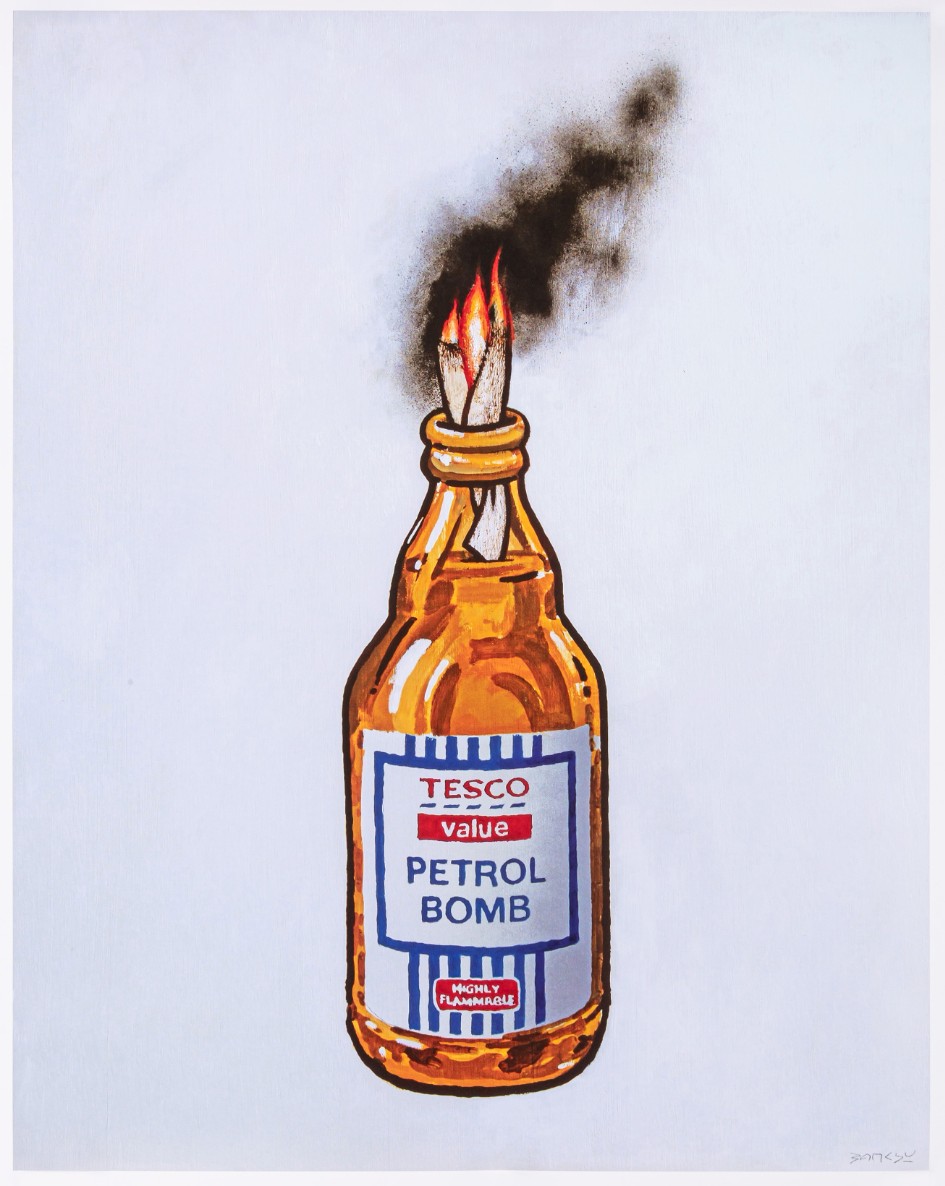
BANKSY (British, b.1974)
Tesco Value Petrol Bomb, 2011
Offset lithograph in colors on smooth wove
Signature printed in the plate
From the unnumbered edition of 2000
XXXXXXXXXX
Roseberys London: 17 September 2025
Estimated: GBP 1,000 – 1,500
GBP 1,574 / USD 2,150
BANKSY (British b. 1974-)
Tesco Petrol Bomb, 2011
Offset lithograph in colors on wove
Printed signature, from an edition of 2000
From the Anarchist Book Fair, Bristol
XXXXXXXXXX
Roseberys London: 9 April 2025
Estimated: GBP 1,500 – 2,000
GBP 1,968 / USD 2,515
BANKSY (British b. 1974-)
Tesco Petrol Bomb, 2011
Offset lithograph in colors on wove
Printed signature, from an edition of 2000
XXXXXXXXXX
SBI Art Auction: 14 September 2024
Estimated: JPY 100,000 – 150,000
JPY 253,000 / USD 1,800
BANKSY
Tesco Value Petrol Bomb, 2011
Offset print
From the edition of 2000
XXXXXXXXXX
Chiswick Auctions: 25 July 2024
Estimated: GBP 1,500 – 2,500
GBP 2,520 / USD 3,245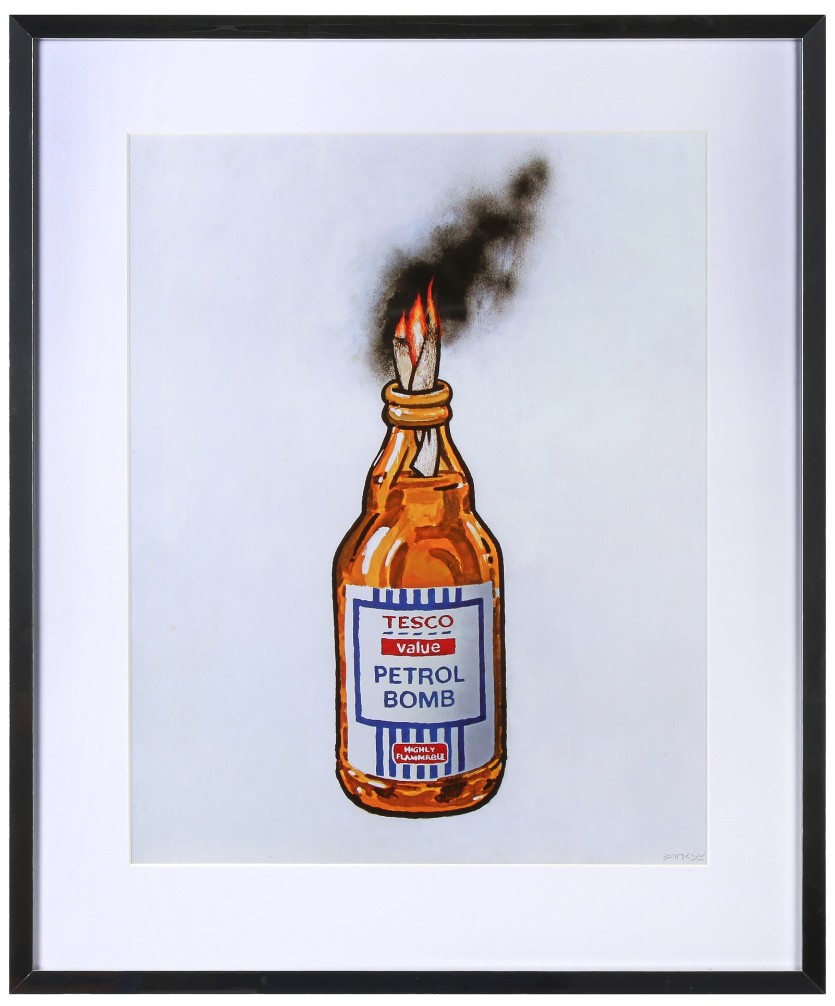
BANKSY (BRITISH B.1974)
Tesco Value Petrol Bomb, 2011
Signature printed in the plate
Offset lithograph in colours on smooth wove
From the unnumbered edition of 2000
XXXXXXXXXX
Tate Ward Auctions: 30 March 2022
Estimated: GBP 3,000 – 5,000
GBP 3,750 / USD 4,930
BANKSY (British 1974-)
‘Tesco Value Petrol Bomb’, 2011
Offset lithograph in colors on smooth wove paper
From an un-numbered edition of 2000
XXXXXXXXXX
Tate Ward Auctions: 24 March 2021
Estimated: GBP 1,000 – 1,500
GBP 4,375 / USD 6,000
BANKSY (British 1974-)
‘Tesco Value Petrol Bomb’, 2011
Offset lithograph in colors on smooth wove paper
From an un-numbered edition of 2000
XXXXXXXXXX
Chiswick Auctions: 26 October 2020
Estimated: GBP 500 – 700
GBP 6,875 / USD 8,950
AUCTION RECORD FOR TESCO VALUE PETROL BOMB
BANKSY (BRITISH B. 1974)
Tesco Value Petrol Bomb, 2011
Offset lithograph
Edition of 2000, signed within image