Banksy Street Works at Auction:
Between Illegality, Authenticity, and Market Reality
Before the editions, before the studio works, and long before the market embraced his name, there was the wall. Banksy’s practice is fundamentally rooted in the street, in interventions executed directly onto the fabric of the city, often without permission and always with intent. These murals are not marginal to his work; they are its foundation. Many of the most recognizable images that later appeared as prints or studio compositions originate from these public interventions, making the street not simply a context but the primary medium through which Banksy first articulated his visual language. To understand Banksy is therefore to begin with these works. They are immediate, site-specific, and inseparable from the urban environments in which they were conceived. They carry the urgency of the moment in which they were painted and the political or social tensions they were meant to expose.
A Category Outside the System
Unlike prints, paintings, or sculptures, Banksy’s street works do not come with certification from Pest Control Office. This absence is often interpreted as a lack of legitimacy, when in reality it reflects a deliberate structural boundary.
The Origin of Banksy’s Practice: The Wall as Primary Medium
Before editions, before studio works, before the market, there is the wall. Banksy’s practice is fundamentally rooted in the street. His murals, executed illegally or semi-legally in public space, constitute not only the most direct expression of his artistic language, but also the conceptual foundation from which much of his later work derives. Many of his most iconic images, later translated into prints or studio pieces, originate precisely from these interventions on urban surfaces.
To speak of Banksy without acknowledging the primacy of the mural is to misunderstand the work entirely. These pieces are not peripheral: they are the source. Banksy did not create these works to enter the market. They were executed in situ, often illegally, without intention of future sale, transport, or conservation. As such, the traditional mechanisms of authentication (requiring inspection, documentation, and controlled conditions) simply do not apply.
More importantly, formal authentication of street works would open a complex and potentially unmanageable field for Pest Control, involving logistical challenges, legal ambiguities, and questions of ownership that the organization has deliberately chosen to avoid. The result is a paradox: some of the most “authentic” Banksy works, those made directly by the artist, in the street, exist outside his official authentication framework.
Authenticity Without a Certificate: A Constructed Consensus
The absence of a certificate does not mean the absence of authorship. It simply means that these works exist outside the framework that governs Banksy’s market-approved production. In this context, authenticity does not disappear; it is constructed differently. Rather than relying on a single institutional authority, the attribution of a Banksy mural rests on a convergence of evidence that, taken together, forms a compelling and often convincing narrative.
Historical photographs of the work in its original location, documentation of its removal, provenance linked to property owners or intermediaries, and contemporaneous media coverage all contribute to this process. In many cases, the works were also documented on Banksy’s own website or through channels associated with his practice, further reinforcing their attribution. Visual analysis plays an equally important role, as the consistency of technique, stencil language, and iconography allows specialists to situate these works within the artist’s known corpus.
What emerges is a form of consensus, not decreed but assembled, in which authenticity is the result of accumulated evidence rather than formal certification.
A Market Both Real and Unresolved
Removal: Vandalism, Theft, or Conservation?
The removal of Banksy murals remains one of the most contentious aspects of this market. For many observers, detaching a work from its original setting represents a form of cultural appropriation, transforming a public gesture into a private commodity. These works were offered freely to the communities in which they appeared, and their extraction can be perceived as a violation of that initial intent.
Yet an opposing argument persists, and it is not without merit. Street works are inherently vulnerable. Exposure to weather, pollution, vandalism, and urban development ensures that many of them are destined to disappear. In this light, removal can be understood as an act of preservation, allowing the work to survive beyond the fragile conditions of the street and to enter collections, whether private or institutional, where it can be conserved and studied.
The tension between these two positions is not easily resolved. It is precisely this unresolved condition that gives these works their particular charge within the market.
The Emergence of a Specialized Market
Despite their ambiguous status, Banksy’s street works have developed a distinct and increasingly structured presence at auction. This market has not been driven primarily by the traditional major houses, but rather by more specialized actors willing to engage with its complexities, most notably Julien’s Auctions and Hessink’s.
Julien’s has played a pioneering role in introducing these works to the American auction landscape, presenting major murals as significant cultural artifacts and emphasizing their rarity and historical importance. Hessink’s, in turn, has approached the category with a systematic ambition, organizing dedicated sales and contributing to the construction of a coherent body of reference for Banksy’s street production. Through repeated transactions, these houses have transformed what might once have been perceived as isolated anomalies into a recognizable and functioning segment of the art market.
The market for Banksy’s street works is no longer speculative. Auction results demonstrate consistent demand, with prices reaching significant levels depending on the scale, subject, and provenance of the piece. Collectors are willing to engage with the complexities of the category, accepting the absence of formal certification in exchange for the opportunity to own a work that is, in many respects, closer to the artist’s original gesture.
Yet this market remains fundamentally unresolved. These works exist outside the artist’s official system while simultaneously being integrated into a commercial framework. They are supported by scholarship and market confidence but also surrounded by ethical ambiguity and conceptual tension. It is precisely this instability that defines their position.
A Parallel Authority: The Catalogue Raisonné
In the absence of certification from Pest Control, the development of a catalogue raisonné of Banksy’s street works by Hessink’s represents a significant evolution. Such a catalogue, when rigorously compiled, provides structure to a field otherwise defined by fragmentation. It documents works, establishes chronology, and offers a framework within which individual pieces can be understood and compared.
While it does not replace the authority of Pest Control, it introduces an alternative form of validation grounded in research, documentation, and expertise. In a market where official endorsement is unavailable, this kind of scholarly infrastructure becomes essential, offering both collectors and institutions a reference point upon which to base their decisions.
What Is Being Sold, Exactly?
What is being sold in these auctions is not simply an image but a fragment of the city itself. These works exist as sections of walls, pieces of concrete, metal panels, doors, or wooden supports that once formed part of a larger architectural context. Their physical presence carries the trace of their original environment, embedding the work within a history that extends beyond the act of painting.
To acquire such a piece is to acquire not only a composition by Banksy but also a material witness to its existence in the public realm. It is this dual nature, at once artwork and artifact, that distinguishes these objects from more conventional forms of artistic production.
The legal status of Banksy’s street works introduces an additional layer of complexity that cannot be overlooked. These murals are often executed without authorization, raising immediate questions about the legitimacy of their removal and subsequent sale. Because they are created on existing structures, ownership of the physical wall typically belongs to the property owner, yet this does not automatically clarify ownership of the image itself. In practice, it is often the owner of the wall who authorizes or undertakes the removal and sale, but this process sits in a legally ambiguous space where property rights, artistic authorship, and public interest intersect. As a result, each transaction carries its own set of legal considerations, making this category of works not only conceptually provocative but also juridically uncertain.
Conclusion: The Purest Banksys?
There is, perhaps, a final irony in all of this. The works that were never meant to be sold, that were created freely and often illegally, now circulate within a structured and increasingly sophisticated market. They resist certification, yet they are recognized. They challenge ownership, yet they are owned.
One might argue that these are among the most authentic Banksys, precisely because they originate directly from the street, unmediated and uncompromised. At the same time, their removal transforms them into objects that exist far from their original purpose. The question of legitimacy therefore remains open. The market has not resolved it. It has simply chosen to operate within it.
2026 Auction Results
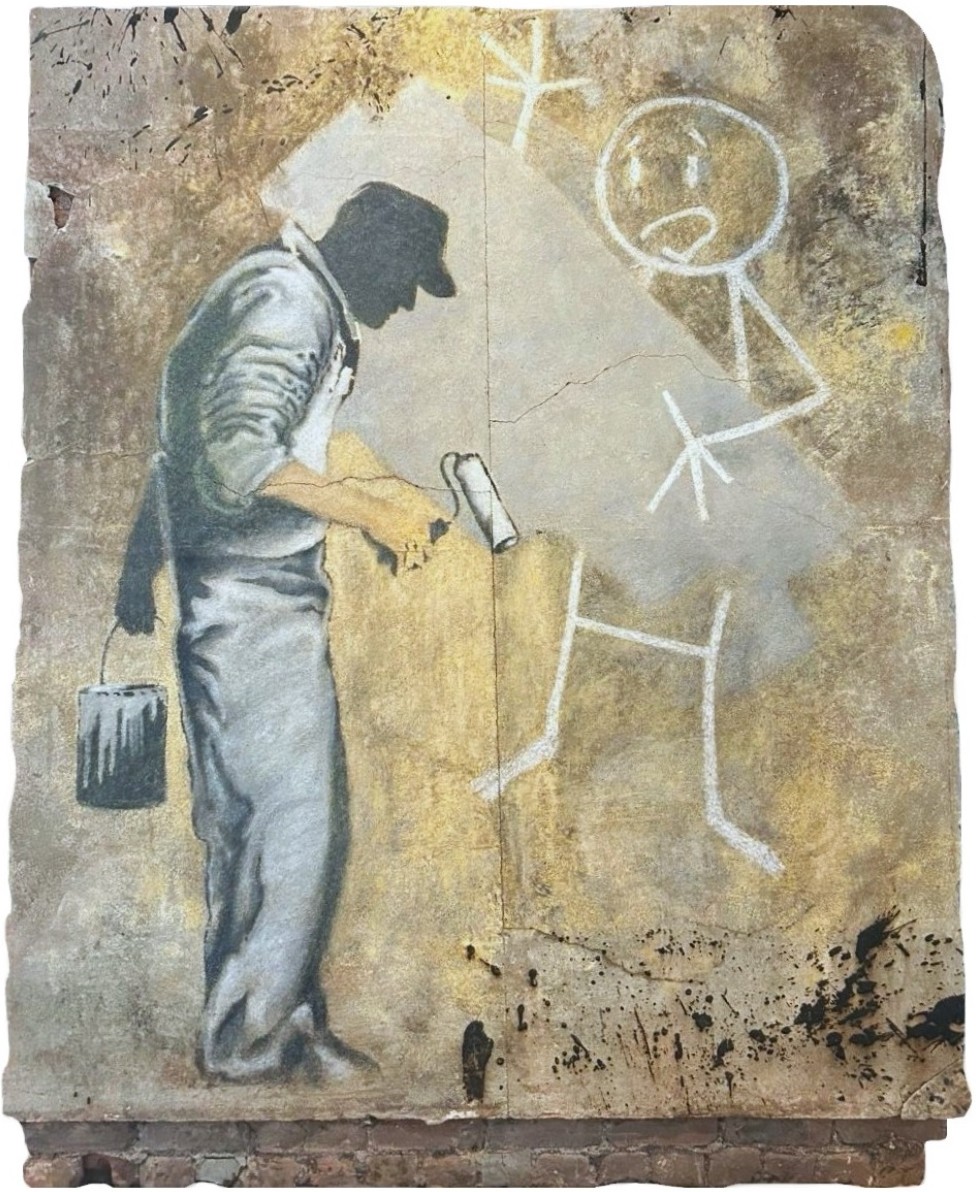
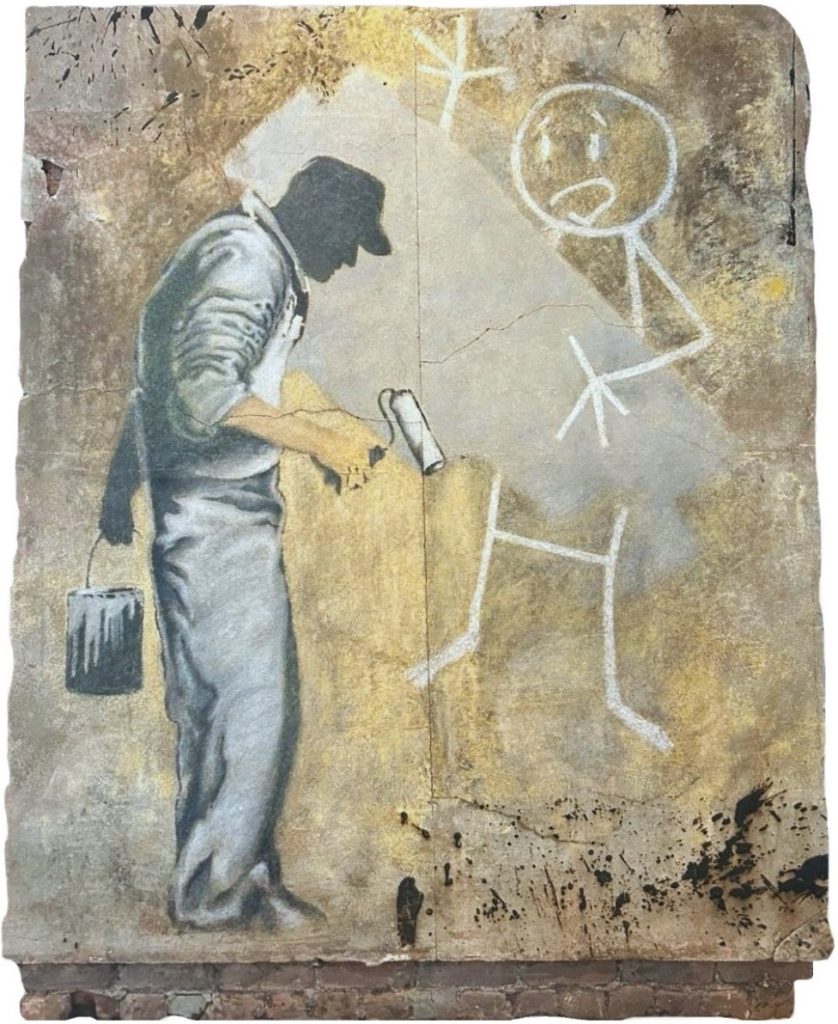
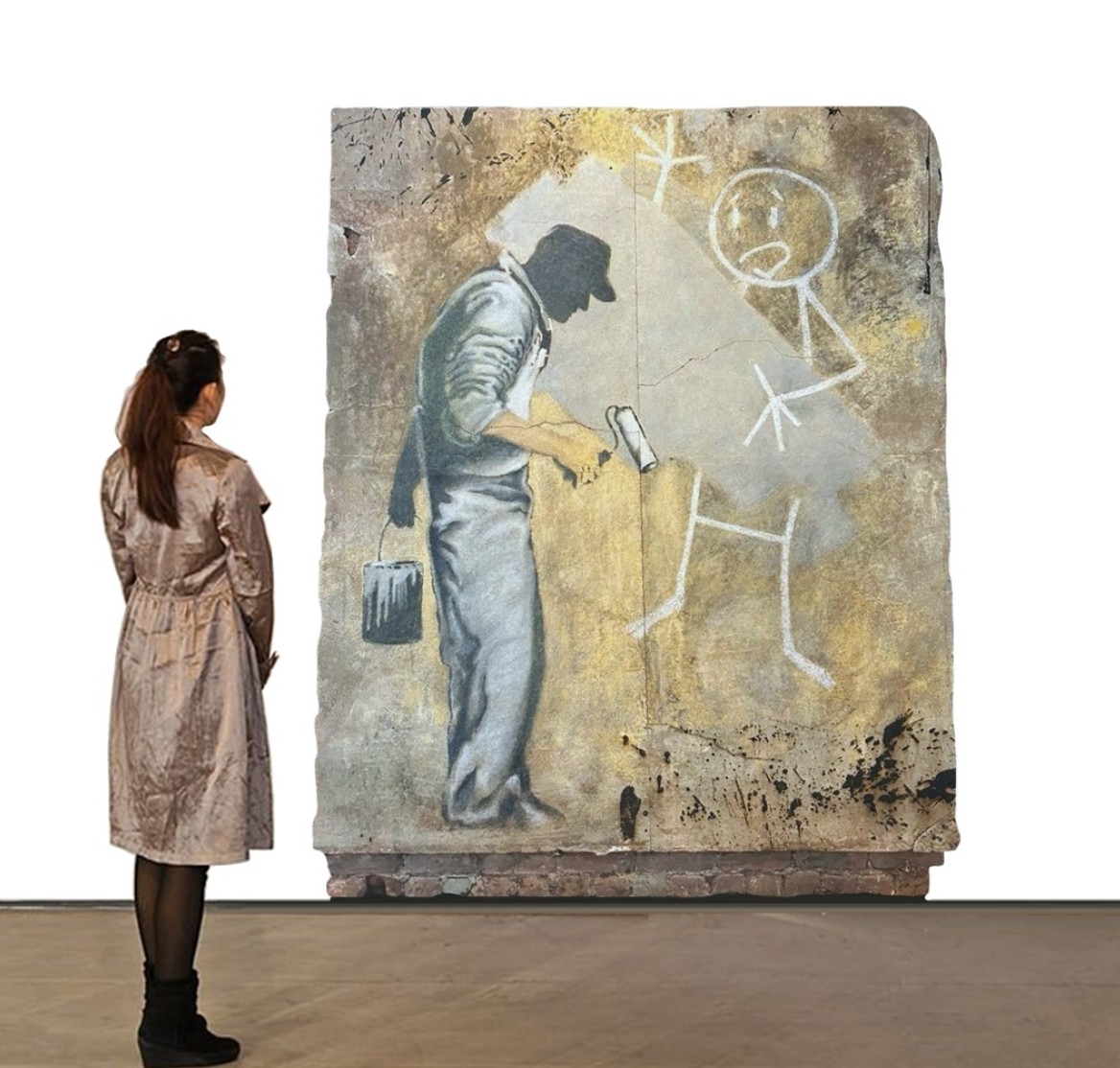
Gray Ghost Attacks Stick Figure, 2008
Hessink’s: 28 March 2026
Estimated: EUR 600,000 – 800,000
EUR 650,000 (Hammer)
EUR 812,500 / USD 937,440
Lot 15 – Banksy (British Street Artist, born 1974)
BANKSY (British Street Artist, born 1974)
Gray Ghost Attacks Stick Figure, 2008
Stencil, freehand and spray paint on a masonry wall
Dimensions: 244 x 152.5 cm (96×60 inches)
Weight: 2,500 kg
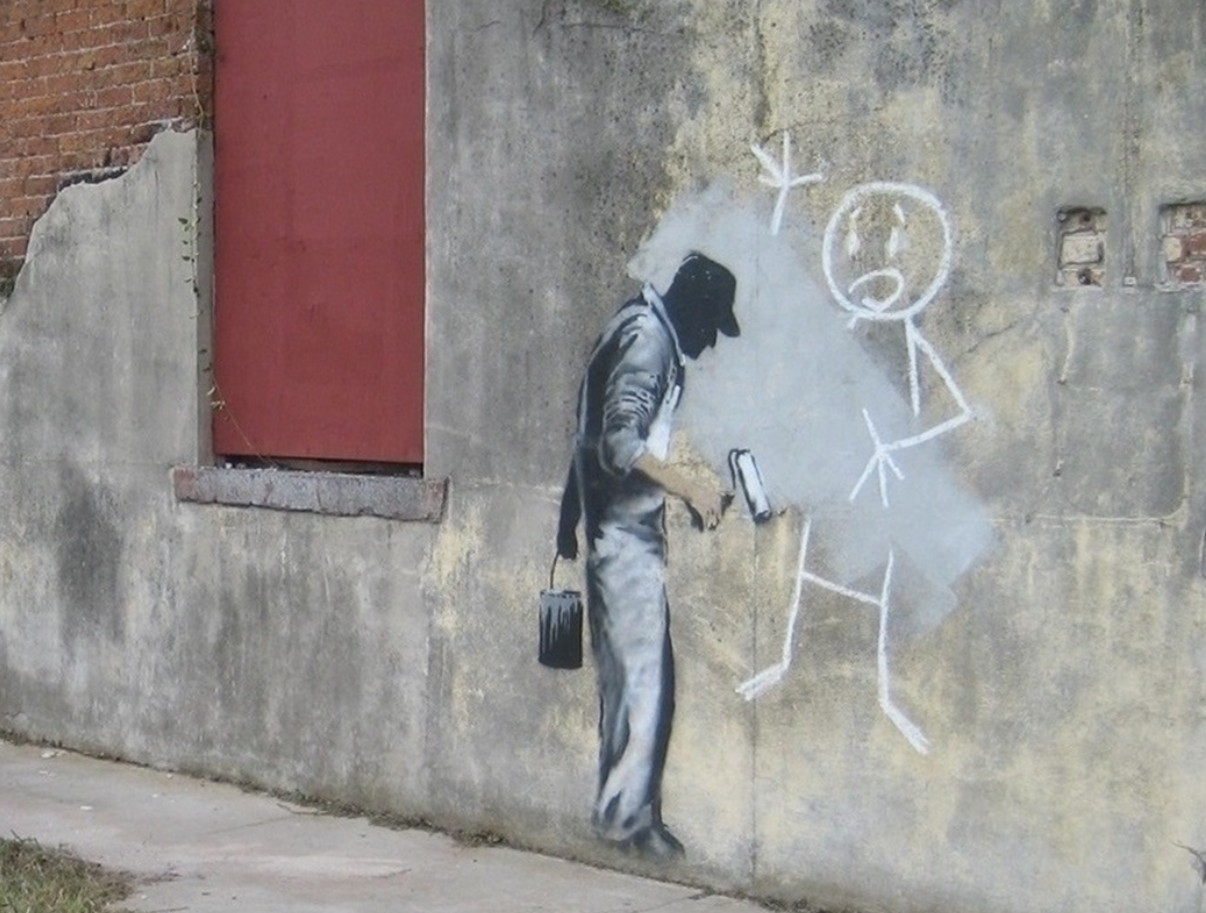
This mural was sprayed on the side of a former firehouse on 514 Jackson Avenue in the lower Garden District in August 2008. The artwork was inspired by an ‘Anti Street Art Vigilante’ known as the “Gray Ghost” (the late Fred Radtke) who had been painting over graffiti in New Orleans for years. The diagonal gray patch was painted by Radtke earlier. Banksy incorporated it into his own work.
3D Rat, 2010
Hessink’s: 28 March 2026
Estimated: EUR 200,000 – 300,000
EUR 340,000 (Hammer)
EUR 425,000 / USD 490,350
Lot 27 – Banksy (British Street Artist, born 1974)
BANKSY (British Street Artist, born 1974)
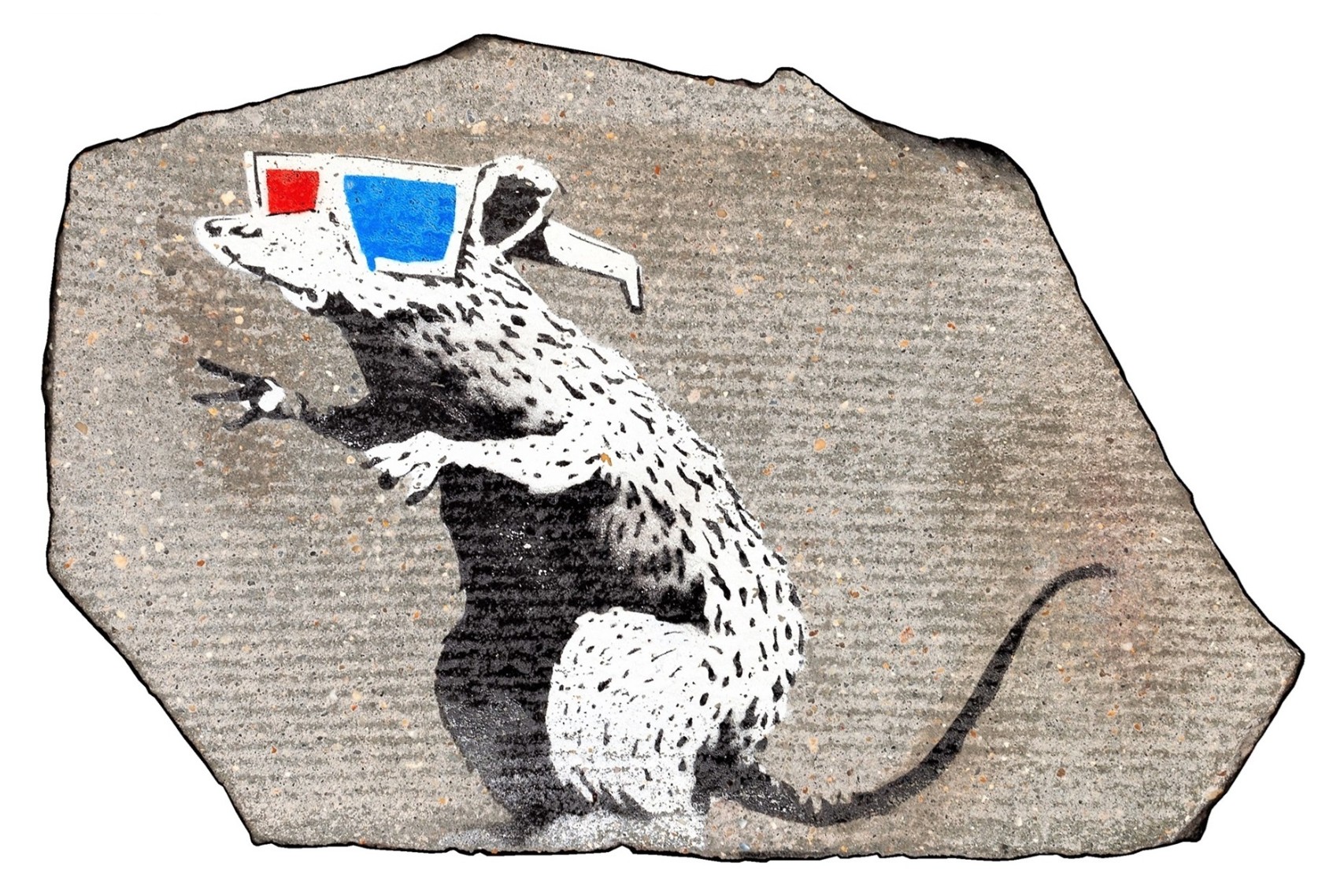
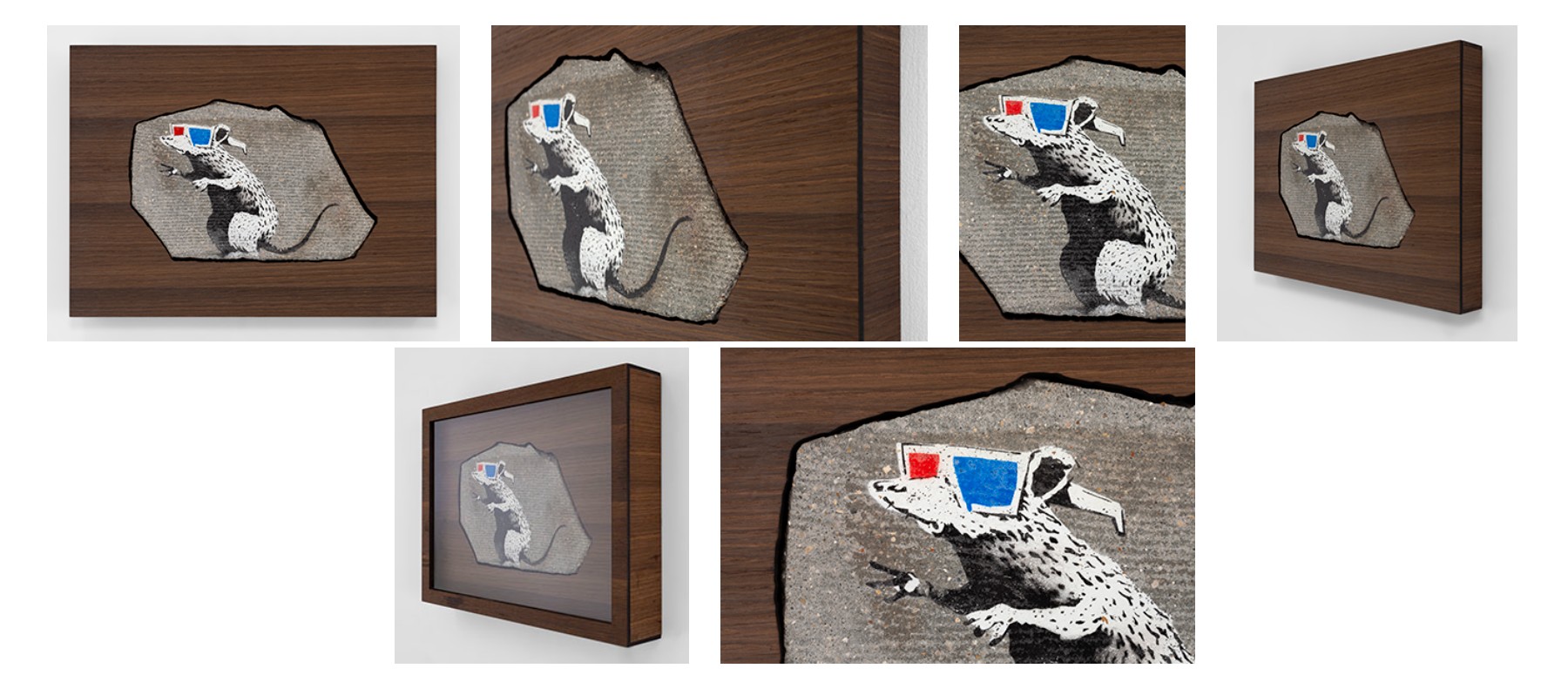
3D Rat, 2010
Stencil and spray paint on concrete
Dimensions: 24×35 cm (16-1/8 x 21-5/8 inches)
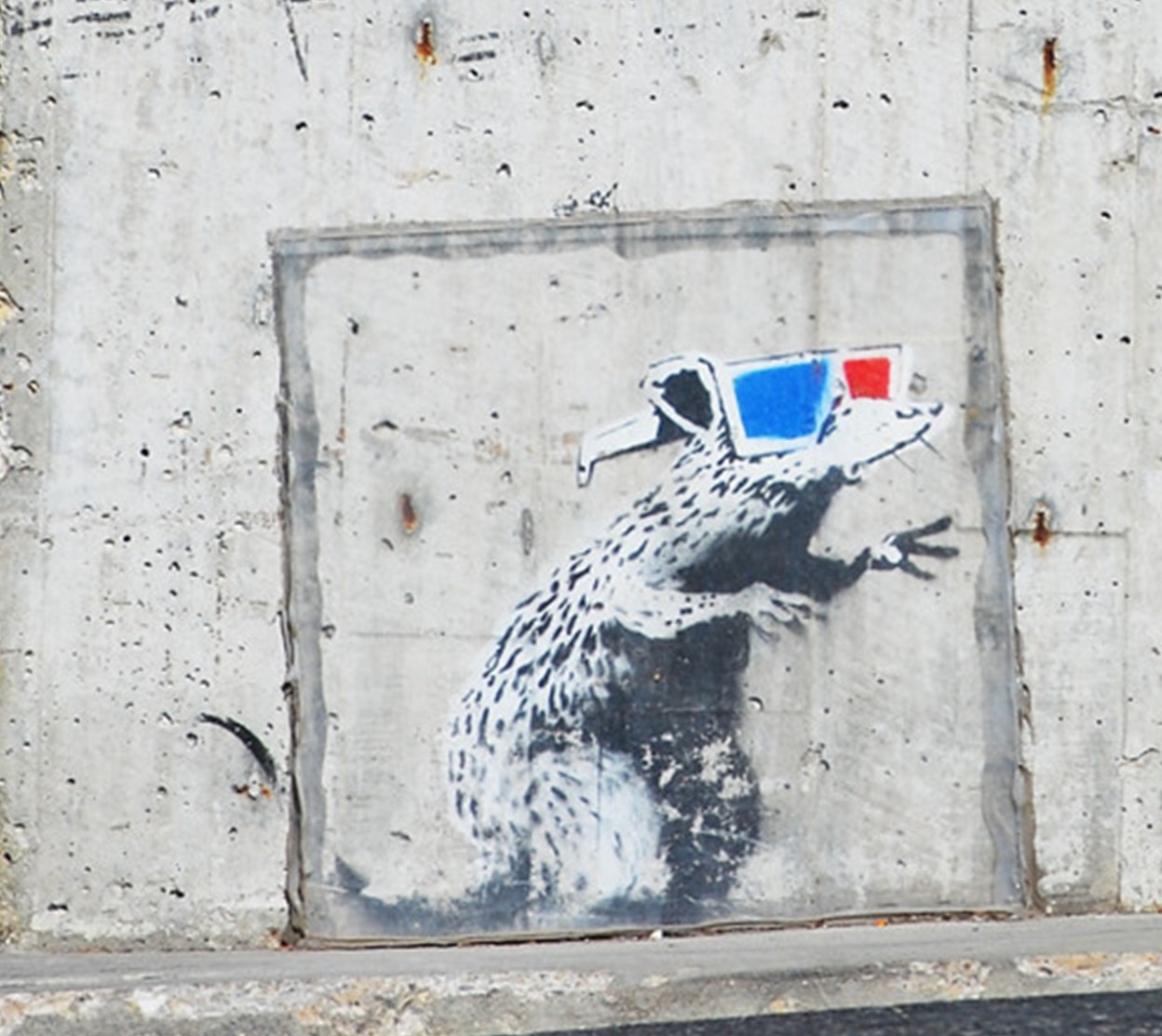
In January 2010, Banksy visited Park City in Utah, where he created several Artworks including some ‘3D Rats’. His trip to Utah was coincide in the run up to the premiere of Banksy’s film ‘Exit Through the Gift Shop’ which was playing at the 2010 Sundance Festival in the Egyptian Theatre in Park City. Most of his pieces he produced during this time were subsequently lost to the harsh weather conditions, painted over by homeowners or damaged by local vandals. Only three ‘3D Rats’ from Banksy´s trip to Park City have survived. This piece is by far the finest example.
Gangsta Rat – Live, circa 2004
Julien’s Auctions: 4 February 2026
Estimated: USD 100,000 – 150,000
USD 160,000 (Hammer)
USD 204,800
Banksy | “Gangsta Rat – Live” Original Liverpool Street Art Painting (with Book)
BANKSY(British, 1974)
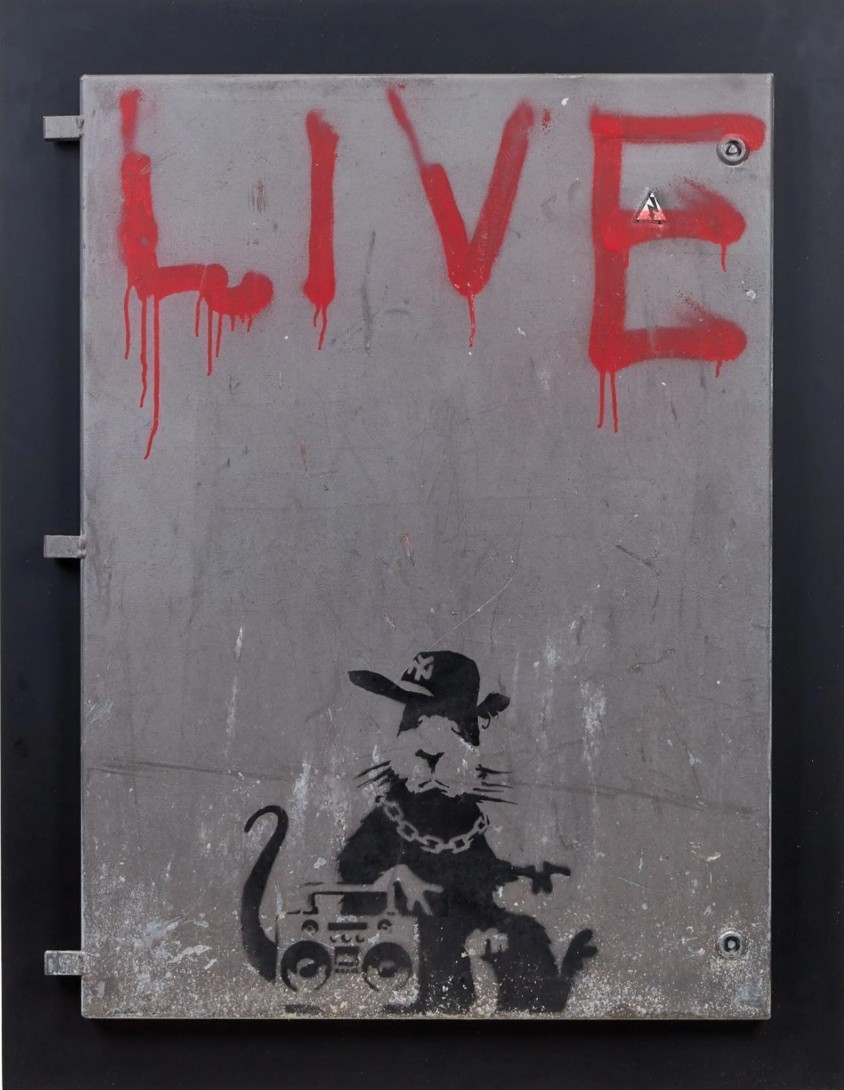
Gangsta Rat – Live, circa 2004
Aerosol on metal door mounted in an acrylic shadowbox frame
Dimensions: 34×26 inches
An original Banksy aerosol painting, featuring a rat with a boombox below the word “Live,” reportedly executed on a British Telecom street box in Liverpool, England, during the 2004 Liverpool Biennial contemporary art festival. The artwork was documented in the Banky’s own publication, “Cut It Out” (Paranoid Pictures, 2004). Accompanied by a copy of the book.
Running Coppers, circa 1999
Hessink’s: 28 March 2026
Estimated: EUR 90,000 – 115,000
EUR 90,000 (Hammer)
EUR 112,500 / USD 129,800
Lot 8 – BANKSY (British Street artist, born 1974)
BANKSY (British Street artist, born 1974)
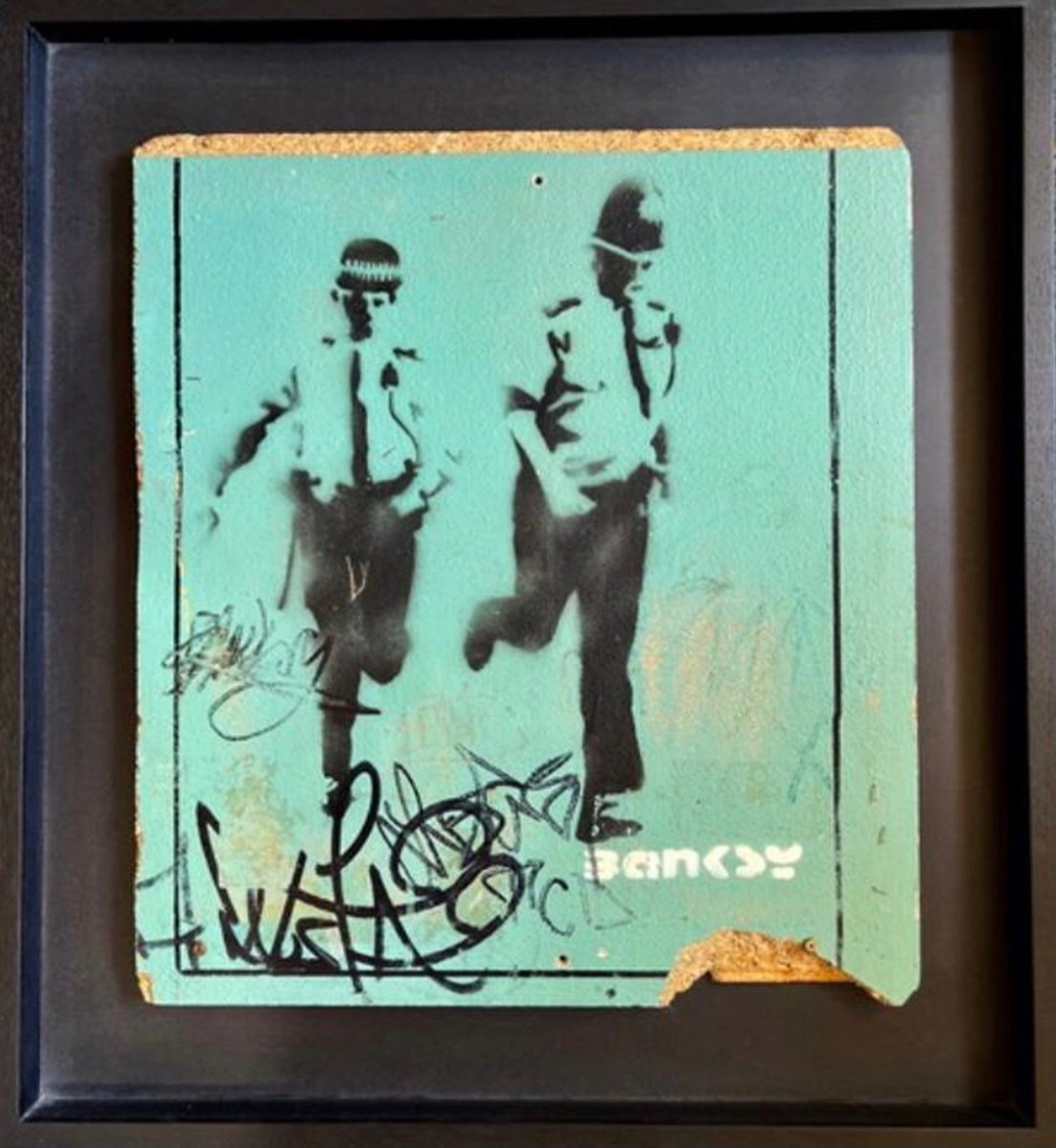
Running Coppers, circa 1999
Stencil and Spray paint on Chipboard
Dimensions: 62x56x2 cm (24-3/8 x 22 x 7/8 inches)
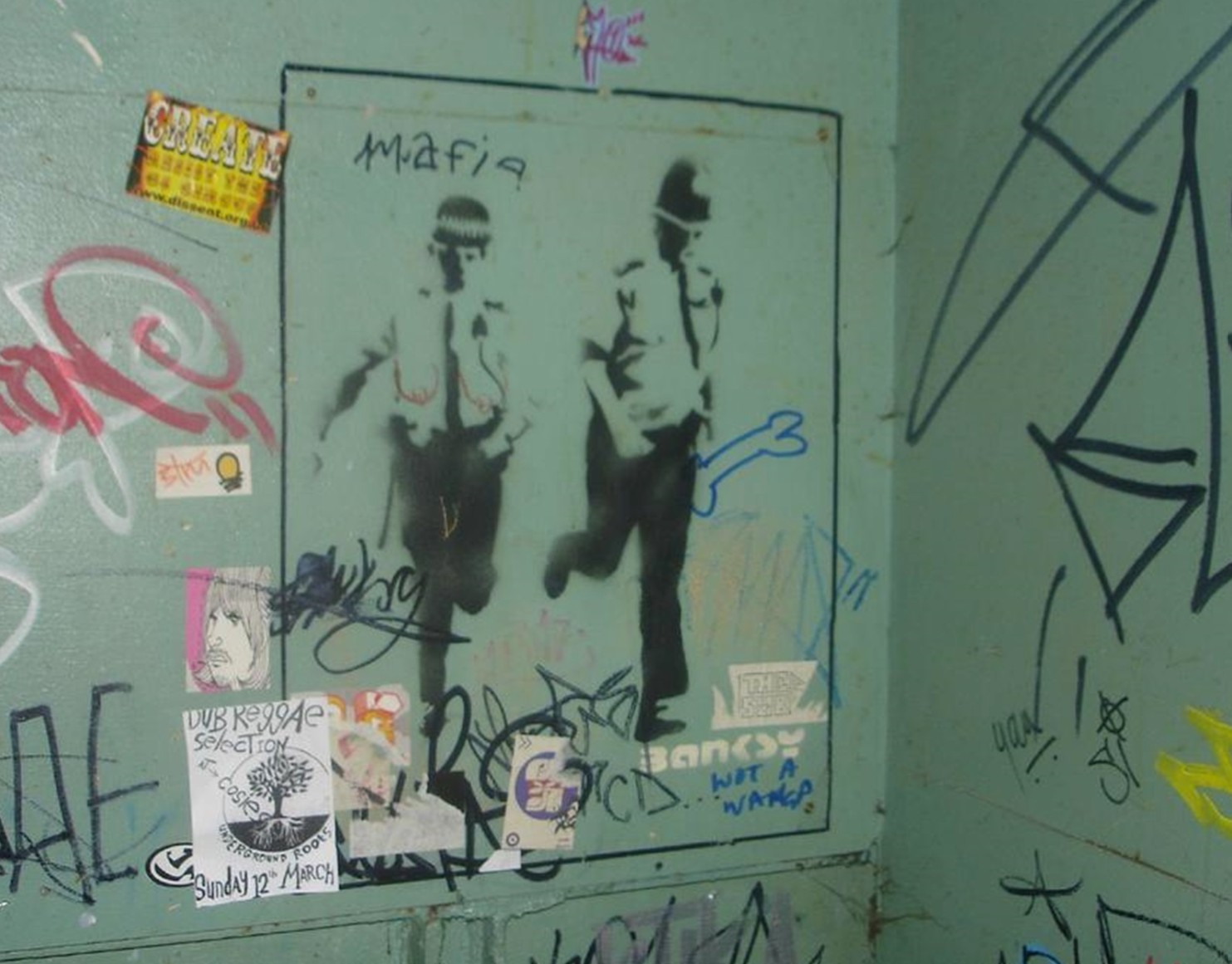
The artwork was painted inside former German cargo ship ‘Thekla’, which was moored in Mud Dock, Bristol. The ship which was converted into a music and comedy venue in 1983 and by the mid 1990’s and early 2000’s it was operating as a nightclub. Banksy painted a number of works at the venue, most famously his ‘Grim Reaper’ on the hull of the ship in 2003, which was later transferred to Bristol Museum’s M Shed, a harbour side museum. The smaller ‘Running Coppers’ was removed from the ship during renovation works in 2006, and was salvaged by one of the site workers who was a fan of Banksy’s work. The site worker then approached Banksy for his permission to keep the piece and was verbally given Banksy’s blessing. One of a number of examples of this particular stencil, produced by Banksy in Bristol in 1999 and later in London. The piece depicts two British police officers in chase mode. Sprayed onto painted chipboard, the piece is quintessential Banksy, capturing a familiar sight in British life, with a few well positioned lines and his uniquely deft touch.
Radar Rat, 2003
Hessink’s: 28 March 2026
Estimated: EUR 140,000 – 180,000
EUR 90,000 (Hammer)
EUR 112,500 / USD 129,800
Lot 2 – Banksy (British Street Artist, born 1974)
BANKSY (British Street Artist, born 1974)
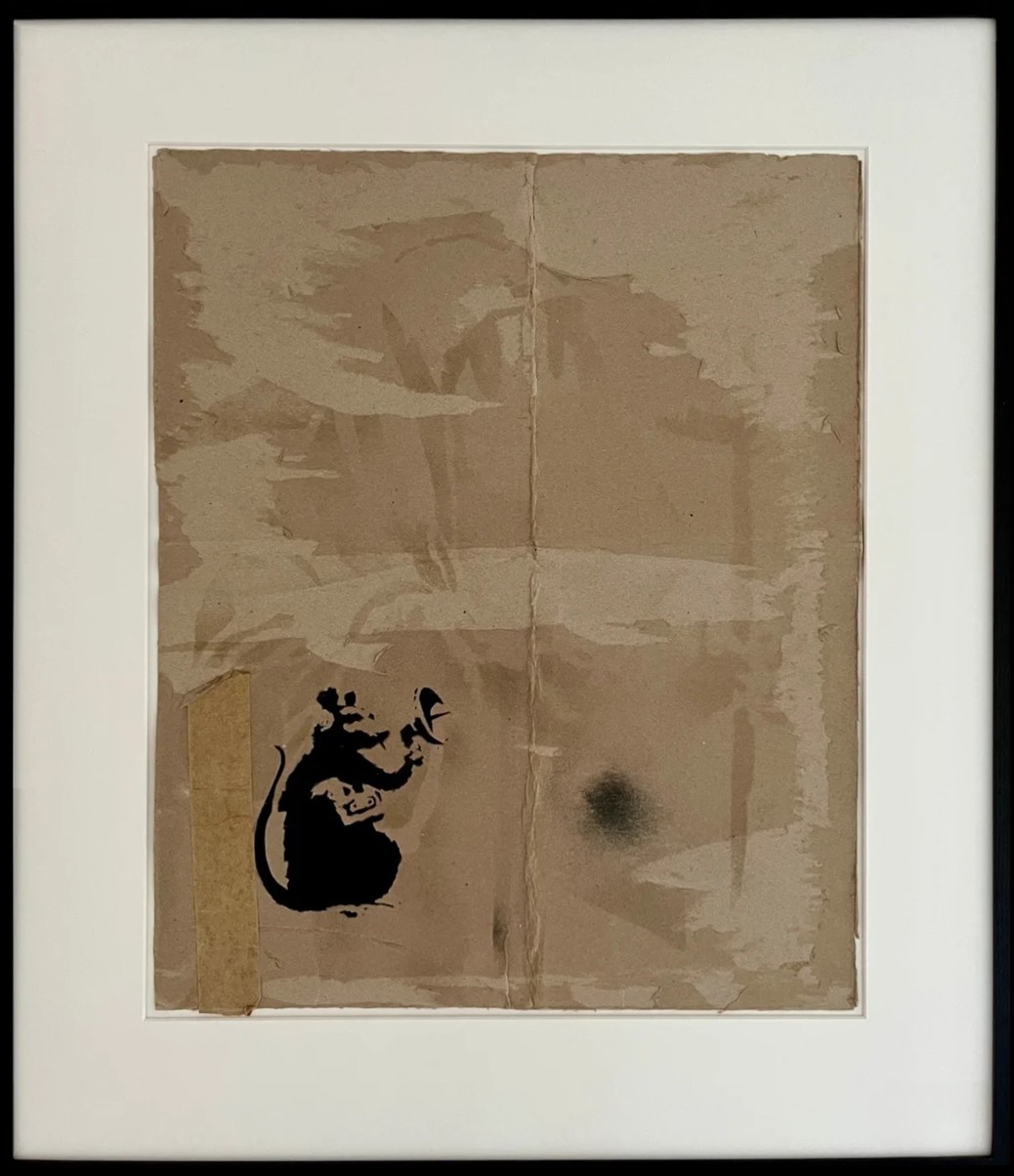
Radar Rat, 2003
Stencil and spray paint on cardboard
Dimensions: 68×56 cm (21-1/4 x 13-3/4 inches)
This work comes from the collection of Harvey Haddock, together with a letter from Harvey Haddock. Forming one of Banksy’s less well known and sought after works, ‘Radar Rat’ or ’Sonic Rat’, which depicts a rat on its hind legs wearing headphones with a tape recorder around its neck and a sonic radar in its hand, first appeared in London’s streets in 2002 and by commission in the ‘Ocean Rooms Nightclub’ in Brighton the same year.
2025 Auction Results
TV Girl, circa 2003/2004
Julien’s Auctions: 27 February 2025
Estimated: USD 200,000 – 300,000
USD 222,250
Banksy | “TV Girl” Original Berlin Germany Street Art Mural Painting
BANKSY (British, 1974)
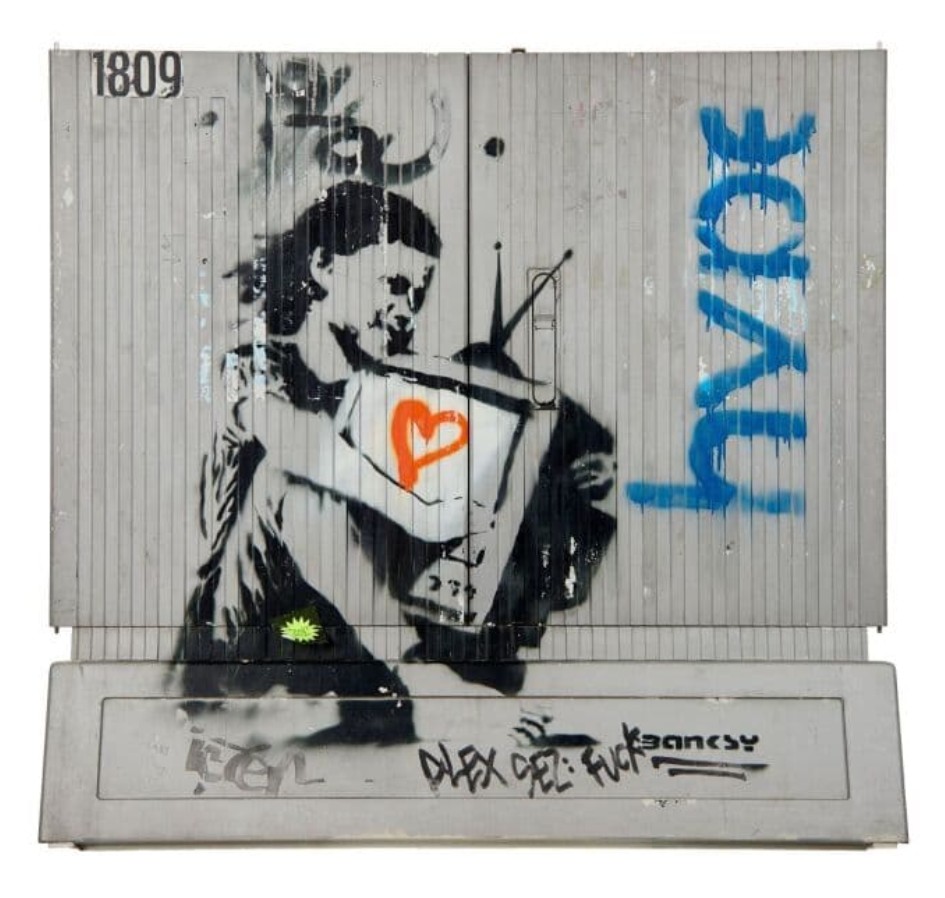
TV Girl, circa 2003/2004
Original Berlin Germany Street Art Mural Painting
Aerosol on resin door panel
110×117 cm (46 x 43.5 inches)
A three-color aerosol stencil and freehand work depicting a young girl embracing a television set, on the screen of which appears an orange heart.
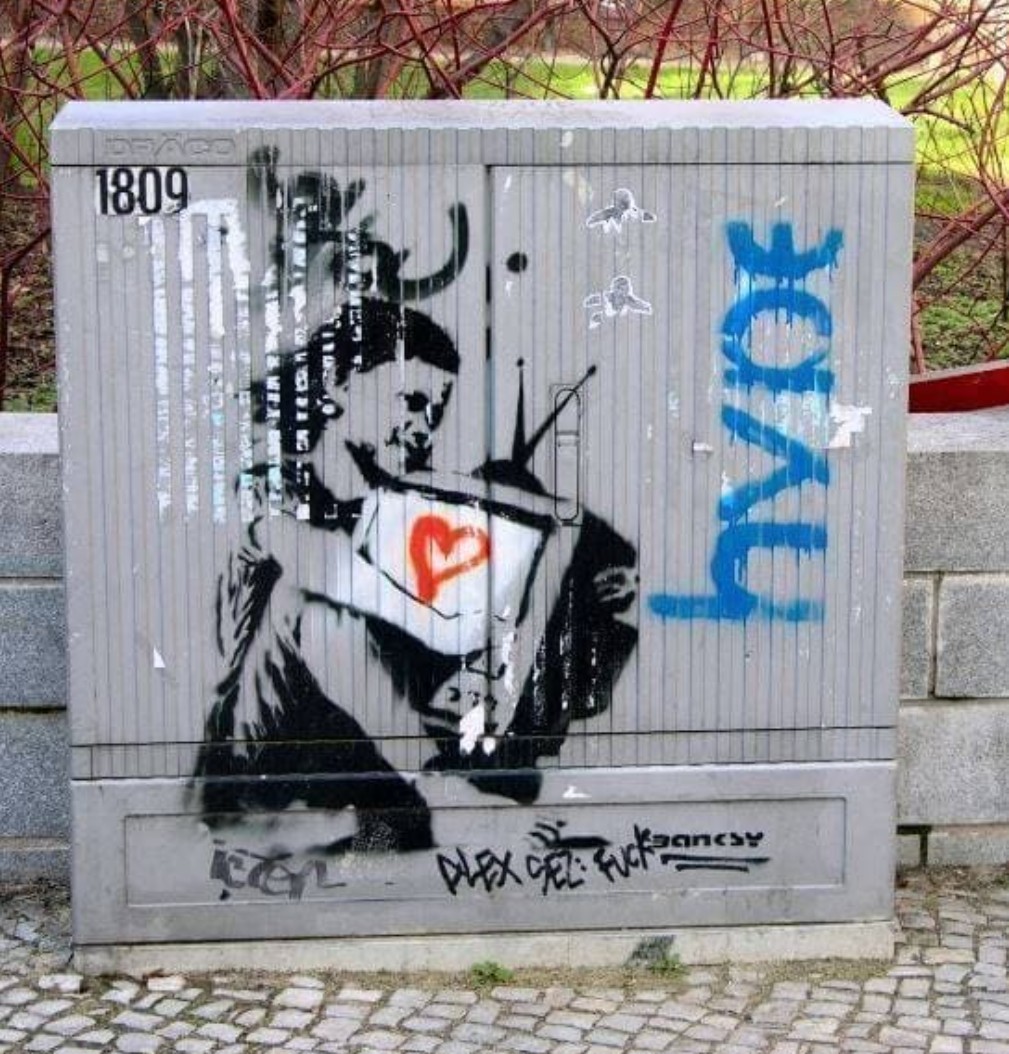
Executed by Banksy during his German tour of 2003/2004 (prior to the formation of Pest Control) on the door panels of a “Draco” transformer box originally located at a park on the corner of Gipsstrasse and Joachimstrasse in Berlin-Mitte. Signed by Banksy to lower right. With works by additional street artists, including a sticker reading “Kunst für Alle” (Art for All), a stenciled tag reading “Hype,” and an obscene remark directed specifically at Banksy.
Accompanied by a copy of a letter of provenance from the work crew that removed the panels for the city.
Mayfair Paparazzi Rat, circa 2006
Julien’s Auctions: 27 February 2025
Estimated: USD 50,000 – 70,000
USD 192,000
Banksy | Paparazzi Rat on Mayfair Door Original London England Street Art Stencil
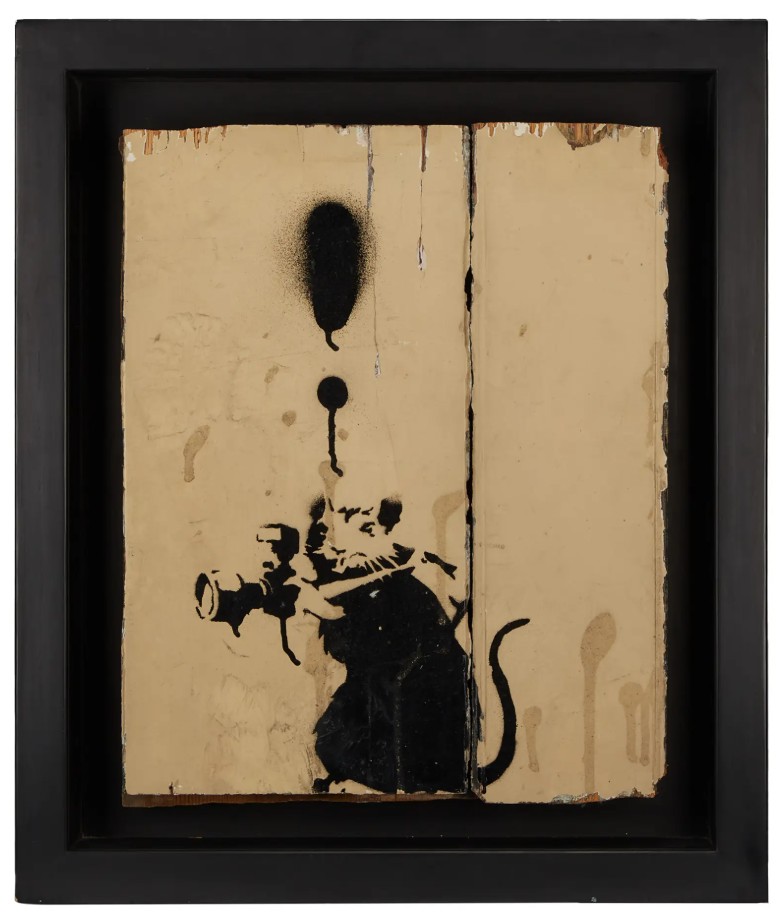
BANKSY (British, 1974)
Mayfair Paparazzi Rat, circa 2006
Aerosol on wooden door panel
Door Panel: 20-1/2 x 16-1/2 inches
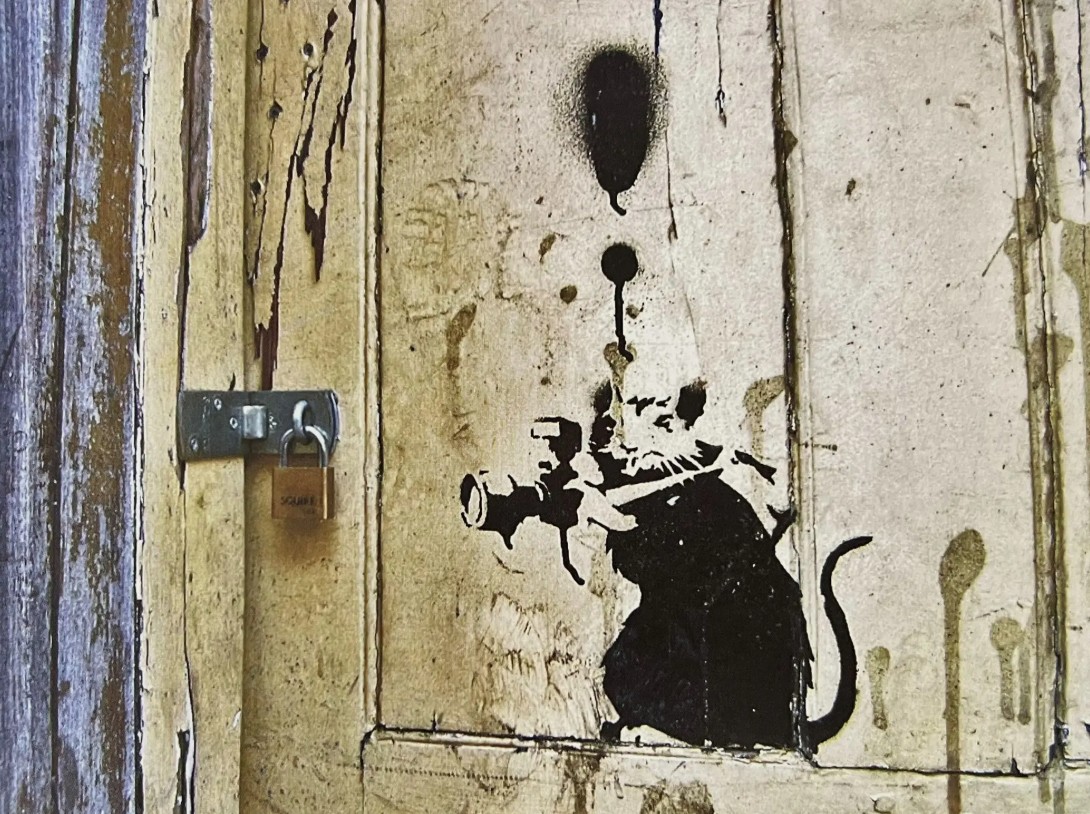
An original Banksy aerosol painting executed on a wooden door panel on Trebeck Street in the Mayfair District of London, England, circa 2006. The door is believed to have originally been part of a restaurant known as Tiddy Dols Eating House (reportedly named after an 18th-century gingerbread seller) and is now the home of an exclusive private members club called Loulou’s. As though Banksy had predicted the future, Loulou’s has earned a reputation for attracting numerous paparazzi targets, including notable figures like Taylor Swift, Tom Cruise, and Kate Middleton. The artwork was documented in the book “Banksy: Locations & Tours (Vol 2)” by Martin Bull (PM Press, 2011), and a copy of the book is included.
2024 Auction Results
Untitled (Police Van Chimp), 2003
Julien’s Auctions: 22 February 2024
Estimated: USD 100,000 – 200,000
USD 224,000
Banksy | Police Van Chimp London Turf War Exhibition Stencil Painting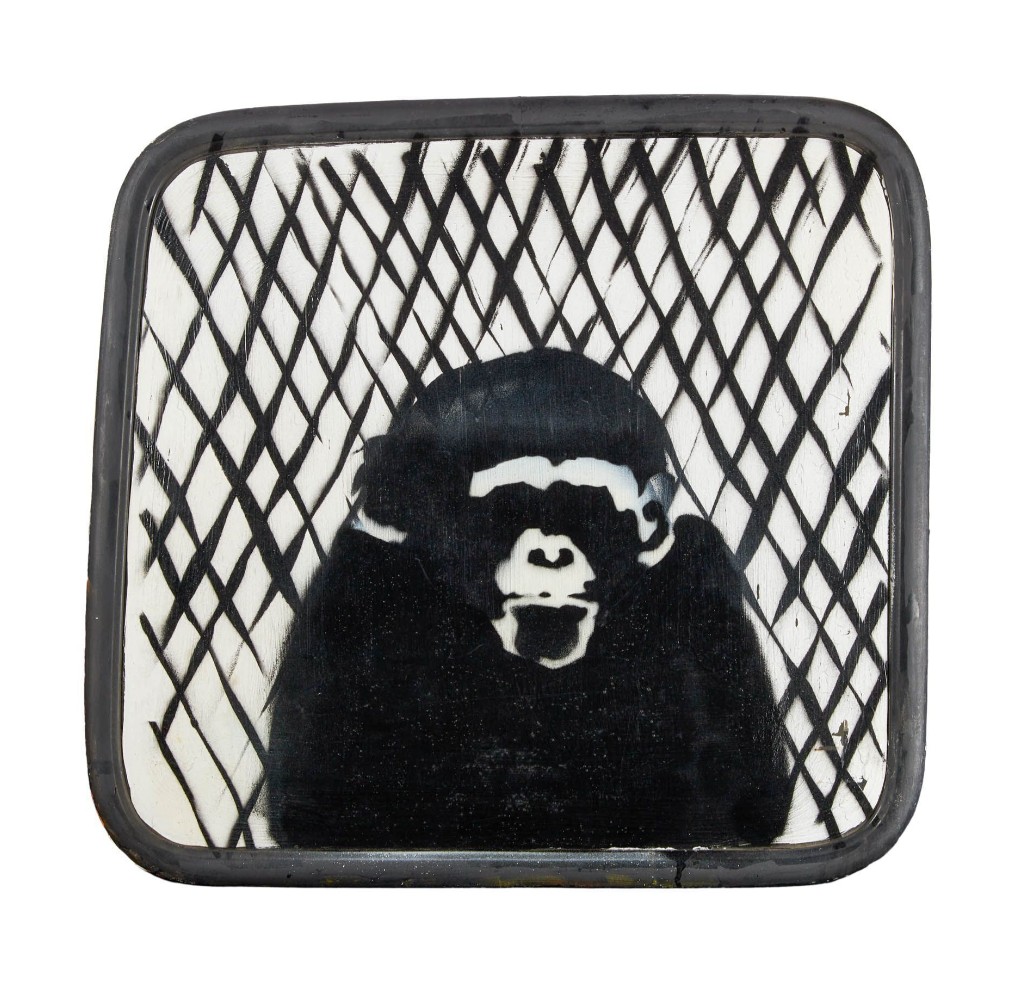
BANKSY (British, 1974)
Untitled (Police Van Chimp), 2003
Aerosol on glass van window
Dimensions: 61×61 cm (24×24 inches)
An original aerosol painting on glass, executed by Banksy as part of his “Turf War” exhibition, which was staged in an abandoned London warehouse in the summer of 2003. Banksy’s “Turf War” exhibition widely considered his breakthrough, combined animal, political, and pop culture imagery: with live cows sporting Andy Warhol’s face; tethered sheep painted as if wearing concentration camp garments; and a crashed “police” van graffitied with subversive imagery.
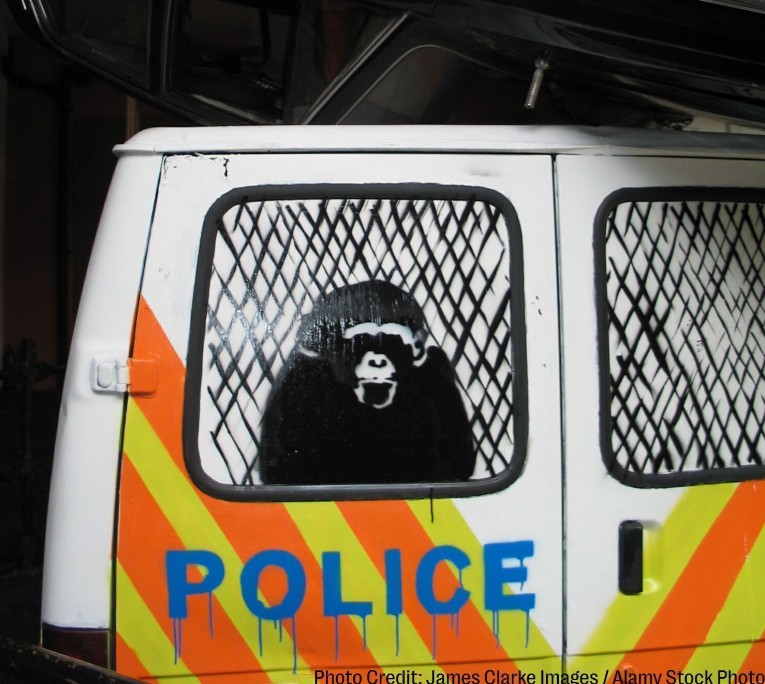
One side of the van featured the words “Turf War” next to a painting of a gas-masked pig lighting a bomb, an anarchy symbol, and flowers. The phrase “Anarchy in the West Country” was sprayed across the other side of the vehicle. The rear of the van featured yellow and orange stripes on the doors, and the image of a chimpanzee staring out at the world from the rear window.
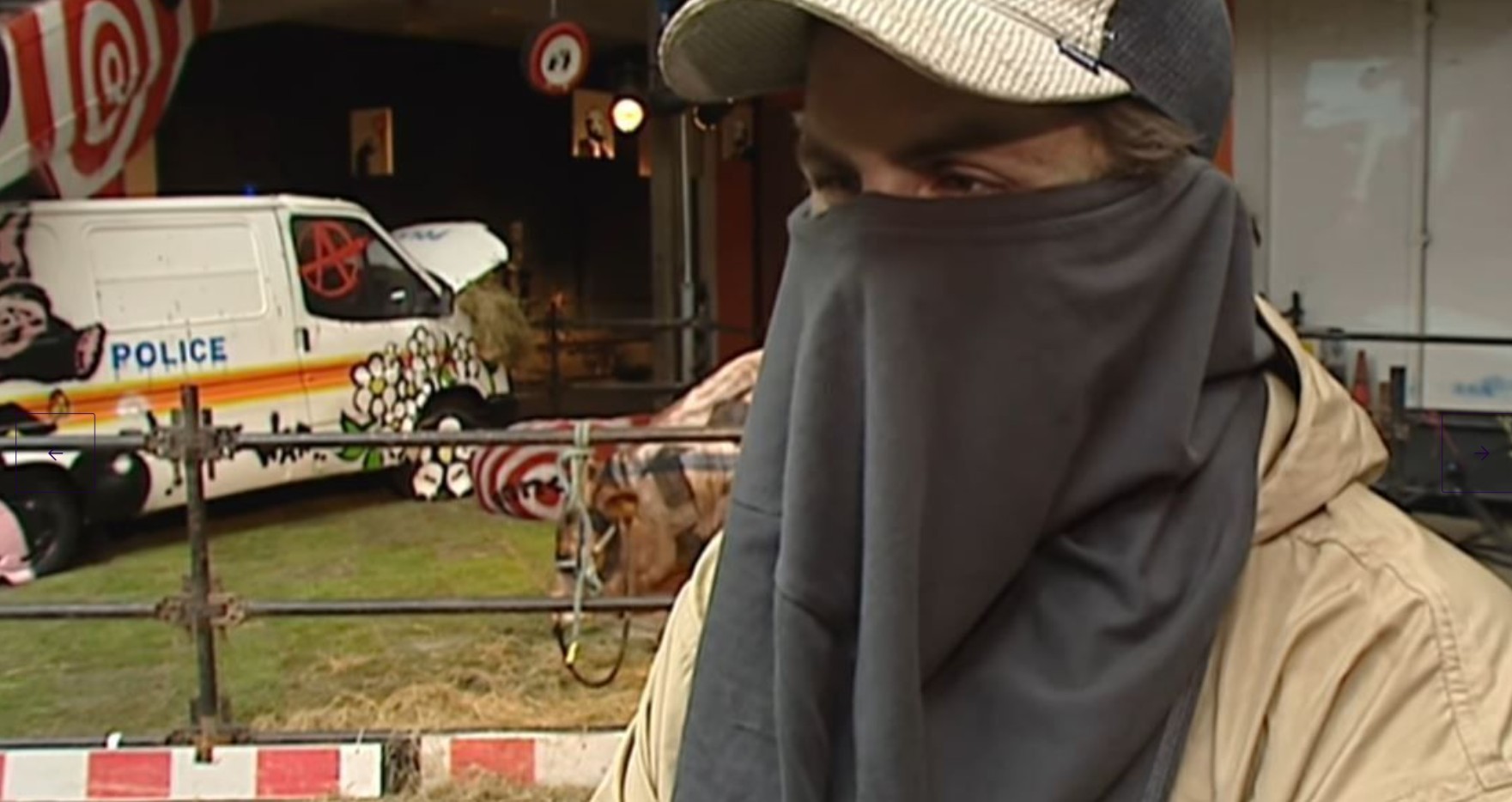
This chimpanzee image stems from Bansky’s artwork “Laugh Now,” originally commissioned by the Ocean Rooms Nightclub in Brighton in 2002. That work was a spray-painted mural featuring ten chimpanzees in a row wearing sandwich boards: some boards blank, some bearing the ominous message “Laugh now, but one day we’ll be in charge.” Following the “Turf War” exhibition, the underground performance group known as the “Prada Meinhof Gang” took possession of the van, intending to destroy it during a future live performance. The van was transported from the warehouse site by friend and fellow artist Mangrey, who ran a now-defunct pallet yard in the Clarnico Sweet Factory. Here, Mangrey removed the back window of the van as a memento and would retain it in his flat for the past 20 years. The van eventually returned to south London before disappearing completely.
This window is a rare original artifact from this groundbreaking exhibition, and a unique example of an original Banksy “Laugh Now” artwork, many originals of which have fetched high prices at auction. An acrylic and aerosol example on canvas sold for $2,280,000 USD in 2021, and a spray-paint and emulsion on paperboard example sold for $2,070,000 USD. Examples of the limited-edition prints of the chimp with sandwich board have sold for upwards of $90,000 USD. The significance of “Turf War” extends beyond marking Banksy’s emergence on the art scene: according to expert Richard Jones, it might also constitute the only on-camera appearance of the elusive artist. A man claiming to be Banksy was interviewed on video at the warehouse by ITV London’s Hague Gordon, with the van bearing the “Laugh Now – Police Van Chimp” clearly visible behind him.
XXXXXXXXXX
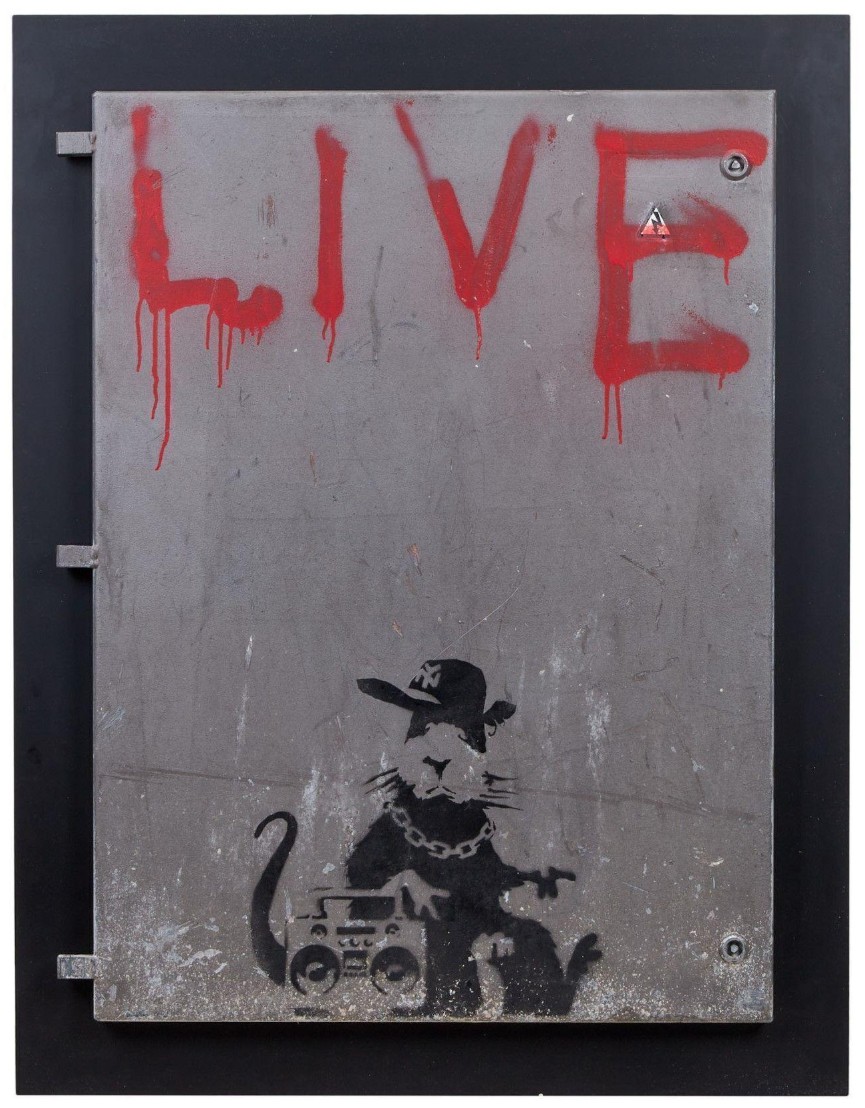
Gangsta Rat – Live, circa 2004
Julien’s Auctions: 22 February 2024
Estimated: USD 80,000 – 100,000
USD 190,500
Banksy | “Gangsta Rat – Live” Liverpool Stencil Painting, with Book
BANKSY (British, 1974)
“Gangsta Rat – Live”, circa 2004
Aerosol on metal door mounted in an acrylic shadowbox frame
Dimensions: 86×66 cm (34×26 inches)
An original Banksy aerosol painting, featuring a rat with a boombox below the word “Live,” reportedly executed on a British Telecom street box in Liverpool, England, during the 2004 Liverpool Biennial contemporary art festival.
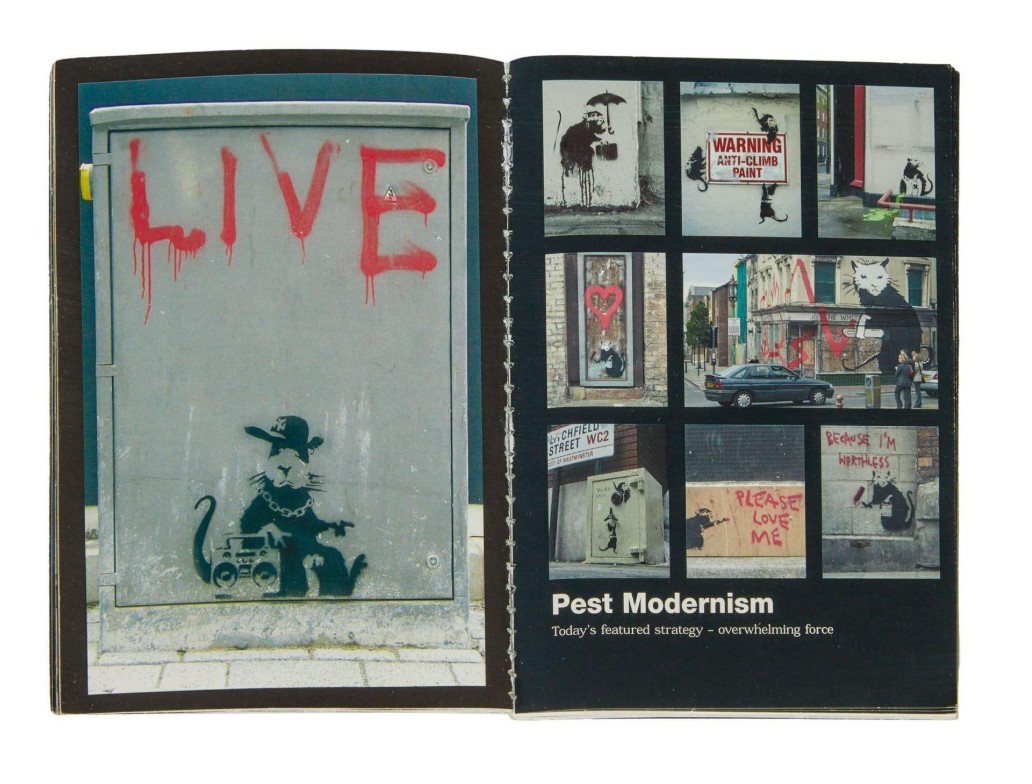
The artwork was documented in the Banky’s own publication, “Cut It Out” (Paranoid Pictures, 2004).
XXXXXXXXXX
Crazy Horse, 2013
Julien’s Auctions: 22 February 2024
Estimated: USD 100,000 – 200,000
USD 160,000
Banksy | Crazy Horse New York City Stencil Painting
BANKSY (British, 1974)
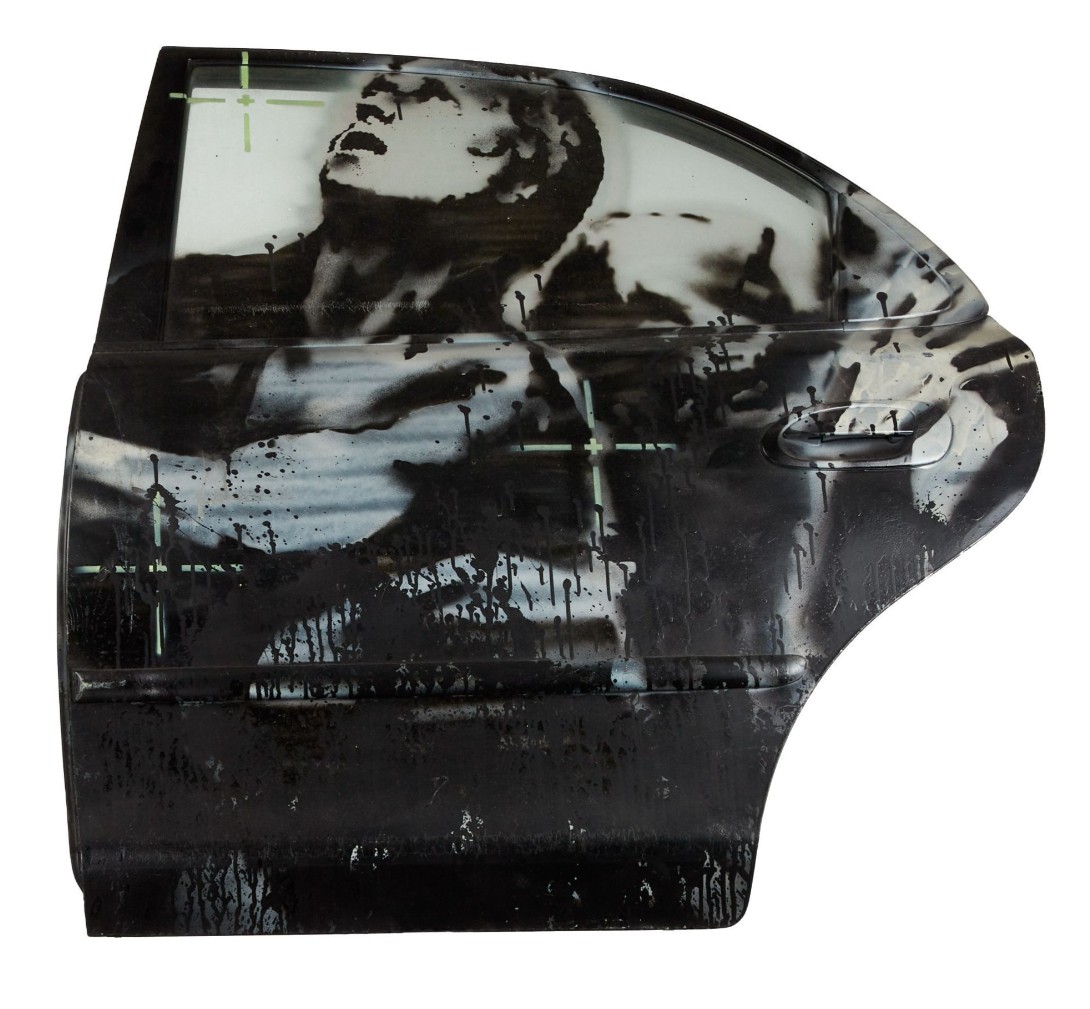
Crazy Horse, 2013
Aerosol on car door
Dimensions: 71 x 40.5 x 30 inches
An original Banksy aerosol painting executed on a car door, from the art installation “Crazy Horse.”
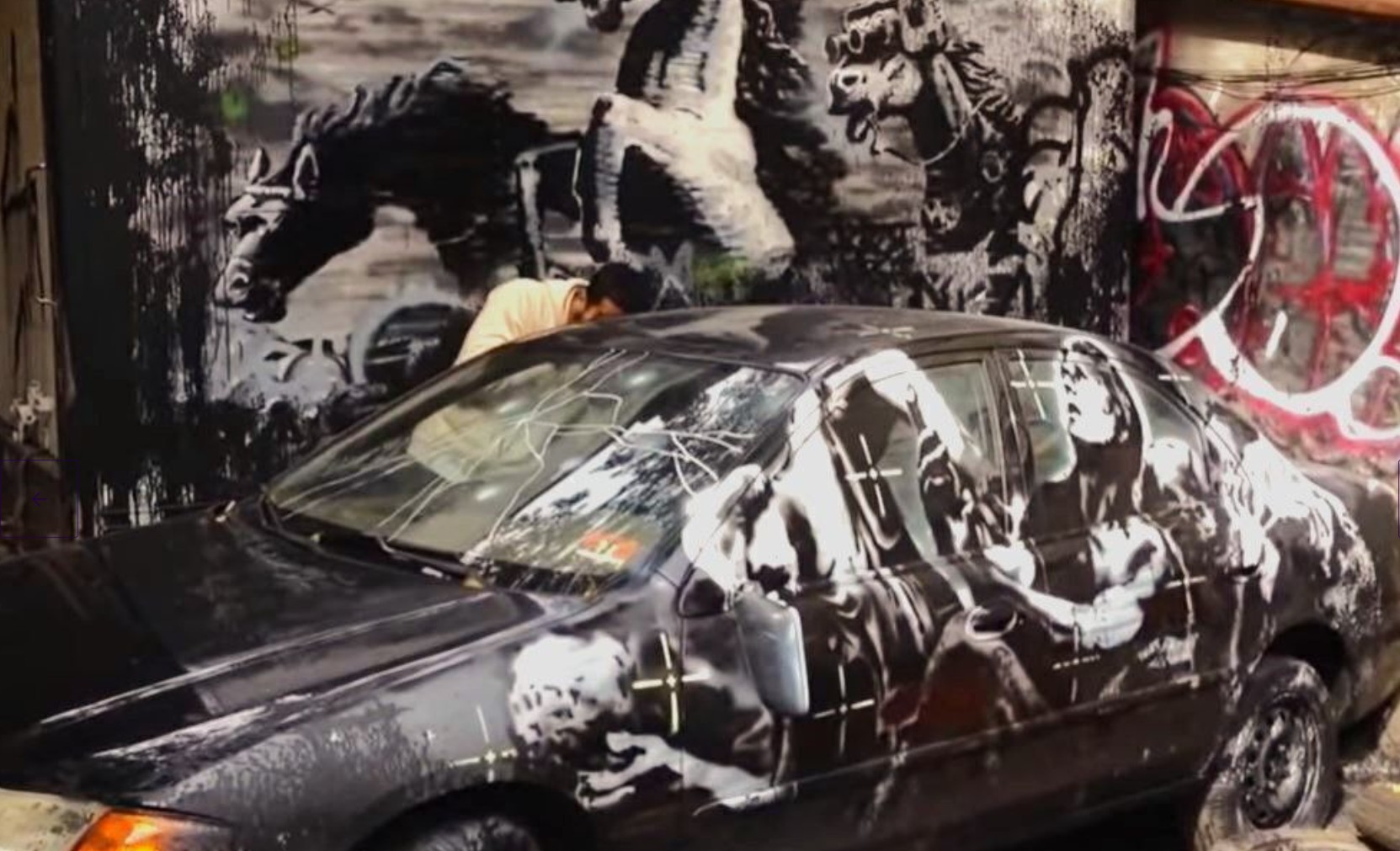
The installation, constructed near the corner of Ludlow & Stanton in New York City’s Lower East Side, consisted of two vehicles painted with a depiction of stampeding horses bearing down on a huddled group of terrified people, and included a phone number through which audio clips could be heard from a 2007 Apache airstrike in Baghdad in which two Reuters correspondents were reportedly killed. The Apache helicopter bore the call-sign “Crazy Horse 18” and inspired the title for this artwork. Audio and video transmissions from the airstrike , which had been released by Wikileaks in 2010 under the title “Collateral Murder,” were shocking due to the apparent indifference of the soldiers in regard to the loss of life, with one soldier saying, “Oh well. Well it’s their fault for bringing their kids to a battle.”
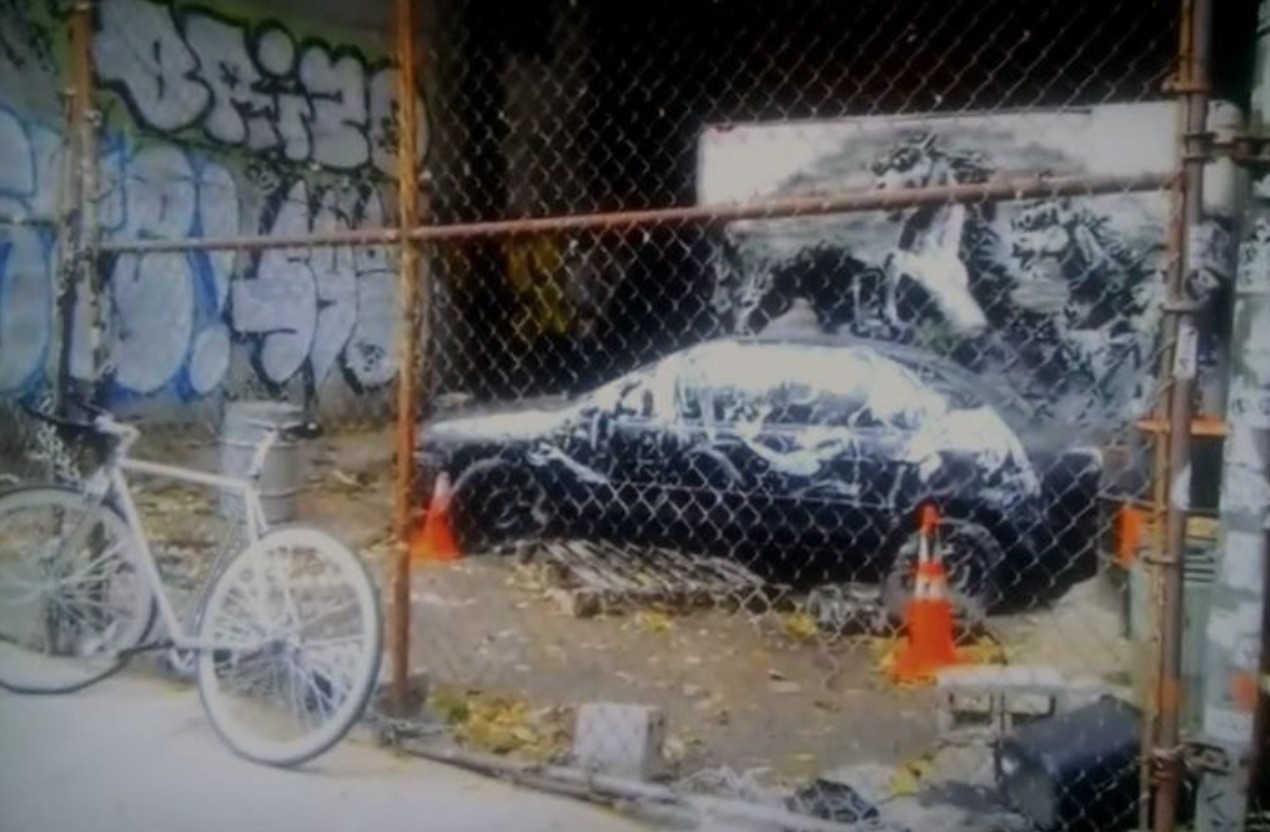
The work was installed on October 9, 2013 as part of Banksy’s highly-publicized New York City residency, “Better Out Than In,” a reference to a quote attributed to 19th century impressionist painter, Paul Cezanne, “…all pictures inside, in the studio, will never be as good as those painted outside.”
Accompanied by a custom-built display stand with an original paint-splattered traffic cone from the installation. Banksy’s Instagram post of this artwork from his personal account can be seen via link upon request.
2022 Auction Results
Bomb Middle England, circa 2003
Julien’s Auctions: 16 March 2022
Estimated: USD 200,000 – 300,000
USD 500,000 (Hammer)
USD 625,000
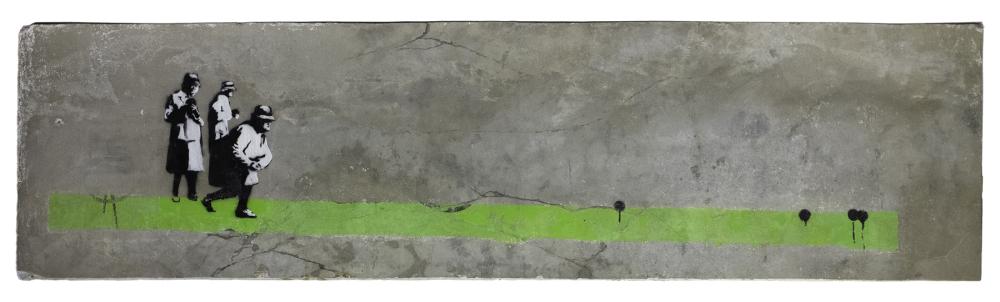
BANKSY: ORIGINAL BOMB MIDDLE ENGLAND MURAL PAINTING
BANKSY (BRITISH, 1974)
Bomb Middle England, circa 2003
Aerosol and acrylic on concrete
Dimensions: 230x60x10 cm (90x24x4 inches)
An early and unique aerosol mural featuring a group of elderly ladies playing the genteel English game of bowling, using bombs on a bowling green, cleverly titled “Bomb Middle England.” The mural was executed by Banksy on the wall of the Parisian creative agency and boutique Surface to Air (S2A) at the time of his art exhibition there, Banksy: Graffiti Lies and Deviousness which debuted on January 25, 2003.
The artwork was later partially covered in whitewash and further obscured by an electrical conduit but was still visible in the music video of “We Are Your Friends” by the French group Justice. The video was filmed at S2A and subsequently won the MTV Euro Music Best Video award in 2006. Banksy’s mural was eventually identified and extricated from the wall for preservation, at which time the whitewash was professionally removed to reveal the original work in its entirety. Alternate versions of the artwork were featured in Banksy’s books Banging Your Head Against a Brick Wall (2001) and Wall and Piece (2005) and the stencil was also produced by Banksy as a limited edition screenprint. In 2013 another example on canvas was auctioned at Phillips for over $350,000.
Mali Girl (Timbuktu, 2009)
Hessink’s: 26 November 2022
Estimated: EUR 325,000 – 375,000
EUR 320,000 (Hammer)
EUR 400,000 / USD 521,520
Lot 16 – BANKSY (British Street Artist, born 1974)
BANKSY (British Street Artist, b. 1974)
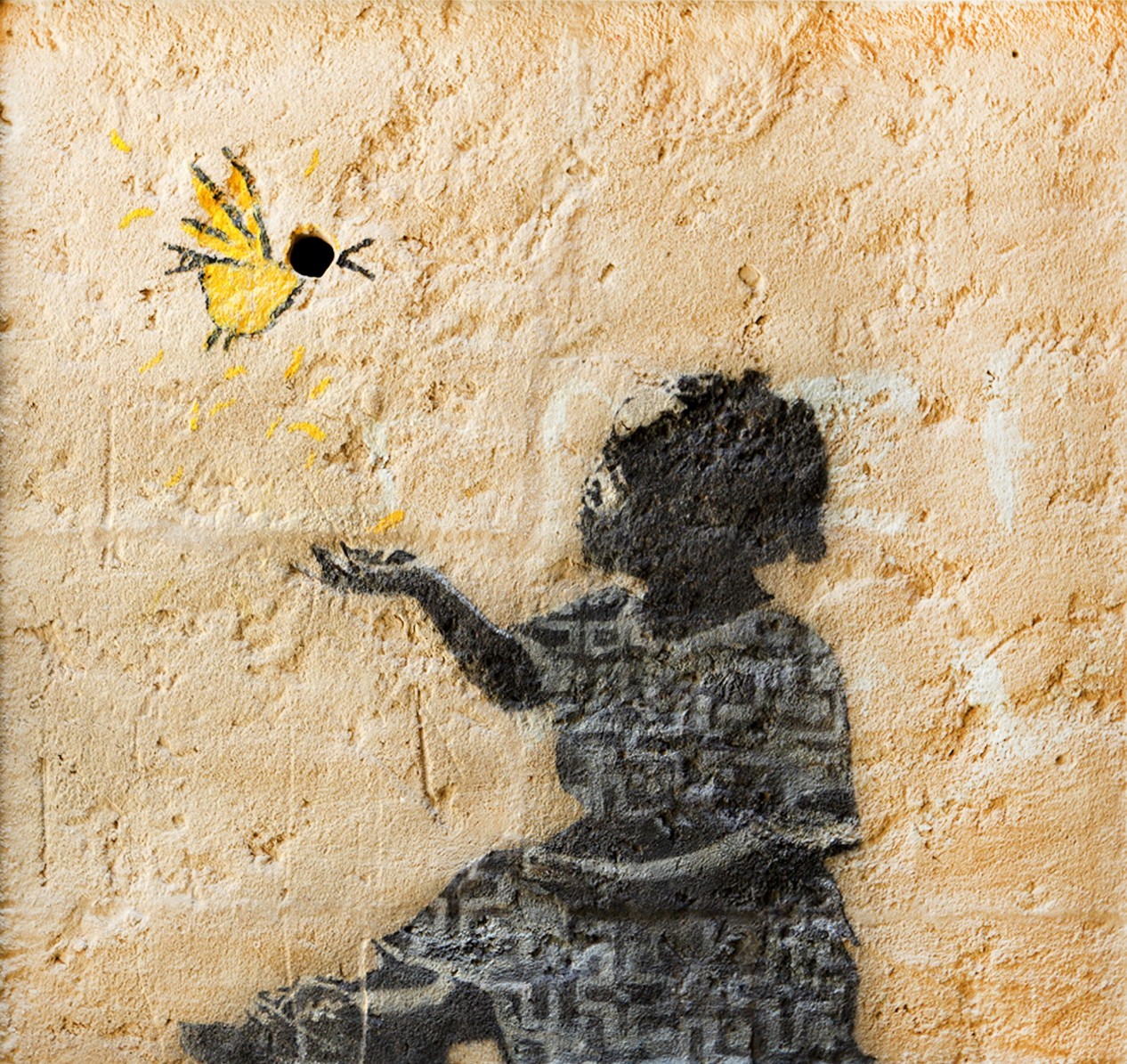
Mali Girl (Timbuktu, 2009)
Stencil, freehand, spray-paint and acrylic on a concrete block wall
Dimensions: 117×123 cm (46×48 inches)
This three-color piece depicts a young girl in a classically patterned knee length dress, sitting on the ground with her legs outstretched. Her left hand is in her lap and her right is raised in the air with the palm of her hand upturned, into which the feathers from a pineapple colored, cartoon style bird are falling. A small circular hole in the wall has been used to represent the bird’s head, whilst its beak, legs, wings and body are delineated by a series of simple, black acrylic lines.
In January 2009, Banksy set off on another impromptu and covert trip, on this occasion to the somewhat mythical destination of Timbuktu. Arriving prior to the country descending into Civil War, he produced six carefully observed works which were regrettably later destroyed, with the exception of ‘Mali Girl’, which was prudently saved by the current owner. The pieces were then recreated in June of the same year, at his critically acclaimed exhibition ‘Banksy versus Bristol Museum’, where he featured sketches and studies from his Timbuktu project, which he showed alongside a vast portfolio of his other stencils, sculptures, paintings, mixed media works and photographs.
Unlike many other works in his street oeuvre, ‘Mali Girl’ is unique not just as a Timbuktu survivor, but is also rare for its simple innocence, possessing little of the artist’s trademark satire and irreverence seen elsewhere in his work, including in Mali, where amongst the works lost, was a piece depicting Peaches Geldof begging. It is an extremely important for these reasons, capturing a unique moment in Banksy’s stellar career and in his very limited time on the continent of Africa. It bears testament to the huge attritional losses seen in Banksy’s street portfolio over the last 25 years and the immense cultural value the surviving works possess.
The most well known of the six works Banksy created in the city of Timbuktu were ‘Washing Zebra Stripes’, ‘Mali Girl’ and ‘Buffalo Hunt’ and the lesser known were ‘No Clean Water Left’ (x2) and ‘Peaches Geldof Please Give Generously’. Of all the Timbuktu works only ‘Mali Girl’ survived, the rest falling foul to vandalism, inclement weather and the Civil War between the Islamic Tuareg rebels of the MNLA and Ansar Dine. It was carefully removed from its original siting by the existing owner, who oversaw its framing, cleaning and modest restoration back to its original condition. (See Hessink’s Catalogue Raisonné of Banksy’s Street Art Work No. 794)