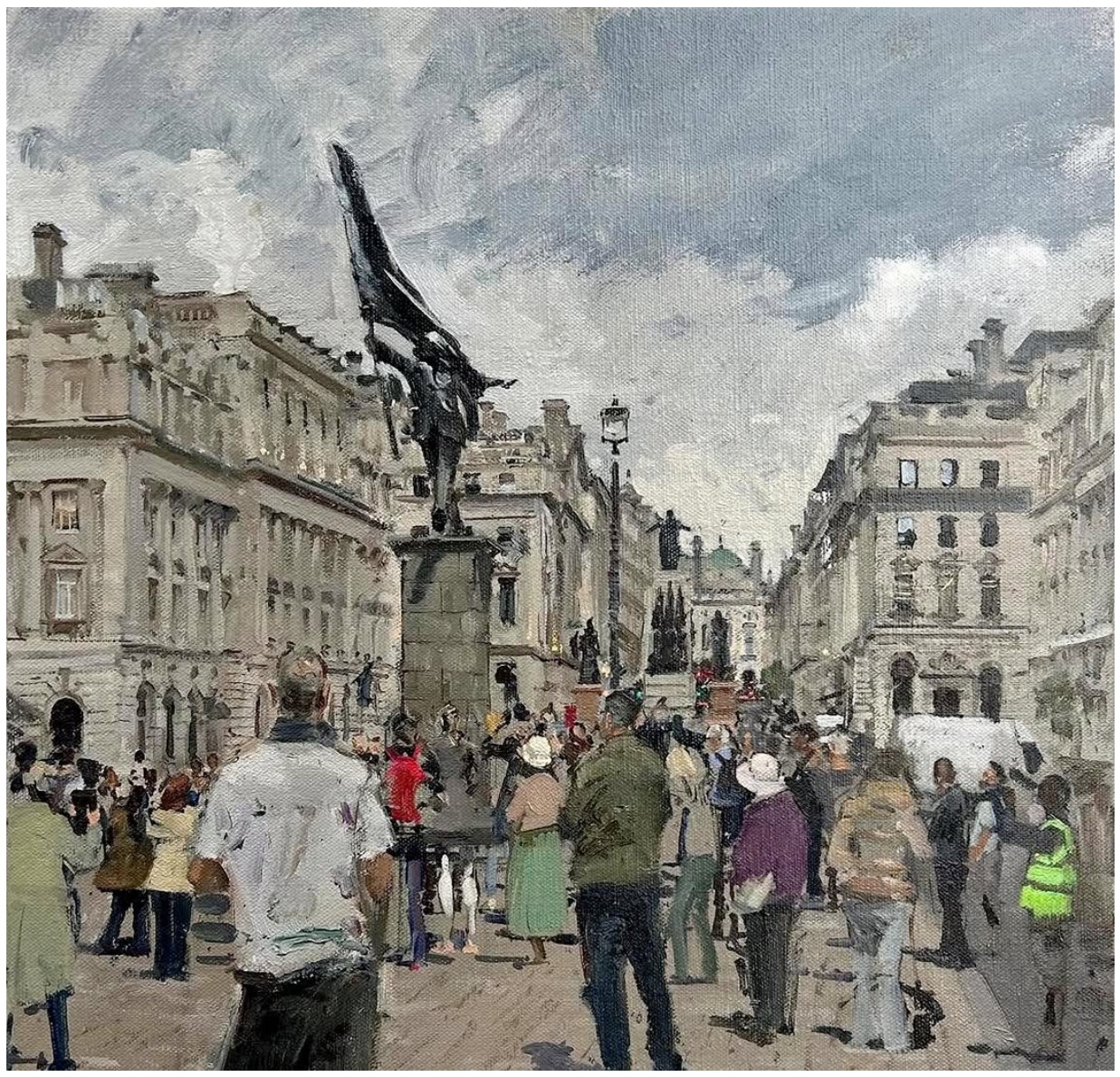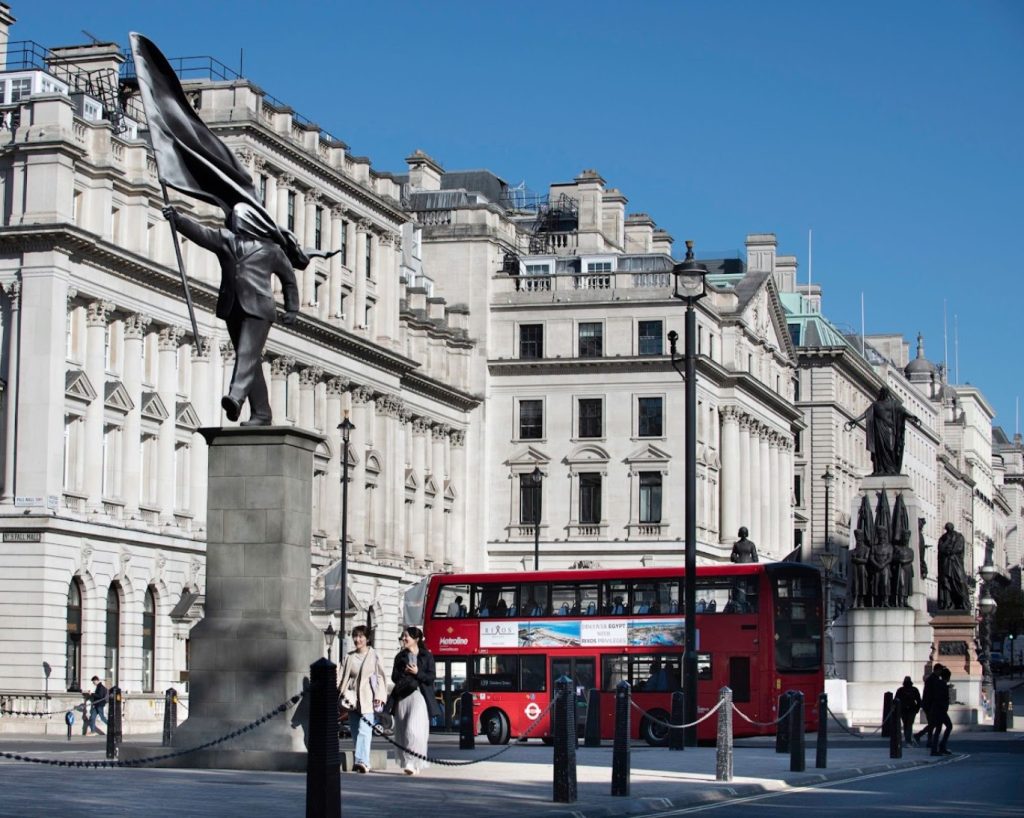
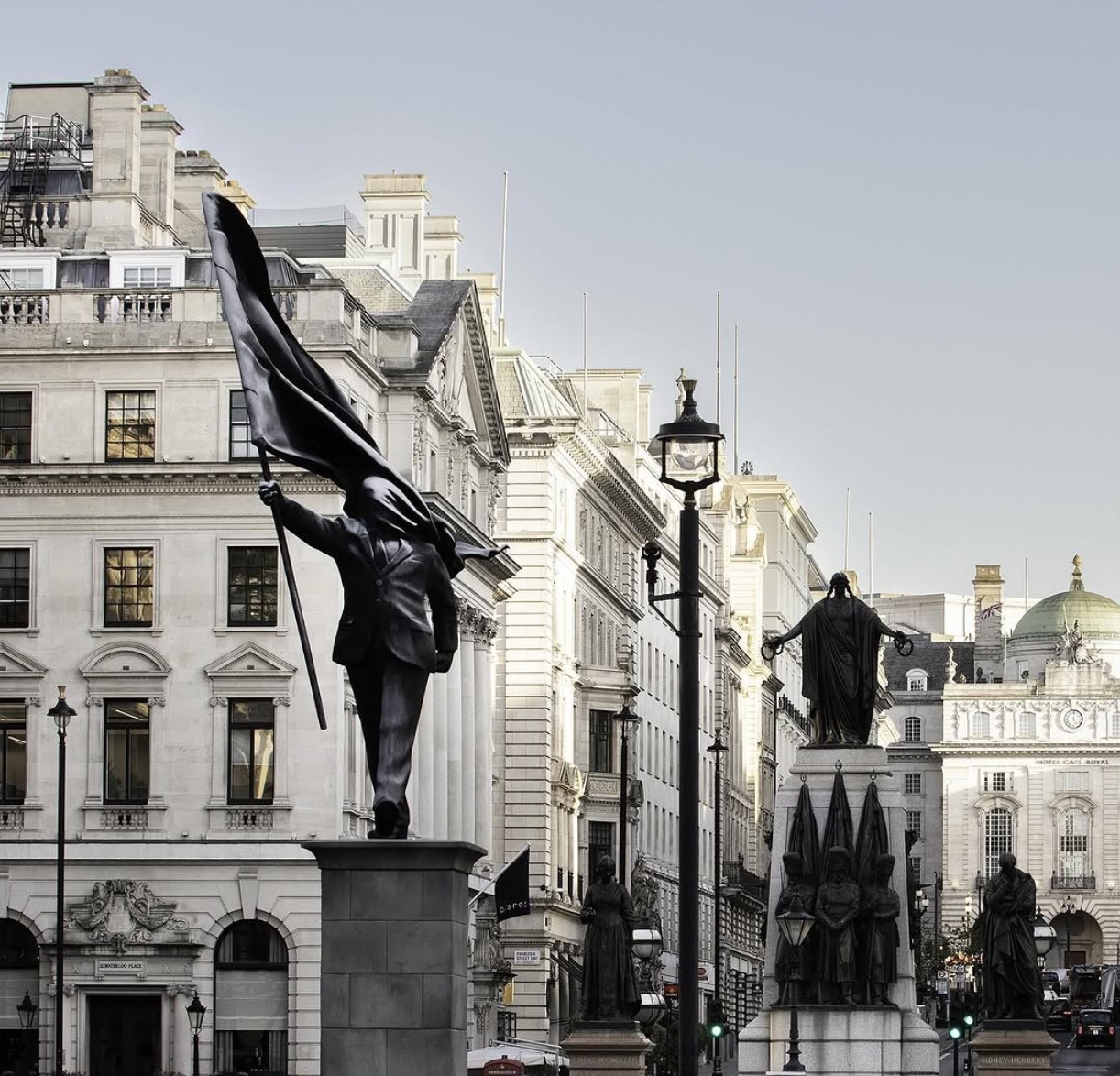
On 30 April 2026, London woke up to what already appears to be one of the most important Banksy interventions in years: a monumental statue installed overnight at the intersection of Waterloo Place and Pall Mall in central London. The sculpture depicts a suited male figure striding forward triumphantly while carrying a large flag that completely covers his face, effectively blinding him. One day later, Banksy confirmed the work through his official Instagram account, immediately transforming speculation into international news.
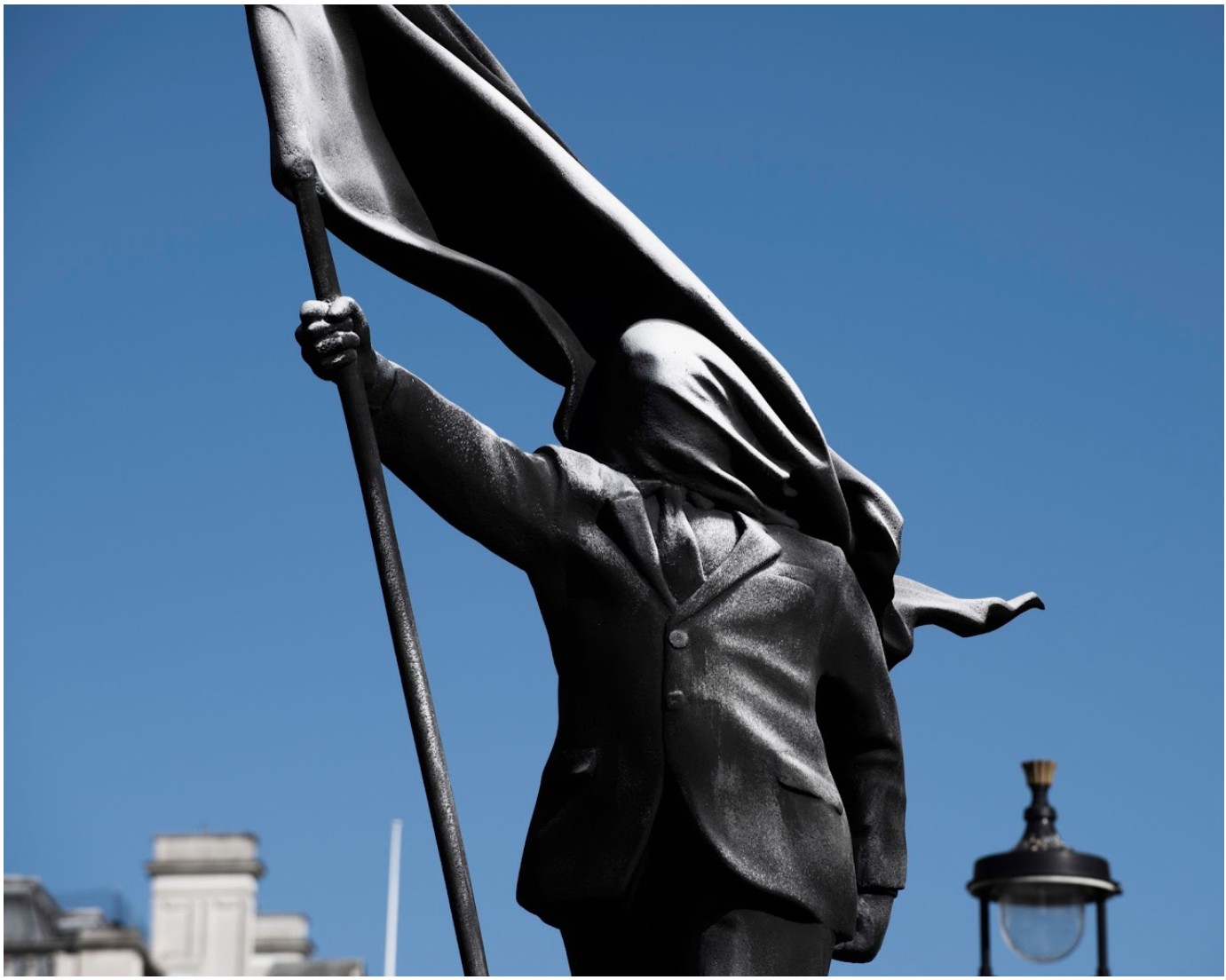
Credit Photo: banksy.blog
The intervention is remarkable not only for its political sharpness, but also because it signals a significant evolution in Banksy’s artistic language. This is no longer simply graffiti or stencil art. It is urban sculpture, institutional infiltration, and political theatre simultaneously. Banksy has moved from painting on the city to physically inserting himself into the symbolic architecture of power itself.
A Monument Against Monuments
This New London Statue is visually brilliant in its simplicity. The sculpture resembles the heroic public monuments that populate central London: military generals, imperial statesmen, victorious admirals and embodiments of British authority. The proportions, dark patina, elevated plinth and dramatic posture all mimic the language of nineteenth-century monumental sculpture. But Banksy immediately sabotages that tradition. The figure walks proudly forward while being entirely blinded by the very flag he carries. Patriotism becomes blindness. National identity transforms into obstruction. The symbol that should guide the figure instead prevents him from seeing where he is going.
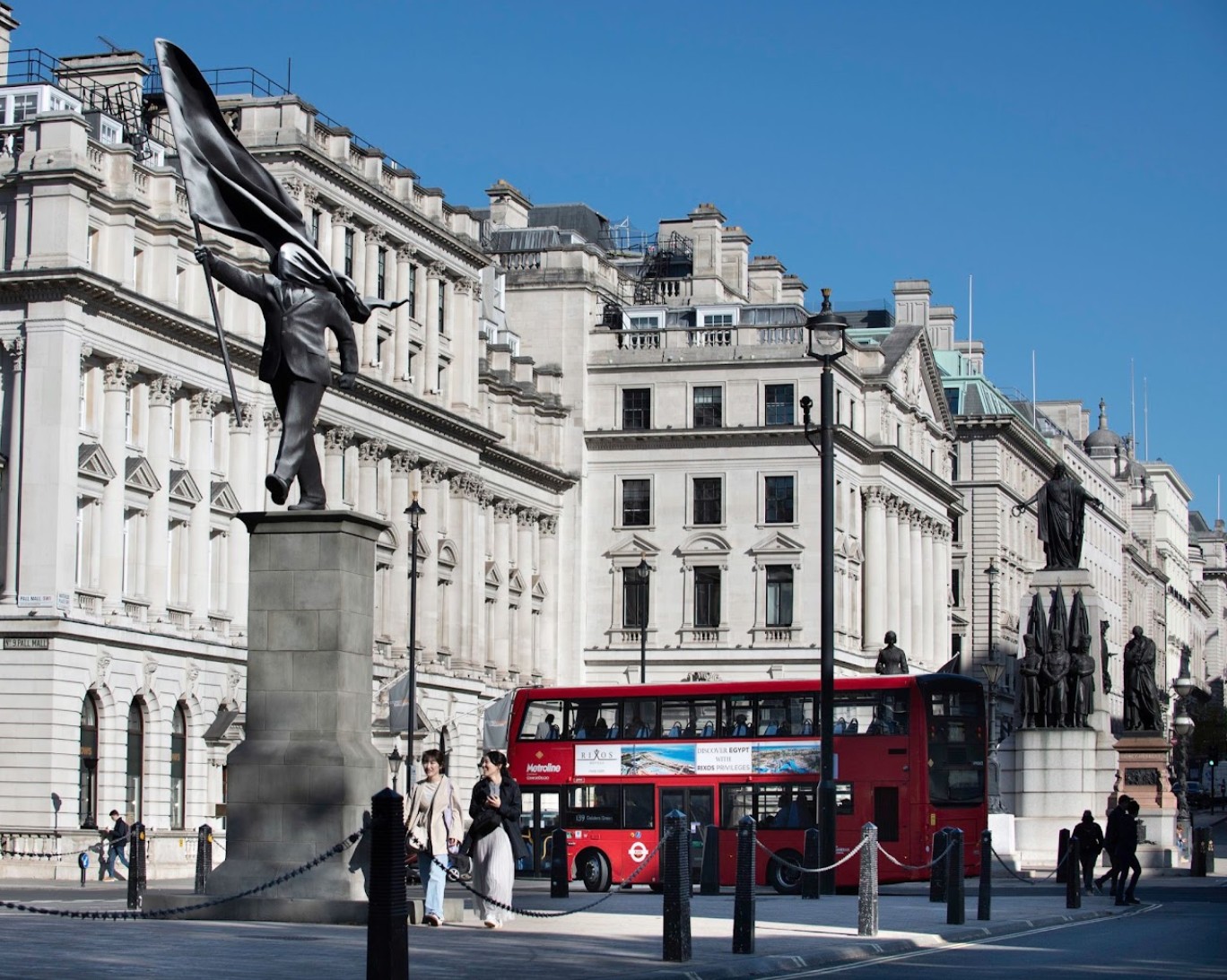
Credit Photo: banksy.blog
The metaphor is devastatingly effective because of its restraint. There is no slogan, no caption, no overt caricature. Banksy allows the absurdity of the image itself to communicate the message. The work can easily be interpreted as a criticism of rising nationalism across the world, whether in Britain, the United States, Russia, or elsewhere. Yet the sculpture avoids simplistic political messaging. It speaks more broadly about ideological blindness itself: the danger of collective identities becoming so absolute that they prevent societies from seeing reality clearly.
There is also something deeply comic about the sculpture, in the tradition of silent cinema or political satire. The figure appears frozen one second before catastrophe, like a self-important character marching proudly into disaster. Banksy has always mastered this balance between humor and menace. The viewer laughs first, then slowly realizes the darker implications beneath the joke.
The Importance of the Location
The location elevates the work from strong intervention to genuine masterpiece of political street art. Waterloo Place and Pall Mall sit at the very centre of British political and imperial symbolism. A few hundred meters away stand Buckingham Palace, Downing Street, Trafalgar Square, St James’s Palace and the Houses of Parliament. This district was historically the administrative and ceremonial heart of the British Empire.
The surrounding area is filled with statues celebrating military triumph, monarchy, colonial expansion and state authority. By placing his sculpture among these monuments, Banksy effectively infiltrates the official visual narrative of British power.
This is crucial because Banksy is not attacking power from outside the system anymore. He inserts his work directly into its symbolic bloodstream.
The intervention recalls earlier moments in art history where artists challenged official monuments and public memory. One thinks of the anti-monuments developed after the Second World War, where public sculpture ceased glorifying victory and instead began questioning ideology, violence and national mythology itself. Banksy’s sculpture functions similarly. It adopts the visual language of authority only to expose its fragility and absurdity.
How Did Team Banksy Do It?
Part of the fascination surrounding the piece comes from the operation itself. The St James’s district is among the most heavily monitored areas in London, surrounded by embassies, government buildings, private clubs, luxury hotels, military presence and extensive CCTV surveillance. Installing a monumental sculpture there without authorization seems almost impossible. Yet Team Banksy appears to have executed the intervention with extraordinary precision and professionalism.
According to footage later published on Banksy’s Instagram, the sculpture was installed during the early morning hours using a crane truck, construction cones, high-visibility jackets and standard construction-site equipment. The sculpture itself appears to be made of fiberglass, while the plinth base was constructed in cement. Nearby scaffolding and ongoing construction work likely helped the operation blend naturally into the urban environment.
It is an almost perfect example of what Banksy has always understood better than most artists: authority often depends on appearance and confidence. If people look official enough, wear the correct uniforms and behave with sufficient assurance, they frequently become invisible within systems of control. In many ways, the installation itself becomes part of the artwork. The performance of infiltrating central London is inseparable from the sculpture’s meaning.
A Return to Sculptural Intervention
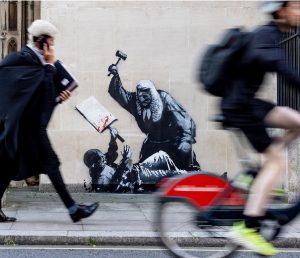
Although the work feels radically fresh, it also reconnects Banksy to an earlier chapter of his career. In 2004, Banksy installed two unauthorized sculptures in London: The Drinker, a satirical reinterpretation of Rodin’s The Thinker, and Justice Unveiled, a blindfolded Lady Justice figure positioned near the Central Criminal Court.
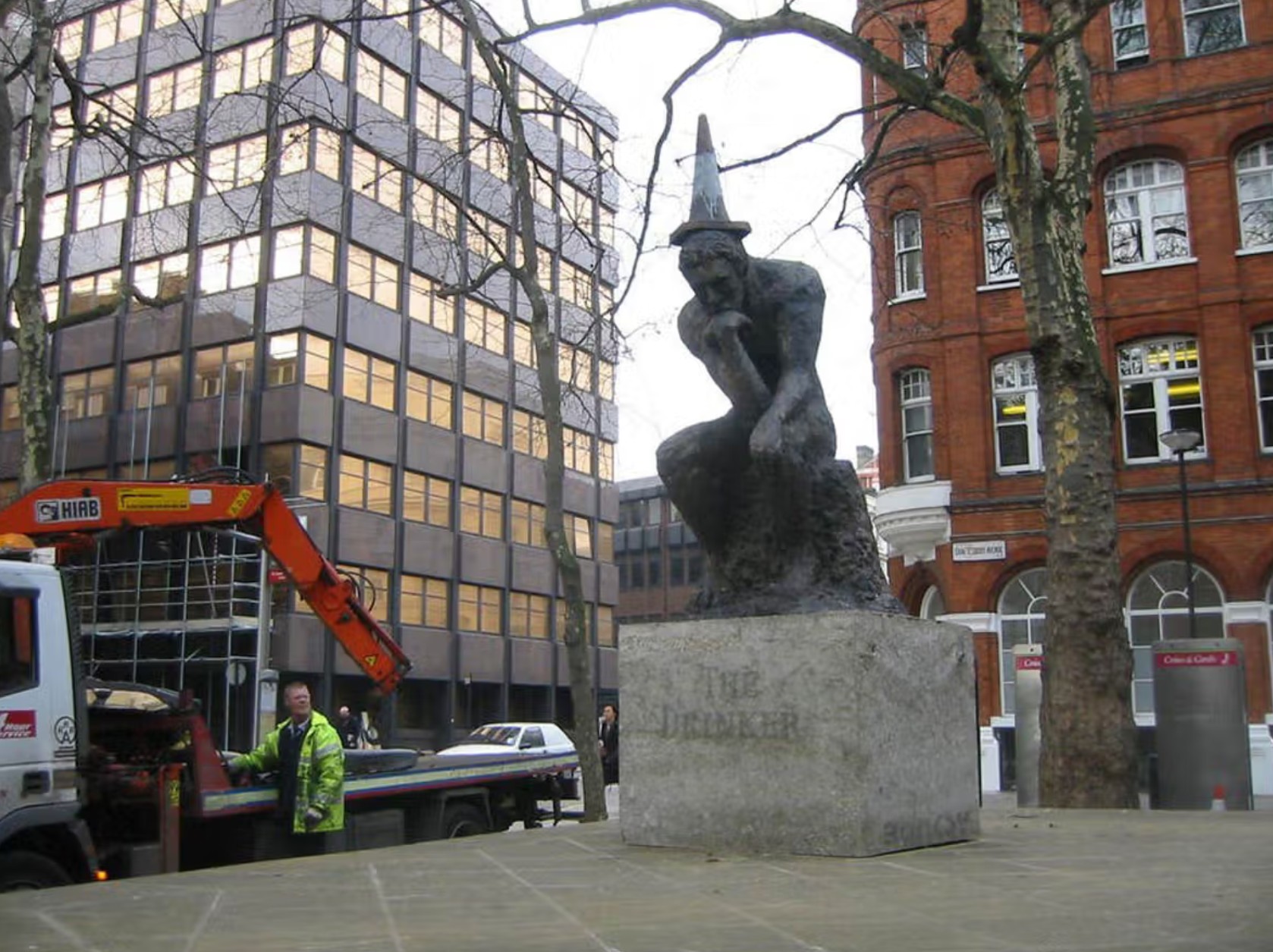
Those works already demonstrated Banksy’s fascination with institutional symbolism and public monuments. But the new Waterloo Place sculpture feels far more mature and sophisticated. Gone is the overt parody of the early 2000s. The humor is quieter, the symbolism more distilled, the execution more cinematic.
This evolution reflects a broader transformation in Banksy’s practice over the last decade. Increasingly, his interventions move beyond pure stencil imagery toward conceptual installations, environmental works and large-scale public theatre. The city itself becomes both stage and medium.
The Evolution of Banksy’s Tone
What is striking about many recent Banksy works is their growing sense of melancholy and ambiguity. Earlier works often relied on immediate visual shock: riot police with smiley faces, kissing policemen, monkeys in parliament, children with weapons or bombs transformed into flowers. The political messages were direct, provocative and instantly legible. The new statue operates differently.
Its power comes from atmosphere rather than confrontation. The work feels almost elegiac, as though Banksy is reflecting less on rebellion itself and more on the exhaustion of societies trapped inside cycles of ideology, spectacle and nationalism. The facelessness of the figure is essential here. Covered entirely by the flag, the individual loses identity and humanity. The man becomes pure symbolism, consumed by the very ideology he carries.
And perhaps that is why the sculpture feels so timely. In an era increasingly dominated by polarization, tribal identities and nationalist rhetoric, Banksy transforms the heroic public monument into an image of collective blindness. It is both absurd and terrifying. Which is precisely why the work succeeds.