I Want To Be What You Saw In Me
Marseille
May 2025
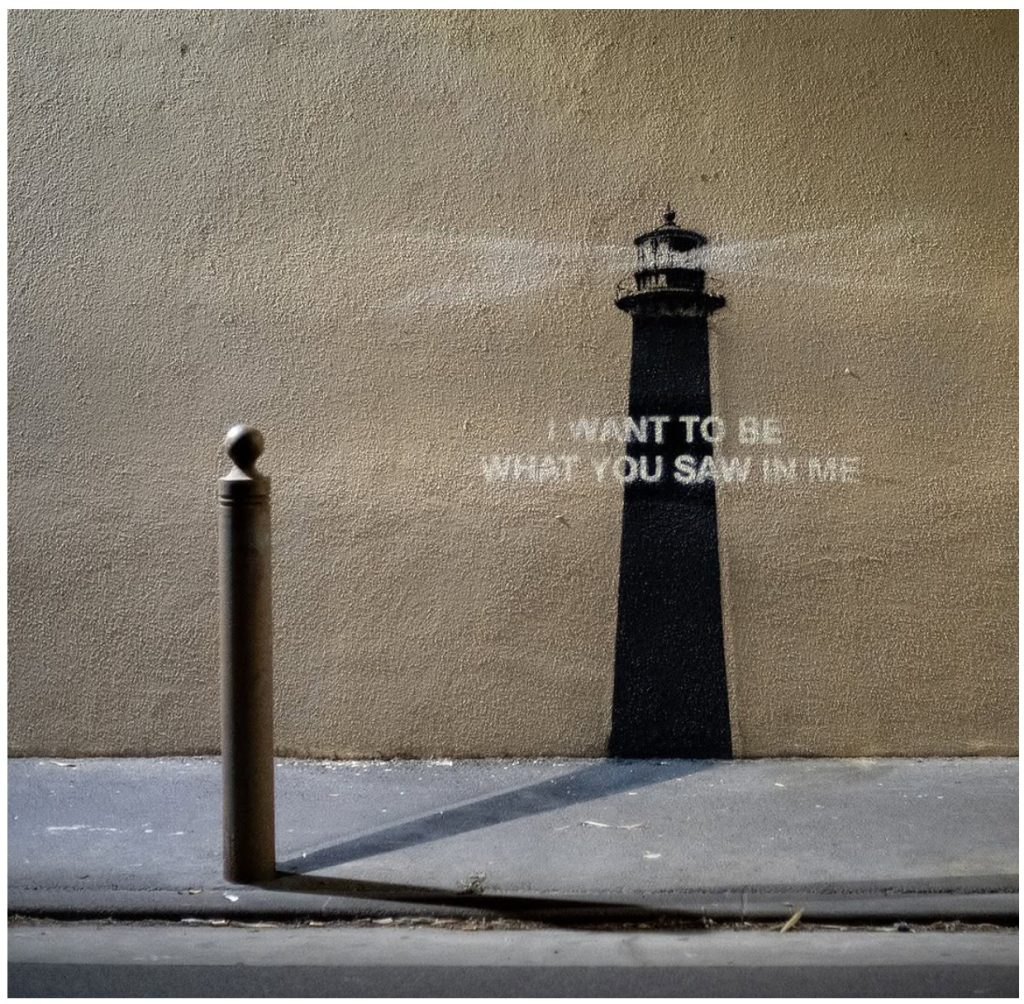
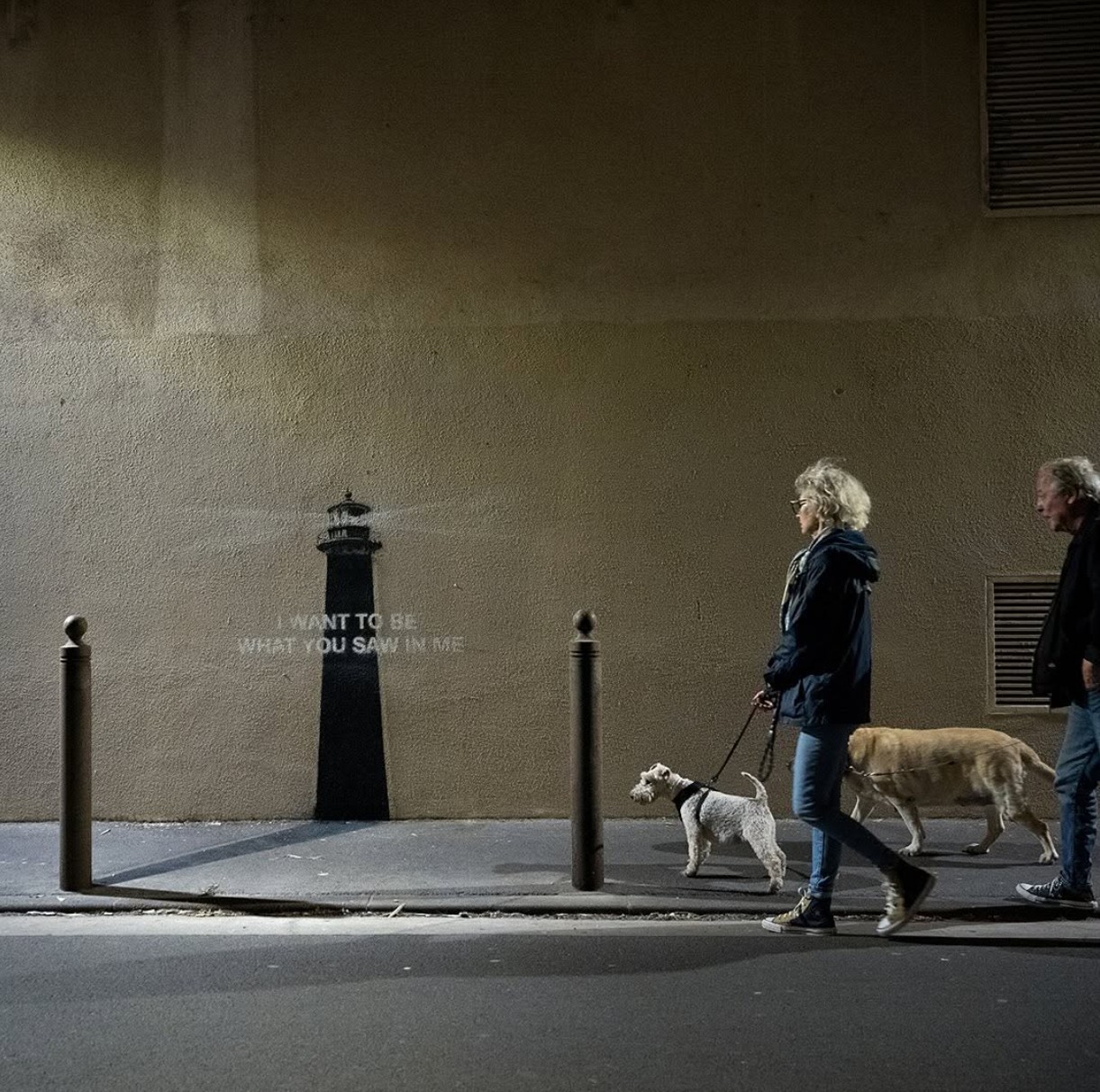
In May 2025, Banksy confirmed a new mural in Marseille, France, through his official Instagram account. The work appeared on a quiet street in the 7th arrondissement, near the old port and close to the Mediterranean, a location that immediately adds resonance to an image built around a lighthouse, a shadow, and a sentence of unusual emotional vulnerability: “I want to be what you saw in me.” The mural had reportedly circulated online for several days before Banksy officially claimed it on 29 May 2025.
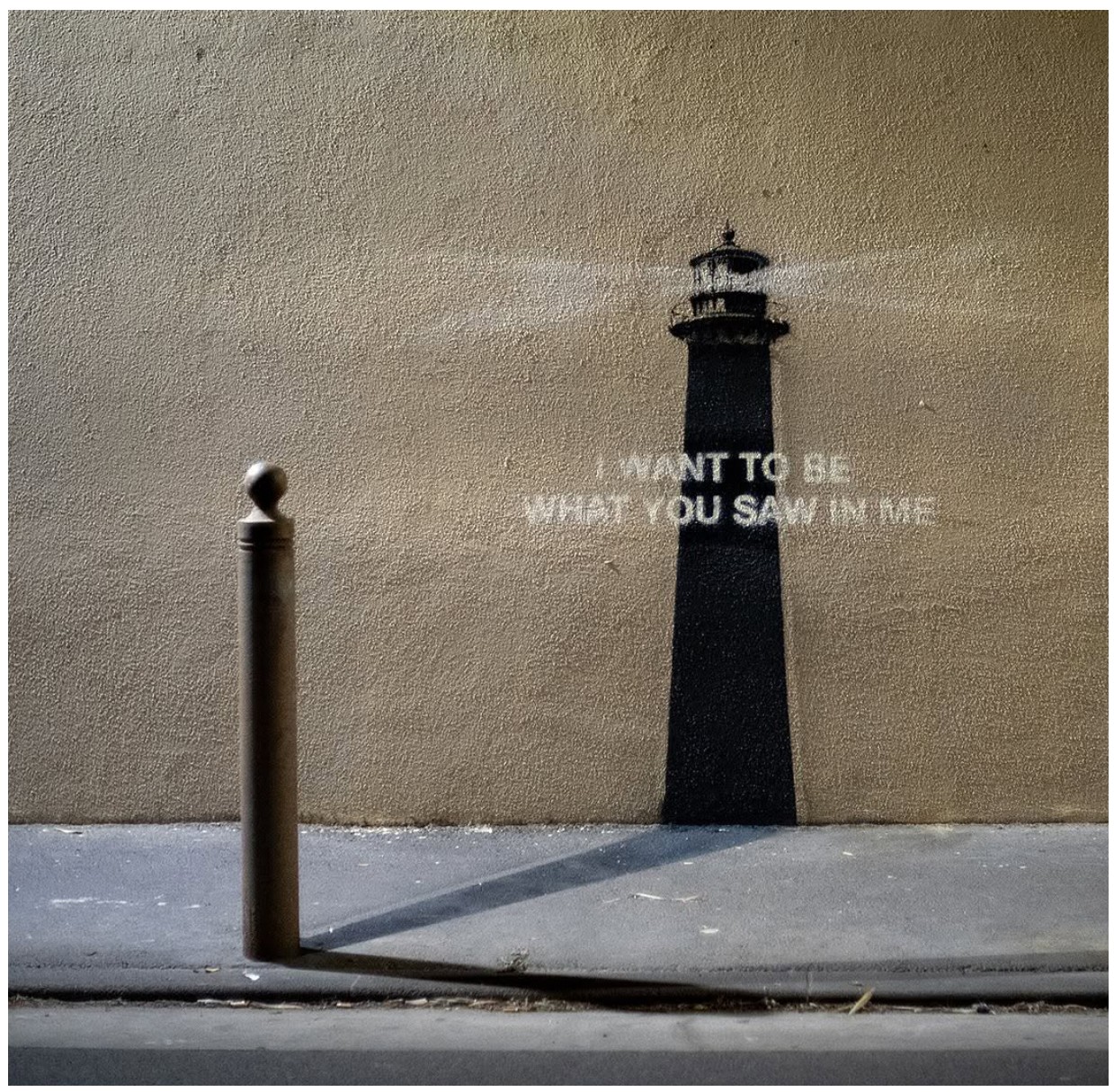
The composition is one of Banksy’s most delicate recent works. On a plain beige wall, the artist painted a black lighthouse whose beam seems to emerge from the shadow of a real street bollard positioned nearby. As so often in Banksy’s best urban interventions, the city is not merely the support for the artwork; it becomes part of the artwork itself. A functional, forgettable object — the kind of street furniture nobody notices unless they trip over it — is transformed into the origin of light. This is Banksy at his most economical: a wall, a post, a shadow, a sentence, and suddenly an entire psychological landscape opens.
The mural’s visual intelligence lies in its modesty. There is no crowd, no riot police, no bomb, no monkey, no slogan aimed directly at political power. Instead, the work operates through atmosphere. The lighthouse stands in darkness, but it is also made from darkness. Its beam is not painted as a heroic burst of illumination; it is derived from a shadow. This quiet paradox gives the work its poetic force. Banksy suggests that guidance, memory, hope, or love may come not from clarity itself, but from the transformation of obscurity.
The Most Personal Banksy?
The sentence “I want to be what you saw in me” marks a striking shift in tone. Banksy has often used text, but usually with irony, aggression, satire or absurdity. Here, the first-person voice feels almost exposed. It does not accuse; it confesses. The Art Newspaper noted that the mural may be the first time Banksy has used the first person in such a direct way in a public mural, prompting speculation that the work represents a more introspective moment in the artist’s career.
The phrase can be read in several ways. It may be romantic, as though addressed to a lost lover or someone whose belief once gave the speaker a better version of himself. It may be spiritual, a reflection on the human desire to live up to the image others hold of us. It may be artistic, even self-reflexive: Banksy, after decades of myth-making, asking whether he can still become the artist the public once imagined him to be. That reading is particularly fascinating because Banksy’s public identity has always been constructed through projection. We do not know his face, but millions of viewers believe they know what he stands for.
There is also a darker possibility. The phrase may be addressed to someone who is gone. Several reports mentioned speculation that the mural could be linked to the recent death of an artist known as Lonely Farmer, reportedly close to Banksy’s circle. That interpretation remains unconfirmed, but it explains why the work has been received as unusually elegiac.
Whatever its precise origin, the phrase is powerful because it refuses to close meaning. It speaks in the language of longing rather than instruction. Banksy is often discussed as a political artist, but this mural reminds us that his strongest works are rarely only political. They are moral, emotional and visual at the same time.
Marseille, Migration and the Sea
The choice of Marseille is far from neutral. As one of the great port cities of the Mediterranean, Marseille has long been associated with movement, migration, exile, trade, arrival and departure. It is a city of crossings. A lighthouse in Marseille cannot be merely decorative; it inevitably evokes the sea, navigation, danger, refuge and rescue.
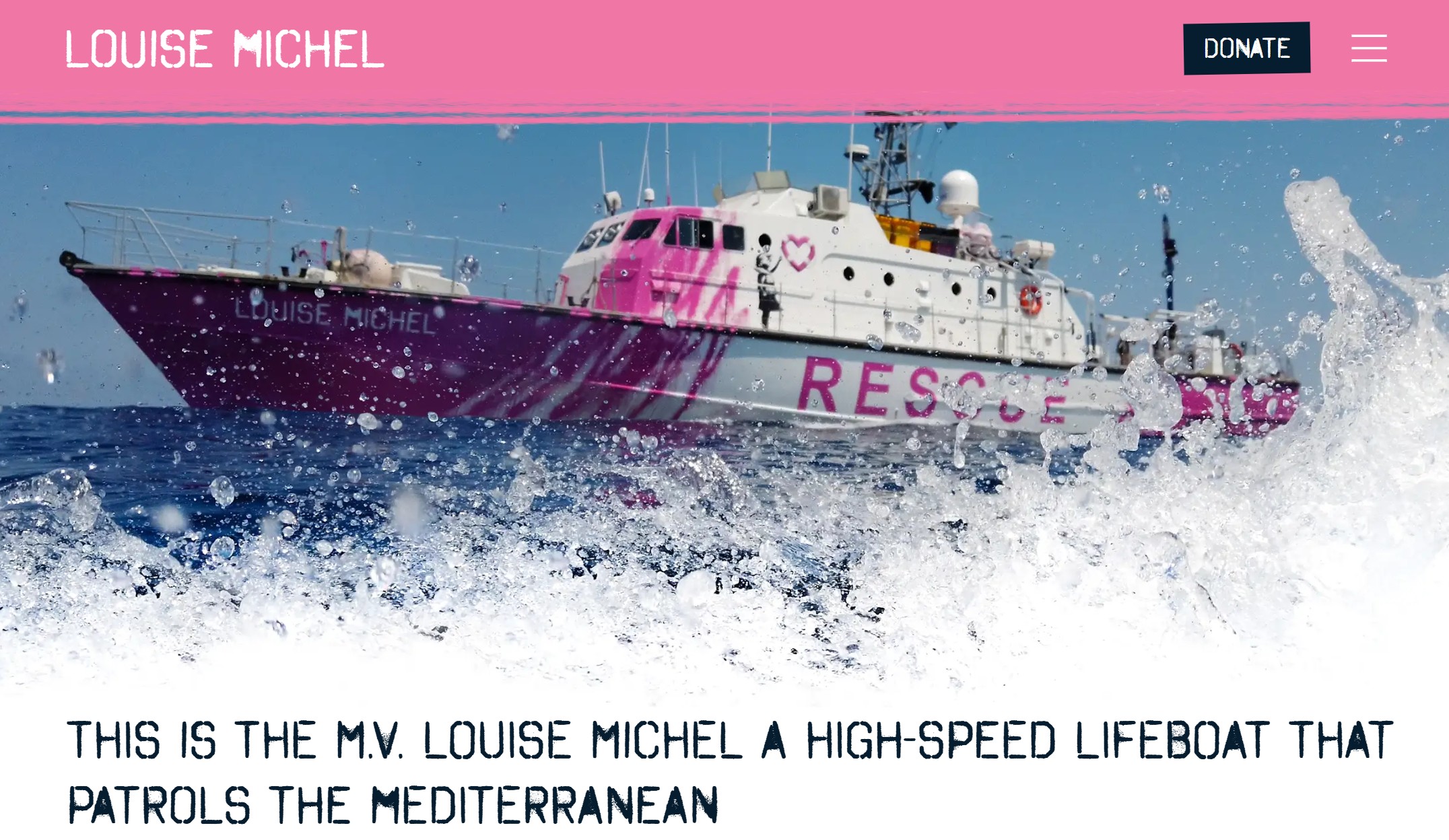
This is where the mural connects to one of Banksy’s most important humanitarian commitments: the MV Louise Michel, the rescue vessel financed by Banksy and named after the French anarchist, teacher and activist Louise Michel. The ship has been active in the Mediterranean migrant crisis, rescuing people attempting dangerous sea crossings. The fact that the mural was confirmed on 29 May, the anniversary of Louise Michel’s birth in 1830, has led many observers to connect the image to the rescue boat and Banksy’s broader engagement with migration and human rights.
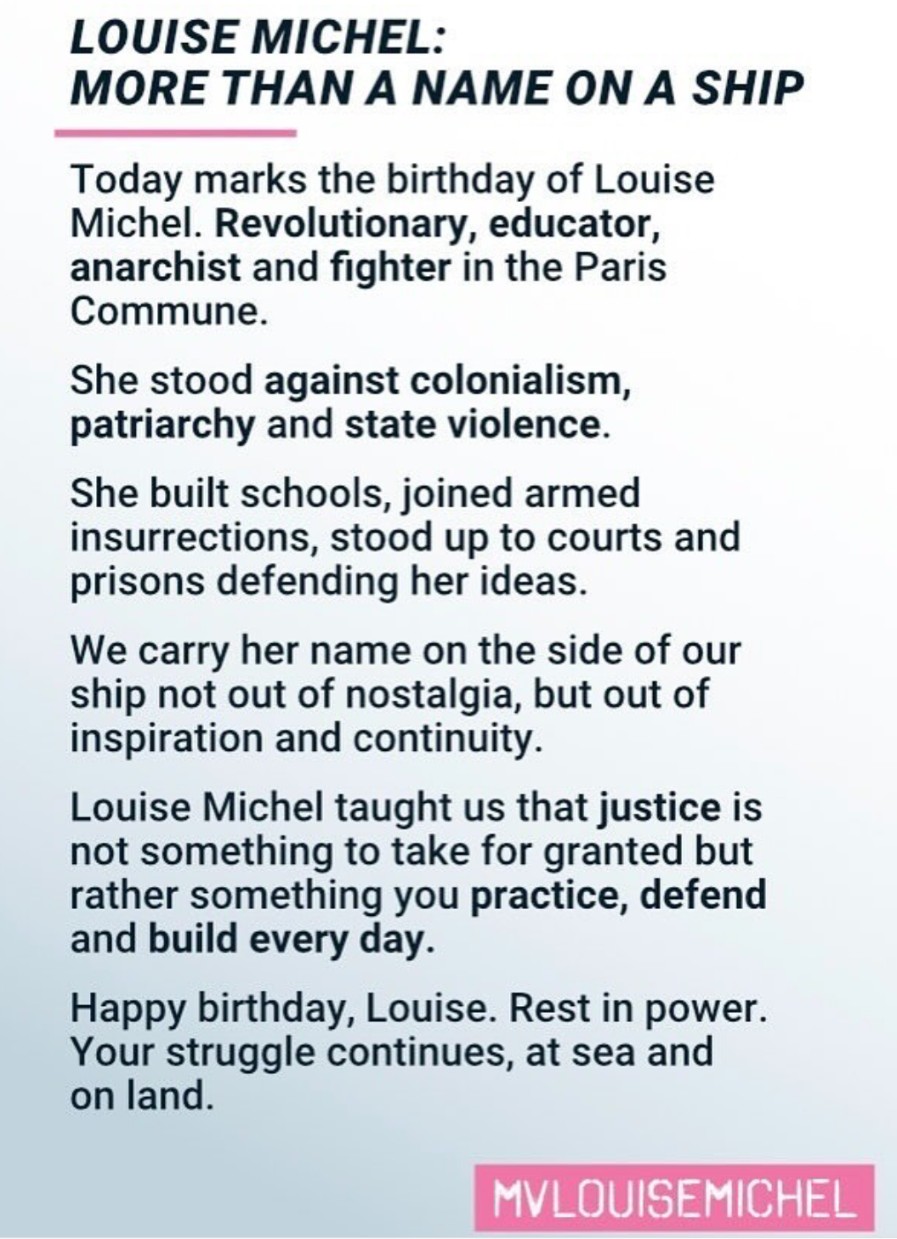
Seen in this context, the lighthouse becomes more than a personal symbol. It becomes an image of rescue, moral orientation and fragile hope. The sentence “I want to be what you saw in me” may then take on a collective meaning. It could be read as Europe speaking to its own ideals: human rights, dignity, asylum, compassion. Europe wants to be what it once claimed to be — or what others believed it could be. That interpretation is particularly sharp because Banksy has repeatedly addressed the refugee crisis, from Dismaland’s migrant boats to Mediterranean Sea View 2017 and his support of the Louise Michel rescue mission.
The mural’s tenderness does not weaken its political force. On the contrary, it makes the politics more devastating. Instead of showing drowning bodies, fences or border violence, Banksy paints a lighthouse whose beam depends on a shadow. The image asks whether Europe can still offer guidance, or whether the beacon has become only an illusion.
The Genius of the Street Object
Banksy has always been at his best when he makes the existing city do half the work. This mural belongs to the same family of interventions in which pipes, cracks, signs, cameras, windows, pavements or street furniture become active elements of the composition. The artist does not simply impose an image onto the wall; he finds a latent image already hidden in the urban environment and reveals it.
Here, the bollard is essential. Without it, the lighthouse would be a small stencil on a plain wall. With it, the work becomes a visual miracle. The bollard’s shadow becomes the beam of light, and the object itself becomes the unseen source of the image. Banksy turns urban banality into poetry with almost indecent efficiency.
There is also a philosophical intelligence in using a shadow to create a lighthouse. A lighthouse is meant to illuminate, but this one emerges from darkness. It is both warning and memory, both guidance and absence. The work suggests that what leads us forward may not be certainty, but the traces left by things we can no longer fully see.
A Softer, Older Banksy
This mural confirms an important evolution in Banksy’s recent practice. The early Banksy was often brutal, hilarious and aggressively direct. Works such as Bomb Hugger, Napalm, Laugh Now, Rude Copper or Love Is In The Air relied on immediate visual contradiction and political bite. The newer Banksy often feels quieter, stranger and more melancholic. The Marseille lighthouse does not shout. It glows.
This shift does not mean Banksy has become less political. Rather, his political language has become more interior. The world he addresses is no longer only one of police, war, capitalism and state violence. It is also a world of exhaustion, memory, grief, projection and disappointed ideals. The joke has not disappeared, but it has softened into something more fragile. In that sense, I Want To Be What You Saw In Me may become one of the defining Banksy works of the mid-2020s. It is not spectacular in the conventional sense. It is not designed around shock. Its strength comes from ambiguity, location and emotional compression. Like Girl with Balloon, it is simple enough to be instantly understood, yet open enough to remain unresolved.
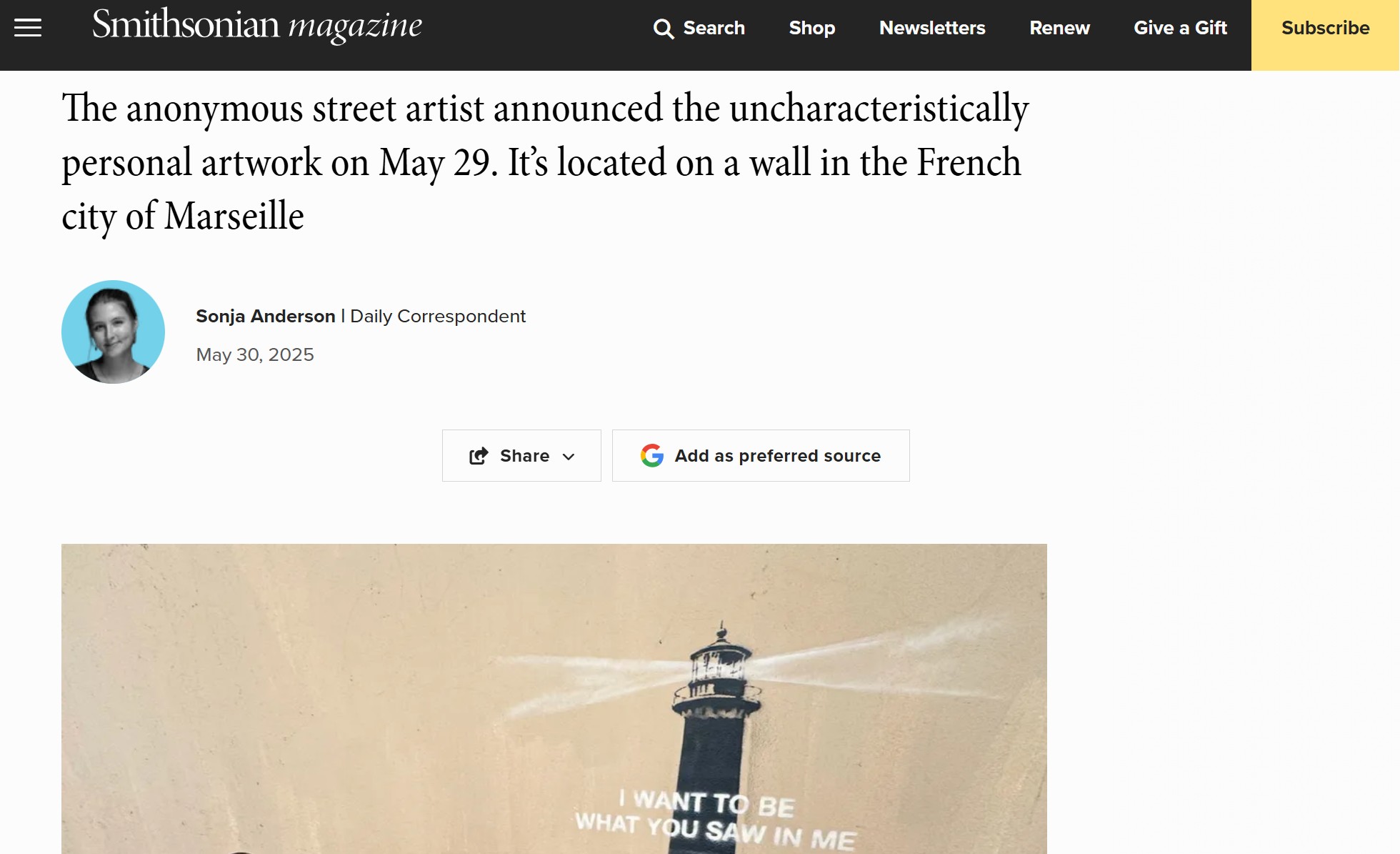
The Marseille lighthouse is important because it shows Banksy doing something increasingly rare: producing a public artwork that feels both intimate and universal. It is a love letter, a lament, a political meditation, and a visual pun. It speaks about personal disappointment, migration, rescue, memory and the burden of being seen by others.
Most importantly, it demonstrates that Banksy’s genius has never depended solely on rebellion. It depends on precision. The right image, in the right place, with the right object, at the right moment. A bollard becomes a lighthouse. A shadow becomes a beam. A wall becomes a confession. And, for once, Banksy does not simply tell us what is wrong with the world. He asks whether we can still become what someone once believed we were.