BANKSY (British, born 1975) – INKIE (British, born 1970)
Silent Majority, 1998
Spray paint on metal from an over lander trailer chassis
240×993 cm (94-1/2 x 390 inches)
Signed in white spray paint by both artists
Provenance
Created as a live performance art at Glastonbury festival in 1998
Private collection by trailer owners
Auction History
Digard Auction: 1 June 2015
Estimated: EUR 400,000 – 600,000
EUR 625,400 / USD 682,385
BANKSY (Britannique, né en 1975) – INKIE (Britannique, né en – Lot 81
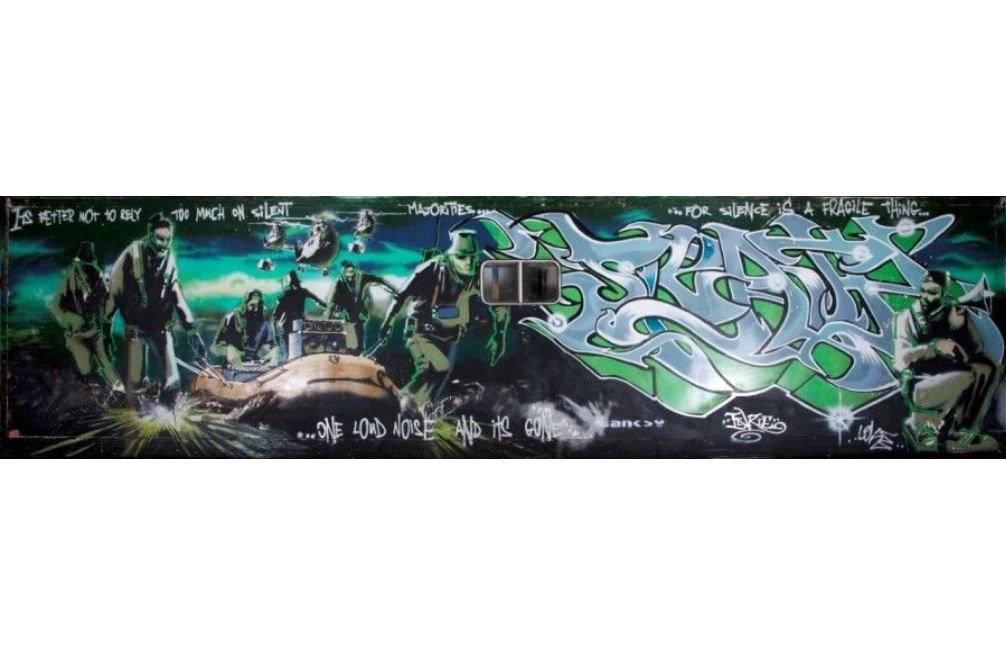
Painted during the 1998 Glastonbury Festival, Silent Majority is one of the earliest documented surviving works by Banksy and an exceptionally rare testament to his formative years within the Bristol graffiti scene. Executed in collaboration with fellow Bristol graffiti pioneer Inkie, the monumental mural, measuring almost ten meters in length, was painted freehand over the course of three days on the side of an overland trailer that served as the home of travelling festival workers. More than a commissioned artwork, it emerged spontaneously from the creative atmosphere that defined Glastonbury in the late 1990s, where music, rave culture, travelers and graffiti artists coexisted in a uniquely fertile artistic environment.
According to the owners of the trailer, Banksy personally approached them during the festival and asked whether he could use the side of their vehicle as “a large blank canvas.” They readily agreed, reasoning that the mural could simply be painted over if they disliked the result. At the time, Banksy was still largely unknown outside Bristol’s underground graffiti community, and no one imagined that the work would one day become one of the most important surviving examples of his early career. The owners had been introduced to Banksy through mutual friends connected with the travelling fairground scene, including the artist Wet Paint, better known as “Bender Dave,” who had previously collaborated with Banksy on The Rib Tickler, one of the artist’s earliest known painted fairground rides. This anecdote offers a rare glimpse into the close-knit network of artists, travelers and festival workers from which Banksy’s career first emerged.
The composition immediately reveals the complementary strengths of its two creators. Inkie, already recognized as one of Britain’s leading graffiti writers, occupies the right half of the mural with an elaborate wild style composition rendered in metallic silver and green. Banksy, meanwhile, contributes the figurative narrative unfolding across the left: a group of military commandos advancing in an inflatable boat, not carrying weapons but transporting an oversized sound system as helicopters hover overhead. Stretching across the upper edge of the composition is the inscription:
“It’s better not to rely too much on silent majorities…
for silence is a fragile thing…
one loud noise and it’s gone.”
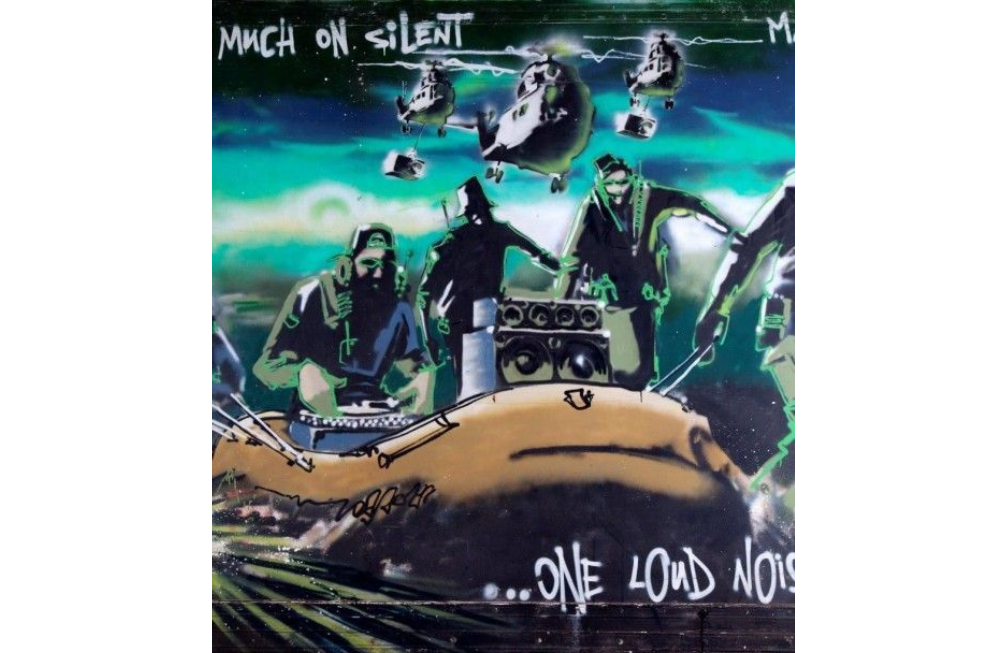
Already, many of the themes that would later define Banksy’s career are unmistakably present. Military imagery is appropriated not to celebrate conflict but to expose its absurdity. The soldiers are transformed into carriers of music rather than violence, suggesting that ideas, culture and collective expression can become more disruptive than weapons themselves. It is an early articulation of a visual strategy that Banksy would revisit throughout his career in works such as Love Is in the Air, Happy Choppers and Bomb Love, where symbols of aggression are consistently subverted into vehicles for humor, peace or resistance.
The title, Silent Majority, introduces a further layer of political meaning. Popularized during the twentieth century, the expression traditionally refers to the supposedly moderate majority whose opinions remain unheard while more vocal minorities dominate public discourse. Banksy and Inkie cleverly invert the concept. Silence, they suggest, is neither permanent nor passive; it is fragile. It requires only “one loud noise” to disappear. Positioned at the very center of the composition, the sound system becomes both a literal object and a metaphor for protest, music and collective voice. Within the context of late-1990s Britain—when free-party culture, sound systems and alternative festivals increasingly found themselves under political and legislative pressure—the mural resonates as a celebration of underground culture and a powerful defense of freedom of expression.
Historically, Silent Majority occupies a pivotal position within Banksy’s development. Painted several years before he adopted the stencil technique that would become his signature, it is executed almost entirely freehand, revealing the artist’s origins as a traditional graffiti writer. Few monumental works from this formative period survive, making the mural an invaluable document of Banksy’s transition from Bristol street artist to internationally recognized contemporary artist.
The collaboration with Inkie further enhances its historical significance. One of the most accomplished figures of the Bristol graffiti movement, Inkie was already an established artist when Banksy was beginning to develop his own visual language. Their collaboration captures a remarkable moment in the history of British urban art, when Bristol’s graffiti community functioned as an extraordinary incubator of talent alongside artists such as Robert Del Naja (3D), Nick Walker and other pioneers who helped redefine contemporary street art.
Following Glastonbury, the mural remained on the trailer for almost two decades before the metal panels were carefully removed and preserved. It was included in the exhibition Stealing Banksy in London in 2014 before being offered at Digard Auction in Paris on 1 June 2015, where it achieved more than USD 680,000, a remarkable result that reflected both its exceptional rarity and its importance within Banksy’s early oeuvre.
Today, Silent Majority stands as far more than an early collaboration between two celebrated graffiti artists. It is one of the earliest documented surviving collaborative works by Banksy and Inkie, and one of the very few monumental freehand paintings from Banksy’s pre-stencil period to remain in private hands. Long before rats, policemen and flower throwers became internationally recognized icons, the mural already contained the essential foundations of Banksy’s artistic vision: political irreverence, visual wit, anti-militaristic imagery and an unwavering belief that culture itself can become an instrument of resistance. As such, Silent Majority occupies a unique place within Banksy’s oeuvre, documenting the precise moment when an anonymous Bristol graffiti writer was beginning the extraordinary journey that would transform him into one of the most influential artists of the twenty-first century.