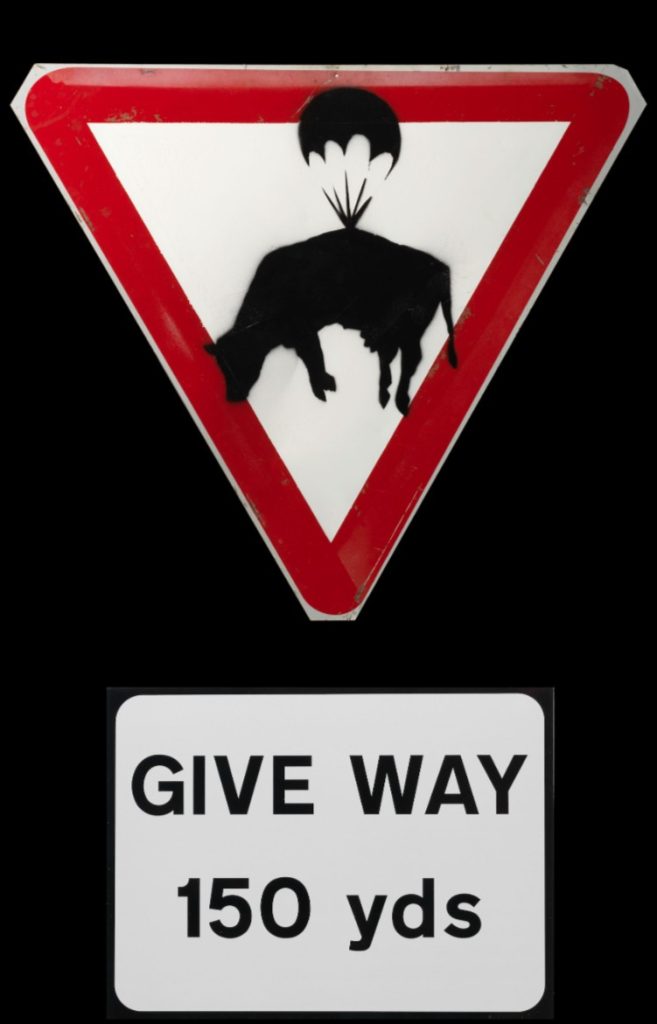
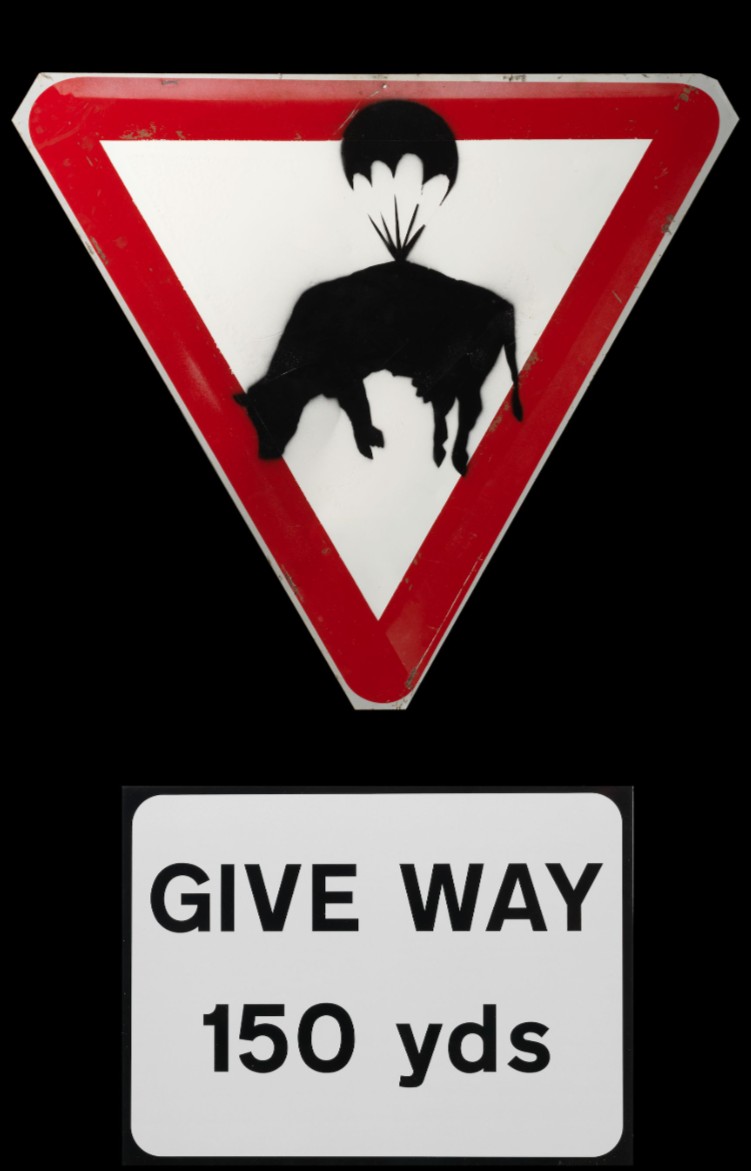
(i): Stencil spray paint on found road sign
(ii): Road sign
(i): 75×86 cm (29-1/2 x 33-7/8 inches)
(ii): 45×60 cm (17-11/16 x 23-5/8 inches)
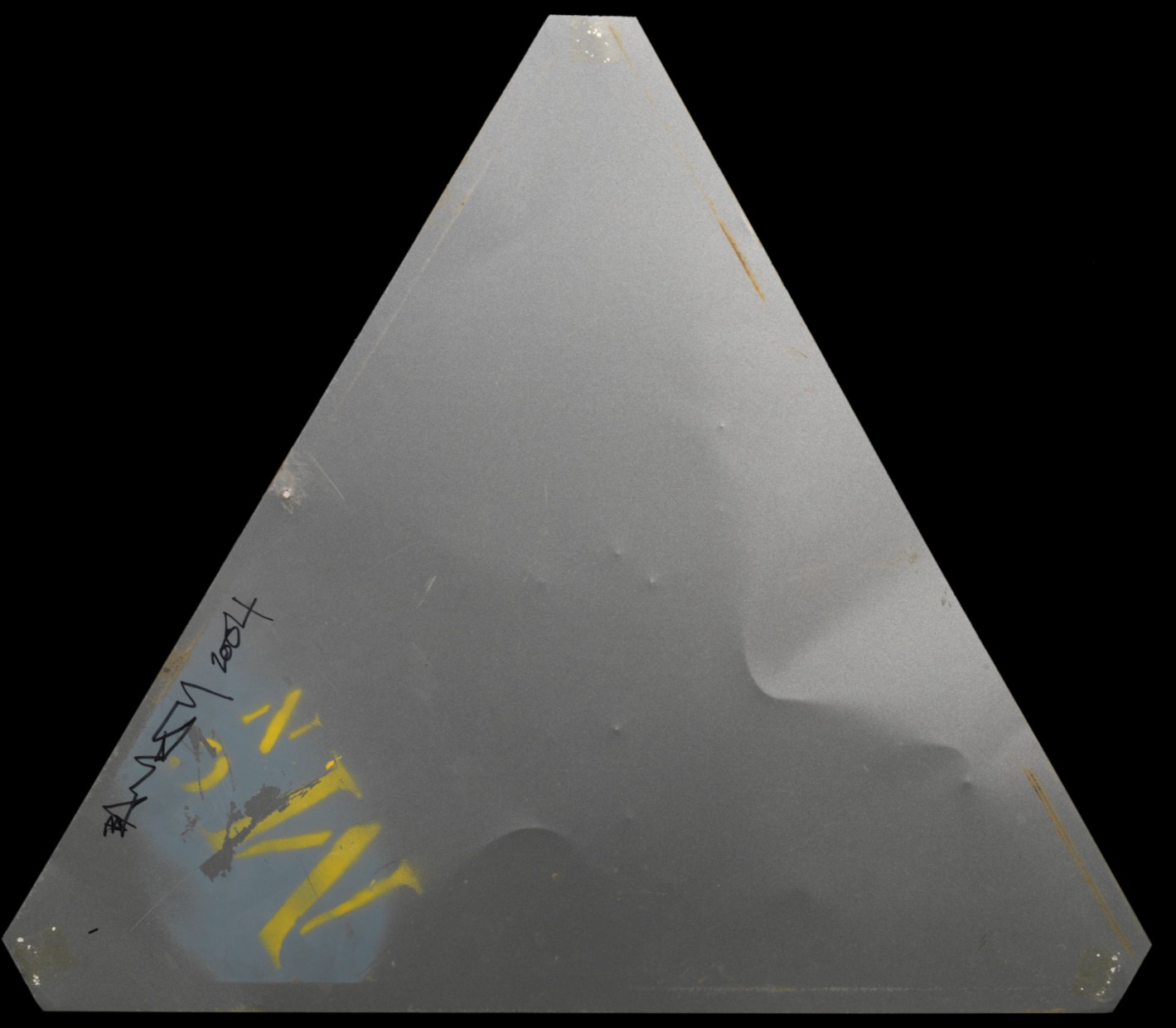
Signed and dated 2004 on the reverse of the triangular sign
Few artists have manipulated the visual vocabulary of the modern city as intelligently as Banksy. While graffiti traditionally occupies walls, bridges and railway arches, Banksy quickly understood that the city itself is already filled with ready-made images: road signs, traffic signals, advertising billboards and official notices that silently regulate the movement of millions of people every day. Created in 2004, Slow Down is one of the earliest and most accomplished examples of this strategy. Rather than painting upon an anonymous wall, Banksy intervenes directly on an authentic British Give Way traffic sign, transforming an ordinary object of public infrastructure into an unexpected work of art.
The intervention is deceptively simple. Suspended beneath a parachute, a black silhouette of a cow gently descends into the center of the triangular warning sign. Below, the original road instruction—”Give Way”—remains perfectly intact, reinforcing the illusion that the animal has become part of the official visual language of the street. The result is immediate, humorous and quietly disorienting.
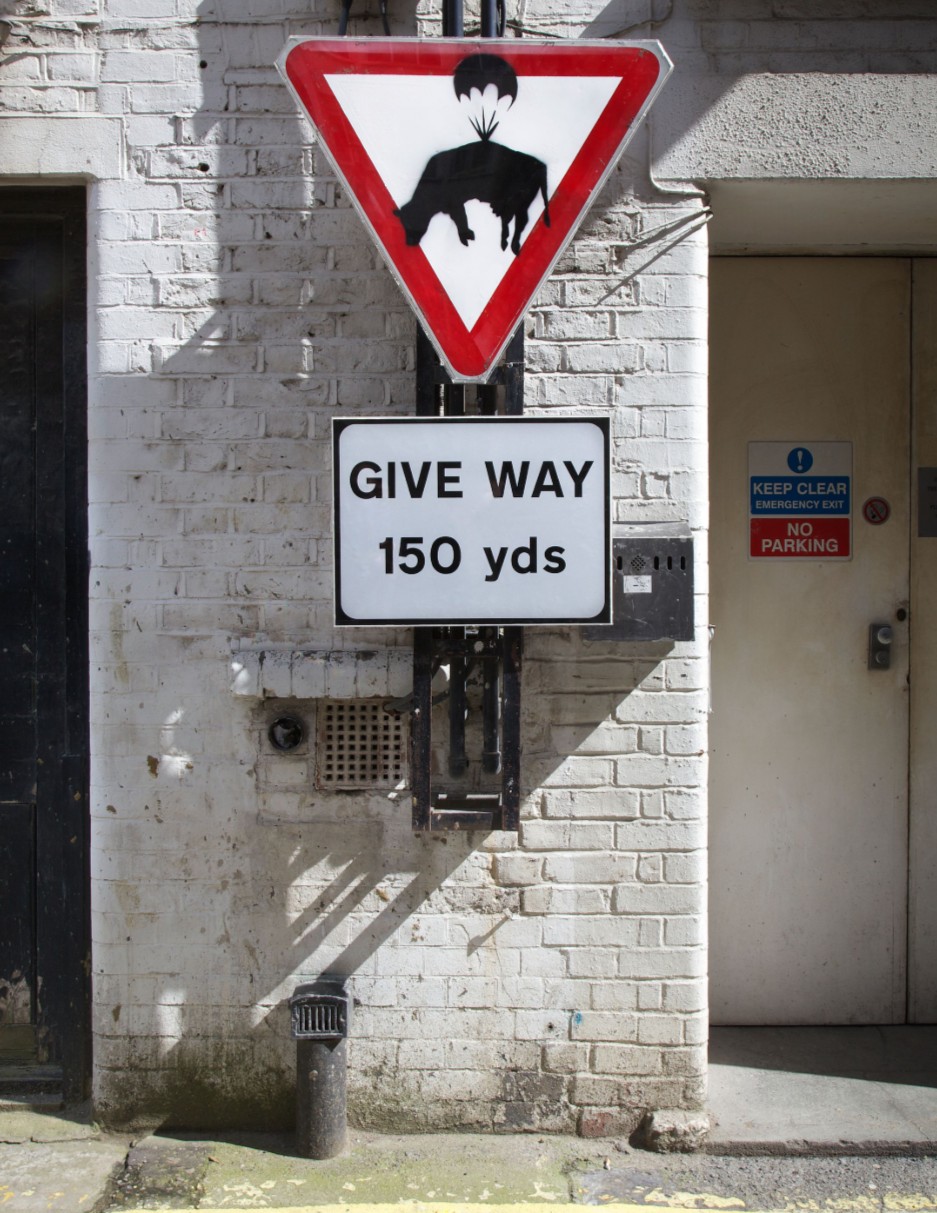
Banksy’s genius has often resided in his ability to alter reality through the smallest possible intervention. Nothing about the road sign itself has changed. Its colors, typography and official function remain untouched. Yet by introducing a single impossible image, Banksy completely transforms the viewer’s experience. What was once ignored as part of the background of everyday life suddenly demands attention.
This approach owes much to the tradition of the readymade, first established by Marcel Duchamp in the early twentieth century. Duchamp demonstrated that ordinary manufactured objects could become works of art simply by being repositioned within a new conceptual framework. Banksy reverses the process. Rather than bringing an everyday object into the museum, he transforms an everyday object already embedded within the city itself into an artistic intervention.
The artwork therefore exists simultaneously in two worlds. It remains a traffic sign. It also ceases to be one. The image itself is wonderfully absurd. Parachuting livestock immediately evokes military supply drops, humanitarian aid missions and emergency evacuations. During the Second World War, and later in numerous humanitarian operations, parachutes became symbols of rescue, survival and logistical ingenuity. Banksy mischievously replaces food, medicine or soldiers with a single bewildered cow. The visual contradiction is irresistible.
The animal appears oddly serene, suspended weightlessly in mid-air, entirely unaware of the impossibility of its own situation. Like so many of Banksy’s finest images, the work asks no explicit question yet quietly encourages viewers to invent their own narrative. Has the cow escaped? Has it been rescued? Has it been dropped into danger? Or is the absurdity itself the point? Banksy rarely answers such questions, preferring to leave the image permanently suspended between comedy and mystery.
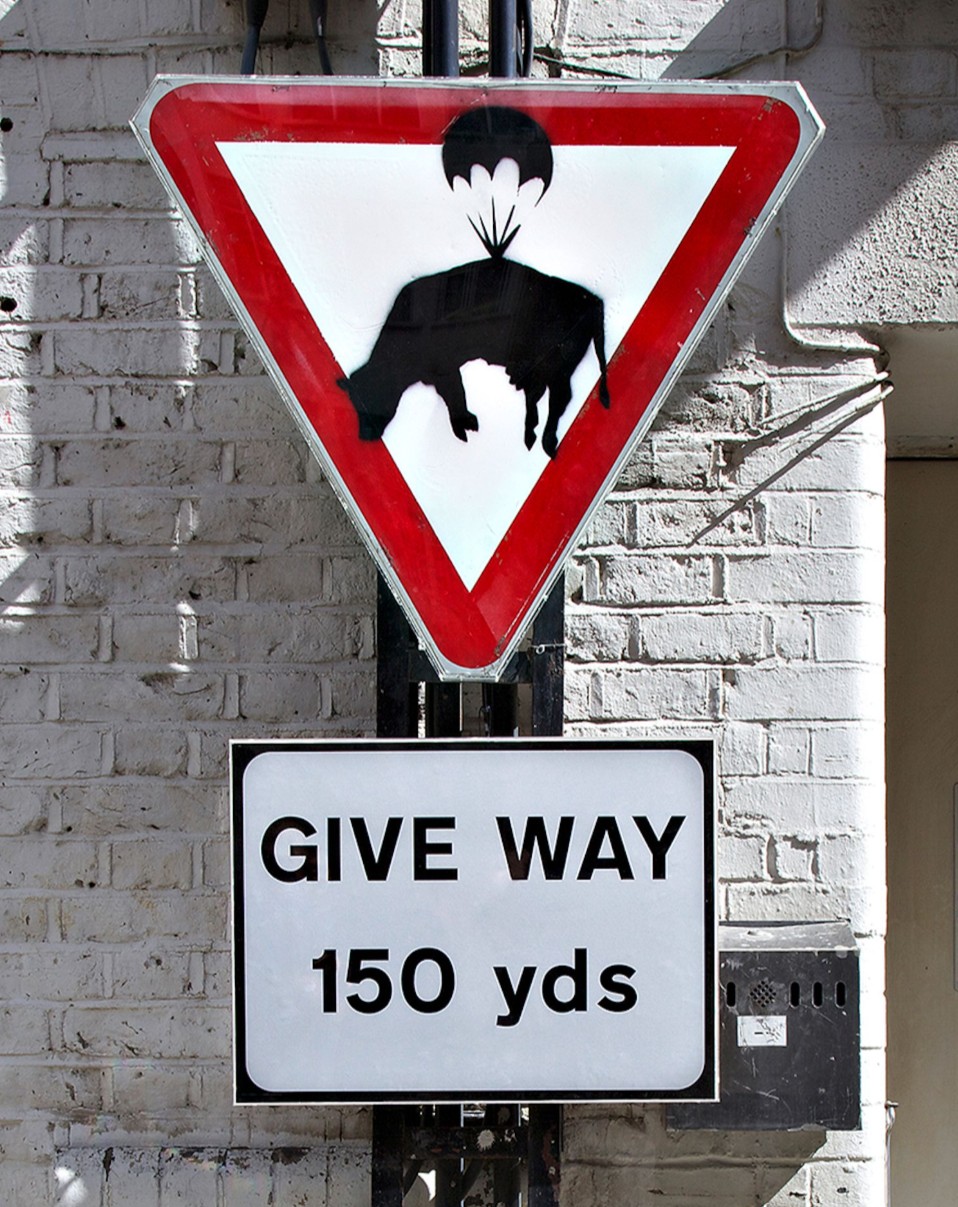
There is another subtle tension at work. Road signs represent one of the purest expressions of bureaucratic order. They standardize behavior, regulate movement and reduce complex situations to universally recognizable symbols. Every color, shape and graphic element has been carefully designed to eliminate ambiguity.
Banksy deliberately reintroduces ambiguity. The parachuting cow interrupts the certainty of the official sign, reminding us that life rarely conforms to the rigid systems created to organize it. Nature, chance and imagination continue to intrude upon even the most carefully regulated environments.
This fascination with institutional language runs throughout Banksy’s career. Whether modifying CCTV cameras, telephone boxes, museum displays or public monuments, he repeatedly appropriates the symbols through which authority communicates with society. Rather than destroying these systems, he quietly rewrites them from within. The city itself becomes his canvas.
The work also reveals Banksy’s remarkable sensitivity to visual rhythm. Great street art depends upon surprise. Unlike gallery visitors, pedestrians do not arrive expecting to encounter art. They are walking to work, driving through traffic or simply moving through familiar surroundings. The effectiveness of a street intervention therefore depends upon its capacity to interrupt routine.
Slow Down achieves precisely that. For a split second, the viewer believes they are looking at an ordinary traffic sign. Only gradually does the impossible silhouette reveal itself. The moment of recognition produces exactly the response Banksy seeks: confusion, amusement and finally reflection. In this sense, the work functions almost like visual poetry. A single unexpected image completely alters the meaning of an otherwise ordinary sentence.
Slow Down belongs to a remarkable series of works in which Banksy appropriated objects already embedded within the urban landscape. During the early 2000s, he increasingly expanded beyond conventional graffiti, transforming telephone boxes, road signs, museum exhibits, public statues and architectural elements into components of his artistic practice.
This evolution marked an important turning point in his career. Rather than simply painting upon the city, Banksy began editing it. The distinction is fundamental. Graffiti adds images to public space. Slow Down rewrites public space itself, demonstrating that artistic intervention need not involve monumental gestures. Sometimes the most powerful transformation consists of altering an object that millions of people pass every day without ever truly seeing it.
Slow Down encapsulates one of Banksy’s greatest artistic achievements: his ability to make us see the familiar as though for the first time. Through the addition of a single stencil, an anonymous traffic sign becomes humorous, poetic and quietly philosophical.
The parachuting cow may never explain why it is falling from the sky, and that is precisely its strength. Banksy understands that imagination begins where certainty ends. By interrupting the rigid visual language of bureaucracy with an image of joyful absurdity, he reminds us that even the most ordinary corners of the city retain the capacity to surprise. More than twenty years after its creation, Slow Down continues to embody the essence of Banksy’s practice. It is not simply an altered road sign; it is a demonstration that art has the power to infiltrate everyday life so seamlessly that, once seen, the world itself can never quite look the same again.