
BANKSY
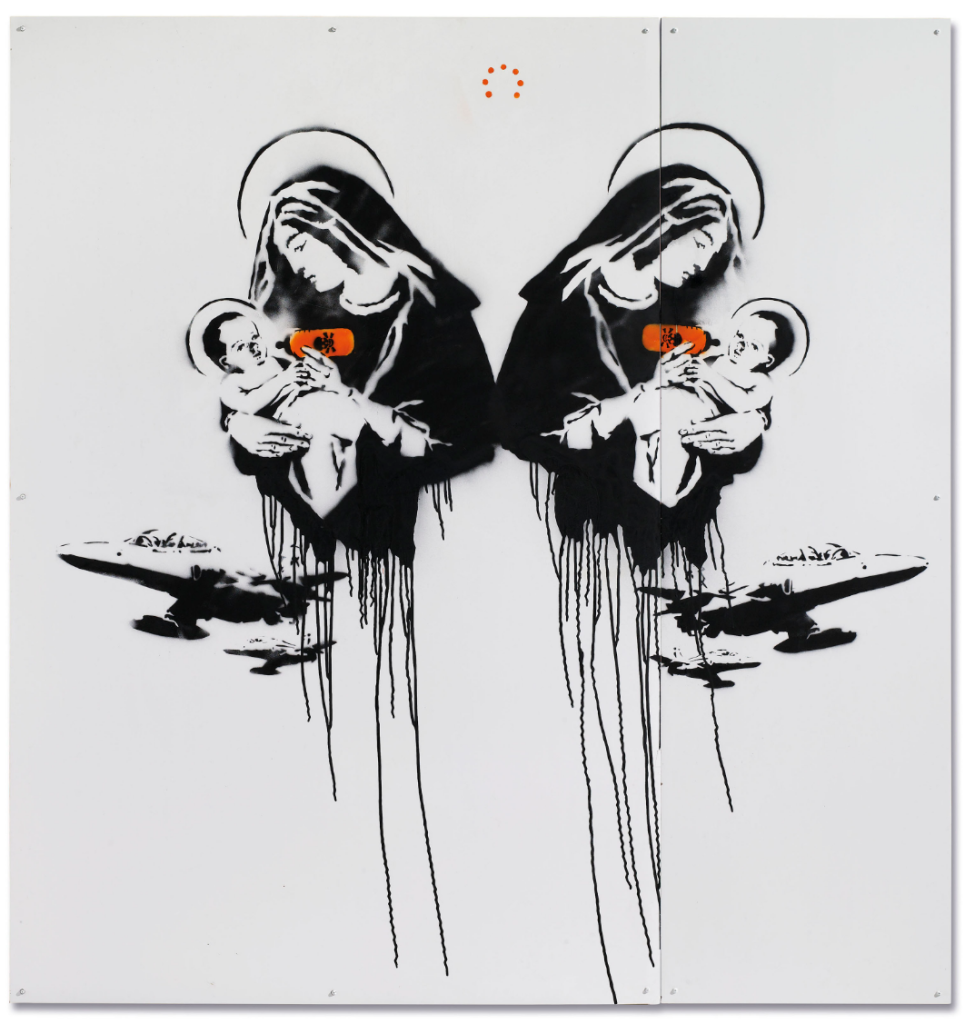
Toxic Mary, 2003
Spray-paint on two panels
180x188cm (74 x 70 3/4 inches)
Private Collection, Los Angeles
Private Collection, UK
Acquired from the above by the present owner in 2012
Auction History
| Christie’s London 12 February 2020 Est.: GBP 400,000 – 600,000 | Price Realized GBP 455,250 / USD 532,240 |
Catalogue Note
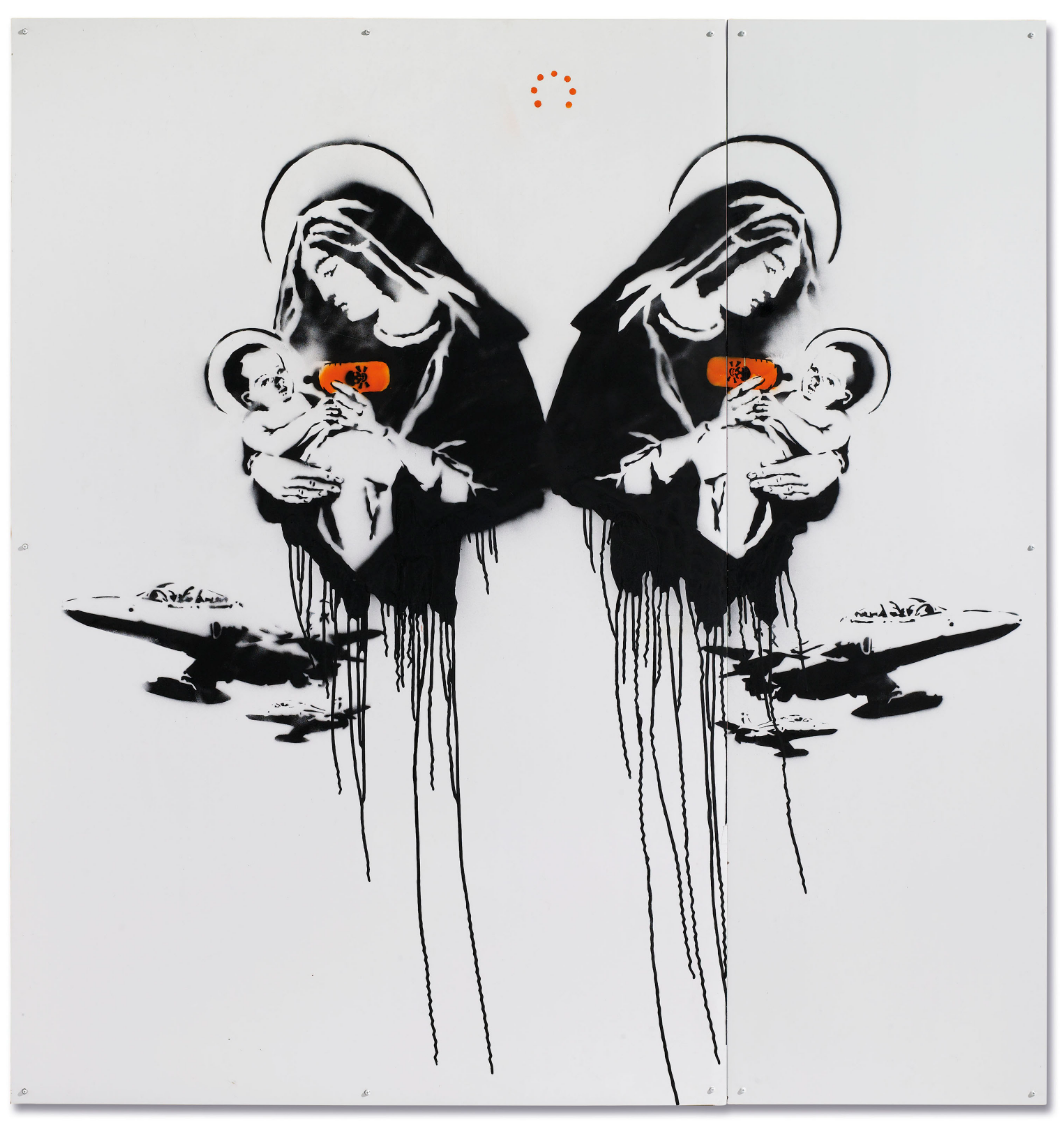
Executed in 2003, Toxic Mary ranks among the most profound and conceptually sophisticated works from Banksy’s formative years. Presented as a monumental diptych, the composition reinterprets one of the most enduring images in the history of Western art—the Madonna and Child—through the visual language of contemporary street art. At once beautiful and deeply unsettling, the work exemplifies Banksy’s extraordinary ability to appropriate universally familiar iconography and transform it into a powerful meditation on the anxieties of the modern world.
“As soon as I cut my first stencil I could feel the power there. I also like the political edge. All graffiti is low-level dissent, but stencils have an extra history. They’ve been used to start revolutions and to stop wars.”

The composition draws directly upon the tradition of the Madonna Lactans, in which the Virgin Mary nursing the infant Christ symbolizes purity, compassion and divine nourishment. Banksy preserves the tenderness of the gesture but radically alters its meaning. Instead of offering life-giving milk, both Madonnas feed their children from bright orange bottles emblazoned with the universal biohazard symbol. With a single substitution, one of Christianity’s most sacred images becomes an allegory of inherited toxicity. The bottle deliberately resists any single interpretation. It may refer to environmental pollution, pharmaceutical dependence, consumerism, ideological indoctrination, or the transmission of violence from one generation to the next. Rather than condemning religion itself, Banksy poses a broader and more unsettling question: what values, fears and poisons does contemporary society unconsciously pass on to its children?
The figure of the Madonna is one of the most easily recognizable, most frequently produced images in the history of art. The word Madonna is derived from the Italian ‘ma donna,’ or ‘my lady’ and is used to describe Mary, the mother of Christ.
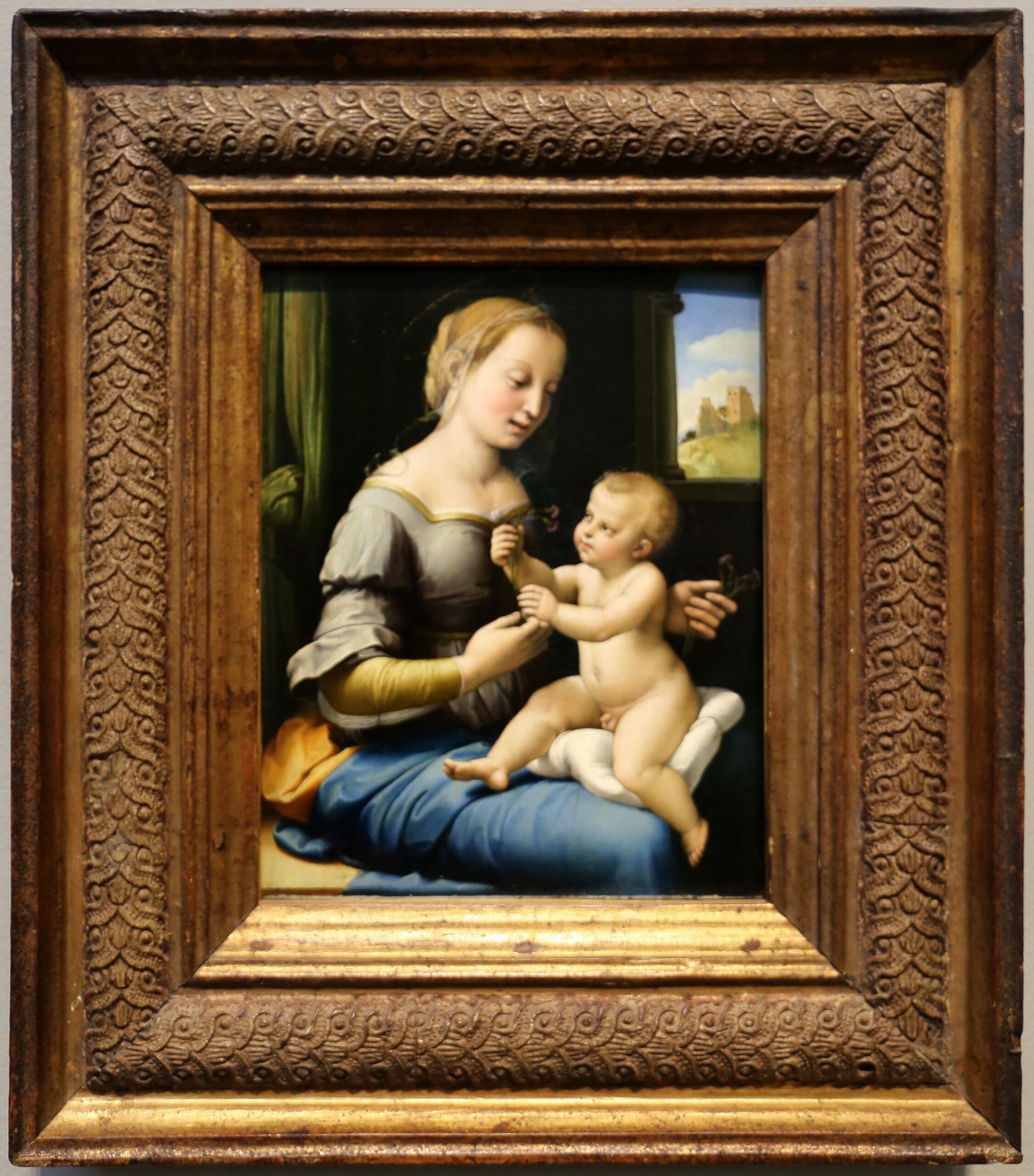
Madonna and Child, c. 1506-1507
Oil on yew wood, 27.9 x 22.4 cm
The National Gallery, London
The most well-known examples of The Madonna and Child were completed by Italian painter Raphael, who moved from his native Urbino to Florence at the turn of the 16th century. Over the course of his career, the artist created more than 30 paintings of The Madonna and Child, for devotional panels and commercial sales, as well as gifts for friends, including one wedding present. His representations are considered among the most reverential and graceful of Mary and Jesus.
The diptych format deepens this reflection. More than a simple doubling of the image, the mirrored composition recalls the hinged devotional panels and altarpieces of the medieval and Renaissance periods. Banksy borrows not only the iconography of Christian painting but also its ceremonial structure. The repeated gesture transforms an isolated act into a universal condition. Toxicity is no longer accidental; it becomes ritualized, repeated endlessly as each generation inherits the moral contradictions of the one before it.
Unlike the earlier Turf War version, this composition restores the halos surrounding both the Virgin and Child, bringing the image visually closer to traditional religious painting. Yet this apparent return to sanctity only heightens the irony. Beneath the symbols of holiness, the Christ Child continues to receive poison rather than nourishment. Banksy masterfully creates an image that appears devotional at first glance, only to reveal itself gradually as a profound inversion of its historical source.
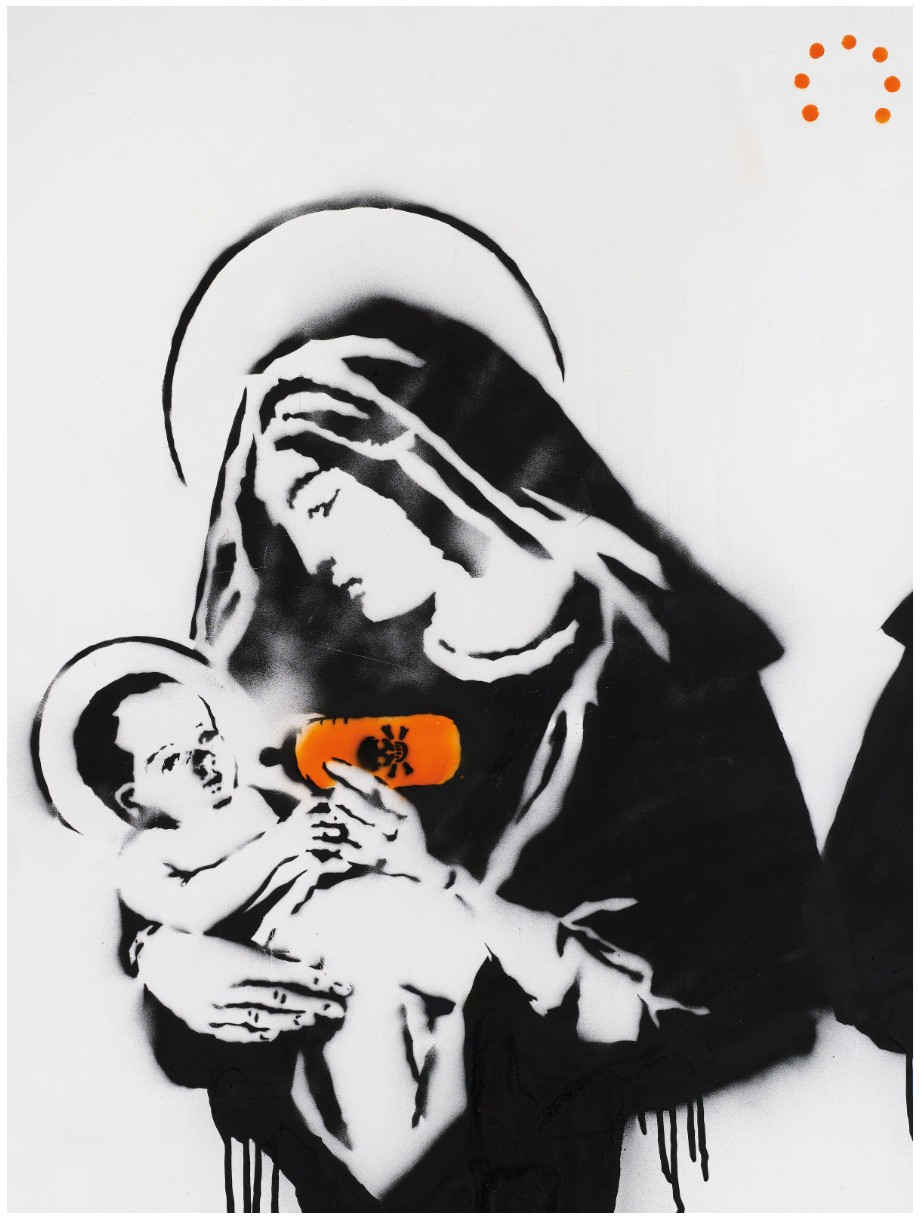
The work unfolds through a carefully orchestrated sequence of visual discoveries. The eye is first drawn to the brilliant orange feeding bottles before returning to the serene faces of the Madonnas. Only gradually does one notice the ring of stars suspended above the composition. Throughout the history of Christian art, stars have symbolized heaven, divine guidance and hope. Here, however, the celestial circle is incomplete, fractured and uncertain. It evokes the heavens while subtly denying their traditional promise of certainty and redemption. Beneath the figures, almost disappearing into the shadows, ghost-like fighter aircraft silently traverse the picture plane. Banksy deliberately avoids sensationalism. The aircraft reveal themselves only after prolonged observation, suggesting that warfare has become an almost invisible foundation of contemporary civilization.
The remarkable restraint of the composition is further enhanced by its pristine white ground. Traditionally associated with purity, innocence and spiritual illumination, the immaculate background appears almost icon-like in its simplicity. Yet Banksy subtly empties the color of its conventional associations. Rather than offering transcendence, the luminous white field becomes a stage upon which contamination quietly unfolds. The work appears serene, balanced and harmonious, while every symbolic element gradually undermines that initial impression.
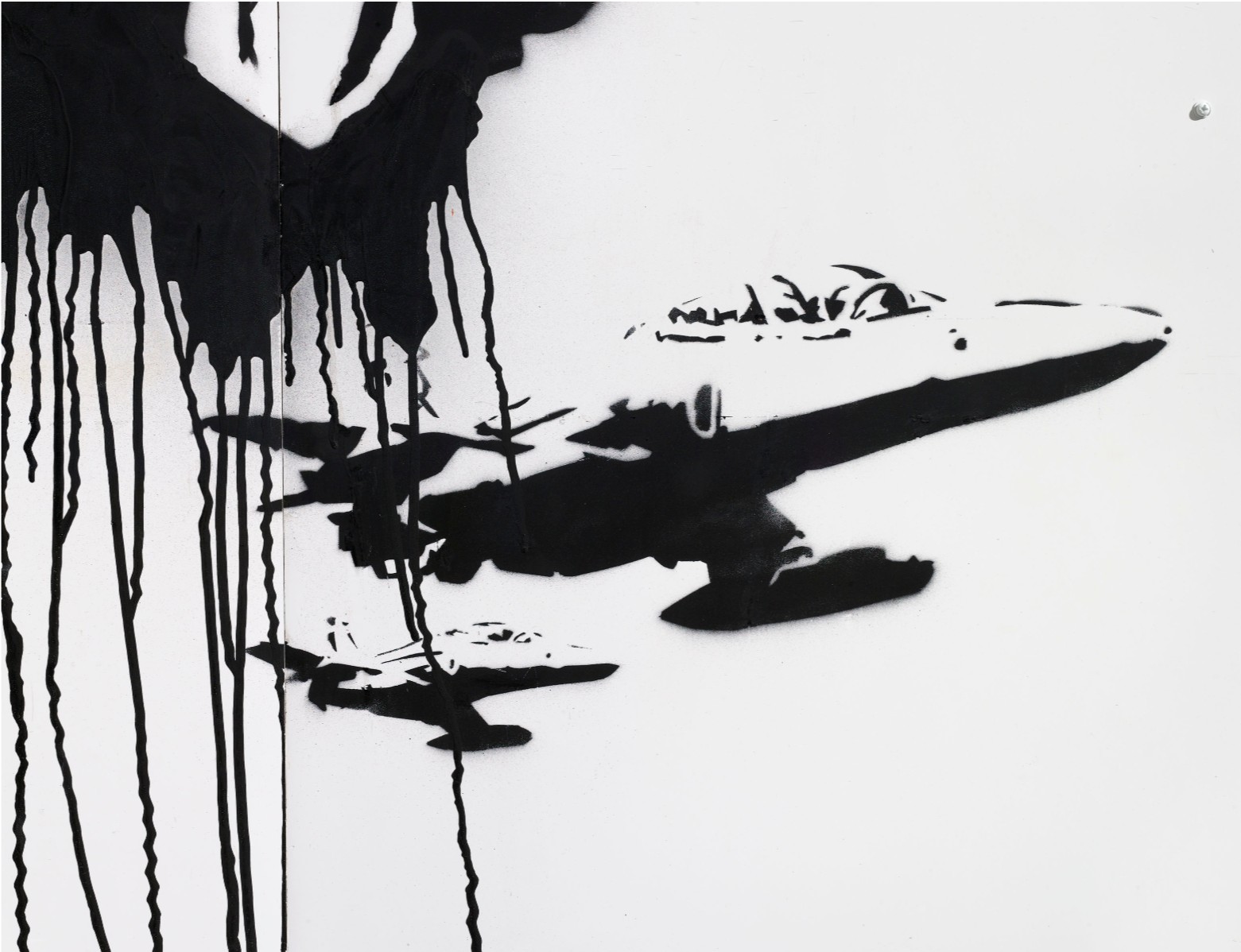
Equally important are the dramatic black drips cascading from the robes of each Madonna. These flowing traces preserve the immediacy of the stencil process while reasserting the work’s origins in the language of graffiti. At the same time, they introduce a powerful emotional ambiguity. They may evoke tears, bleeding wounds, dissolving paint or the gradual erosion of sacred ideals, allowing the image to oscillate between permanence and decay. In this subtle tension between the timelessness of religious iconography and the ephemerality of street art lies much of the work’s extraordinary power.
What makes Toxic Mary so compelling is precisely the way its meaning unfolds over time. Like the finest Renaissance altarpieces, the composition rewards slow and sustained contemplation. Yet Banksy reverses the traditional spiritual journey. Rather than leading the viewer toward redemption, each newly discovered symbol—the biohazard bottle, the fractured celestial circle, the ghost-like aircraft and the dripping black paint—draws us back toward the anxieties of the contemporary world. The painting appears at first to promise comfort and devotion, only to reveal itself as a deeply unsettling reflection on a society in which violence, consumerism and environmental contamination have infiltrated even its most sacred symbols.
Rich in historical references yet unmistakably contemporary, Toxic Mary stands among the masterpieces of Banksy’s early career. It demonstrates not only his mastery of visual economy but also his extraordinary ability to engage with the great traditions of Western art while exposing their continuing relevance to the moral dilemmas of the twenty-first century. More than a satire of religion, it functions as a modern parable, asking what kind of world we are preparing for future generations—and what invisible poisons we continue to place in their hands under the guise of care, progress and civilization.