BANKSY
Monkey Detonator, 2002
Spray-paint on card
90.8 x 90.8 cm (35 3/4 x35 3/4 inches)
From a series, unique in this format
Provenance
Lazinc, United Kingdom (acquired directly from the artist)
Acquired from the above by the present owner
Auction History
| Phillips Hong-Kong 3 December 2020 Est.: HKD 3,800,000 – 4,800,000 | Price Realized |
Catalogue Note
Executed in 2002, Monkey Detonator belongs to the earliest and most compelling examples of Banksy’s enduring monkey imagery. Spray-painted on card with remarkable economy, the composition depicts a chimpanzee captured in the split second before pressing the plunger of a detonator. Suspended between anticipation and catastrophe, the image derives its extraordinary tension from the fact that nothing has yet happened. The explosion remains entirely in the viewer’s imagination.
As throughout Banksy’s early oeuvre, the monkey functions as a surrogate for humanity itself. Borrowing from the long artistic tradition of the singerie, in which monkeys imitate human behavior, Banksy reverses the relationship between man and animal. His monkeys are rarely foolish simply because they are animals; rather, they expose the irrationality of human society. Here, the chimp calmly prepares to unleash destruction using one of the most sophisticated symbols of modern warfare, suggesting that technological progress has done little to restrain humanity’s oldest destructive instincts.
“You paint 100 chimpanzees and they still call you a guerrilla artist.”
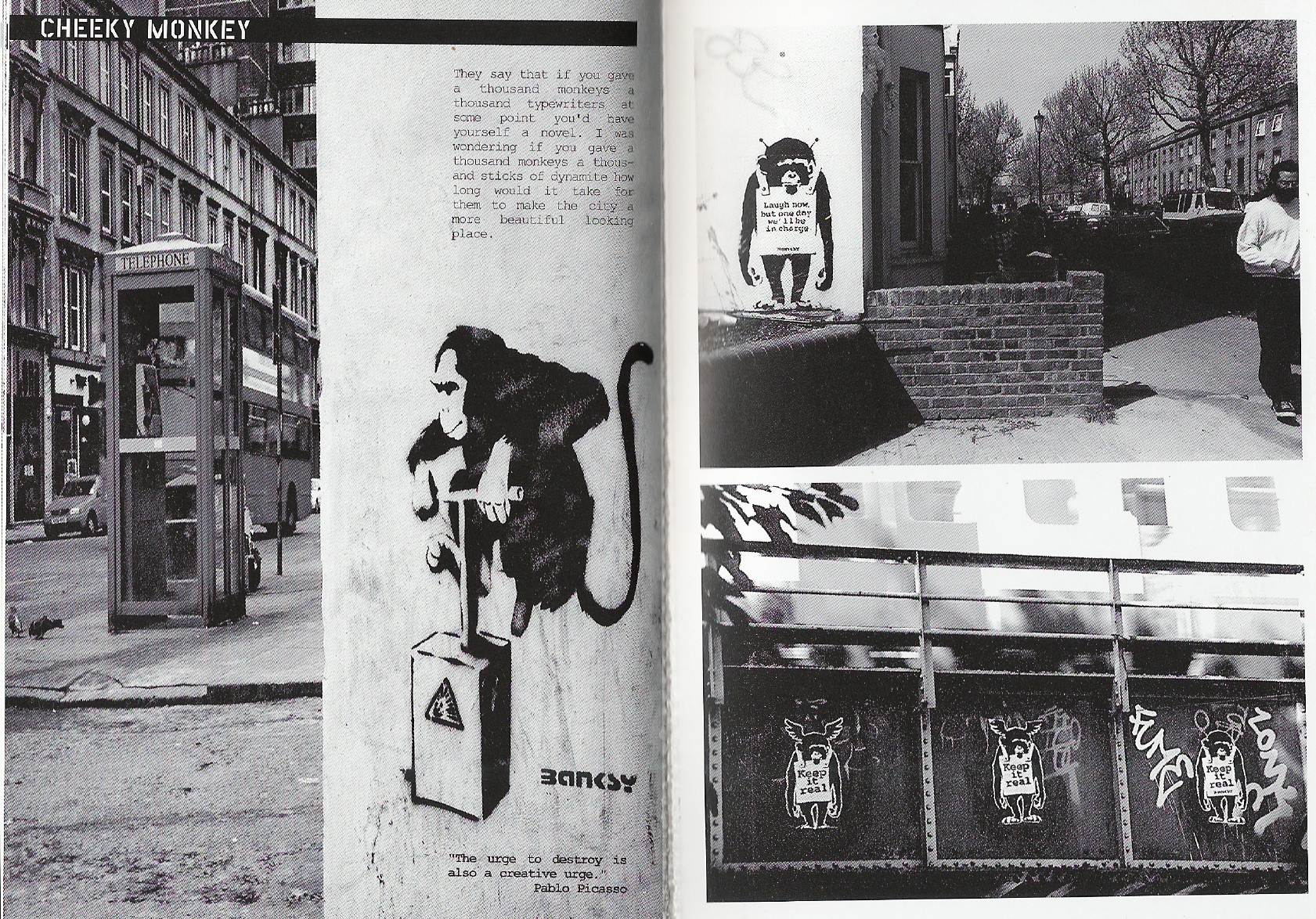
Banksy, Banging Your Head Against A Brick Wall, November 2001
The detonator itself carries powerful symbolic weight. Designed to trigger events from a safe distance, it represents the increasing separation between action and consequence that characterizes contemporary conflict. Wars are fought remotely, decisions are made anonymously and responsibility becomes increasingly diffuse. By placing the plunger beneath the hands of a monkey, Banksy reduces this complex machinery of destruction to an almost absurd gesture, exposing the fragility of the systems upon which modern power depends.
The composition is remarkable for its restraint. Set against a vast, empty ground, the isolated figure becomes almost theatrical, deprived of any narrative context. Banksy offers no indication of what lies beneath the detonator or what catastrophe may follow. Instead, he concentrates entirely on the psychological moment preceding action. The silence surrounding the monkey becomes more unsettling than any explosion could be.
The support further reinforces the work’s origins. Executed on card rather than a conventional canvas, Monkey Detonator retains the immediacy and informality that characterized Banksy’s earliest studio practice. Like many of his original works from this period, the humble material preserves a close connection to the temporary surfaces of the street, emphasizing the artist’s preference for direct communication over preciousness.
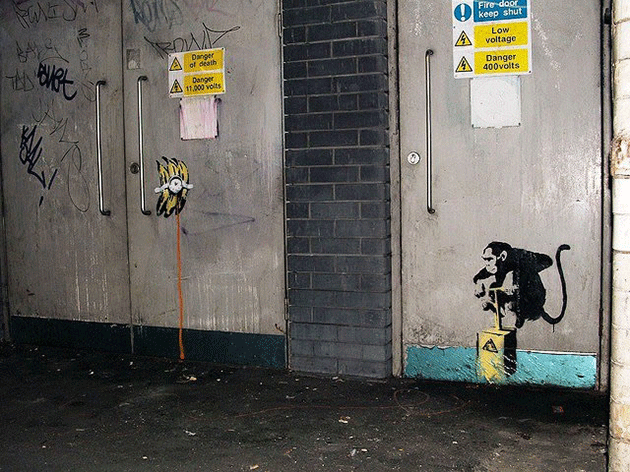
Although the image later appeared as a celebrated mural in Waterloo, London, in 2006, this early painted version predates that public intervention and belongs to the formative period during which Banksy established many of the visual ideas that would define his career. The monkey would become one of his most persistent protagonists, repeatedly questioning authority, exposing hypocrisy and reflecting the contradictions of modern society with equal measures of humor and melancholy.
More than twenty years after its creation, Monkey Detonatorremains one of Banksy’s most psychologically unsettling images. It reminds us that the greatest danger does not lie in the explosion itself but in the ordinary moment before it—the instant in which destructive decisions appear almost casual. In Banksy’s hands, the monkey is never merely an animal. It is a mirror, reflecting the uncomfortable possibility that humanity itself may be the creature most willing to press the button.