Girl with Balloon (Diptych)
Year: 2005
Medium: Acrylic and spray-paint stencil on canvas in two parts
Dimensions: 30.5 x 30.5 cm (12×12 inches) each
Edition: 25
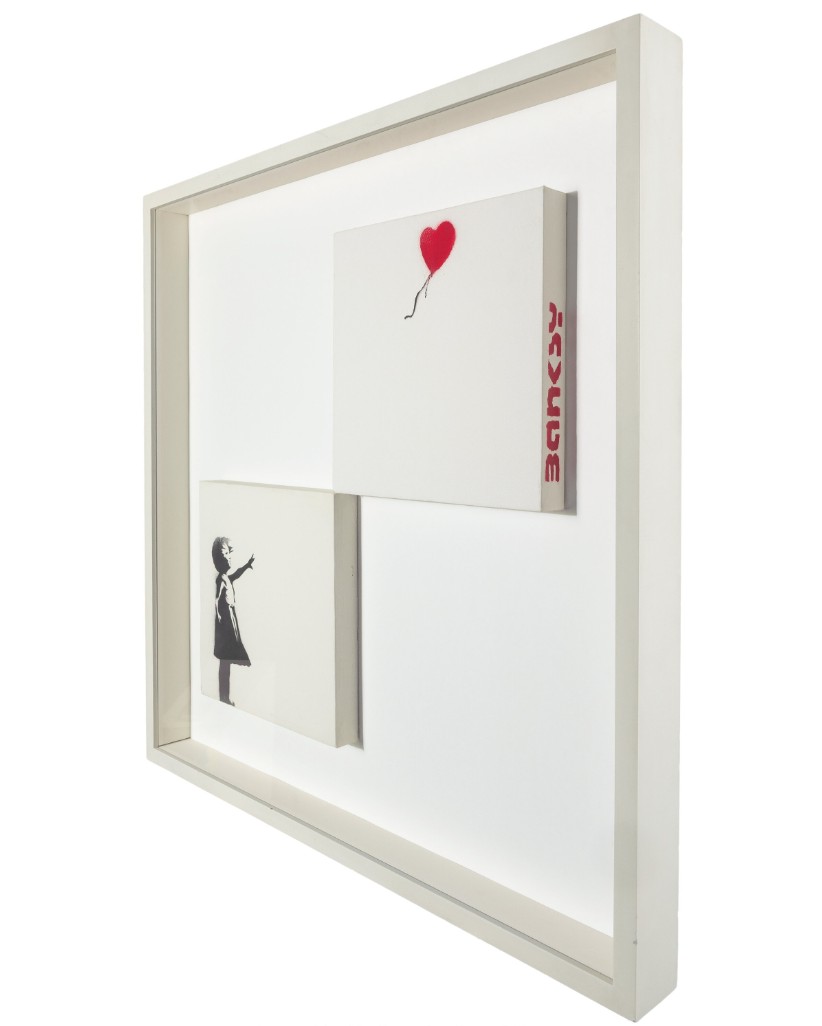
Stenciled “BANKSY” in red spray paint on the turnover edge
Further dated and numbered /25 on the stretcher
The image appears almost absurdly simple. A child reaches outward. The balloon escapes. Yet Banksy has always understood that the shortest visual sentence can sometimes carry the longest emotional echo. The work speaks simultaneously about hope and loss, innocence and fragility, aspiration and disappointment. It can function as a love story, a political statement, or a quiet meditation on human experience. Much like the strongest poetry, it says little and somehow says everything. Rather than presenting Banksy’s famous composition in its familiar form, Girl with Balloon (Diptych) from 2005 disassembles the image itself, almost as if the artist had decided to separate two inseparable elements: desire and object, hope and pursuit, the child and the dream.
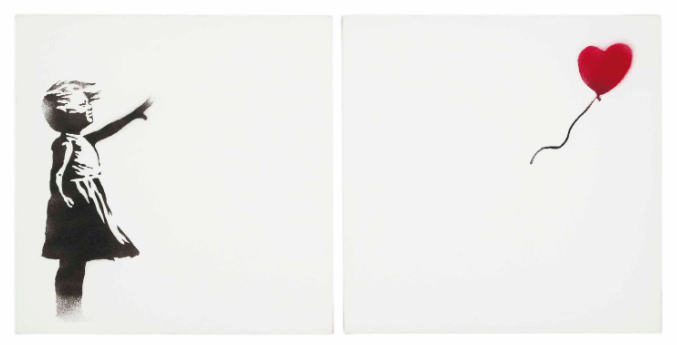
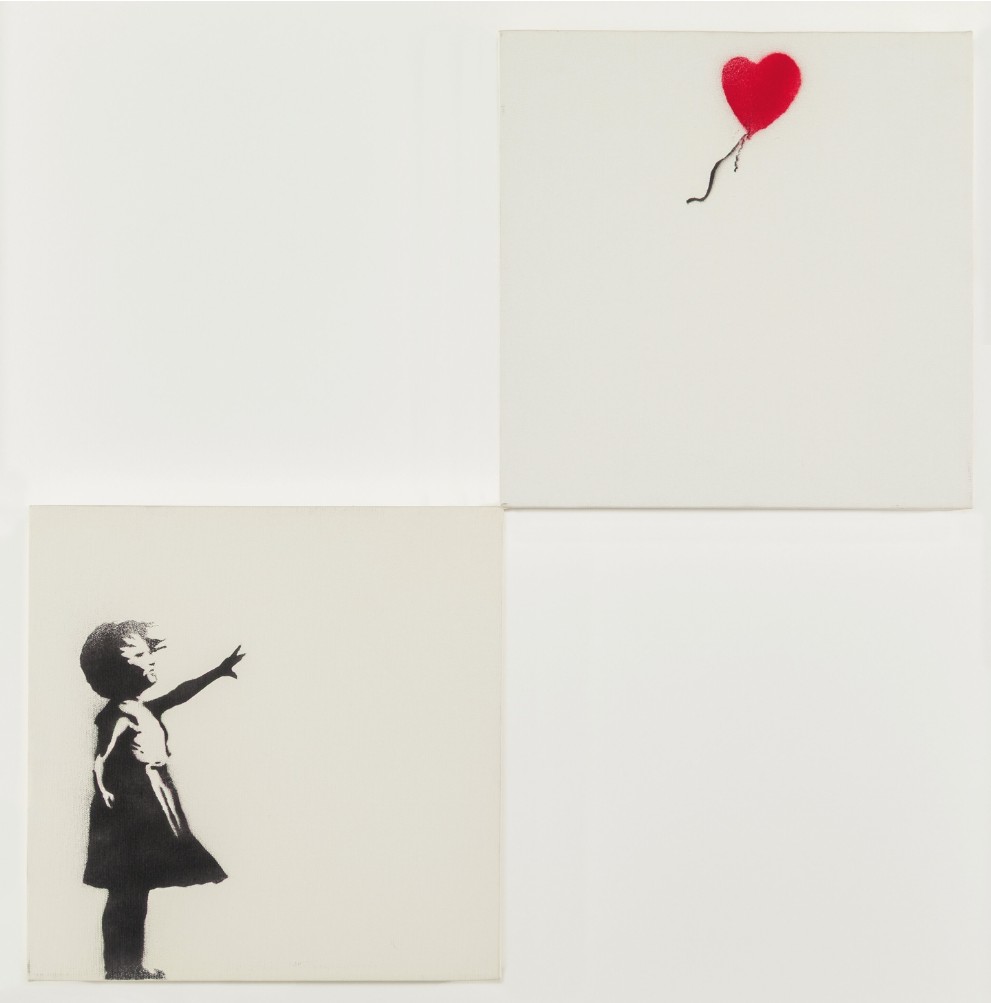
Executed in spray paint across two canvases, each measuring 12 × 12 inches and conceived as a single installation, the work fractures one of Banksy’s most recognizable compositions into two physically independent components. On the lower left canvas stands the iconic silhouette of the girl, her body rendered in Banksy’s stark monochromatic stencil language. Her arm extends upward, fingers reaching into empty space. On the upper right canvas floats the now-famous red heart-shaped balloon, isolated against a field of white.
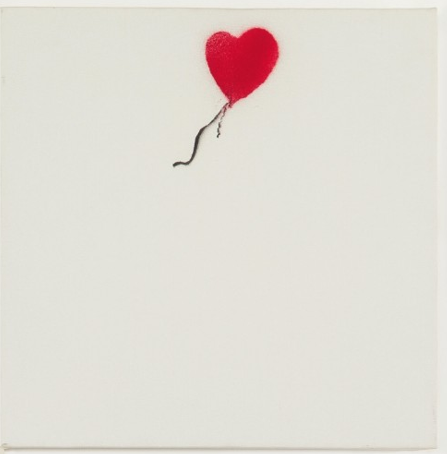
The result is subtle yet surprisingly powerful. In the original composition, the eye immediately connects the child and the balloon. Here, however, Banksy introduces literal distance. The viewer becomes responsible for mentally reconstructing the image. That small shift changes everything.
The empty space between the two canvases suddenly becomes part of the work itself. It becomes absence. It becomes time. It becomes longing. Perhaps even memory. The separation creates tension because the viewer instinctively wishes to reconnect the image, to bridge the gap that Banksy has deliberately created.
Great artists often understand that what is removed can be as important as what is shown.
The work recalls certain conceptual strategies found throughout twentieth-century art. One might think of the fragmentation of form introduced by Pablo Picasso and Georges Braque, where objects were broken apart and reassembled from multiple perspectives. One may also think of the minimalist use of emptiness found in Japanese aesthetics, where negative space becomes an active component rather than a passive background.
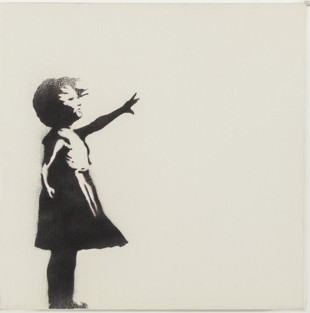
Banksy rarely receives attention for these more formal artistic decisions because his work often arrives disguised as visual jokes or social commentary. Yet Girl with Balloon (Diptych) demonstrates a surprising sophistication beneath the apparent simplicity.
The red balloon itself, the only vivid element in the composition, acquires even greater symbolic force through isolation. Floating independently from the child, it appears less like a toy and more like an autonomous presence. Hope itself seems to have escaped the frame. One cannot help but notice a certain irony as well. Banksy, whose work often criticizes systems of separation — social barriers, political divisions, walls and inequalities — here separates his own most famous image into two distinct entities. He turns viewers into participants, forcing them to complete the work psychologically.
The result feels almost cinematic: a suspended moment between possession and loss, between reaching and letting go. And perhaps that unresolved space between the girl and the balloon is precisely where the emotional power of the image has always existed.
Auction Results
PLEASE CLICK HERE FOR AUCTION RESULTS