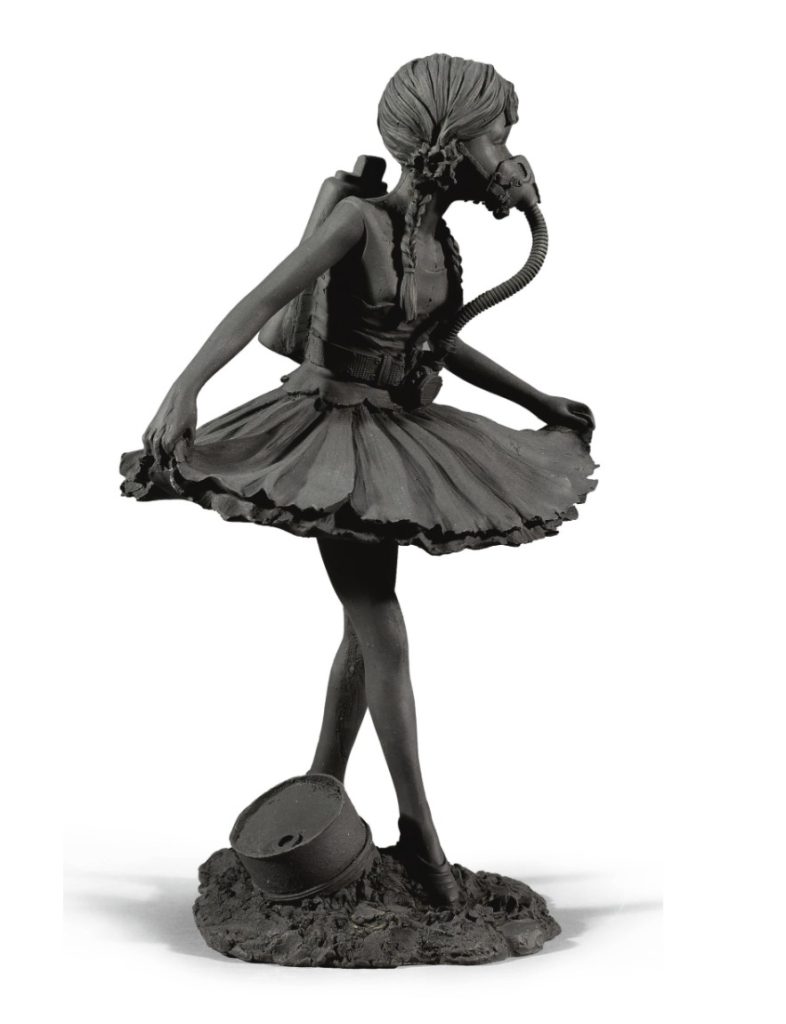
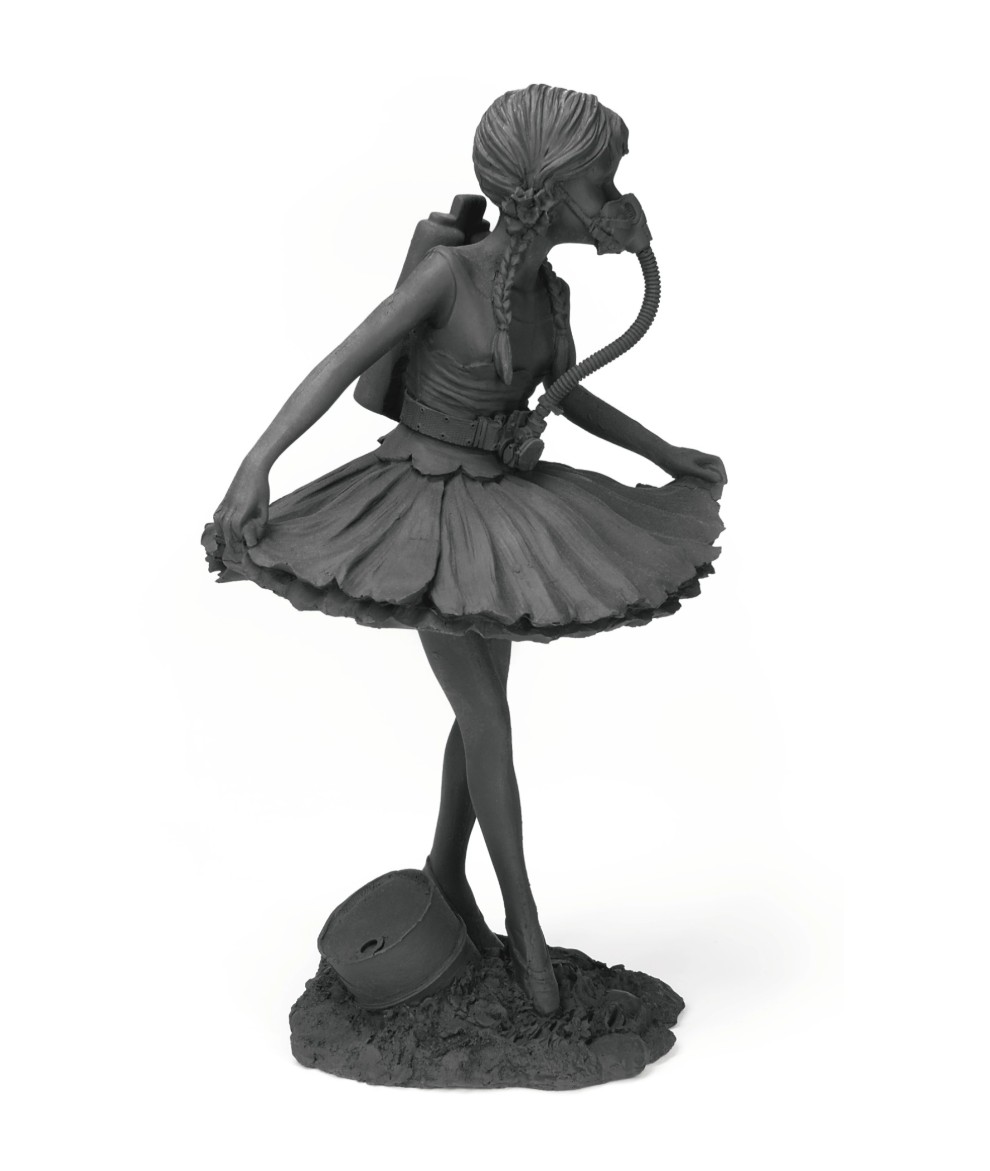
Ballerina with Action Man Parts, 2005
Stamped with the artist’s signature
Exhibited
Crude Oils, London, 2005
Banksy vs. Bristol Museum, Bristol Museum, Bristol, 2009
Banksy: The Unauthorized Retrospective, S/2 London, curated by Steve Lazarides, 2014
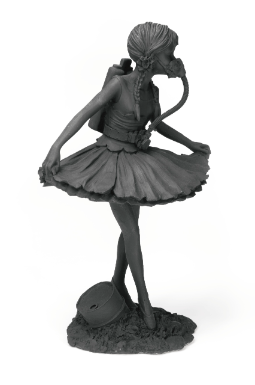
Created in 2005, Ballerina with Action Man Parts is one of Banksy’s most compelling sculptural works, seamlessly combining the grace of classical ballet with the brutal realities of modern warfare. Produced in a small edition of only six examples, the sculpture was first exhibited in Crude Oils, Banksy’s landmark London exhibition, before being included in Banksy vs Bristol Museum (2009) and Steve Lazarides’ Banksy: The Unauthorized Retrospective (2014). Its repeated inclusion in major exhibitions reflects its importance within Banksy’s sculptural oeuvre.
At first glance, the figure immediately recalls Edgar Degas’ celebrated Little Dancer Aged Fourteen, one of the most iconic sculptures in the history of Western art. Like Degas’ young ballerina, Banksy’s figure stands poised in an elegant ballet position, her tutu delicately spread between her hands. Yet any sense of innocence is immediately shattered. Instead of youthful optimism, the dancer wears a military gas mask connected to a breathing apparatus strapped across her back. At her feet lies a discarded oil drum resting upon contaminated ground, while the entire sculpture is cast in a monochromatic industrial grey that evokes ash, concrete and dust rather than flesh.

National Gallery of Art
In a review, J.-K. Huysmans wrote:
“The terrible reality of this statuette evidently produces uneasiness in the spectators; all their notions about sculpture, about those cold inanimate witnesses… are here overturned. The fact is that with his first attempt Monsieur Degas has revolutionized the traditions of sculpture as he has long since shaken the conventions of painting.”
Banksy’s transformation of Degas’ celebrated dancer is both immediate and unsettling. The elegance of classical art collides with the aesthetics of conflict, suggesting that even the most refined expressions of human culture cannot remain untouched by war and environmental destruction. The title itself offers another clue. Ballerina with Action Man Parts alludes to the famous military action figure that became a symbol of post-war childhood. Banksy fuses these two worlds—the fragile ballerina and the toy soldier—into a single hybrid figure, where innocence and militarization become inseparable.
The sculpture emerged during a period when the consequences of the wars in Afghanistan and Iraq dominated public debate. Gas masks had once again become potent symbols of chemical warfare, civilian vulnerability and geopolitical anxiety. The oil barrel beneath the dancer’s feet inevitably recalls the contested relationship between modern warfare and fossil fuels, while also suggesting the polluted landscapes left behind by industrial exploitation. Yet Banksy avoids direct political slogans. Instead, he condenses these anxieties into a single unforgettable image.
Like many of Banksy’s most successful works, the sculpture functions through contradiction. Ballet traditionally represents discipline, beauty and harmony. Military equipment embodies conflict, survival and violence. Their coexistence produces an image that is simultaneously elegant and profoundly tragic. Despite her protective equipment, the ballerina continues to dance. Grace survives, but only under conditions that should make beauty impossible.
The dialogue with Degas is particularly significant. When Little Dancer Aged Fourteen was first exhibited in Paris in 1881, critics were shocked by its unprecedented realism. Degas challenged the academic conventions of sculpture by presenting an ordinary working-class ballet student wearing real fabric and human hair. More than a century later, Banksy performs a similar operation. He appropriates one of the great icons of nineteenth-century sculpture and updates it for the twenty-first century, replacing Victorian realism with the visual language of global conflict and environmental anxiety. Just as Degas revolutionised sculptural representation in his own time, Banksy questions what a contemporary sculpture should represent today.
More broadly, Ballerina with Action Man Parts belongs to a recurring theme that runs throughout Banksy’s career: the collision between childhood innocence and the machinery of war. Whether embracing a bomb instead of a teddy bear, throwing flowers instead of explosives, or here dancing in a gas mask, Banksy’s protagonists repeatedly confront violence without surrendering their humanity. His works rarely depict war itself; rather, they examine how conflict quietly infiltrates everyday life, education, entertainment and even our cultural ideals.

Although produced in an edition of only six, Ballerina with Action Man Parts possesses the presence of a unique museum object. Unlike Banksy’s better-known editions and canvases, it demonstrates his remarkable ability to translate his visual vocabulary into three dimensions without losing any of its conceptual clarity. The sculpture is at once beautiful and disturbing, familiar and deeply unsettling.
Ultimately, Ballerina with Action Man Parts reminds us that civilization often continues to perform its rituals of beauty even as the world around it deteriorates. The dancer remains poised, elegant and disciplined, but she no longer performs upon a theatre stage. She dances through the ruins of the modern world, breathing through a gas mask, balancing gracefully upon the fragile boundary between culture and catastrophe.
Auction Results
Estimated: GBP 70,000 – 90,000
GBP 87,500 / USD 135,070(#360) Banksy
BANKSY
Ballerina, 2005
Painted resin
31x20x18 cm (12-1/4 x 8 x 7 inches)
Signed on the underside
This work is from an edition of 6
Estimated: GBP 40,000 – 60,000
GBP 49,250 / USD
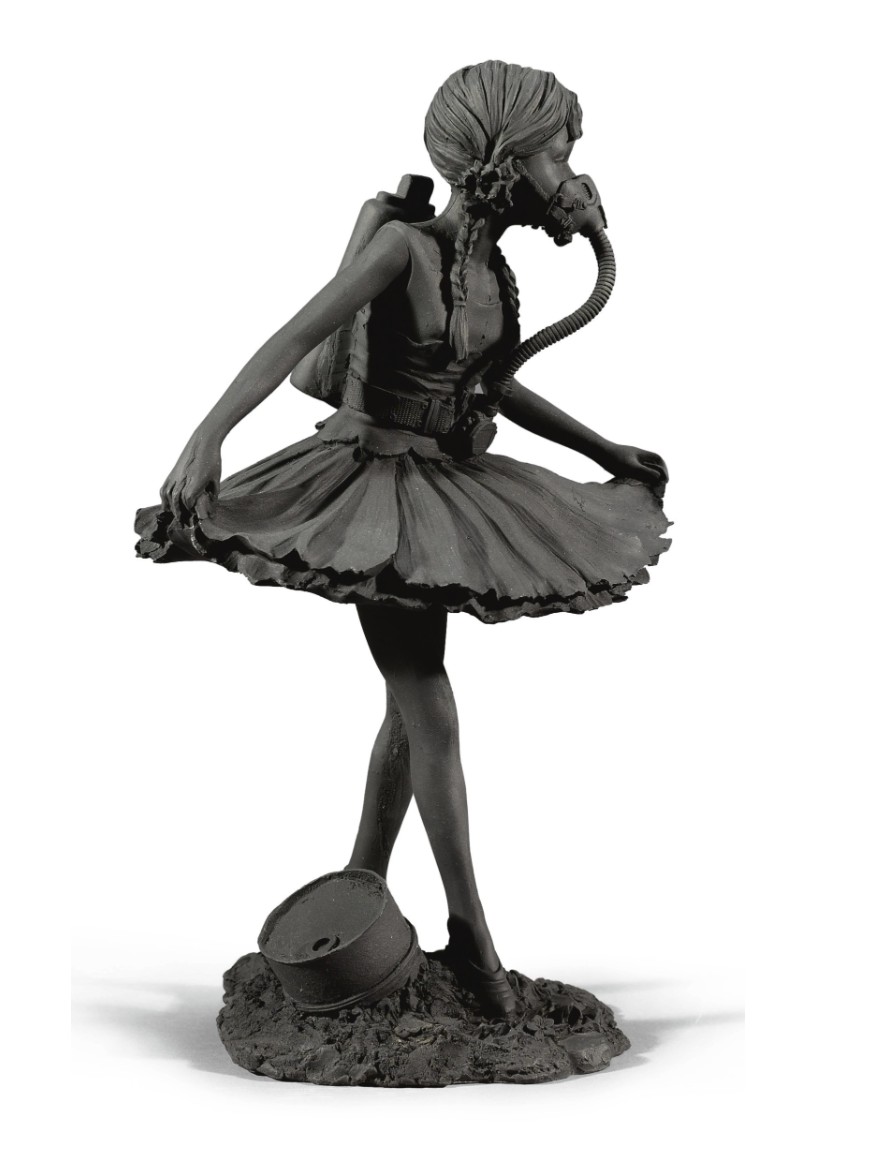
Ballerina with Action Man Parts, 2005
Painted resin
31x20x18 cm (12-1/4 x 7-7/8 x 7-1/8 inches)
Stamped with the artist’s signature
This work is from an edition of 6
Acquired directly from the artist by the present owner