Guantanamo Bay, 2005
Exhibited
Crude Oils, London, 2005
Barely Legal, Los Angeles, 2006
Banksy: The unauthorized retrospective, S/2 London, curated by Steve Lazarides, 2014
Catalogue Note
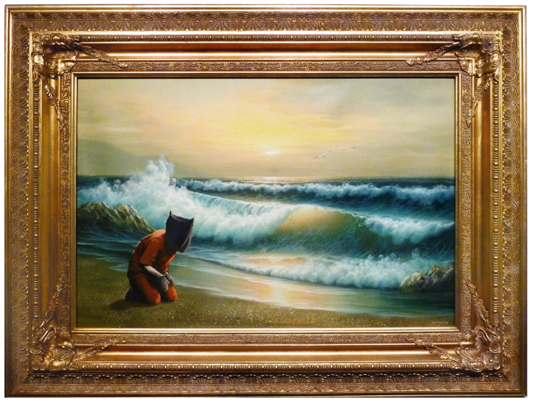
Among the most poignant works in Banksy’s celebrated Crude Oils series, Guantanamo Bay transforms an idyllic nineteenth-century seascape into a powerful meditation on the fragility of human rights in the post-9/11 world. Kneeling on the shoreline, dressed in the now-infamous orange jumpsuit with his hands bound and a black hood covering his face, the solitary prisoner is immediately recognizable as one of the detainees held at the U.S. detention camp in Cuba. His presence shatters the serenity of the landscape, confronting the viewer with the uncomfortable intrusion of political reality into an image traditionally associated with beauty, escape and contemplation.
Like many of Banksy’s finest interventions, the work derives its power from contrast rather than confrontation. The luminous sky, rolling waves and picturesque coastline evoke the timeless language of Romantic landscape painting, yet the anonymous prisoner transforms this peaceful scene into a quiet indictment of torture, indefinite detention and the moral compromises made in the name of security. Rather than depicting violence itself, Banksy focuses on its human consequences, allowing silence and isolation to carry the emotional weight.
Created shortly before Banksy’s now legendary installation of an inflatable Guantánamo detainee inside Disneyland in 2006, Guantanamo Bay marks a pivotal moment in the artist’s engagement with global politics. It demonstrates how the Crude Oils series moved beyond parody of art history to become a vehicle for profound social commentary, proving that even the most tranquil landscape can become a stage upon which the defining ethical questions of our time are played out.