I Fought The Law
Editions
Signed Edition: 150
Unsigned Edition: 500
Artist’s Proofs
71 signed APs
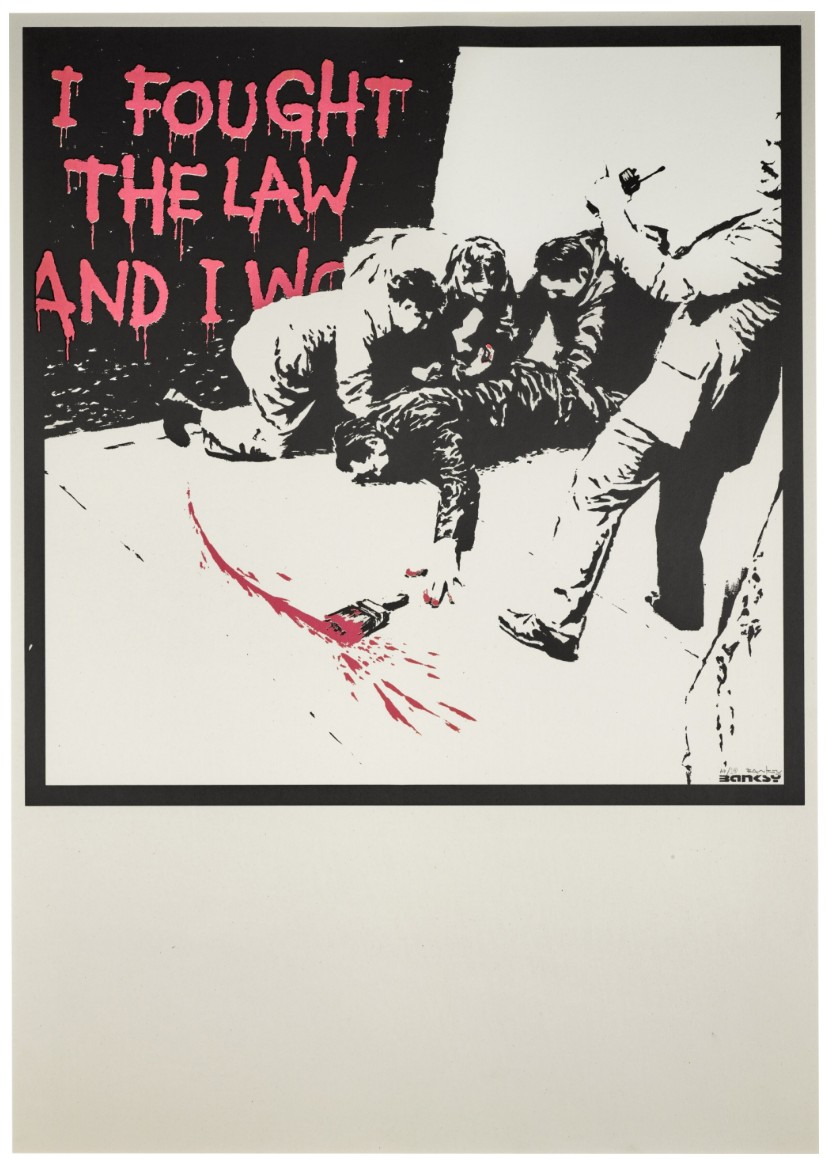
Colors vary throughout the edition: orange, pink, red, yellow and silver
Including 26 uncut APs printed in various color combinations
A Violent Arrest Rewritten
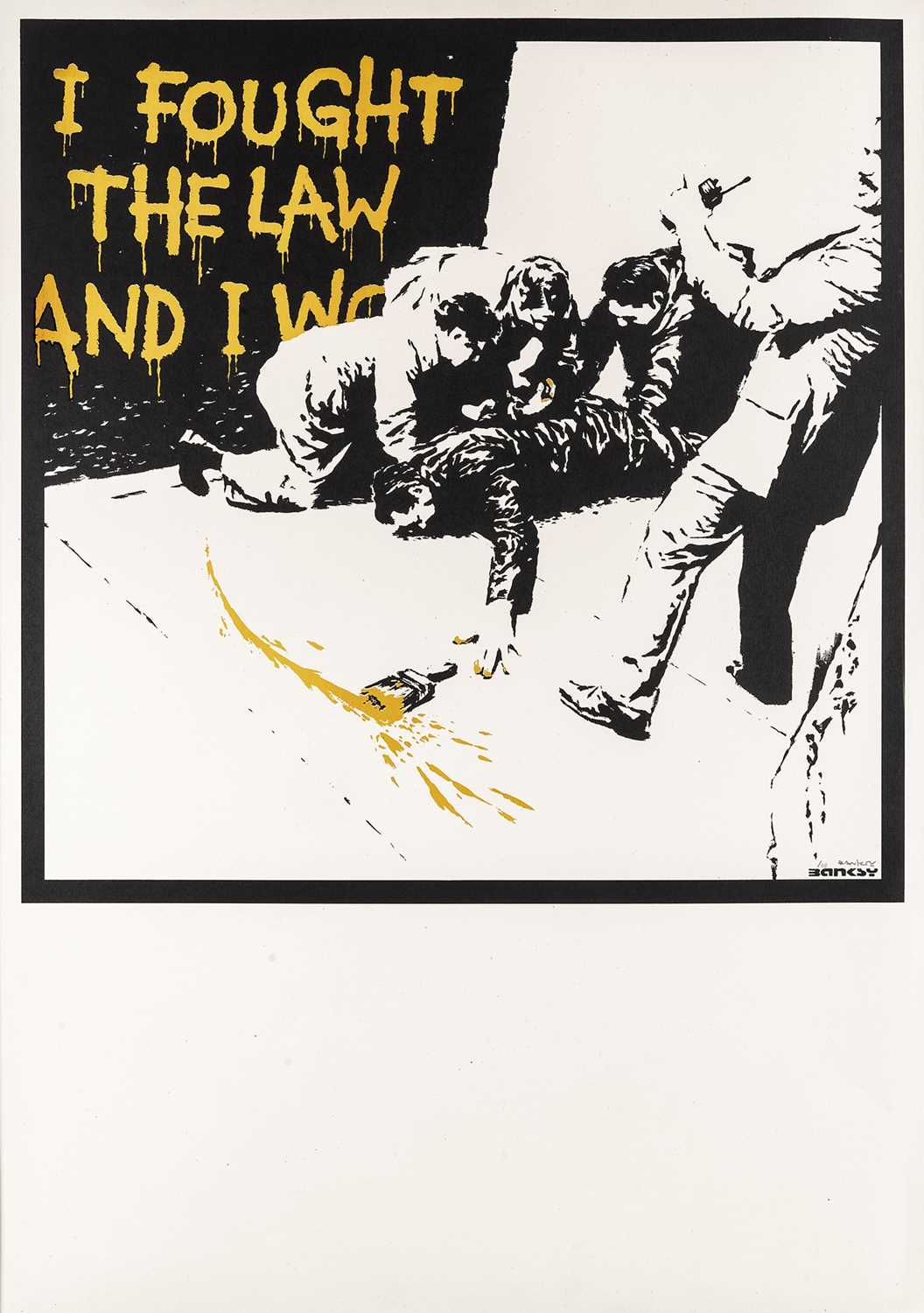
In I Fought the Law, Banksy constructs one of his most explicit and confrontational images, rooted not in abstraction, but in a precise historical reference. The work captures a moment of violence already embedded in collective memory, only to reframe it entirely: the weapon is gone, replaced by a paintbrush, and the criminal becomes an artist. Created in 2004, I Fought the Law, often abbreviated as IFTL, draws directly from video footage of the 1981 assassination attempt on U.S. President Ronald Reagan. The original scene, one of chaos and urgency, is reinterpreted by Banksy with a crucial shift: the act is no longer political violence, but an act of graffiti. Through this substitution, the artist collapses the distance between criminality and artistic expression.
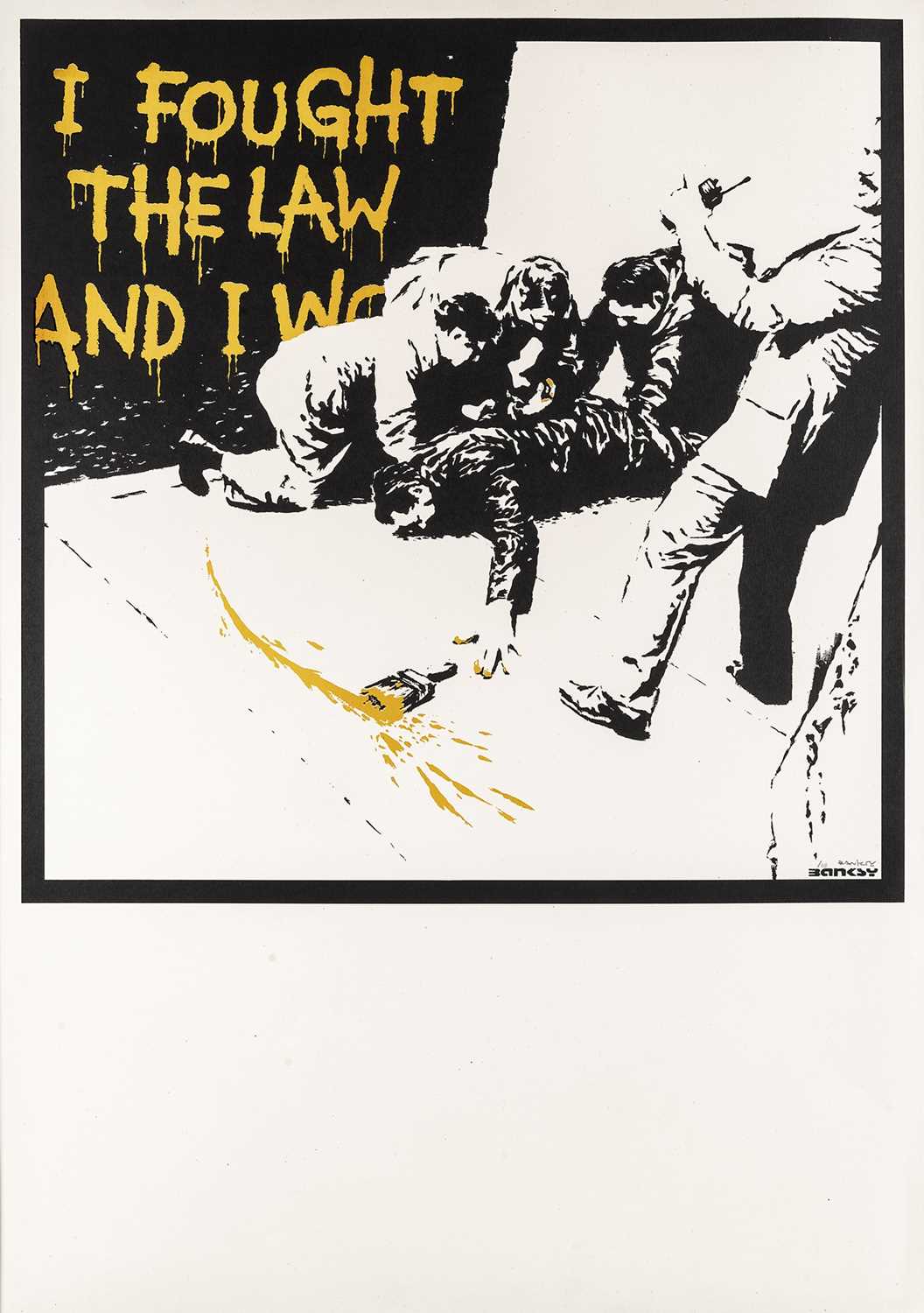
The composition shows a man pinned to the ground by several figures, law enforcement or security forces, caught in the aftermath of an attempted act. The struggle is forceful, unambiguous, and grounded in real-world imagery. Yet Banksy introduces a decisive alteration. Near the man’s hand lies a dropped paintbrush, still trailing bright orange paint across the ground. Behind the scene, the wall bears the freshly written words:
“I FOUGHT THE LAW AND I WON.”
This detail transforms the entire narrative. The act has already taken place: not an attack, but a message. The violence we witness is no longer the cause, but the consequence. In replacing Hinckley’s weapon with a paintbrush, Banksy performs a conceptual inversion. The figure on the ground is no longer an assassin, but a graffiti artist.
This shift is fundamental. It suggests that, in the eyes of authority, the distinction may be thinner than expected. The force used to restrain him echoes the severity reserved for far greater crimes, raising a pointed question: how does society classify acts of expression that defy its rules? Banksy implicitly places himself in this position: the artist as offender, subdued not for violence, but for visibility.
Victory or Defeat? The Ambiguity of Resistance
The central tension of the work lies in its contradiction. The artist is caught, restrained, overpowered. From one perspective, the law has prevailed. The system has reasserted control. And yet, the message is already on the wall. “I fought the law and I won.” This reversal introduces a second reading. The act of expression, once made public, cannot be undone. The arrest becomes secondary to the gesture itself. Banksy leaves the outcome unresolved. Victory is not defined by escape, but by impact.

The title references the song popularized by The Clash, whose refrain, “I fought the law and the law won”, suggests inevitability and defeat. Banksy alters this narrative.

By rewriting the ending directly within the image, he reclaims the phrase, turning resignation into defiance. The work becomes overtly anti-authoritarian, not only criticizing the force of law enforcement, but also exposing how dissent is framed, controlled, and punished.
I Fought the Law stands among Banksy’s most direct and politically charged works. Unlike more symbolic compositions, it anchors itself in a specific historical event, amplifying its impact through precision rather than abstraction. For collectors and observers, it represents a key moment in Banksy’s practice, where the relationship between street art and illegality is not implied, but confronted head-on. It is not merely about rebellion. It is about who defines it, and who gets to win.
I Fought The Law Colorways


I Fought The Law (Yellow), 2004


I Fought The Law (uncut Yellow AP), 2004
I Fought The Law (uncut Pink AP), 2004

Auction Results
PLEASE CLICK BELOW FOR AUCTION RESULTS