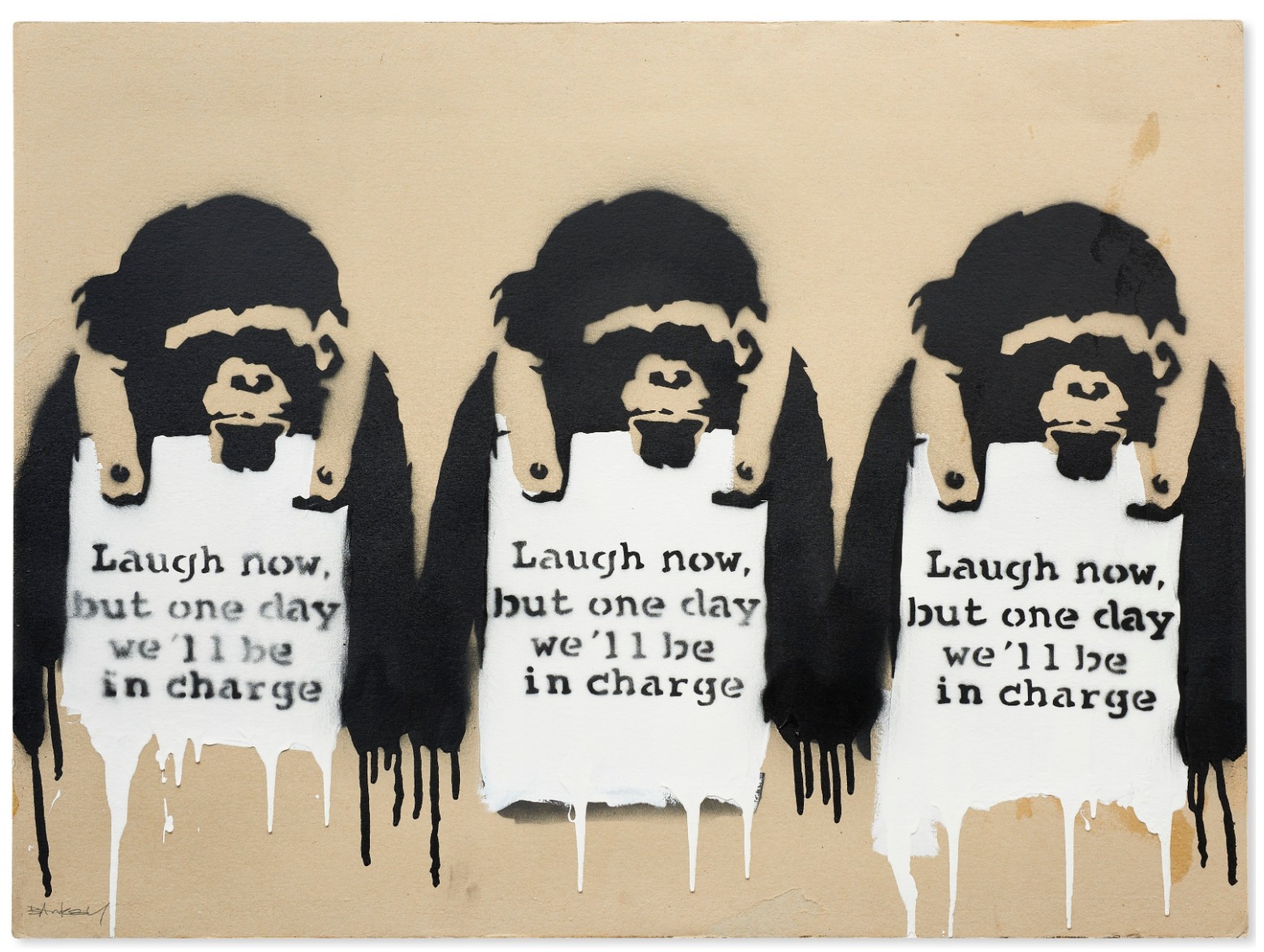
Laugh Now But One Day We’ll Be In Charge, 2002
Andipa Gallery, London
Acquired from the above by the present owner, 2007
Auction History
| Christie’s New-York 11 May 2021 Est.: USD 2,000,000 – 3,000,000 |
Price Realized USD 2,070,000 |
Catalogue Note
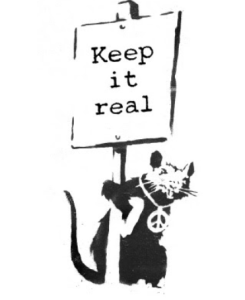
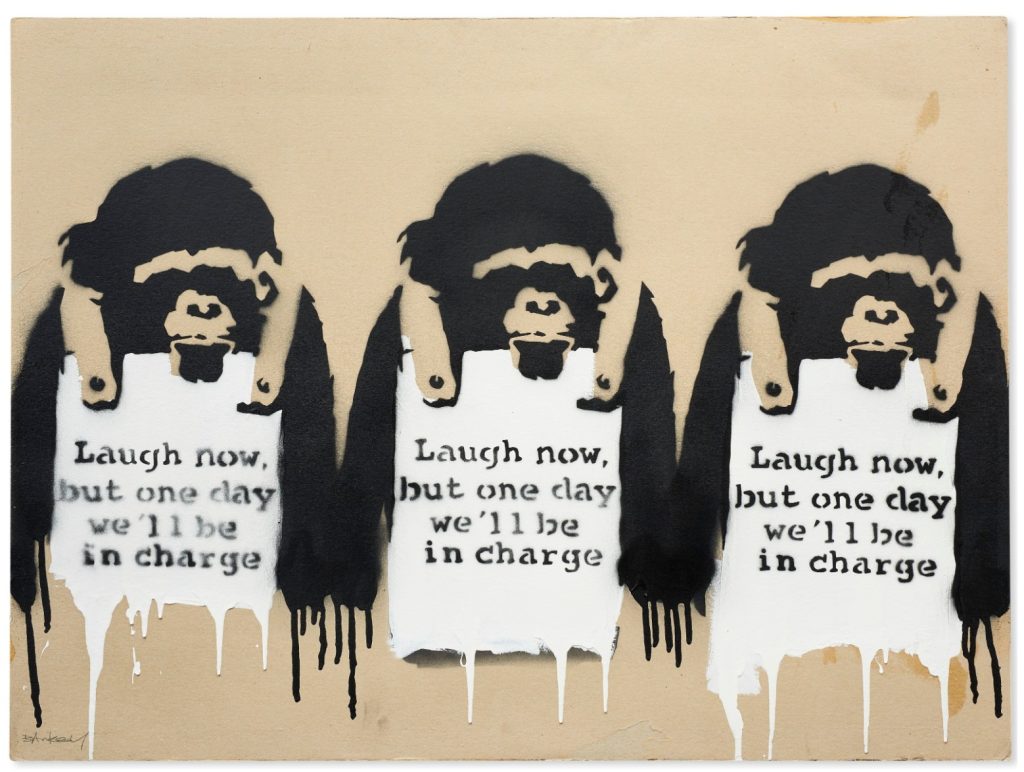
Few images have become as inseparable from Banksy’s artistic identity as Laugh Now. Alongside Girl with Balloon, Love is in the Air and the Rat, the melancholy chimpanzee has become one of the defining icons of contemporary art. First conceived as a mural commissioned in 2002 for the Brighton nightclub Ocean Rooms, the image depicts a procession of monkeys wearing sandwich boards bearing the now famous inscription: “Laugh now, but one day we’ll be in charge.” Simple in appearance yet remarkably layered in meaning, the work encapsulates Banksy’s ability to transform satire into modern mythology.
The present work belongs to the earliest and most important painted iterations of the composition. Executed the same year as the original mural, it retains the raw immediacy of Banksy’s street practice. Three chimpanzees stand shoulder to shoulder against an unadorned background, their bodies rendered in stark black stencil while the white placards drip with fresh paint, preserving the physical language of graffiti. Their expressions are neither aggressive nor comic. Heads bowed and shoulders slumped, they appear resigned to a fate imposed upon them, silently carrying a message whose significance seems to extend far beyond the words themselves.
The monkey occupies a unique position within Banksy’s visual vocabulary. If the rat represents the anonymous outsider and the policeman institutional authority, the monkey embodies obedience. Throughout history, monkeys have been employed as symbols of imitation, entertainment and submission, trained to perform for the amusement of others while remaining deprived of genuine agency. Banksy quietly overturns that tradition. His chimpanzees are no longer comic performers but witnesses. They endure humiliation today while calmly predicting tomorrow’s reversal of fortune. The sentence upon their placards is not a threat. It is a prophecy.
The origins of the image are closely tied to Banksy’s fascination with performance and spectatorship. Installed inside a busy nightclub, the original mural watched over crowds seeking distraction and entertainment. Few patrons could have imagined that the silent monkeys observing them from the walls would eventually become one of the defining images of twenty-first-century art. Banksy repeatedly returns to this idea throughout his career: those dismissed, ignored or ridiculed by society often become the very agents of its transformation. The same inversion appears in his rats, his children confronting soldiers, and ultimately in Devolved Parliament, where chimpanzees literally assume control of the House of Commons. Seen in retrospect, Laugh Now was not merely an isolated image but the beginning of a narrative that Banksy would continue developing for more than two decades.
The phrase itself deserves particular attention. “Laugh now, but one day we’ll be in charge.” At first it resembles little more than a witty punchline. Yet its ambiguity is precisely its strength. Who are “we”? The monkeys? Artists? Outsiders? The working class? Artificial intelligence? Future generations? Banksy deliberately refuses to specify. The sentence functions less as political slogan than universal warning, reminding every generation that power is never permanent. Those who laugh today may themselves become tomorrow’s spectacle.
The work also invites broader historical reflection. Charles Darwin fundamentally challenged humanity’s conception of itself by demonstrating our biological kinship with the great apes. Banksy transforms that uncomfortable truth into political satire. His monkeys are not simply our evolutionary cousins; they become mirrors. The distinction between human civilization and animal instinct begins to collapse, exposing the fragility of the hierarchies upon which modern societies so confidently rely. Like George Orwell before him in Animal Farm, Banksy uses animals not to escape politics but to illuminate it.
More than twenty years after its creation, the painting feels less like satire than observation. Banksy understood that history rarely moves in straight lines. Political systems change. Empires collapse. Cultural values evolve. Those occupying the margins often become tomorrow’s establishment, while today’s certainties quietly dissolve. The monkeys never needed to shout. They simply waited. And perhaps that is the quiet genius of Laugh Now. It is not a painting about monkeys at all. It is a painting about us.