BANKSY
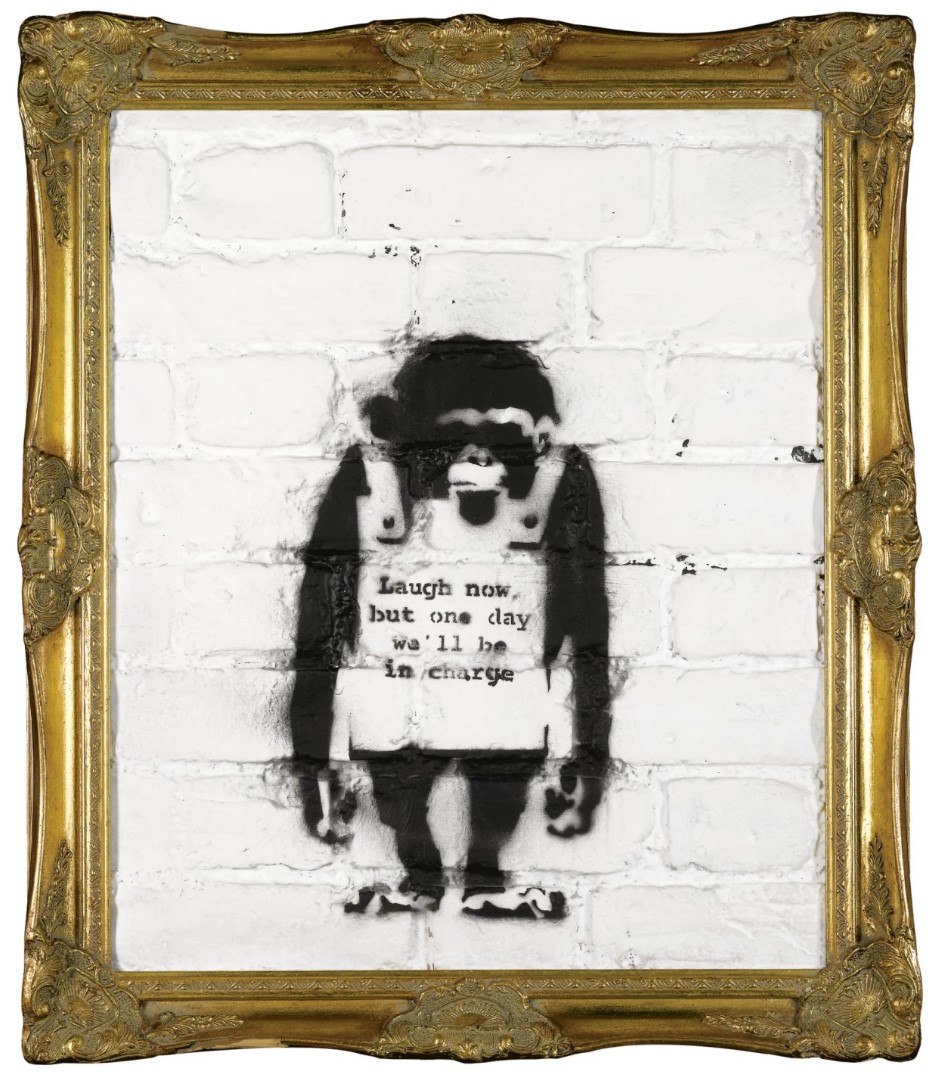
Laugh Now But One Day We’ll Be In Charge, circa 2002
Acrylic and spraypaint stencil on cast plaster on board in artist’s frame
61 x 50.7cm (24×20 inches)
Stenciled with the artist’s signature on the reverse
Provenance
Acquired directly from the artist by the present owner in 2002
Auction History
| Sotheby’s London 20 October 2008 Est.: GBP 60,000 – 80,000 | Price Realized |
Catalogue Note
Executed circa 2002, Laugh Now But One Day We’ll Be In Charge is one of the most compelling early interpretations of Banksy’s defining monkey motif. Rather than presenting the image on a conventional canvas or industrial support, Banksy spray-painted the stencil directly onto cast plaster moulded to resemble a brick wall, preserving the physical character of the urban surfaces upon which his earliest works first appeared. More than a painted object, this work recreates the experience of encountering graffiti in the street while simultaneously transforming it into a unique gallery piece.
The illusion is remarkably convincing. Every brick, mortar joint and irregular surface has been carefully reproduced, allowing the stencil to interact with the relief exactly as it would on an exterior wall. The slight interruptions in the spray paint, the uneven texture and the softened edges created by the raised brickwork reinforce the authenticity of the image, reminding the viewer that Banksy’s visual language was born not on canvas but on the fabric of the city itself.
This emphasis on materiality fundamentally distinguishes the work from other early Laugh Now paintings. Here, the support is no longer a passive surface but an active participant in the composition. Banksy does not simply transfer graffiti into the gallery; he reconstructs its original environment. The brick wall becomes both subject and support, preserving the inseparable relationship between stencil and architecture that defines street art.
The richly ornamented gilded frame introduces a further layer of irony. Traditionally reserved for Old Master paintings and official portraits, it surrounds an image originally conceived as an illegal intervention upon an anonymous urban wall. The deliberate contrast between the refined elegance of the frame and the rough immediacy of the plaster creates one of Banksy’s favourite paradoxes: the collision between institutional art history and the anti-establishment language of graffiti. Rather than disguising this contradiction, Banksy celebrates it, questioning where artistic value truly resides—in the image, the object or the institution that chooses to display it.
The monkey itself remains one of Banksy’s most enduring and psychologically complex creations. Its slumped shoulders suggest resignation, yet its planted stance and quietly clenched hands convey determination rather than defeat. The famous placard—“Laugh now, but one day we’ll be in charge”—continues to oscillate between humour, warning and prophecy, its meaning acquiring new resonance with each passing year. Removed from the street yet still standing against its familiar brick wall, the figure appears caught between two worlds, embodying the very transition that Banksy’s own career would soon undergo.
Viewed today, this work possesses an almost self-reflexive quality. Created at a time when Banksy remained an anonymous street artist, it anticipates the journey of graffiti itself from the margins of urban culture into the world’s leading museums and private collections. By preserving the texture of the wall while enclosing it within an ornate gilt frame, Banksy does not simply exhibit street art—he invites us to question the very boundaries between vandalism and heritage, ephemerality and permanence, the street and the gallery.
Among the earliest and most inventive variations of the Laugh Now series, this work demonstrates Banksy’s extraordinary ability to transform not only an image but also its physical context into an essential part of the artistic experience. It reminds us that, for Banksy, the wall was never merely a place to paint—it was always part of the artwork itself.