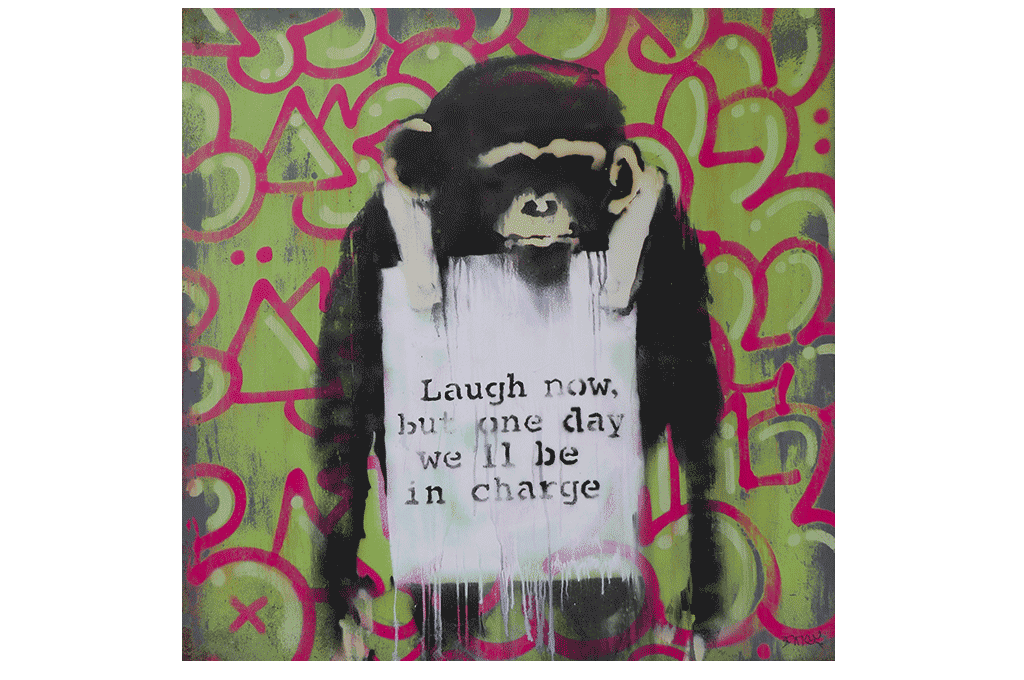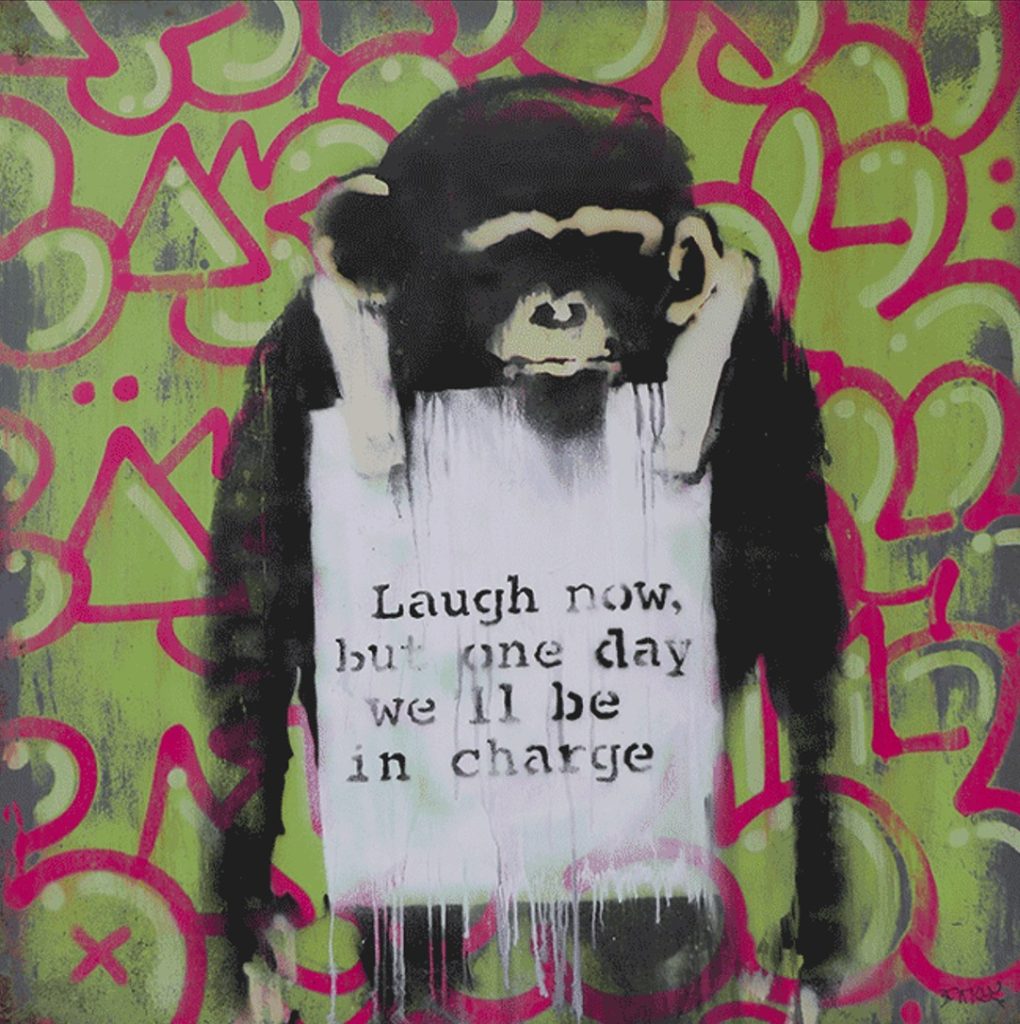
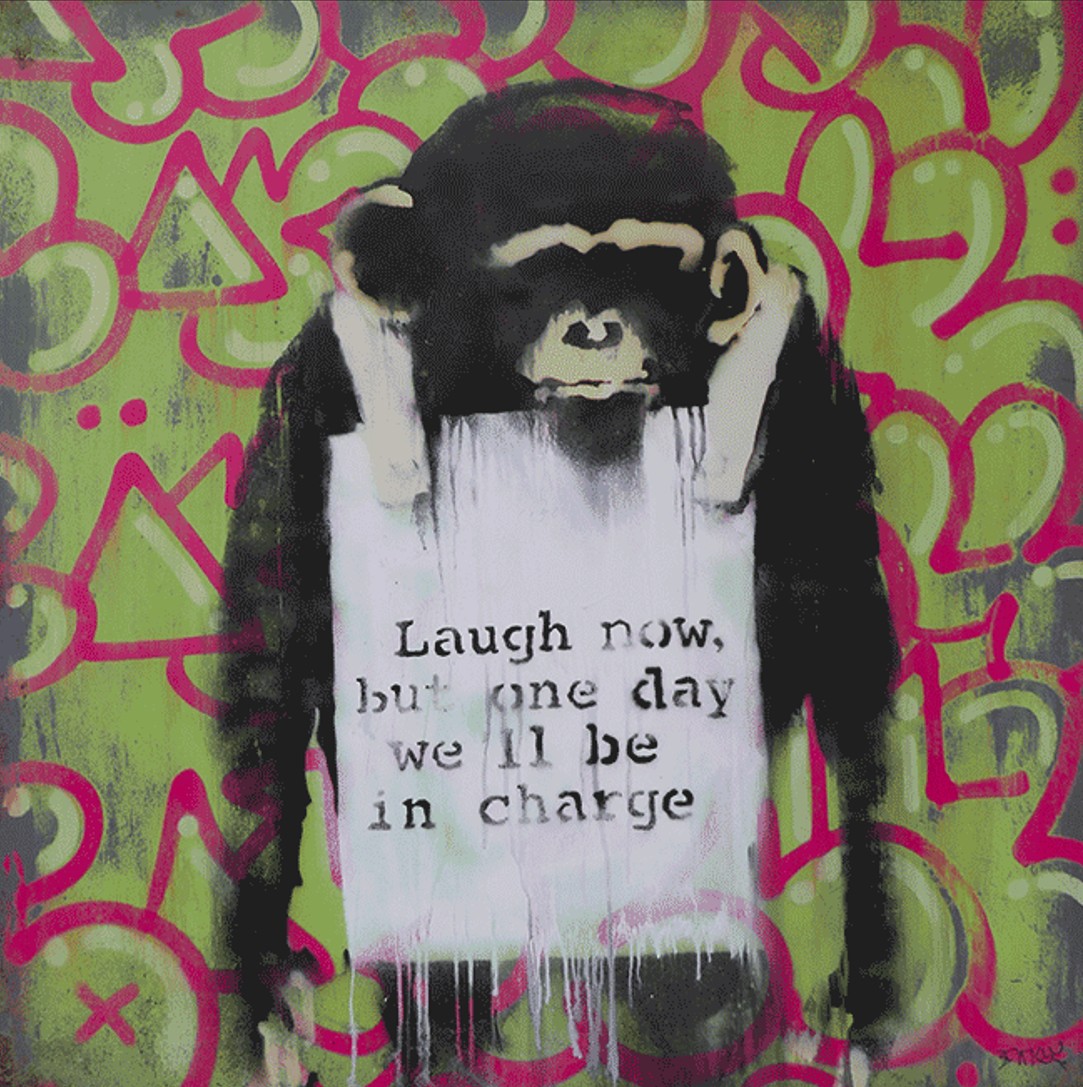
Laugh Now But One Day We’ll Be In Charge, 2008
Spray-paint on found steel
Catalogue Note
By 2008, Laugh Now had already become one of Banksy’s defining images. Yet this unique work on found steel demonstrates that the artist never regarded his most iconic motifs as fixed compositions. Instead, he continually reinvented them, allowing each new support and setting to reshape their meaning.
The familiar chimpanzee wearing the sandwich board proclaiming “Laugh now, but one day we’ll be in charge” remains the emotional center of the composition. Behind him, however, the pristine white background of earlier versions has disappeared. In its place erupts a vibrant field of fluorescent green covered with exuberant pink graffiti. The monkey no longer exists in isolation; he has returned to the visual environment from which he originally emerged. The polished gallery image has been reclaimed by the street.
This transformation is significant. Throughout Banksy’s career, graffiti has functioned not merely as decoration but as the language of urban dissent. By placing the chimpanzee against a wall of spontaneous tags and abstract forms, Banksy reconnects one of his most celebrated creations with the raw energy of graffiti culture. The work reminds us that before Laugh Now became an internationally recognized icon, it was first conceived as an act of illegal public intervention.
The use of found steel reinforces this return to the city’s physical fabric. Unlike canvas, steel carries its own history. It bears the marks of industry, construction, decay and urban life. Banksy repeatedly chose reclaimed metal during this period, transforming discarded industrial materials into works of art without erasing their previous existence. The support itself becomes part of the narrative, blurring the distinction between artwork and fragment of the street.
The vivid graffiti background also introduces an intriguing paradox. The monkey’s message speaks of future revolution—“one day we’ll be in charge”—while the surrounding tags evoke the visual language of youthful rebellion. Yet both have already been absorbed into the contemporary art market. The once-subversive imagery now hangs inside galleries and private collections. Rather than undermining the work, this contradiction becomes one of its central themes. Like Morons, Banksy acknowledges that resistance itself can become collectible.
Within Banksy’s oeuvre, the monkey has always served as humanity’s mirror. From Monkey Queen to Monkey Parliament, primates expose the absurdity of human ambition, politics and social hierarchies. Here, however, the chimpanzee appears almost melancholic. His posture is resigned rather than confrontational, while the dripping paint softens the slogan into something closer to prophecy than protest. The future he predicts may no longer be revolutionary; it may simply be inevitable.
This version also encapsulates one of Banksy’s greatest achievements. During the first decade of his career, he accomplished what few street artists had managed before him: he transported graffiti into museums and auction houses without allowing it to lose its visual identity. The graffiti remains graffiti. The monkey remains a street intervention. Only the context has changed.
Ultimately, Laugh Now But One Day We’ll Be In Charge is about more than the relationship between humans and monkeys. It is about outsiders and insiders, the margins and the establishment, rebellion and acceptance. The fluorescent background becomes a reminder that beneath every celebrated Banksy masterpiece still lies the visual language of the street. The monkey may have entered the museum, but the wall came with him.