BANKSY
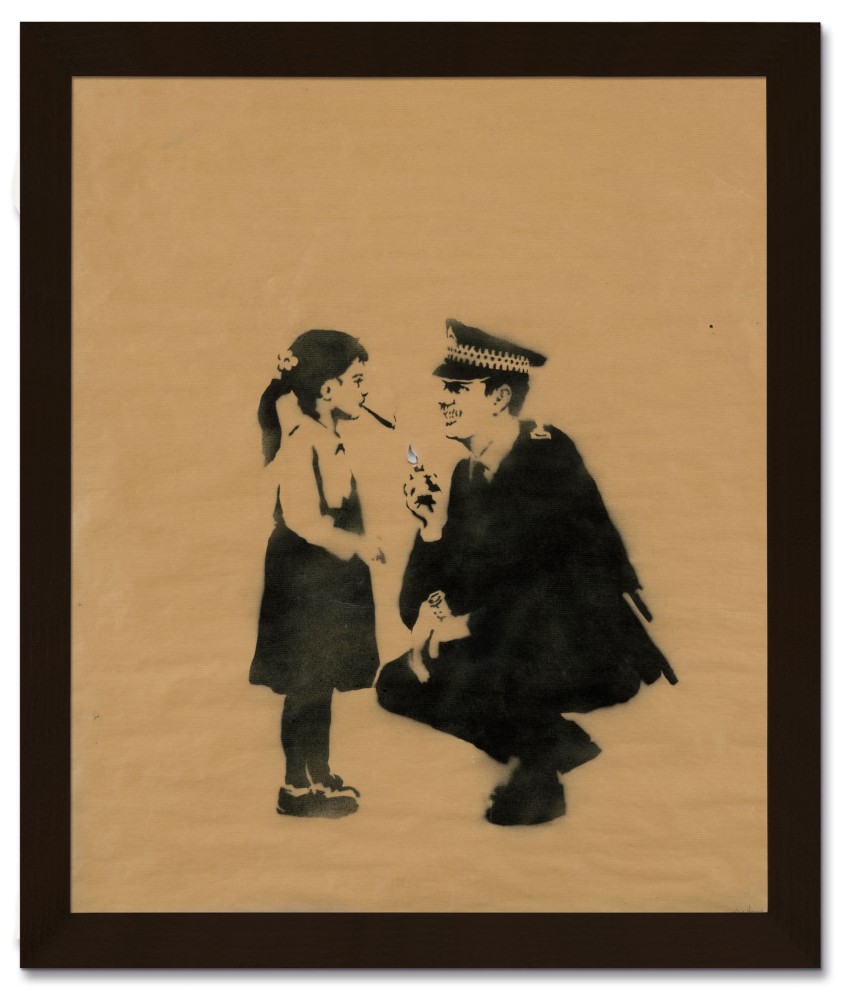
Lost Children’s Sign from Glastonbury Festival (Sketch), 2005
Lost Children’s Sign from Glastonbury Festival (Sketch), 2005
Spray paint on packing paper
89×81 cm (35 x 31 7/8 inches)
Signed and dated ‘BANKSY 2005’ (lower right)
Provenance
Haunch of Venison, London
Vanmoerkerke Collection, Belgium (aquired from the above)
His sale, Phillips London, 3 April 2008, lot 19
Andipa Gallery, London
Acquired from the above by the present owner in 2009
Haunch of Venison, London
Vanmoerkerke Collection, Belgium (aquired from the above)
His sale, Phillips London, 3 April 2008, lot 19
Andipa Gallery, London
Acquired from the above by the present owner in 2009
Auction History
| Christie’s London 25 March 2021 Est.: GBP 200,000 – 300,000 |
Price Realized GBP 525,000 / USD 719,000 BANKSY| Christie’s |
REPEAT SALE
| Phillips London 3 April 2008 Est.: GBP 30,000 – 50,000 |
Price Realized
GBP 58,100 / USD 115,960
|
Catalogue Note
In Banksy’s Lost Children’s Sign from Glastonbury Festival (Sketch) (2005), a grinning policeman bends down to light up a spliff in the mouth of a young girl. Created as part of an intervention at the 2005 Glastonbury Festival—which also included a tent lifted into the sky by helium balloons—it is an instantly recognizable example of the artist’s anti-establishment wit. This would not be the last time Banksy made an appearance at Glastonbury: in 2019, he created the iconic Union Jack stab-proof vest worn by rapper Stormzy for his headline performance on the Pyramid Stage.
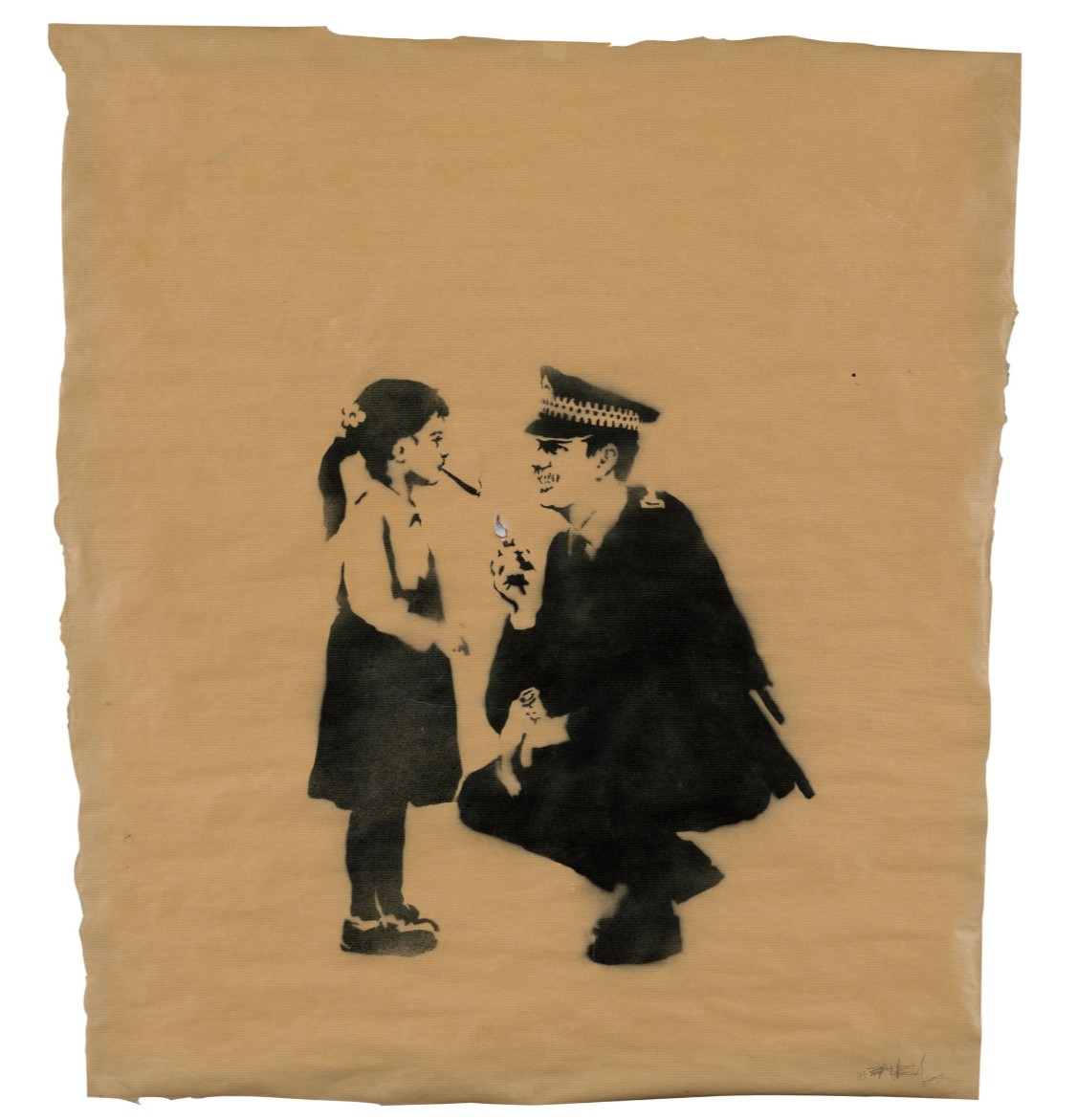
Banksy has depicted policemen in many of his best-known images, including Snorting Copper and Kissing Coppers, which first appeared on walls in London and Brighton in 2005. In counterpart to these subverted authority figures, perhaps his most famed stencil of all is Girl with Balloon (2002), which resonates with viewers worldwide as an emblem of hope and innocence. Lost Children’s Sign from Glastonbury Festival (Sketch) juxtaposes these two central Banksy characters to create a striking satirical vision, with the long arm of the law made gleefully demonic.
“Imagine a city where graffiti wasn’t illegal,’ he has written, ‘a city where everybody could draw wherever they liked. Where every street was awash with a million colors and little phrases. Where standing at a bus stop was never boring. A city that felt like a party where everyone was invited, not just the estate agents and barons of big business. Imagine a city like that and stop leaning against the wall—it’s wet.”
Banksy’s characteristic use of stencils, as seen in the present work, was first inspired by a run-in with the police at eighteen. Fleeing the Bristol constabulary one evening, he hid underneath a garbage truck where he studied the lettering on the side of the cabin door. Immersing himself in the thriving graffiti scene of his native city, he began to stencil on walls, trains and unlikely public spaces, working across the UK and the wider world as his ambition grew. His fascination with the motif of the police officer, in this regard, may be understood in relation to the apparent lawlessness of his own practice.