MOBILE LOVERS
Together, but Somewhere Else
Mobile Lovers appeared in April 2014 on a doorway in Clement Street, Bristol, close to the Broad Plain Boys’ Club. Banksy first revealed the work by publishing a photograph on his website on 14 April without identifying its location; it was found in Bristol shortly afterwards.
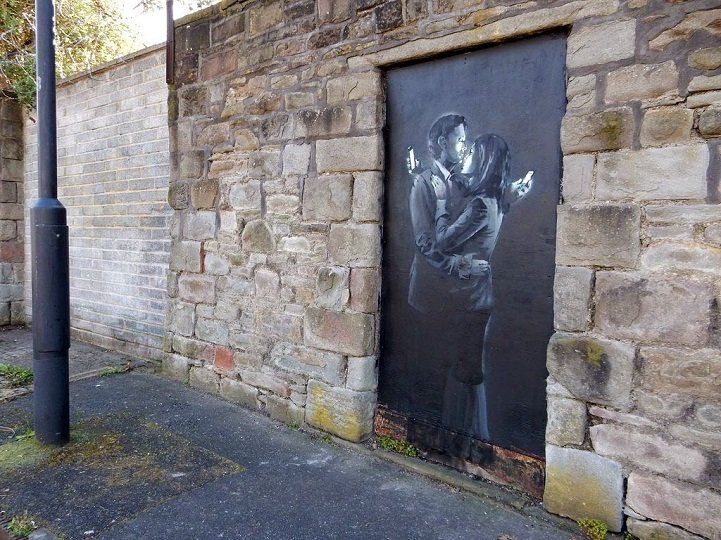
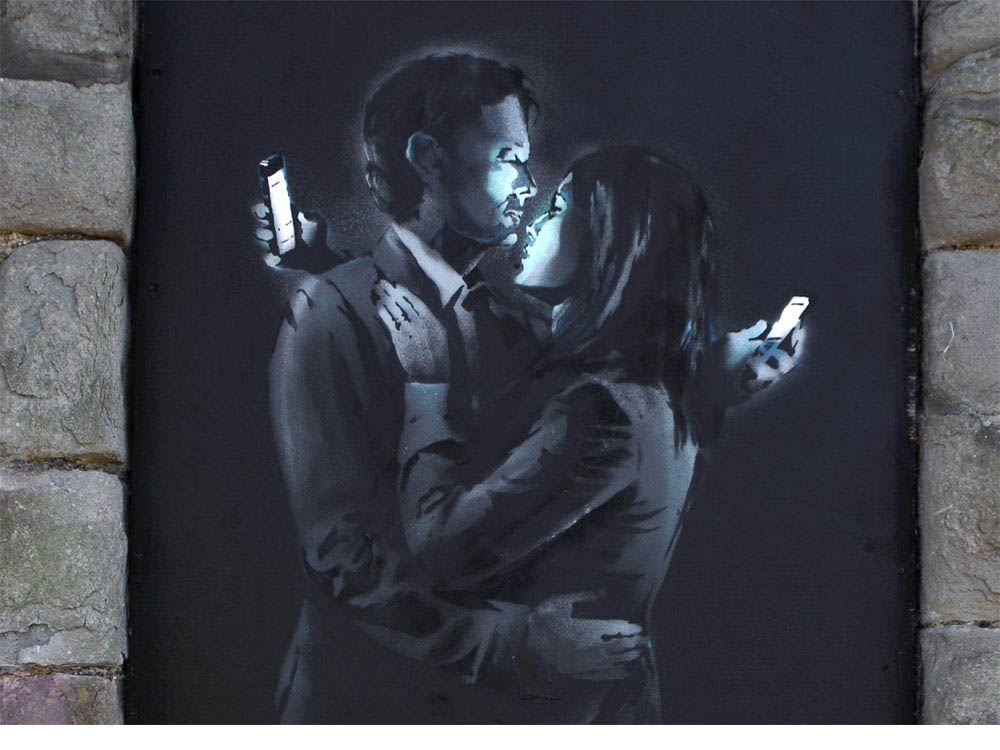
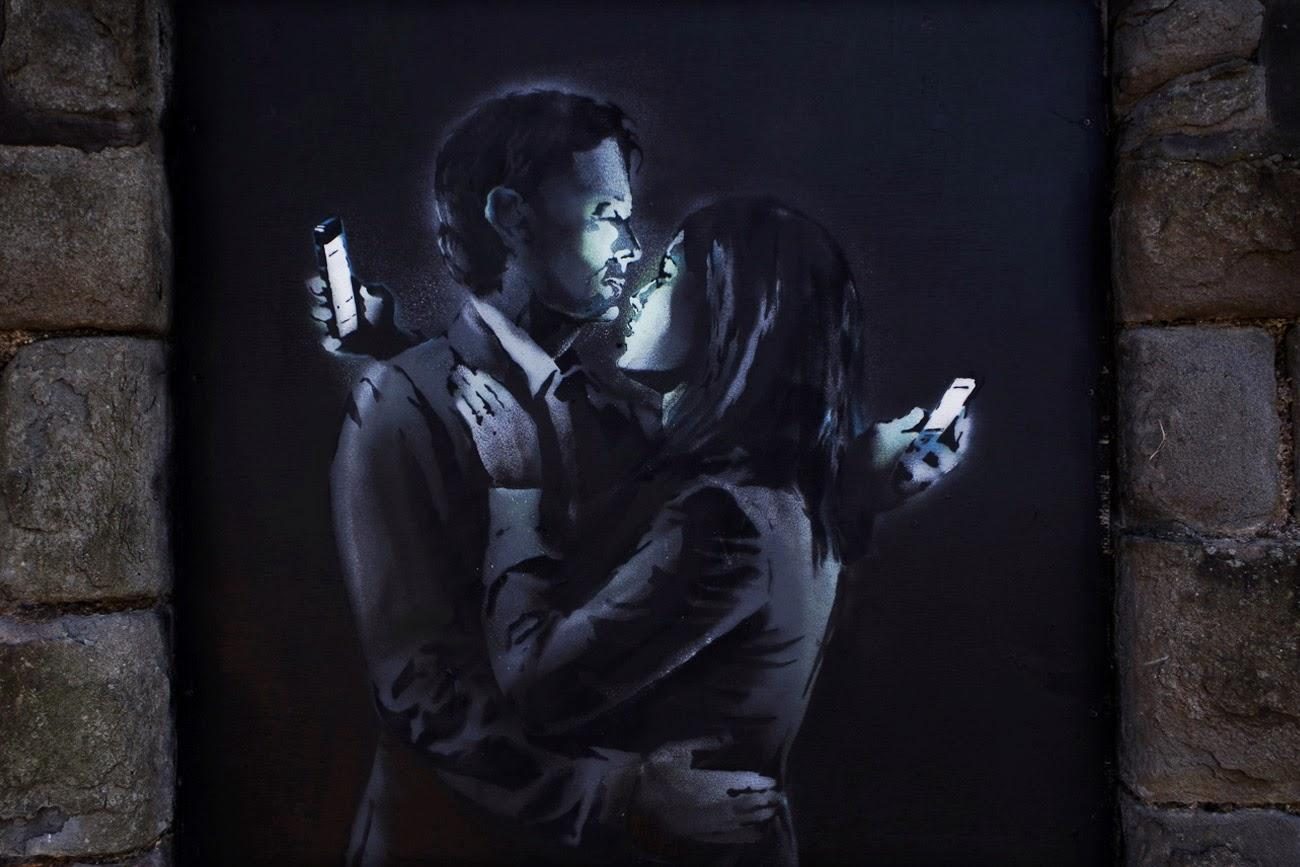
The image depicts a man and woman locked in an apparently intimate embrace. Their bodies touch and their faces almost meet, yet each looks past the other toward the illuminated screen of a mobile phone concealed behind their partner’s back. Banksy constructs the composition around this contradiction: physically the couple could hardly be closer, but psychologically their attention is elsewhere.
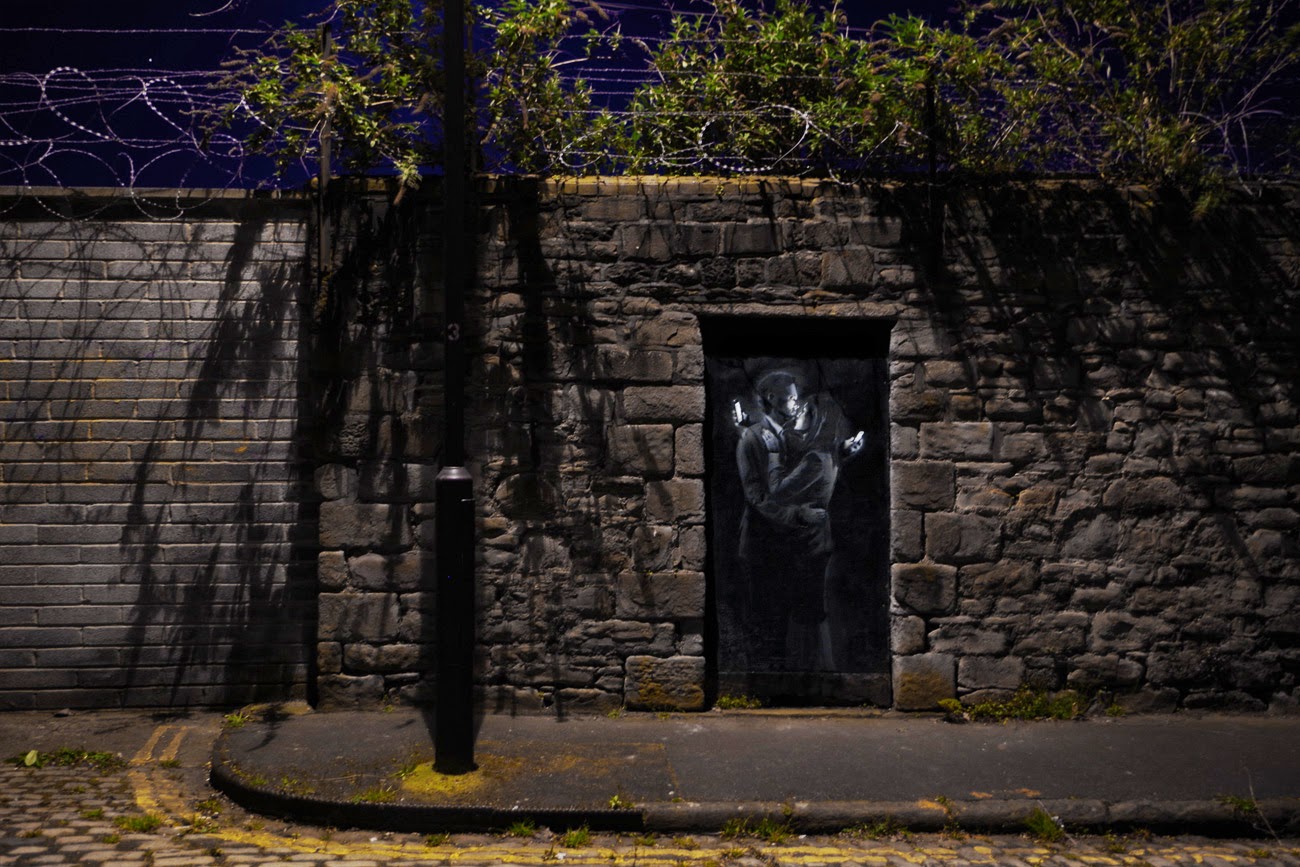
The setting intensifies the effect. Emerging from the darkness of the doorway, the two faces are illuminated by the pale blue-white glow of their screens. What initially resembles romantic lighting is therefore generated by the very devices separating them. The smartphones are small details within the composition, but their light determines where both figures look and consequently controls the entire emotional structure of the image.
Intimacy in the Smartphone Age
Created at a moment when smartphones and social media had rapidly become embedded in everyday life, Mobile Lovers is among Banksy’s most direct observations of technology’s effect on human behavior. There is no slogan because none is required. The contradiction between the embrace and the diverted gaze communicates the idea almost instantaneously.
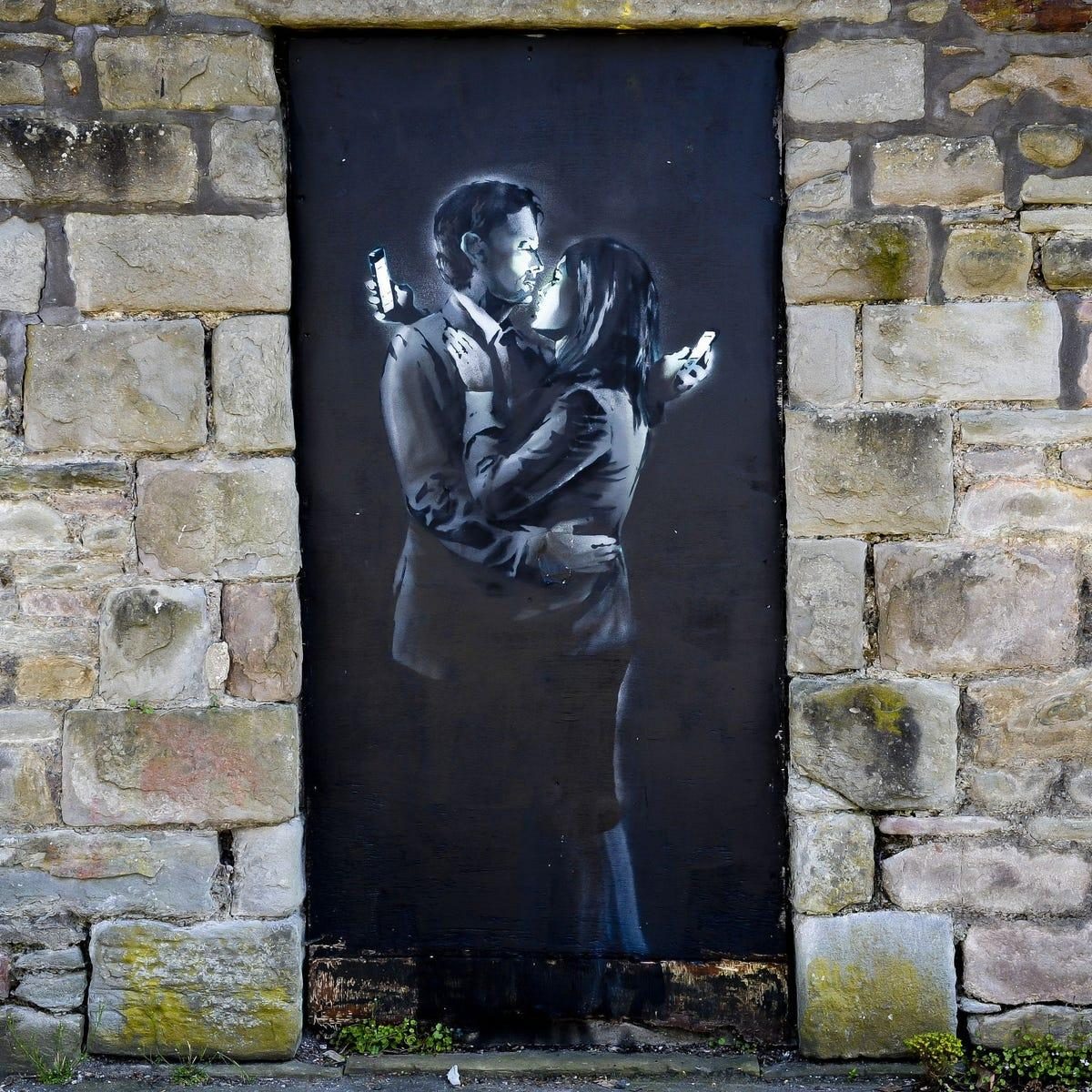
Yet the image is more ambiguous than a simple warning that mobile phones are destroying relationships. Neither lover is innocent and neither is portrayed as the cause of the other's distraction. They mirror one another almost perfectly. Each secretly directs attention outside the relationship while continuing to perform the physical gestures of intimacy.
That symmetry is what gives the mural much of its lasting relevance. Banksy is less interested in the technology itself than in divided attention: the peculiar condition of being physically present with another person while simultaneously inhabiting somewhere else. The phones provide access to an invisible world beyond the couple, but they also prevent either figure from fully occupying the moment immediately in front of them.
A Mural Removed Within Days
The physical history of Mobile Lovers became almost as remarkable as the image itself. The work had been painted on a sheet of wood attached to a council-owned doorway near the Broad Plain Boys’ Club, a financially struggling youth organization. Club leader Dennis Stinchcombe removed the panel with a crowbar shortly after the mural was discovered, hoping that the Banksy could be used to raise money and secure the club’s future.
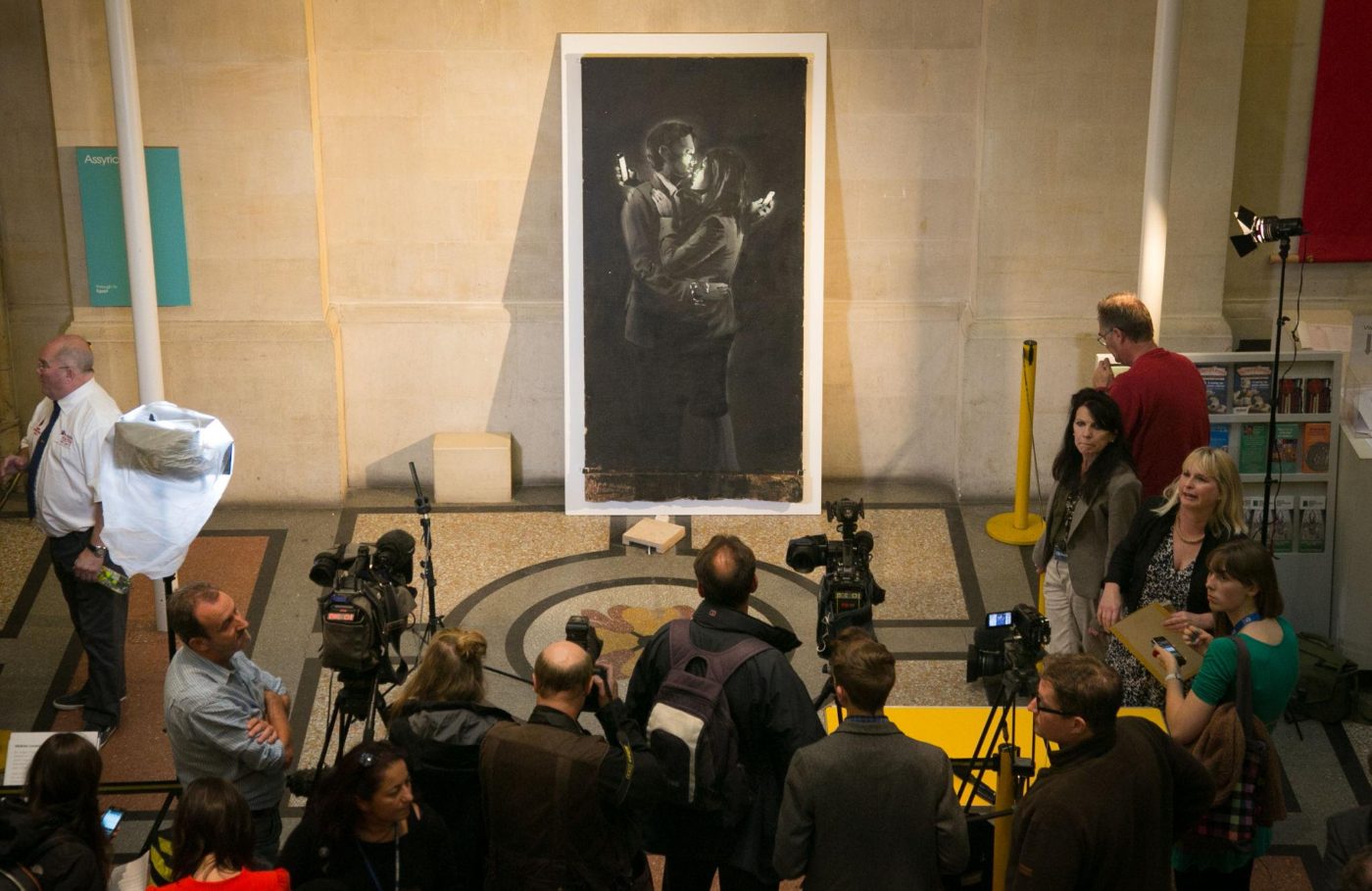
The removal immediately created a dispute over ownership. Because the doorway belonged to Bristol City Council, police took possession of the work and it was transferred to Bristol Museum & Art Gallery, where it was placed on public display while the question was resolved.
Banksy then made an unusually direct intervention. In a letter delivered to the youth club, he explained that the mural had been intended as a small visual gift to the area but acknowledged that a financial gift might prove more useful. Crucially, he gave the club his blessing to decide what to do with the work. Bristol's mayor subsequently confirmed the letter's authenticity, effectively ending the dispute in the club's favor.
A Banksy That Saved a Youth Club
In August 2014, Mobile Lovers was sold to a private UK collector for £403,000, with the proceeds going to the Broad Plain Boys’ Club and affiliated youth organizations. The money secured the future of a club that Stinchcombe said otherwise faced closure within approximately a year.
Its history provides an illuminating counterpoint to the controversy surrounding Slave Labour. Both murals were removed from public sites and converted into valuable private objects, but Banksy’s direct intervention fundamentally altered the circumstances of Mobile Lovers. Rather than remaining silent about the competing claims of property owner, community and art market, he explicitly allowed the nearby youth club to benefit financially from the work.
That afterlife adds an unexpected dimension to a mural concerned with disconnection. Mobile Lovers depicts two people standing inches apart while directing their attention elsewhere; once removed from its wall, however, the artwork generated precisely the opposite phenomenon. It focused attention on a small neighborhood institution and ultimately provided the money that allowed it to continue serving its community.
STAY INFORMED
Receive the latest news, exhibitions, artworks and market updates on Banksy.