Peckham Rock
Year: 2018
Medium: Wooden postcard
Dimensions: 12×18 cm
Produced by the British Museum
Description
Among Banksy’s most legendary interventions, Peckham Rock occupies a unique place. Unlike a mural painted illegally on a wall or a print released through Pictures on Walls, this work infiltrated one of Britain’s oldest and most respected cultural institutions: the British Museum. Conceived as both an artwork and an elaborate practical joke, Peckham Rock questioned the authority of museums to determine what deserves preservation, historical significance and artistic legitimacy.
The wooden postcard released in 2018 commemorates the return of this infamous object to the British Museum—this time not as an act of artistic infiltration, but as an officially sanctioned exhibit. It therefore celebrates one of the rare occasions in which Banksy’s institutional critique ultimately became accepted by the very institution it originally mocked.
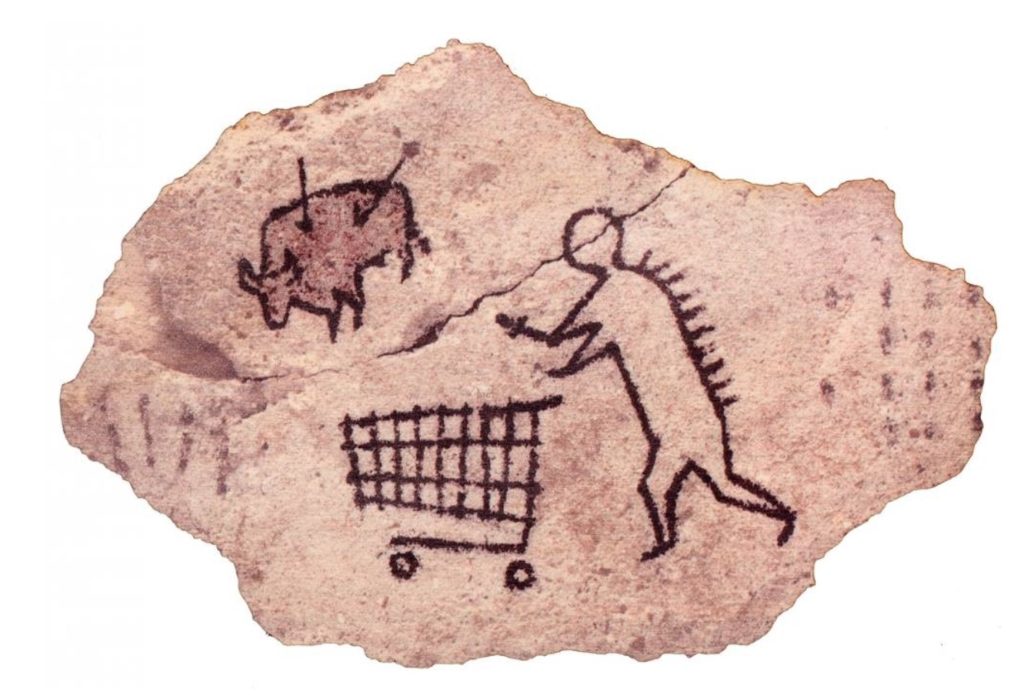
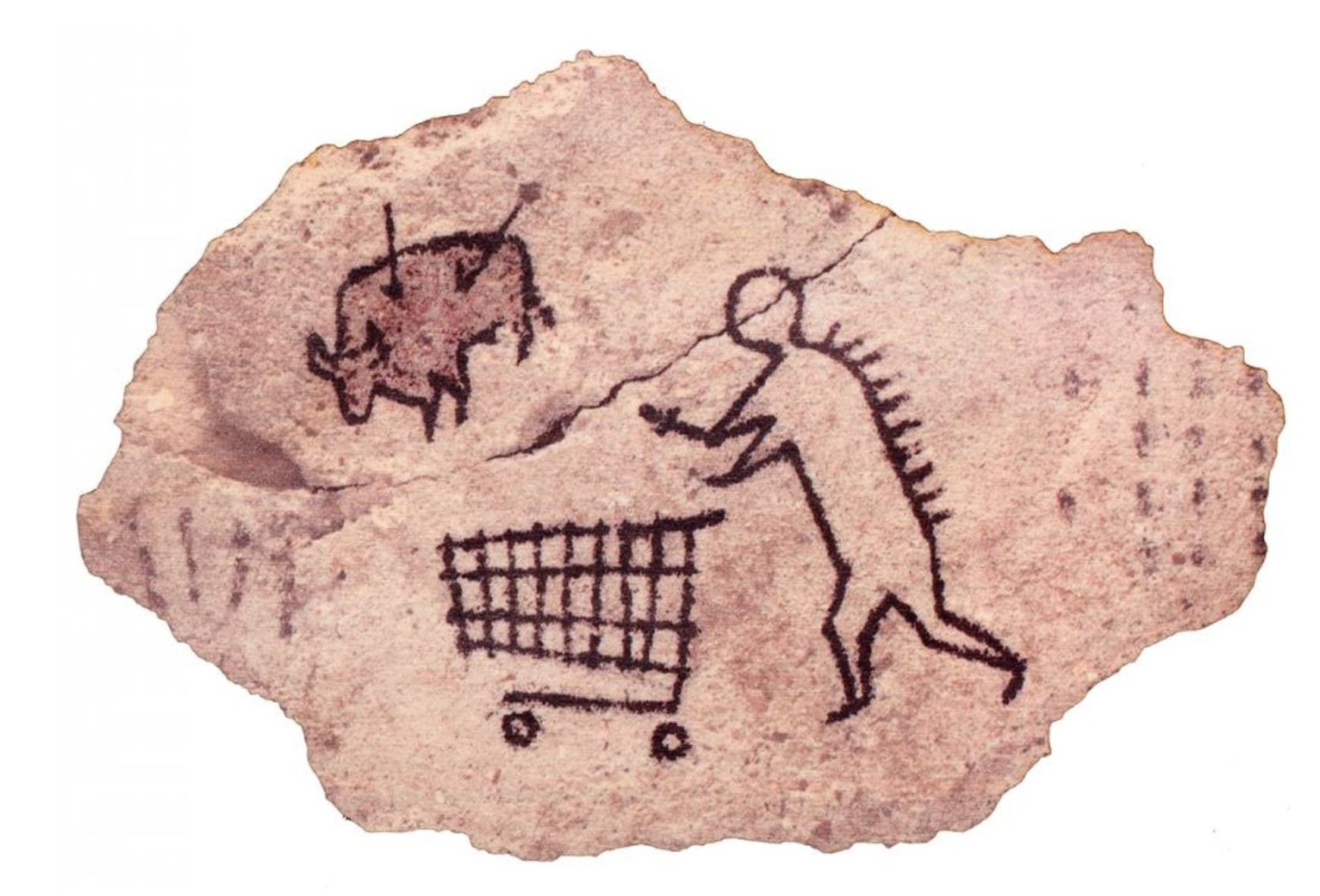
Produced in 2018, the Peckham Rock wooden postcard reproduces Banksy’s celebrated faux archaeological artefact in remarkable detail. It depicts a fragment of prehistoric-looking limestone upon which appears one of Banksy’s most ingenious drawings: a primitive hunter pushing a modern supermarket shopping trolley while pursuing a wounded bison pierced by arrows.
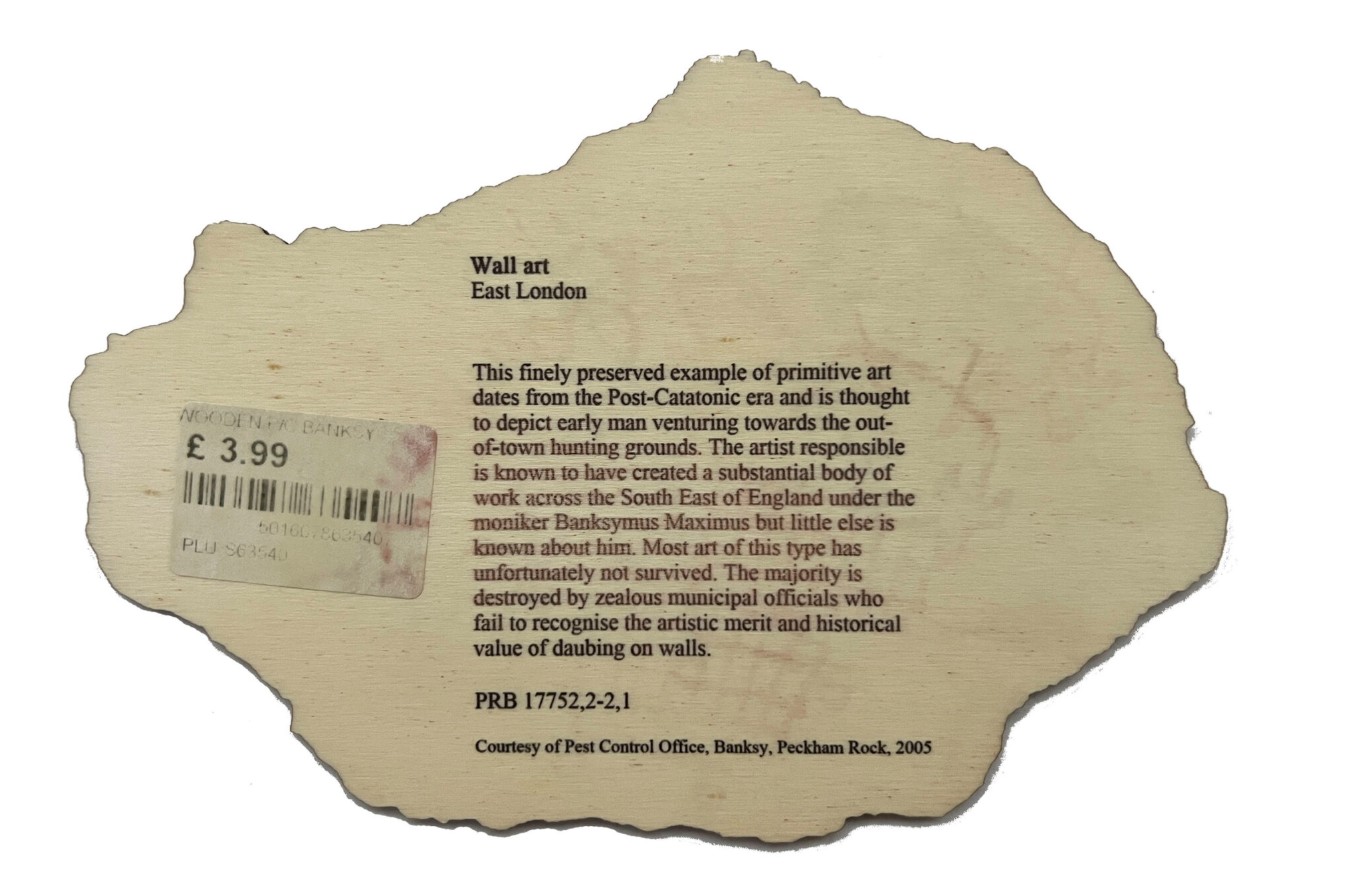
The reverse faithfully reproduces the fictitious museum label that accompanied the original installation. Written in the sober academic language of curatorial cataloguing, the text identifies the object as:
“This finely preserved example of primitive art dates from the Post-Catatonic era…”
The description continues by introducing the supposed prehistoric artist “Banksymus Maximus”, while lamenting that much of his surviving work has been destroyed by municipal authorities incapable of recognising “the artistic merit and historical value of daubing on walls.”
Like the original installation, the postcard perfectly mimics the visual language of museum interpretation. Even the identification number, catalogue text and typography reproduce the conventions of archaeological displays, allowing satire to masquerade as scholarship.
Authorised by Banksy/Pest Control, the postcard was produced in conjunction with the object’s official return to the British Museum and features a retail barcode sticker on the reverse, further documenting its museum provenance.
The Original Intervention
In May 2005, Banksy quietly entered the British Museum carrying what appeared to be an authentic archaeological artefact. Without permission, he installed the object inside the Roman Britain Gallery, complete with professionally designed identification label and catalogue number. Remarkably, the piece remained on public display for two full days before museum staff realized it had never formed part of the collection.
The success of the intervention depended entirely upon institutional trust. Visitors naturally assumed that any object displayed within the museum must possess historical legitimacy. Banksy exploited this assumption to reveal how strongly authority influences perception. Had the same stone fragment been discovered lying on a London pavement, few would have considered it worthy of attention. Placed behind museum glass, however, it instantly acquired the appearance of cultural significance.
The prank rapidly became one of Banksy’s most celebrated institutional interventions and marked one of the earliest occasions on which he challenged not merely public space, but the authority of museums themselves.
A Satire of Art History
Few works better demonstrate Banksy’s sophisticated understanding of institutional criticism.
The image itself appears deceptively simple. A prehistoric hunter pushes a shopping trolley instead of carrying a spear, while pursuing wounded prey. Thousands of years collapse into a single humorous drawing in which consumer culture is presented as humanity’s most enduring instinct. Shopping becomes our contemporary equivalent of hunting.
Yet the true masterpiece lies in the accompanying label.
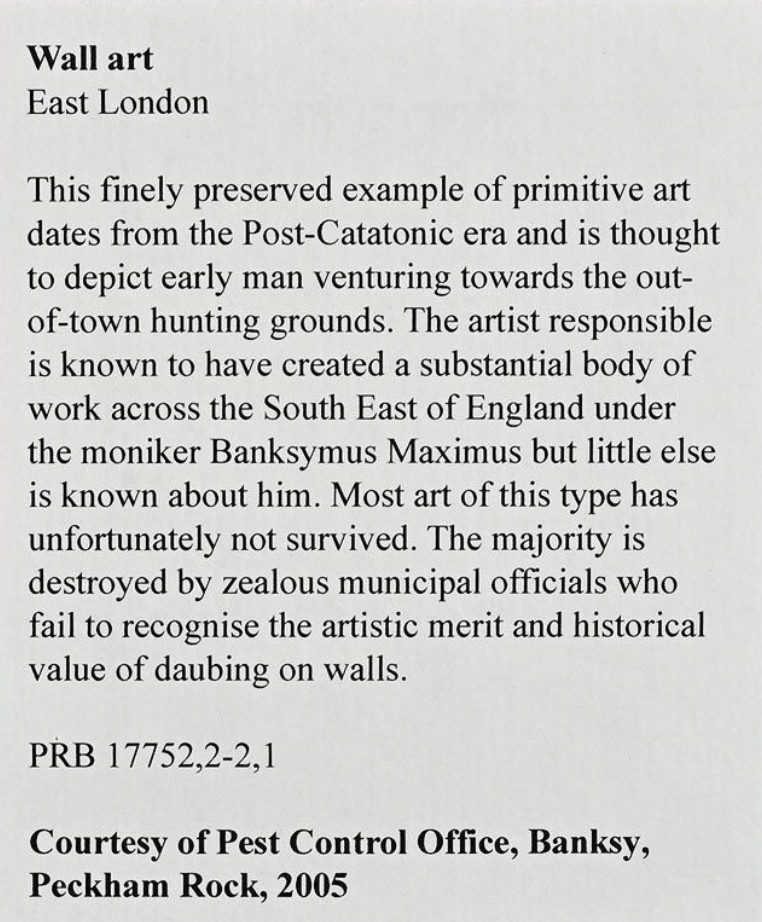
Rather than parodying prehistoric civilization, Banksy parodies museum scholarship itself. Every sentence mimics the detached language of archaeology, inventing an entirely fictional civilization while treating graffiti as though it were an endangered historical tradition deserving preservation.
The invented artist, Banksymus Maximus, simultaneously mocks the conventions of classical nomenclature and Banksy’s own anonymity. Future archaeologists, the label suggests, may know as little about Banksy as modern historians know about anonymous cave painters.
Perhaps the most brilliant passage concerns the disappearance of such works:
“Most art of this type has unfortunately not survived. The majority is destroyed by zealous municipal officials…”
The irony is devastating. Museums dedicate enormous resources to preserving prehistoric cave paintings while contemporary authorities routinely erase street art that future generations may one day regard with equal historical importance.
Banksy versus the Museum
Peckham Rock represents one of Banksy’s earliest and clearest explorations of a question that would define much of his later career:
Who decides what is art?
Unlike many institutional critiques that simply attack museums, Banksy’s intervention ultimately became a dialogue rather than a confrontation. In 2009, the original object reappeared in the landmark exhibition Banksy versus Bristol Museum, where it was exhibited openly alongside hundreds of other works.
The story came full circle in 2018, when the British Museum itself invited Peckham Rock back into its galleries as part of The Past is Present, an exhibition curated by journalist and broadcaster Ian Hislop exploring objects that challenge accepted historical narratives.
The transformation was extraordinary. An object once removed as an act of vandalism returned as an officially recognized museum exhibit. Banksy’s critique had become part of the institution’s own narrative. Few artistic pranks have ever achieved such poetic resolution.
Production and Collectability
The Peckham Rock wooden postcard was produced exclusively to commemorate this remarkable historical moment. Unlike conventional museum postcards printed on paper, its wooden construction deliberately echoes the appearance of the original carved fragment, reinforcing the illusion of holding a miniature archaeological relic.
Because it was officially authorized by Pest Control and distributed through the British Museum during the exhibition, it occupies a distinctive place among Banksy’s collectibles. It documents not simply an artwork, but the reconciliation between one of the world’s greatest museums and one of its most audacious unofficial exhibitors.
For collectors specializing in Banksy’s exhibitions, interventions and institutional projects, the postcard represents an especially significant object. It bridges the artist’s illegal early career with the international recognition that would later place his work inside the very museums that once rejected it.
Few Banksy works have aged as elegantly as Peckham Rock. What began as an anonymous prank evolved into one of the defining artistic statements about museums, authorship and cultural authority in the twenty-first century. By quietly placing his own object among genuine archaeological treasures, Banksy exposed how profoundly context shapes artistic value. The artwork itself never changed—only its surroundings did.
The 2018 wooden postcard commemorates this remarkable journey. More than a souvenir, it celebrates the extraordinary moment when one of Banksy’s greatest acts of institutional subversion was finally embraced by the institution it had originally deceived. It is therefore not merely a reproduction of an artwork, but a tangible reminder that history itself is never fixed. As Peckham Rock brilliantly demonstrates, today’s act of rebellion may become tomorrow’s museum piece.
Auction Results
WORK IN PROGRESS
Morgan O’Driscoll: 30 June 2026
Estimated: EUR 400 – 600
EUR 600 (Hammer)
EUR 720 / USD 825
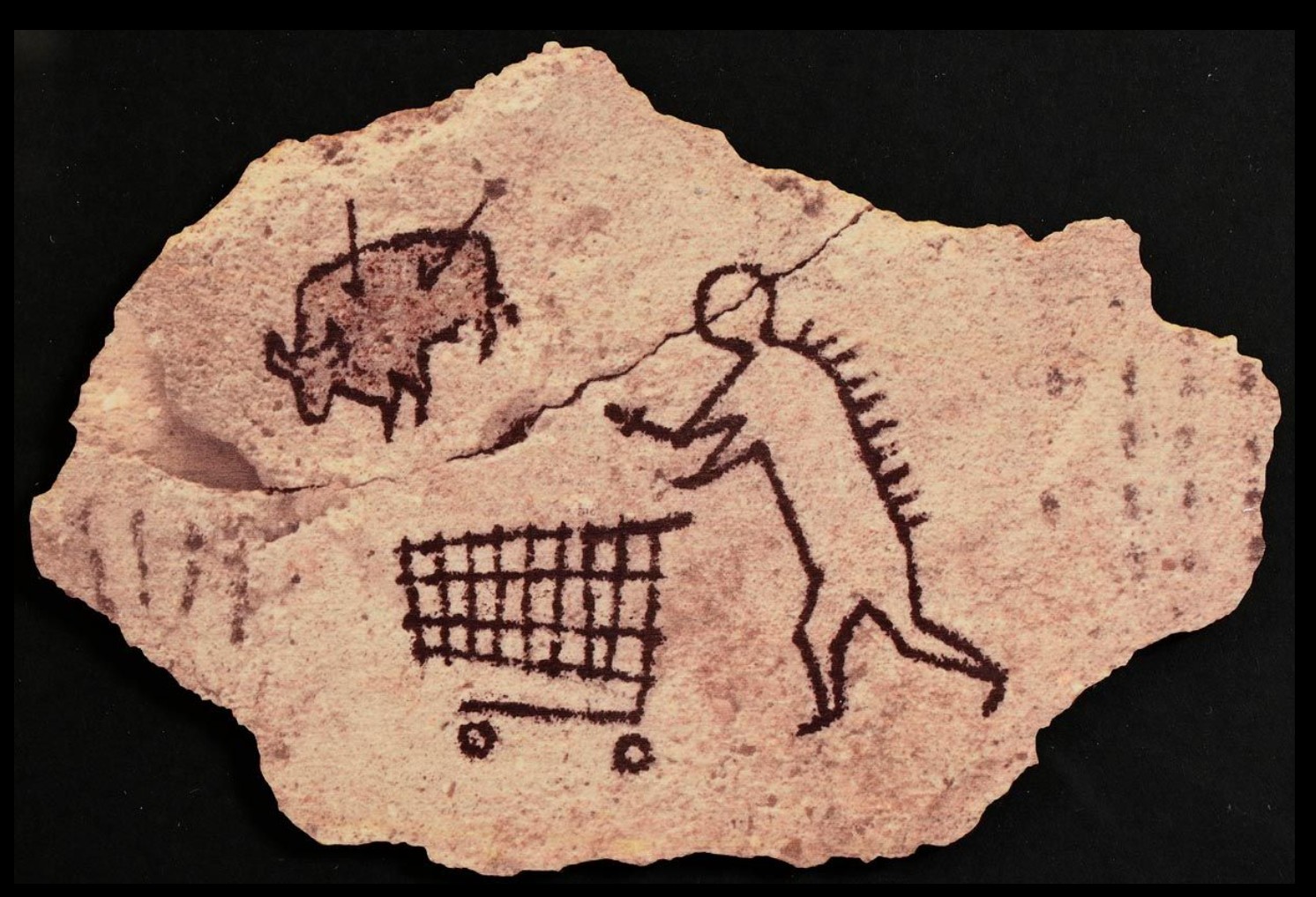
BANKSY (British, b. 1973)
Peckham Rock, 2018
Timber cut wooden replica
Recreated by the British Museum in 2018
XXXXXXXXXXX
Tate Ward Auctions: 24 February 2021
Estimated: GBP 150 – 250
GBP 1,875 / USD 2,600
AUCTION RECORD FOR PECKHAM ROCK
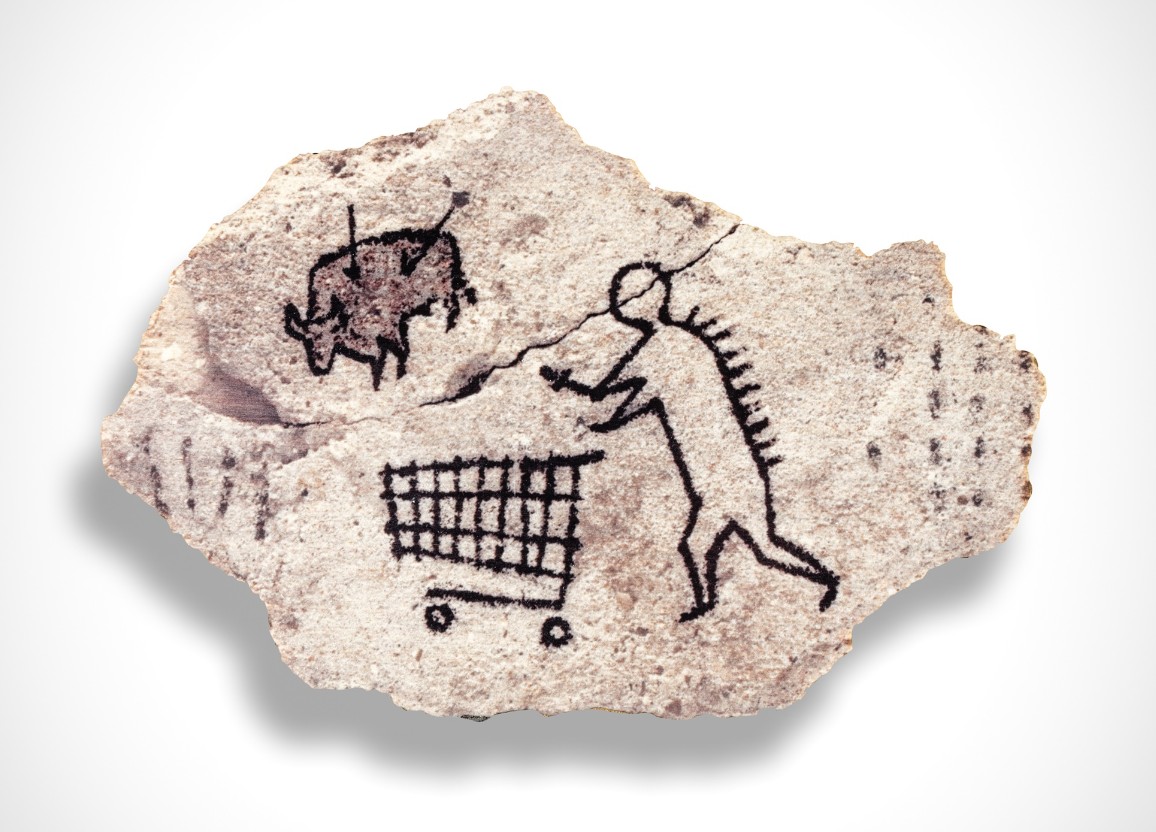
Banksy (British 1974-), ‘Peckham Rock’, 2018, wooden postcard, produced by the British Museum; Peckham Rock: 12 x 18cm
ARR