BANKSY
Picasso Quote, 2009
Carved marble and wood
Marble: 102x124x13.5 cm (40 ¼ x 48 8/10 x 5 1/3 inches)
Plinth: 74.5x79x83.5 cm (29 1/3 x 31 1/10 x 32 9/12 inches)
Private Collection, Netherlands (acquired directly from the artist)
Artcurial, Paris, 28 February 2017, lot 17
Private Collection, Hong Kong
Acquired from the above by the present owner in 2019
Exhibited
Banksy vs. Bristol Museum, Bristol, 2009
Auction History
| Phillips London 16 April 2026 Est.: GBP 200,000 – 300,000 | Price Realized GBP 258,000 / USD 350,180 Banksy Modern & Contemporary Art |
REPEAT SALE
| Artcurial Paris 28 February 2017 Est.: EUR 100,000 – 200,000 | Price Realized EUR 379,500 / USD 415,795 Urban Anthology from a Private Collector |
Catalogue Note
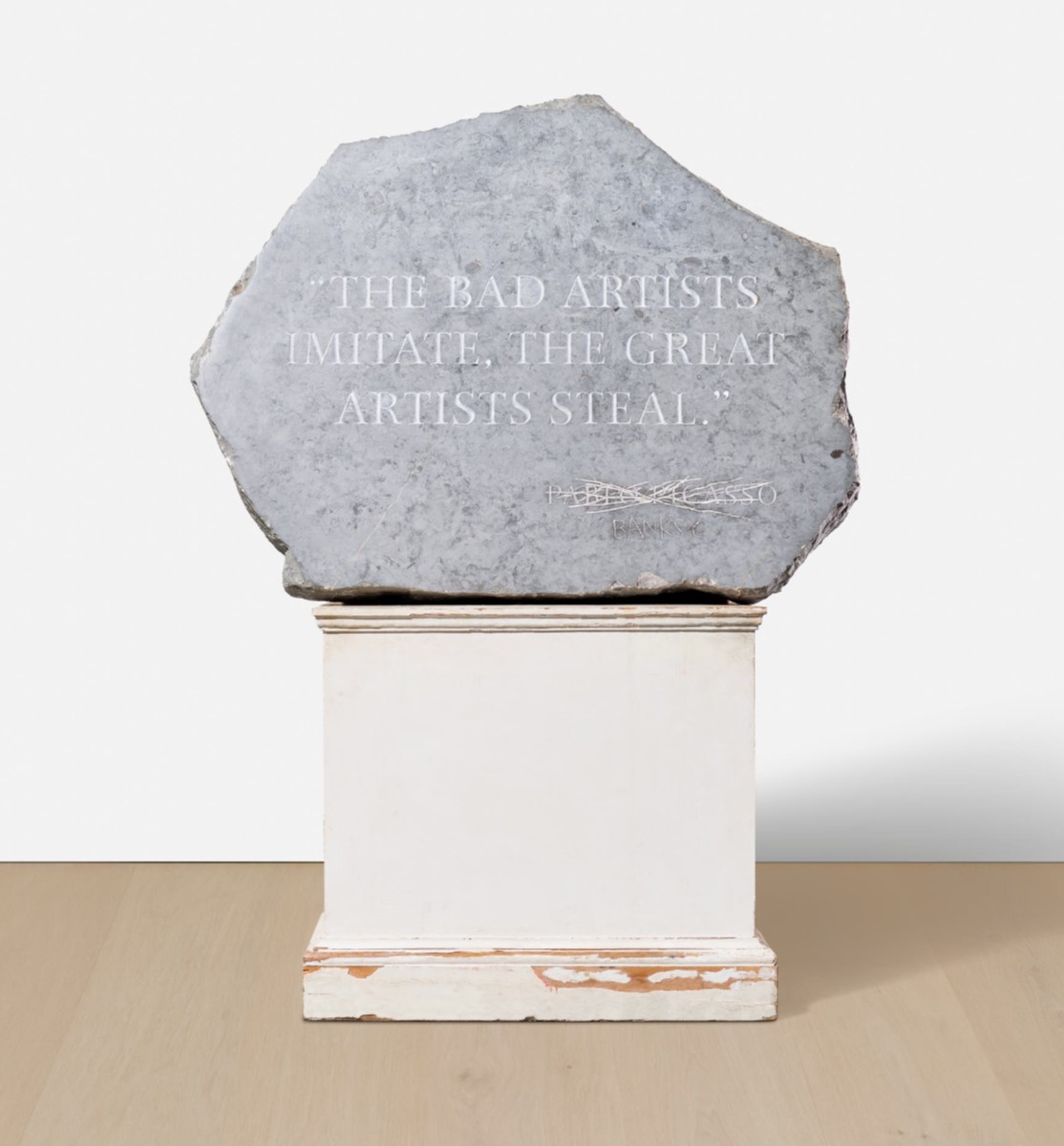
‘The bad artists imitate, the great artists steal’. The aphorism, widely attributed to Pablo Picasso though never reliably sourced, has circulated for decades as a kind of creative license: a permission slip for appropriation. In Picasso (2009), Banksy takes the quotation at its word, carving it into an irregular slab of grey marble, crossing out Picasso’s name beneath and substituting his own. The theft is performed in plain sight and the joke, characteristically, cuts in more than one direction.
“Nobody ever listened to me until they didn’t know who I was.”
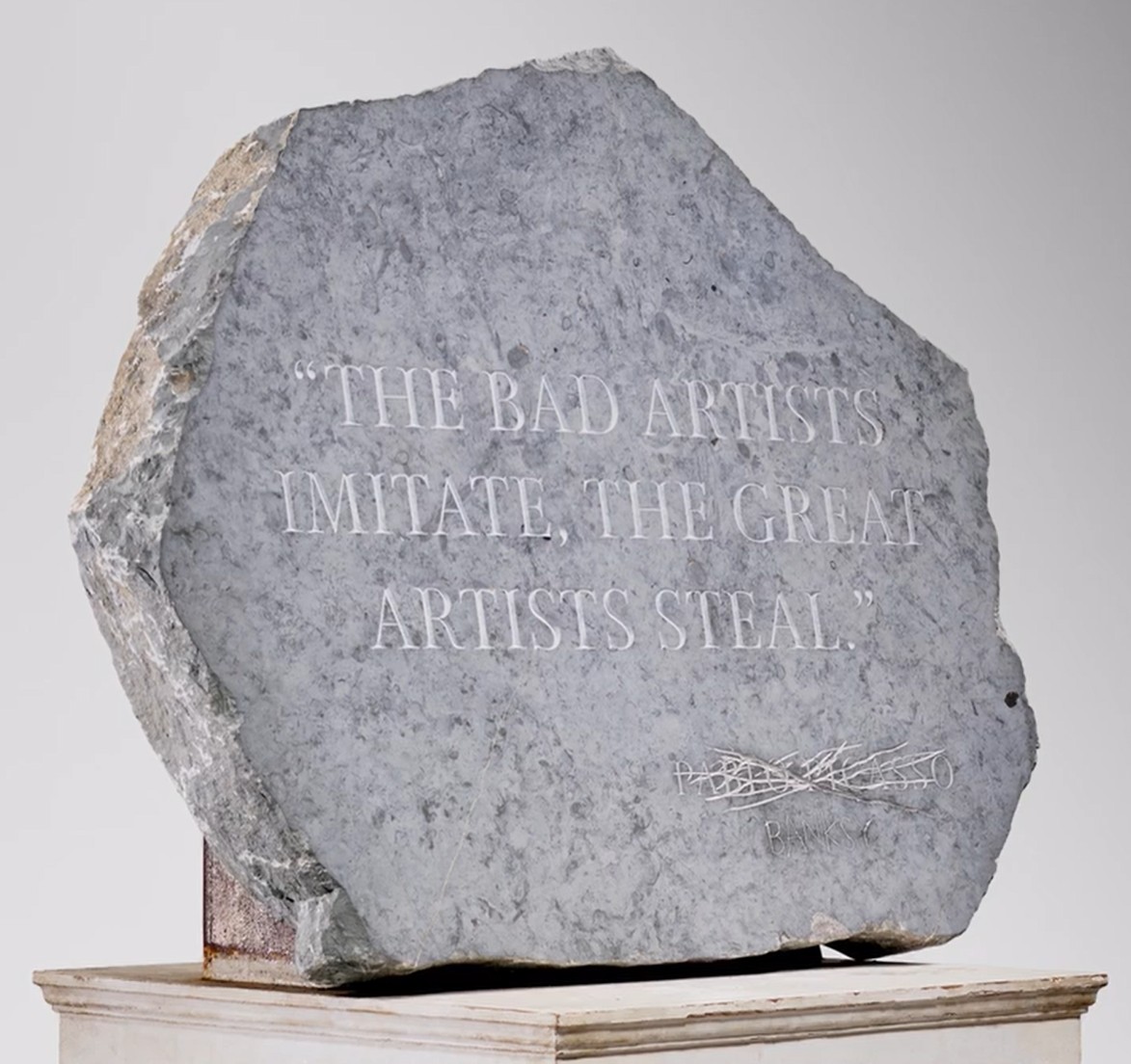

Formally, the piece repays close looking. The marble is rough-hewn and irregularly shaped, its cool blue-grey surface left largely unpolished — a deliberate contrast with the neat, serif-style lettering incised across its face. The quotation is carved with lapidary precision, evoking Roman epigraphy or memorial stonework, lending the borrowed words an unearned air of permanence. Below, Picasso’s name appears to have been scratched through with hasty, almost impatient strokes, and ‘BANKSY’ is inscribed beneath in a looser hand.
The whole assemblage rests on a white wooden pedestal implying age and the patina of institutional display. At nearly two meters tall, the work commands a physical presence that belies its apparent simplicity, confronting the viewer at eye level.The work’s conceptual lineage is rich.
The complex artistic strategy of inscribing text on stone connects to a tradition running from ancient votive tablets through to Jenny Holzer’s marble benches and Lawrence Weiner’s linguistic propositions, while the act of authorial substitution can be read as a knowing echo of Duchamp’s defacement of the Mona Lisa in L.H.O.O.Q. (1919) — another artist playfully reappropriating a predecessor’s legacy. That Picasso was subsequently selected for Post-Picasso: Contemporary Reactions at Barcelona’s Museu Picasso in 2014 confirms the seriousness with which the dialogue it proposes has been received, even — or especially — within the institution dedicated to the very artist whose name it strikes through. More layered than its apparent one-liner suggests, Picasso endures as one of Banksy’s sharpest sculptural statements — a work that asks who owns an idea, then answers by sealing it in stone.