BANKSY
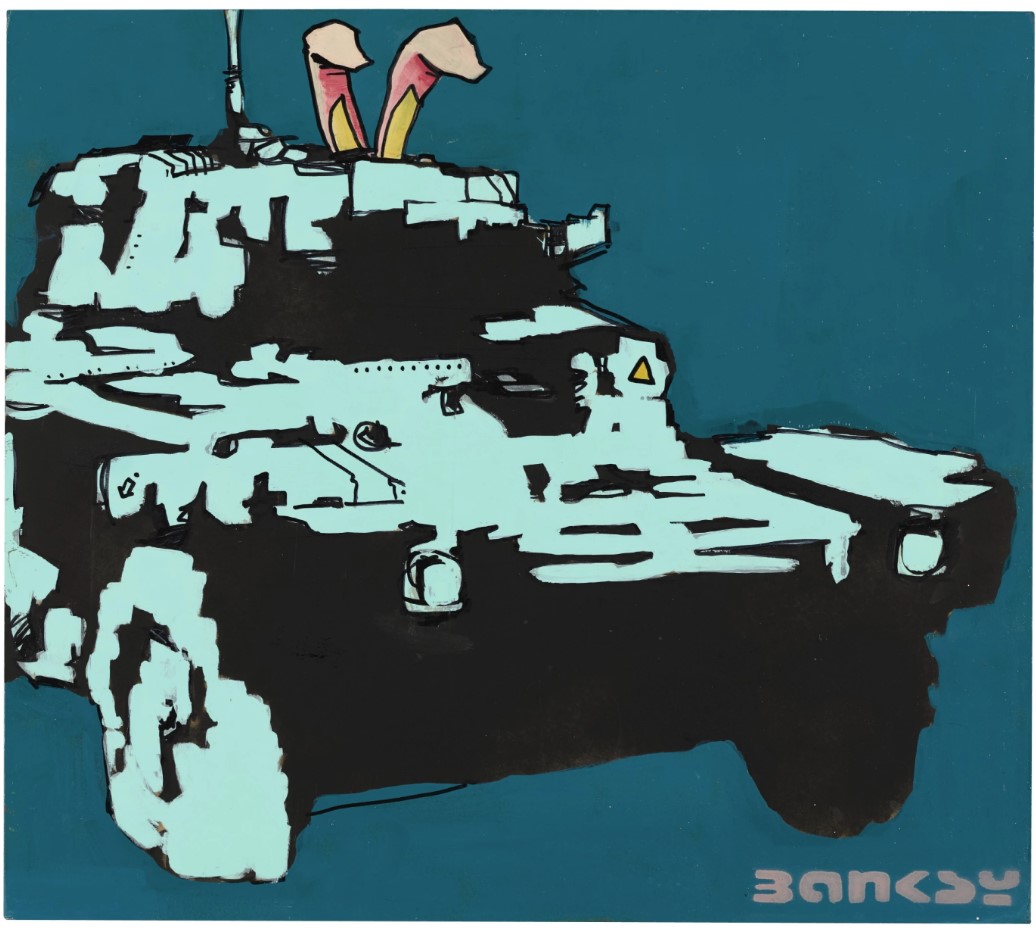
Playmate of the Month, 2000
Acrylic and marker on wood
38.5 x 43.5 cm (15 1/8 x 17 1/8 inches)
Stencil-signed “BANKSY”, lower right
Private Collection, Europe
Bonhams, London, 24 October 2007, Lot 153
Private collection, Europe
Sotheby’s, London, 13 February 2014, Lot 348
Private Collection, New York
Acquired from the above by the present owner
Exhibited
Severnshed, Bristol, 2000
Auction History
| Sotheby’s London 27 June 2018 Est.: GBP 80,000 – 120,000 | Price Realized GBP 187,500 / USD 246,315 |
Catalogue Note
Painted in 2000 and exhibited at Banksy’s seminal Severnshed exhibition in Bristol, Playmate of the Month perfectly encapsulates the artist’s early fascination with the absurd coexistence of violence and popular culture. The composition depicts a heavily armed military tank, its imposing silhouette rendered in Banksy’s characteristic blend of stencil and painterly brushwork. Yet, protruding mischievously from the turret are a pair of unmistakable pink Playboy bunny ears.
The joke is immediate, but its implications are unsettling. By adorning one of the most powerful symbols of warfare with an icon synonymous with glamour, consumerism and sexual fantasy, Banksy exposes the strange ways in which contemporary culture packages violence as entertainment. The title itself plays on the famous Playboy feature, transforming a weapon of destruction into an object of ironic desire.
This collision between militarism and mass media became one of Banksy’s defining strategies. Rather than depicting war as distant or heroic, he reveals how easily it is aestheticized, commercialized and absorbed into popular culture. The bunny ears neither humanize nor soften the tank; instead, they heighten its absurdity, reminding us that modern conflict is often presented with the same seductive language used to sell magazines, films or consumer products.
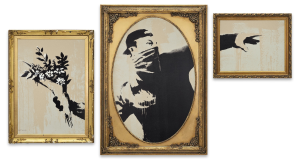
Executed during the formative years of his career, Playmate of the Month demonstrates Banksy’s extraordinary ability to reduce complex political criticism to a single unforgettable visual gag. Like Bomb Hugger, Heavy Weaponry and Love Is in the Air, it transforms an instrument of war into a deceptively simple image whose humor lingers long after its deeper meaning begins to unfold.